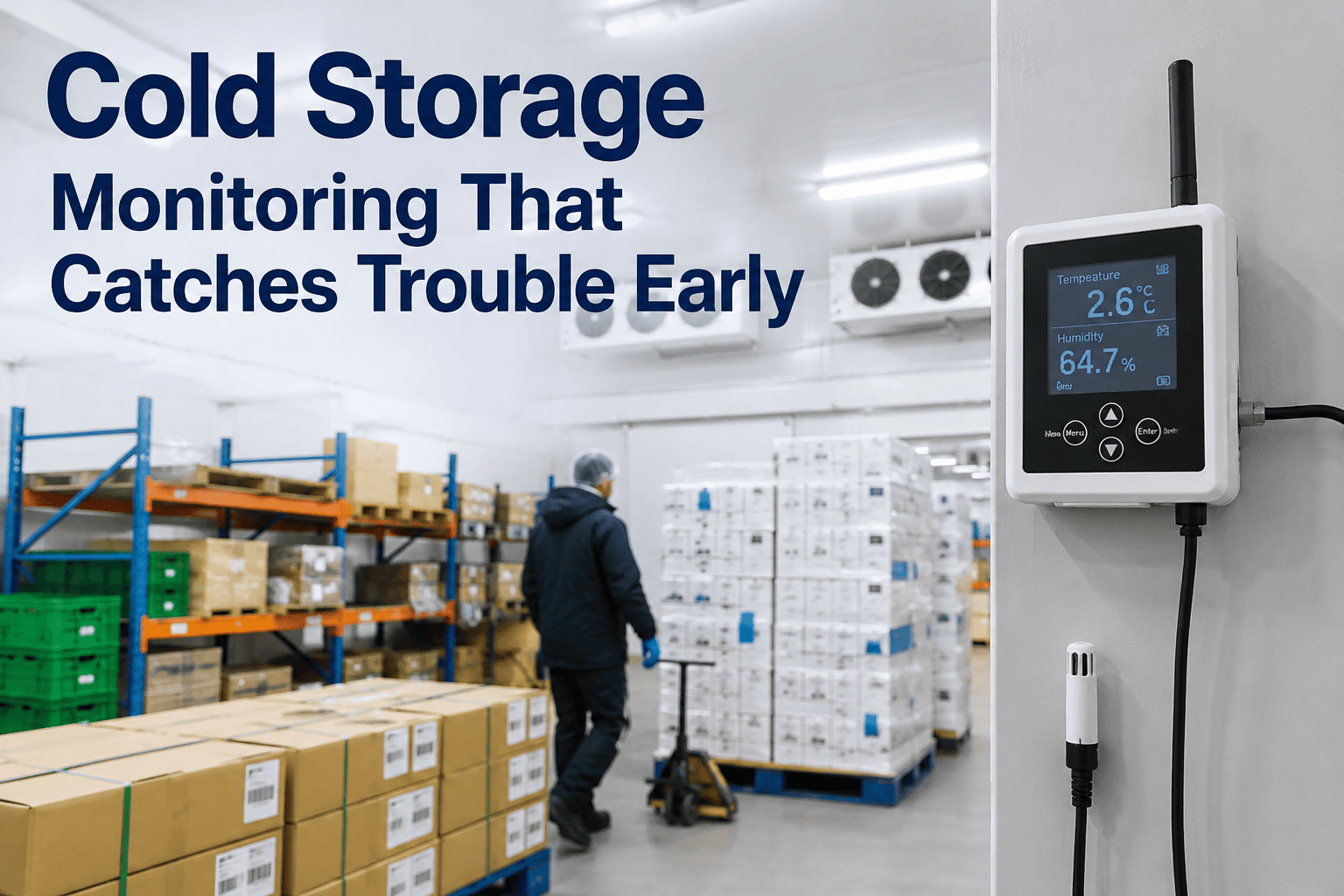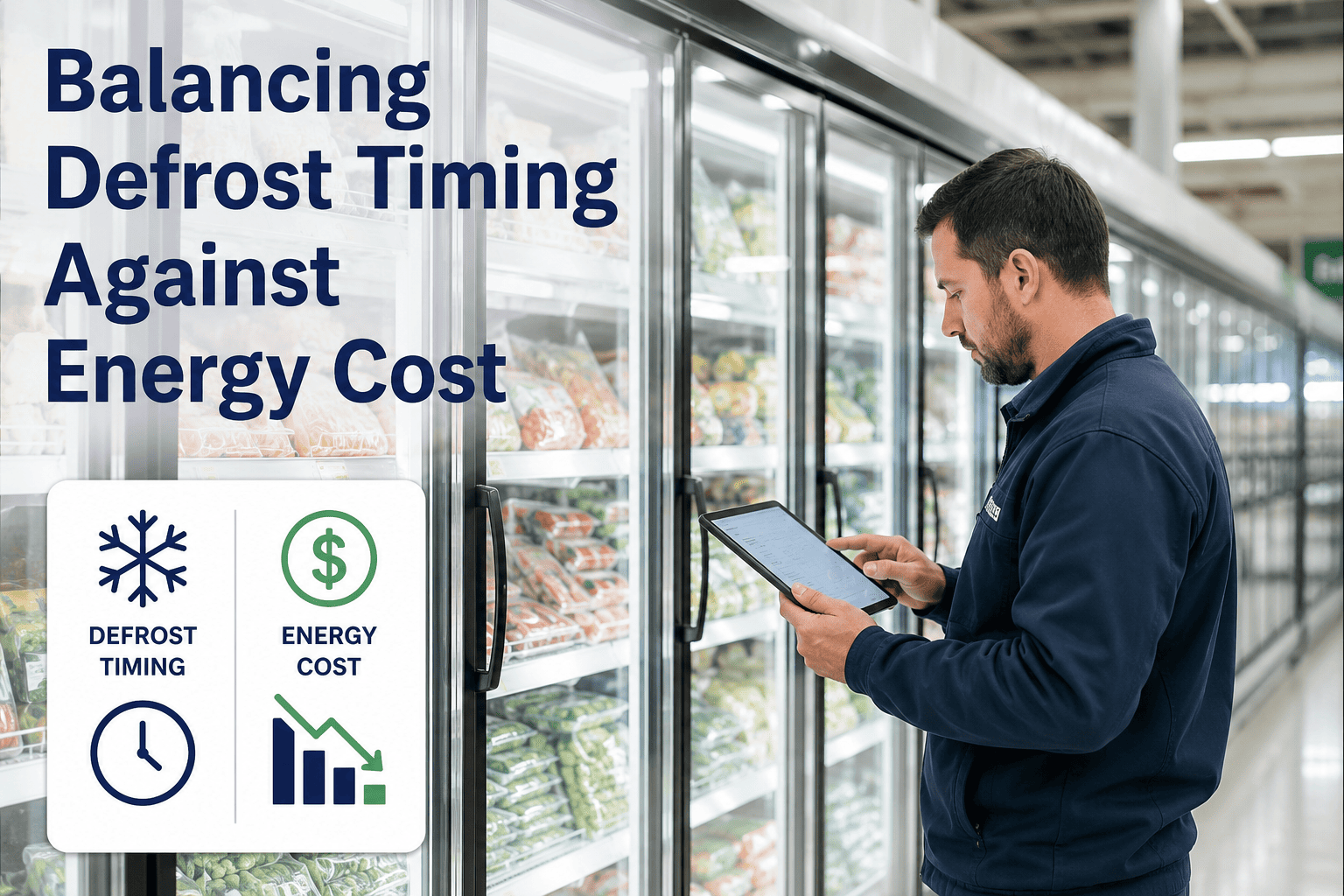
Defrost cycle timing is one of the most under-tuned variables in cold storage operations — a frozen food warehouse running fixed 30-minute defrosts four times a day can waste 8–12% of its annual refrigeration energy on cycles that were never needed, while an under-defrosted evaporator silently sheds cooling capacity and pushes product temperatures toward the danger zone. The real cost isn't only kilowatts: ice bridging across coil fins reduces heat transfer by up to 30%, forcing compressors to run longer and harder, accelerating wear on fans and valves, and risking product loss when head pressure climbs on hot afternoons. Modern CMMS platforms now make demand-based defrost scheduling practical at scale by integrating coil temperature, suction pressure, and door-activity data into a single maintenance workflow. Teams that rebalance defrost timing against energy cost typically cut defrost-related energy spend by 20–35% within the first quarter while improving temperature stability — start by exploring the platform through a Start Free Trial.
Is your defrost schedule melting away thousands in energy every month?
Most cold storage facilities still run fixed defrost timers tuned for worst-case frost — meaning up to 70% of cycles fire when the coil is clean. A CMMS-driven defrost program cuts waste, protects cooling capacity, and keeps product within HACCP temperature bands without manual guesswork.
One schedule never fits every evaporator
Frost accumulation depends on coil design, airflow, room humidity, and door traffic — variables that change by unit type. Matching the defrost method and trigger to each evaporator class is the first step in cutting unnecessary cycles.
Ceiling Unit Coolers
High surface area + frequent door activity. Frost builds fast in loading docks and pick rooms. Use electric or hot-gas defrost triggered by ΔT across the coil exceeding 4–6°F rather than a fixed clock. Typical cycle: 12–18 minutes.
Blast Freezer Coils
Heavy frost load during product pull-down. Demand defrost on suction pressure drop or ice-thickness sensor. Schedule a mandatory defrost after every blast cycle plus one demand-triggered mid-cycle if run exceeds 6 hours.
Holding Room Evaporators
Stable load, low door traffic. Frost builds slowly. Often over-defrosted on legacy 4×/day timers. Move to 2×/day with demand override based on fan-amp rise or air-off temperature depression. Most units need only 8–10 minutes per cycle.
From the clock to the coil: triggering defrost only when needed
Demand-based defrost replaces fixed-interval timers with real sensor inputs. The CMMS reads those signals, schedules the cycle, logs the duration, and flags drift before it becomes a freeze-up event.
Coil temperature differential
The cleanest indicator of frost loading. As ice bridges fins, the gap between air-on and air-off temperatures widens. A widening ΔT of 5°F above the clean-coil baseline signals 25–30% capacity loss — the moment to defrost.
Fan motor amperage
Frost restricts airflow, forcing fans to work harder against higher static pressure. A 15% amperage rise above the commissioned baseline correlates with enough frost buildup to justify a defrost — without waiting for a scheduled time slot.
Door-activity counter
Each dock door opening pulls humid air into the box. A CMMS linked to the door PLC can weight defrost frequency by door-open minutes per hour — a high-traffic day triggers an extra cycle; a closed Sunday skips one.
Auto-generated work order
When defrost duration trends 20% above baseline for three consecutive cycles, the CMMS raises a corrective work order: inspect heater strip continuity, drain pan heat tape, and defrost termination switch before the next freeze-up.
The math of a smarter defrost cycle
A single 20-minute electric defrost on a 15 kW evaporator coil heater bank consumes roughly 5 kWh. At $0.12/kWh, that is $0.60 per cycle — small until you multiply across 6 units firing 4×/day, 365 days a year.
A 40,000 ft² facility operating 42 evaporators across 6 temperature zones was spending an estimated $42,000/year on defrost energy plus $11,000 in re-cool penalties. After migrating to CMMS-driven demand defrost — coil ΔT triggers, fan-amp overrides, door-activity weighting — the team cut average defrost frequency from 4.0 to 2.3 cycles/day per unit. Defrost duration fell from 22 to 14 minutes average. Net annual energy savings: $19,800, with zero product-temperature excursions logged in the first 6 months. Payback on the CMMS subscription and sensor retrofit: under 5 months.
What changes when the CMMS takes over defrost scheduling
The table below isolates the operating differences a CMMS-driven defrost program creates across energy, capacity, labor, and food-safety metrics — based on aggregated data from cold storage deployments.
| Operating Metric | Fixed Timer Schedule | CMMS Demand-Based | Delta |
|---|---|---|---|
| Average cycles per unit / day | 4.0 (fixed) | 2.1 (dynamic) | −47% |
| Average defrost duration | 22 min | 14 min | −36% |
| Annual defrost energy per 6-unit block | $5,256 | $2,470 | −53% |
| Re-cool energy penalty | $11,000/yr | $4,900/yr | −55% |
| Coil capacity retention at peak load | 68–75% | 92–96% | +21 pts |
| Product temp excursions / quarter | 4–7 events | 0–1 events | −85% |
| Manual defrost-log labor / week | 6.5 hrs | 0.5 hrs | −92% |
| Time to detect a failed heater strip | 2–5 days | Same shift | −95% |
Stop paying for defrosts your coils never needed
Spin up a CMMS-driven defrost program in days — connect coil sensors, door PLCs, and your existing refrigeration controls, then let the platform schedule, log, and alert automatically.
A 4-month rollout timeline
A defrost optimization program isn't a one-day switch — it's a phased commissioning effort. Here's how a typical mid-size cold storage facility moves from legacy timers to a fully CMMS-managed defrost schedule over 16 weeks.
Baseline & Sensor Audit
Inventory every evaporator. Log current defrost schedule, coil ΔT baselines, fan amps, and termination temps. Install or verify air-on/air-off sensors and drain-pan heat traces. Document clean-coil benchmarks.
Deliverable · Asset & sensor registerPilot Demand Defrost
Select 4–6 evaporators across zones. Switch from timer to demand triggers in the CMMS. Run 30 days of parallel logging — original schedule vs. demand — to quantify cycle reduction, duration, and energy delta.
Deliverable · Pilot energy & capacity reportFacility-Wide Rollout
Tune trigger thresholds per unit type. Migrate all evaporators to CMMS-managed defrost. Connect door-activity weighting. Configure automatic work-order generation for drift, failed heaters, and drain-line ice events.
Deliverable · Full schedule migrationOptimize & Verify
Quarterly review of defrost frequency, duration, and energy use per unit. Compare against HACCP temperature logs. Tighten or loosen thresholds. Lock the optimized schedule as the new baseline and set quarterly review reminders.
Deliverable · Verified savings & SOPDefrost timing, answered
How do I know if my current defrost schedule is wasting energy?
Pull 90 days of defrost logs from your refrigeration controller. If more than 50% of cycles terminate on the time limit rather than the temperature termination switch, your coils are defrosting clean — a clear sign of over-defrosting. The CMMS surfaces this metric automatically and flags units trending toward timer termination so you can adjust the schedule within the same shift.
Will demand-based defrost risk product temperature excursions?
No — properly configured demand defrost reduces excursion risk. Because cycles only fire when frost is actually reducing capacity, coils run closer to their clean-baseline performance between defrosts. The CMMS also enforces a maximum interval cap (typically 12 hours) so a low-traffic day never lets frost accumulate past the point of safe recovery. You can review the full trigger logic and interval caps by booking a walkthrough at Book a Demo.
What sensors do I need to add for demand-based defrost?
At minimum, an air-on and air-off temperature sensor pair per coil to measure ΔT, plus fan-motor amperage from the existing starter. Most modern evaporators already have a coil-temperature termination sensor — the CMMS simply reads it. Door-position switches are typically already present in the BMS. A retrofit for a 6-unit block usually runs $3,000–$5,000 and pays back in under 6 months on energy savings alone.
Can the CMMS handle both electric and hot-gas defrost systems?
Yes. The CMMS manages the defrost schedule and trigger logic regardless of heat source. For electric defrost it monitors heater-bank amperage and termination temperature. For hot-gas defrost it tracks solenoid-cycle counts, gas-header temperature, and equalization pressure. The platform generates separate work-order templates for each system type, so technicians get the right inspection checklist every time.
How quickly can I see a return on a defrost optimization program?
Most mid-size cold storage facilities (30–60 evaporators) see measurable energy savings within 4–6 weeks of pilot kickoff, with full payback on CMMS subscription and sensor retrofit in 3–6 months. A facility spending $40K–$60K annually on defrost energy typically captures $12K–$22K in year-one savings, plus reduced product-loss incidents and lower compressor maintenance costs. Start capturing those savings today — Start Free Trial.
Run defrost on demand, not on a guess
Join the cold storage teams using CMMS-driven defrost scheduling to cut energy waste, protect cooling capacity, and keep product temperatures locked in spec.
Free 14-day trial · No credit card