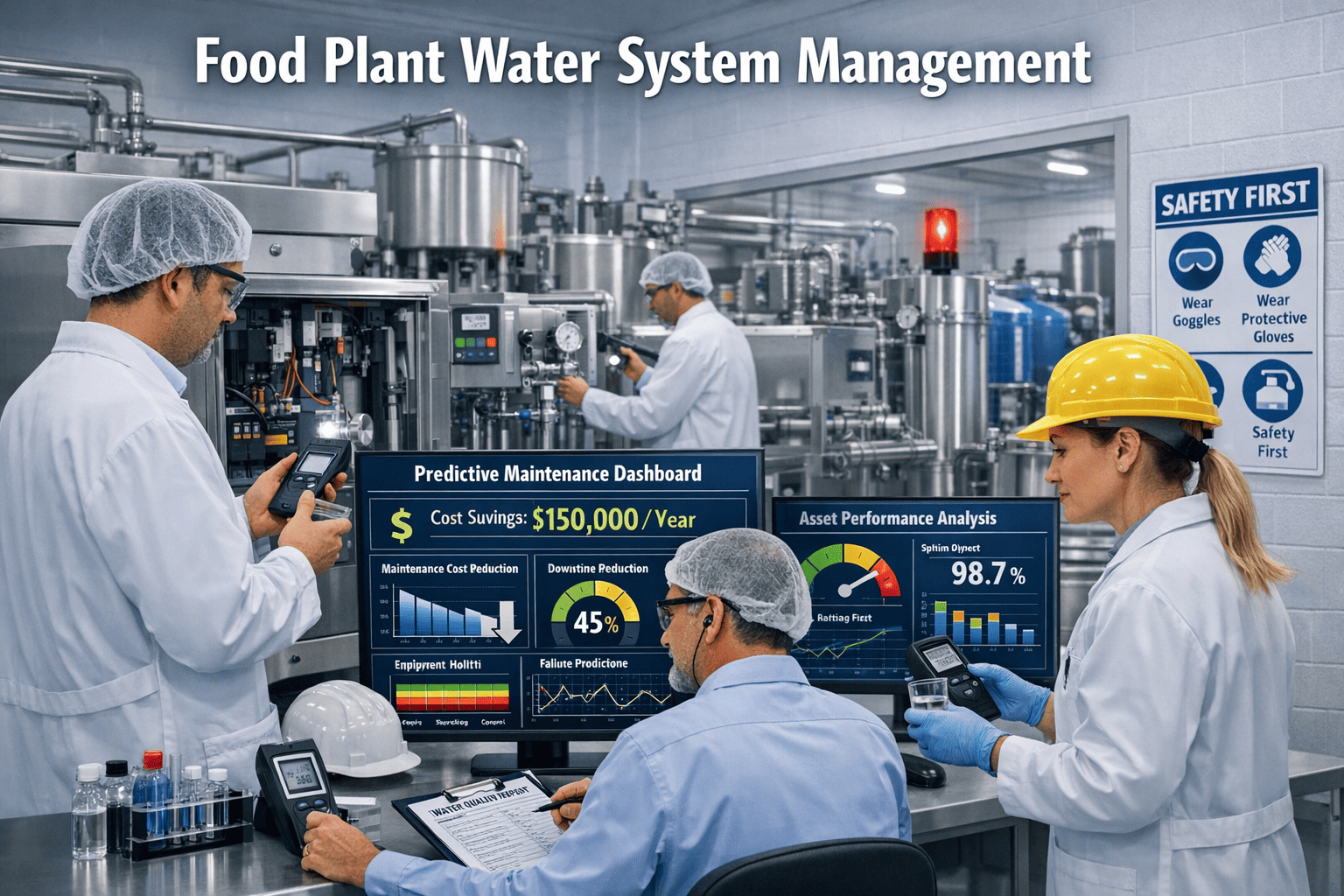
Modern Bottled Water Plant operations demand maintenance programs that are as disciplined as the production processes they support. Equipment failures in food and beverage manufacturing do not just create downtime — they create regulatory exposure, product loss, and audit findings that shut down bonded production faster than any mechanical issue alone. Facilities that centralise their preventive maintenance, calibration records, and sanitation documentation in a single CMMS platform eliminate the fragmentation that turns minor maintenance gaps into major compliance events. OxMaint is built specifically for this challenge — giving maintenance and operations teams one platform that manages PM schedules, equipment records, and regulatory documentation simultaneously, accessible from the production floor on mobile devices. Ready to see what structured maintenance looks like for your operation? Book a demo to walk through a Bottled Water Plant maintenance workflow, or start a free trial and register your first assets today.
Bottled Water Plant Maintenance: CMMS for RO Membranes, UV Systems, Ozone Generators, and FDA Compliance
Maintain RO membrane systems, UV sterilisation units, ozone generators, and filling lines with CMMS-tracked PM schedules, water quality verification records, and FDA 21 CFR Part 129 compliance documentation.
What Is Bottled Water Plant Maintenance
Bottled water plant maintenance is defined entirely by water quality — every piece of production equipment from source intake through sealed bottle exit must be maintained to standards that protect the microbiological and chemical integrity of the product. RO membranes are the foundation of the treatment train; when rejection rates decline from fouling or scaling, every downstream treatment stage must compensate for heavier contamination loads it was not designed to handle. UV lamp output degrades continuously over operating hours — a lamp at 10,000 hours delivering 50% of rated UV dose provides 50% of the microbiological kill designed into the system, but there is no visible indicator that this is happening. Ozone generators with fouled electrodes underdeliver ozone concentration without alarming — product ships with insufficient residual disinfection. OxMaint tracks every treatment parameter with PM triggers that prevent these invisible failures — start a free trial and configure your water treatment asset registry today.
FDA 21 CFR Part 129 requires bottled water plants to maintain complete records of source water quality, treatment equipment operation, and sanitation for every production day. The regulation is specific: UV systems must document lamp hours and intensity verification; ozone systems must document ozone concentration and residual at point of use; RO systems must document rejection rates and permeate quality on defined schedules. Paper-based maintenance programs routinely produce the documentation gaps that generate FDA 483 observations — not because maintenance was actually skipped, but because no one created a complete, linked record. OxMaint creates those records automatically at every PM and verification event — book a demo to see FDA 21 CFR Part 129 compliance management in action.
See How OxMaint Manages Every Bottled Water Plant Asset — From PM Schedules to Compliance Records
Configure your asset registry, set up maintenance schedules, and generate your first compliance report in under 30 minutes. No implementation project. No consultant. Just results.
Core Bottled Water Plant Maintenance Concepts
Where Bottled Water Plant Maintenance Programs Break Down
How OxMaint Manages Your Bottled Water Plant
Reactive vs. Planned: The Bottled Water Plant Maintenance Comparison
The difference between reactive and planned maintenance in a Bottled Water Plant operation is not just downtime — it is the difference between producing a regulatory audit trail that satisfies inspectors and producing findings that halt production. Every row below represents a decision point that separates high-performing maintenance programs from facilities that manage compliance by accident rather than design.
| Maintenance Activity | Reactive / Paper-Based | Planned / OxMaint |
|---|---|---|
| UV lamp replacement trigger | Calendar schedule or lamp failure | Hour-based PM at 90% of rated life |
| RO membrane fouling detection | Discovered at product quality failure | Rejection rate trending with cleaning alerts |
| Ozone output documentation | Manual log, often incomplete | Digital record per verification with sign-off |
| Source water daily records | Handwritten forms with gaps | Auto-generated digital records per shift |
| Filling line CIP records | Paper log with missing fields | Complete digital CIP record with conductivity |
| FDA Part 129 audit package | 3-5 days assembling paper records | Complete package compiled in under 10 minutes |
ROI and Results: What Bottled Water Plant Teams Achieve with OxMaint
These are not projections from a vendor brochure — they are outcomes reported by food and beverage operations teams that implemented structured CMMS-based maintenance programs. The facilities that achieve these numbers share one characteristic: they stopped managing maintenance reactively and built PM programs that run automatically, document themselves, and alert teams before failures occur. Ready to put a number on your own opportunity — start a free trial and begin tracking your baseline, or book a demo to see the ROI calculation for your specific operation.
Frequently Asked Questions
Does OxMaint track UV lamp operating hours for bottled water treatment
Yes — UV lamp hour tracking is a core bottled water capability in OxMaint. Every UV lamp records actual operating hours from installation against the manufacturer-rated replacement interval. OxMaint generates the replacement work order at a configurable percentage of rated life — typically 90% — ensuring lamps are replaced before output degrades below the dose required for microbiological compliance. Post-replacement intensity verification is a required sign-off on the work order, creating the complete FDA 21 CFR Part 129 record that documents both the replacement and the confirmation that the new lamp delivers rated output. Facilities with multiple UV systems at different operating hours manage each individually.
How does OxMaint manage RO membrane fouling and chemical cleaning records
OxMaint tracks RO membrane rejection rates, normalised permeate flow, and salt passage measurements at configurable intervals. Trend analysis identifies when fouling factor calculations indicate a cleaning requirement — triggering a chemical cleaning work order before rejection rates cross FDA compliance thresholds rather than after product quality is impacted. Chemical cleaning records document the cleaning agent, concentration, temperature, duration, and post-cleaning performance verification — creating the complete maintenance history that demonstrates proactive membrane management. When membranes approach end of life based on performance trends, OxMaint alerts procurement for replacement planning before an emergency replacement event.
Can OxMaint generate FDA 21 CFR Part 129 compliance reports
Yes — OxMaint maintains the complete record structure required by FDA 21 CFR Part 129: source water quality documentation, treatment system performance records, UV and ozone verification logs, chemical dosing records, and filling line sanitation documentation. Every record carries a timestamp, the identity of the responsible technician, and links to the associated production batch or treatment system. For any FDA inspection requesting records covering a specific date range, OxMaint generates the complete package in minutes. Facilities that have implemented OxMaint for bottled water compliance report eliminating the 3-5 day pre-inspection record assembly process that defines paper-based Part 129 compliance programs.
How quickly can OxMaint be configured for a bottled water plant
Most bottled water plants complete their core asset registry — source water treatment, RO trains, UV systems, ozone generators, pre-treatment equipment, filling lines, and utilities — within 2-3 weeks. Pre-built water treatment PM templates and FDA Part 129 record formats accelerate configuration significantly. UV lamp hour tracking, RO rejection trending, and ozone documentation records begin accumulating from day one. By your next FDA inspection, you will have a complete digital treatment and maintenance history — no binder assembly, no gaps, no findings from missing records.
Every UV Lamp Tracked. Every RO Membrane Trended. Every Ozone Record Complete. FDA 21 CFR Part 129 Ready Before the Inspector Arrives.
UV lamp hour tracking. RO membrane rejection trending. Ozone generator PM. Filling line CIP documentation. FDA-ready in one platform your water treatment team runs from the plant floor.
- Hour-based UV lamp PM before dose output degrades below compliance
- RO rejection rate trending with cleaning alerts before product impact
- FDA Part 129 audit packages compiled in minutes, not days
Live in weeks, not months. No consultant required. Works across multi-site bottled water portfolios.