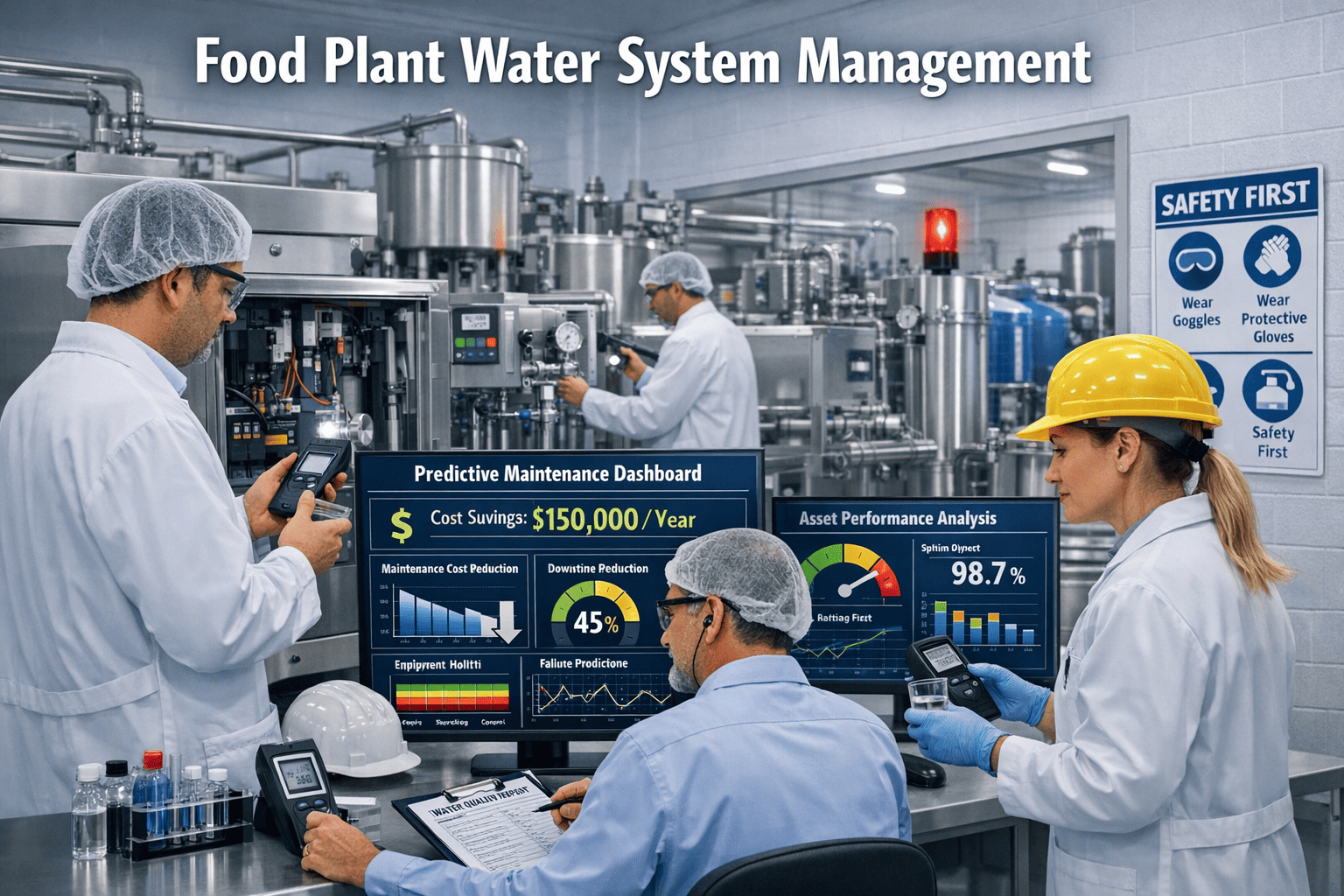
Water treatment system maintenance in food processing plants is one of the most compliance-critical and operationally sensitive disciplines in modern food manufacturing. Every liter of water that contacts raw ingredients, processed product, or food-contact surfaces must meet strict microbiological, chemical, and physical standards — governed by FDA, FSMA, and HACCP frameworks. Facilities that allow water treatment infrastructure to degrade face a cascading risk: compromised product safety, failed audits, costly production halts, and regulatory action. This guide covers everything utilities engineers and plant maintenance teams need to know to keep RO membranes, UV disinfection units, chemical dosing systems, water softeners, and wastewater treatment equipment operating at peak performance year-round. Sign up free to explore how a CMMS built for food manufacturing can bring structure and compliance to your water treatment program from day one.
Why Water Treatment Maintenance Is Non-Negotiable in Food Processing
Water is the single most-used process input in food and beverage manufacturing — used in ingredient hydration, CIP (clean-in-place) cycles, steam generation, cooling systems, and final product rinse. When water treatment systems underperform, the contamination risk doesn't stay isolated to the utility room. Biofilm in poorly maintained RO systems, chloramine breakthrough from exhausted carbon beds, or scale buildup in softeners can migrate directly into process lines — creating microbial hazards that invalidate entire production batches.
Regulatory expectations are equally demanding. FDA's Food Safety Modernization Act (FSMA) Preventive Controls rule requires facilities to identify water quality as a potential hazard and implement verified preventive controls. HACCP plans routinely designate water treatment checkpoints as Critical Control Points. Falling behind on maintenance documentation isn't just an operational risk — it's a direct audit exposure that can trigger FDA warning letters, third-party audit failures, and customer qualification loss. Book a demo to see how OxMaint helps food plant teams stay audit-ready year-round with automated compliance records.
Core Water Treatment Systems in Food Manufacturing Plants
Modern food processing facilities operate multiple interdependent water treatment systems, each with distinct maintenance requirements and failure modes. Understanding each system's role and vulnerability profile is the foundation of an effective maintenance strategy.
Reverse Osmosis (RO) Membrane Systems
RO systems remove dissolved solids, heavy metals, and microbial contaminants to produce high-purity water for direct product contact and ingredient use. Membranes are susceptible to scaling from calcium and magnesium, biofouling from bacterial colonization, and chlorine degradation from inadequately conditioned feed water. Routine pressure differential monitoring, normalized permeate flow tracking, and salt rejection testing are the primary health indicators. Membrane replacement cycles in food plants typically range from 2–5 years depending on feed water quality and pretreatment effectiveness.
UV Disinfection Systems
Ultraviolet disinfection is a chemical-free pathogen control method used across ingredient water, process water, and final rinse applications in food plants. UV lamp intensity degrades progressively — typically declining to 70% of initial output within 9,000–12,000 operating hours. Quartz sleeve fouling from mineral deposits or biofilm reduces UV transmittance independently of lamp degradation, creating a compounding risk that simple hours-based replacement schedules miss. Effective UV maintenance requires continuous UV intensity monitoring, quarterly sleeve inspection and cleaning, and validated intensity logs as part of FSMA documentation.
Chemical Dosing Systems
Chemical dosing equipment delivers chlorine, chloramine, antiscalants, pH adjusters, and biocides at precisely controlled concentrations into process water streams. Dosing pump calibration drift is the primary failure mode — delivering under- or over-concentration of treatment chemicals without triggering visible alarms. In food facilities, underdosing creates microbiological risk while overdosing creates chemical contamination hazard. Dosing system maintenance must include pump output verification, chemical residual testing at multiple points, tubing inspection for crystallization or cracking, and actuator calibration checks on a defined schedule.
Water Softeners and Ion Exchange Systems
Ion exchange softeners protect downstream RO membranes, heat exchangers, and boilers from calcium and magnesium scaling. Resin bed exhaustion is the central maintenance concern — hardness breakthrough into softened water streams can be catastrophic for membrane systems and steam generation equipment. Resin regeneration cycles must be validated against actual feed water hardness rather than defaulting to fixed-frequency schedules. Resin bed inspection every 2–3 years for degradation, fouling, or channeling is essential in food plant environments where feed water chemistry fluctuates seasonally.
Wastewater Treatment and Effluent Management
Food processing generates high-BOD (biochemical oxygen demand) wastewater from product washdowns, CIP discharge, and process drains. Wastewater treatment systems — including dissolved air flotation (DAF) units, biological treatment reactors, and pH neutralization systems — must be maintained to meet local discharge permits and prevent surcharge penalties. DAF units require regular skimmer blade inspection, float chemistry optimization, and sludge pump maintenance. Biological reactors depend on consistent aeration and nutrient dosing to maintain healthy biomass populations.
Water Treatment Failure Modes and Predictive Indicators
The majority of water treatment failures in food manufacturing plants are progressive — they develop over days or weeks and produce measurable indicators well before water quality deteriorates to an unacceptable level. The table below maps each major system to its critical failure modes, the operational parameters that reveal early-stage degradation, and the regulatory risk each failure carries. Try OxMaint free to start tracking these indicators automatically with sensor-integrated condition monitoring built for food plant water systems.
| System | Primary Failure Mode | Early Warning Indicator | Detection Lead Time | Regulatory Risk |
|---|---|---|---|---|
| RO Membrane | Biofouling / scaling | Rising pressure differential, declining normalized flow | 2–4 weeks | FSMA Preventive Controls violation |
| UV Disinfection | Lamp intensity degradation | UV sensor output decline below 40 mJ/cm² | 1–3 weeks | HACCP CCP deviation, FDA audit finding |
| Chemical Dosing Pump | Calibration drift / diaphragm wear | Residual chemical deviation at test points | Days–2 weeks | Microbiological contamination risk |
| Water Softener Resin | Hardness breakthrough | Elevated hardness in softened water effluent | 1–2 weeks | RO membrane damage, boiler scaling |
| DAF Unit | Float chemistry failure, skimmer wear | Rising effluent TSS, reduced float blanket | 2–5 days | Discharge permit exceedance, surcharge |
| Activated Carbon Filter | Chlorine/chloramine breakthrough | Residual chlorine detected downstream of filter | Days–1 week | RO membrane oxidation, product taint |
| Storage Tank | Biofilm formation, sediment accumulation | Elevated HPC counts, turbidity rise | 2–6 weeks | Product contamination, FSMA violation |
FDA and FSMA Water Quality Compliance Requirements for Food Plants
Regulatory compliance is not a periodic audit event — it is a continuous operational obligation for utilities engineers managing food plant water systems. Understanding the specific requirements that govern water treatment maintenance is essential for both operational planning and audit readiness. Sign up free to see how OxMaint centralizes compliance documentation for water treatment across your facility.
FSMA Preventive Controls for Human Food
- Water used in food contact applications must be safe and of adequate sanitary quality
- Water quality hazard analysis required as part of Food Safety Plan
- Preventive controls must be validated, monitored, and corrective actions documented
- Water testing records must be retained for a minimum of 2 years
- Annual reassessment of water safety plan required when processes or equipment change
HACCP Water Critical Control Points
- Water CCPs require defined critical limits (microbial, chemical, physical parameters)
- Monitoring procedures must specify frequency, method, and responsible personnel
- Corrective action plans required for every CCP deviation — including water treatment failures
- Verification activities must include independent water quality testing beyond monitoring
- All CCP records subject to third-party audit review — completeness is a scored criterion
Step-by-Step Water Treatment Maintenance Program for Food Plants
Building a structured water treatment maintenance program requires moving beyond ad-hoc inspections and vendor-driven schedules. A systematic approach ensures that maintenance frequency is calibrated to actual equipment condition and regulatory requirements — not convenience or budget cycles. Get started free with OxMaint and follow the five-step framework below to build a fully compliant, condition-based water treatment maintenance program for your food facility.
Water System Asset Inventory and Risk Classification
Document every water treatment asset — RO systems, UV units, dosing pumps, softeners, storage tanks, DAF units, and distribution lines — with location, age, capacity, and downstream use. Classify each by consequence of failure: product-contact water systems carry highest risk and get priority maintenance scheduling. Identify regulatory obligations for each asset, including CCP designations and monitoring frequencies.
Water Quality Baseline Testing and Parameter Definition
Establish baseline performance parameters for each system: RO salt rejection percentage, UV intensity at commissioning, softener hardness output, and chemical residuals at all test points. Document these baselines as the reference against which future readings are compared. Baseline data is also required as evidence in FSMA Food Safety Plans and HACCP validation records.
Condition-Based and Compliance-Driven Maintenance Scheduling
Assign maintenance tasks to each asset with frequency defined by both condition indicators and regulatory requirements. RO membrane cleaning is condition-triggered by pressure differential rise; UV lamp replacement is hours-based. Build compliance-mandatory tasks (FSMA monitoring frequencies, HACCP CCP checks) directly into CMMS schedules so regulatory obligations are never overridden by operational pressure.
Water Quality Monitoring and Automated Alert Configuration
Integrate online water quality sensors (conductivity, pH, turbidity, UV transmittance, free chlorine residual) with your maintenance platform so out-of-spec readings auto-generate corrective work orders. Define alert tiers — advisory, corrective, and critical — with escalation protocols for each. Critical alerts on product-contact water systems must route immediately to qualified personnel with defined response time requirements.
Documentation, Audit Trail, and Continuous Improvement
Every water quality test result, maintenance task completion, corrective action, and deviation must be documented with timestamp, responsible personnel, and result — in a system that produces audit-ready reports on demand. Review water treatment KPIs quarterly: uptime by system, deviation frequency, corrective action response time, and compliance task completion rate. Use trend data to refine schedules and identify assets approaching end-of-life before failure.
RO Membrane Maintenance in Food Processing: A Detailed Guide
Reverse osmosis membranes are among the highest-value and most failure-sensitive assets in food plant water treatment. A well-maintained RO system produces consistent high-purity water for years; a neglected one can foul irreversibly within months — requiring full membrane replacement at significant cost and production disruption. Book a demo to see how OxMaint's condition monitoring dashboards give utilities engineers real-time visibility into RO membrane health across every shift.
UV Disinfection Maintenance for Food and Beverage Applications
UV disinfection systems are valued in food manufacturing for their chemical-free operation, consistent performance, and absence of disinfection byproducts — but they require precise maintenance to deliver the validated dose required for pathogen inactivation.
Water Treatment Maintenance KPIs for Food Manufacturing Facilities
Tracking the right performance indicators enables utilities engineers and facility managers to demonstrate compliance, justify maintenance investment, and identify degradation trends before they produce regulatory or quality events. These are the KPIs that matter most in food plant water treatment programs.
CMMS Integration for Food Plant Water Treatment Compliance
A Computerized Maintenance Management System (CMMS) purpose-built for food manufacturing environments transforms water treatment maintenance from a documentation burden into a compliance asset. The right CMMS platform provides automated scheduling aligned to FSMA monitoring frequencies, mobile task execution with inline data capture, and audit-ready reporting that eliminates manual record compilation before inspections.
Effective CMMS integration for food plant water treatment includes auto-generation of corrective work orders when water quality sensors detect out-of-spec conditions, technician calibration checklists embedded in preventive maintenance tasks, and immutable record-keeping with timestamp and user attribution that satisfies FDA electronic records requirements. Get started free to see how OxMaint's CMMS delivers this capability out-of-the-box for food manufacturing maintenance teams.
Frequently Asked Questions: Water Treatment Maintenance in Food Processing Plants
How often should RO membranes be cleaned in a food processing facility?
RO membrane cleaning frequency should be condition-triggered rather than calendar-based. Clean when normalized pressure differential rises 15% above baseline or normalized permeate flow declines 10% below baseline — whichever occurs first. In high-fouling food plant environments, this may result in cleaning every 3–6 months. Annual cleaning regardless of condition data is an insufficient and potentially non-compliant approach.
What water quality parameters must food plants monitor under FSMA?
FSMA Preventive Controls requires food plants to monitor any water quality parameters identified as hazards in their Food Safety Plan. For product-contact water, this typically includes microbial indicators (total coliform, E. coli, HPC), chemical parameters (chlorine residual, pH, conductivity), and physical parameters (turbidity). Specific limits and monitoring frequencies must be defined in the Food Safety Plan and aligned with the facility's HACCP program.
How long do UV lamps last in food and beverage water treatment?
UV lamp operational life in food and beverage applications is typically 9,000–12,000 hours before output degrades below 70% of initial intensity. At 24/7 operation, this equates to approximately 12–16 months. However, replacement should be based on validated intensity readings rather than hours alone — real-world lamp degradation varies with feed water chemistry, temperature, and operational cycling patterns.
What causes chemical dosing pumps to drift out of calibration in food plants?
The primary causes of dosing pump calibration drift in food manufacturing environments are diaphragm wear from continuous cycling, chemical crystallization in feed lines and injection points, air entrainment in chemical feed suction lines, and temperature-driven viscosity changes in chemical solutions. Monthly output verification using a graduated cylinder test is the standard method for detecting drift before it produces a water quality exceedance.
Can a CMMS manage water treatment compliance documentation for FDA audits?
Yes — a CMMS with food manufacturing compliance features can centralize all water treatment maintenance records, quality test results, corrective actions, and calibration certificates in a searchable, audit-ready format. The key requirements are immutable timestamped records, user attribution for all entries, and the ability to generate system-specific maintenance history reports on demand. OxMaint's CMMS is purpose-built to meet these requirements for food plant utilities teams.
What is the most common cause of RO membrane failure in food processing plants?
The leading cause of premature RO membrane failure in food plants is pretreatment system failure — specifically, free chlorine breakthrough from exhausted activated carbon beds, which oxidizes polyamide membrane surfaces irreversibly. Hardness breakthrough from softener resin exhaustion is the second most common cause, producing calcium carbonate scaling that blocks membrane pores. Both failures are preventable with properly scheduled and monitored pretreatment maintenance.