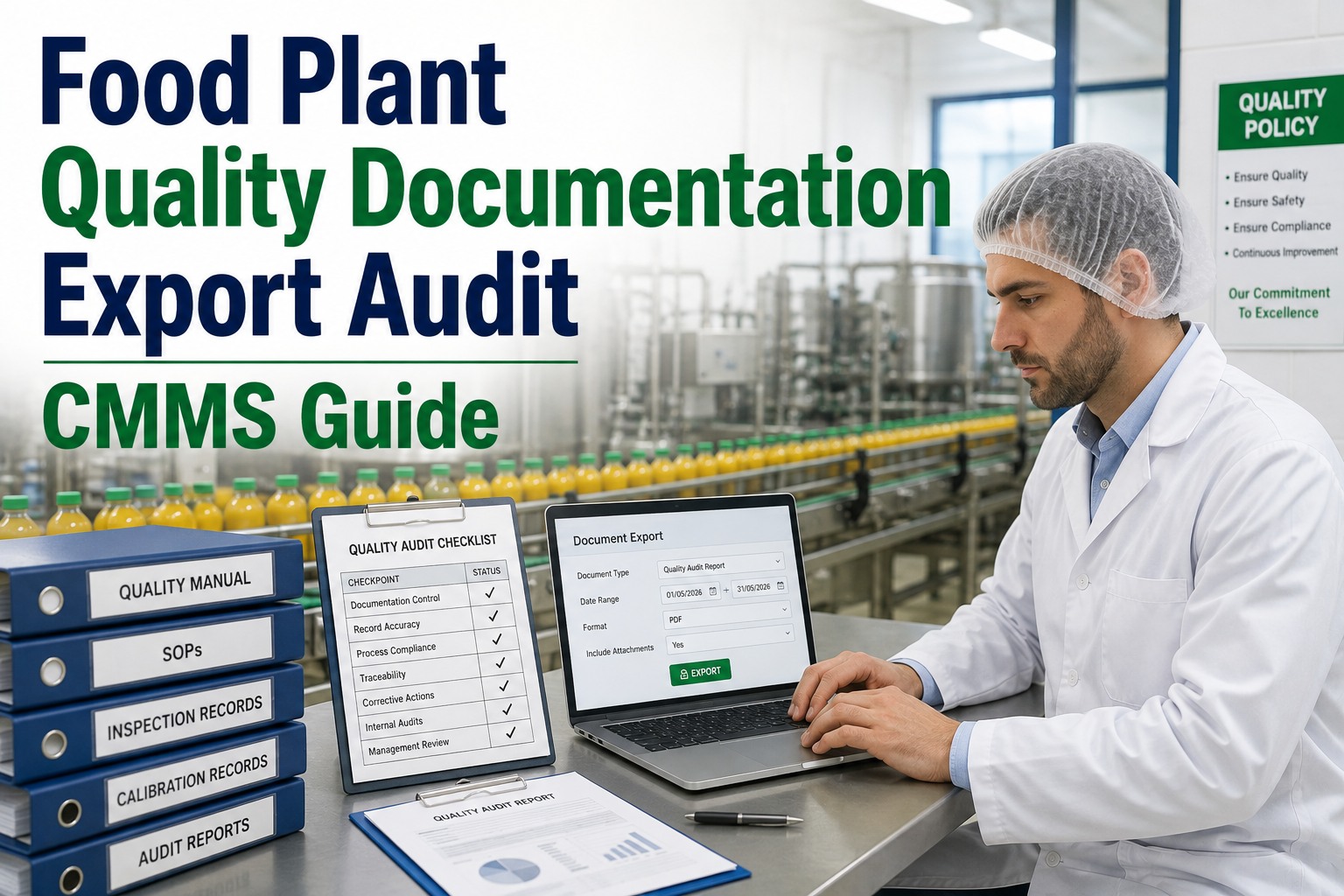
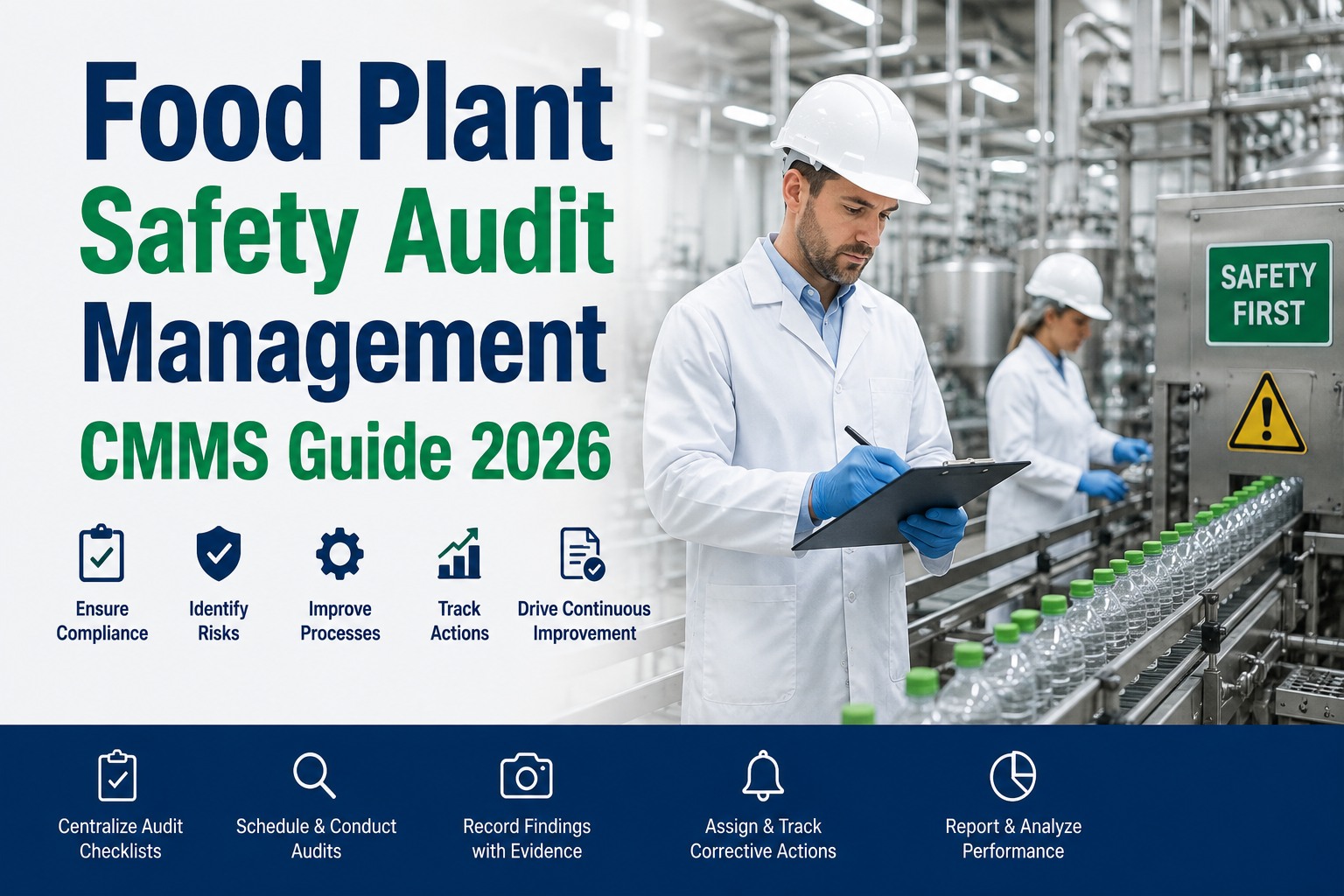
SQF certification maintenance is one of the most demanding ongoing responsibilities in food manufacturing — and one of the most consequential. A single audit gap, a missing corrective action record, or an undocumented equipment inspection can cost your facility its certification, disrupt customer contracts, and invite regulatory scrutiny. Yet most food plants still manage SQF compliance through spreadsheets, paper logs, and shared drives that fragment critical data across departments. A purpose-built CMMS (Computerized Maintenance Management System) changes that equation entirely — giving food manufacturers a centralized, audit-ready compliance infrastructure that works every day of the year, not just the weeks before an auditor walks through the door. Sign up for OxMaint to bring continuous SQF audit readiness to your food plant operations.
Keep Your Food Plant SQF-Compliant 365 Days a Year
OxMaint delivers digital inspection management, corrective action tracking, and real-time compliance documentation — built for food manufacturing environments.
What SQF Certification Maintenance Actually Requires
The Safe Quality Food (SQF) program, managed by the Food Marketing Institute under the GFSI umbrella, is one of the most rigorous food safety certification standards in global supply chains. Achieving SQF certification is a milestone — but maintaining it is the true operational challenge. SQF audits evaluate not just whether your food safety systems exist on paper, but whether they are being actively implemented, monitored, documented, and improved on a continuous basis.
SQF Code compliance requires ongoing execution across several demanding operational areas: preventive maintenance schedules for food-contact and non-food-contact equipment, sanitation and hygiene verification records, pest control logs, supplier verification documentation, internal audit trails, corrective and preventive action (CAPA) workflows, and employee training records. Each of these areas generates documentation that must be accurate, complete, retrievable on demand, and traceable to specific equipment, personnel, or events. Managing this volume of compliance data manually is where most food plants develop the gaps that become audit findings.
Why Traditional Compliance Methods Fail SQF Audits
Food safety compliance software solves a problem that paper-based and spreadsheet-driven systems cannot: the problem of fragmentation. When preventive maintenance records live in one spreadsheet, sanitation logs exist as printed forms in binders, corrective actions are tracked in email threads, and calibration certificates are scattered across shared drives, the compliance picture is never complete — and it is never current.
SQF auditors assess food safety management systems holistically. They look for evidence that your food safety plan is a living operational system, not a static document set. They will ask to see the corrective action raised after a specific equipment failure and trace it through root cause analysis to verified closure. They will request calibration records for a specific instrument and verify that the calibration schedule was followed without gaps. They will check whether the internal audit finding from six months ago generated a documented preventive action with assigned ownership and a verified completion date. These are the questions that expose the structural weakness of manual compliance management in food manufacturing environments.
SQF auditors don't just review whether processes exist — they verify continuous execution, traceable documentation, and closed-loop corrective action across the entire food safety management system. Manual tracking cannot provide this level of evidential completeness reliably.
How CMMS Software Transforms SQF Compliance Tracking
A food industry CMMS is not merely a maintenance scheduling tool — it is a compliance infrastructure platform. When configured for SQF requirements, a CMMS functions as the operational backbone of your food safety management system, connecting preventive maintenance execution, inspection management, corrective action workflows, and documentation control into a single auditable system. The result is continuous audit readiness: every compliance task executed, every record captured, every non-conformance tracked from identification to verified closure.
CMMS platforms automatically generate and assign PM work orders based on SQF-required intervals for food-contact equipment, environmental monitoring systems, and critical control point instrumentation — creating a documented maintenance trail that directly satisfies SQF Code requirements for equipment maintenance programs.
Inspection management software for the food industry replaces paper-based checklists with digital forms that capture technician sign-off, timestamps, equipment readings, and photographic evidence — creating inspection records that are automatically stored, searchable, and retrievable during an SQF audit without manual assembly.
When an inspection finding, equipment failure, or internal audit observation generates a non-conformance, CMMS corrective action workflows assign ownership, track root cause analysis, set resolution deadlines, and capture verification evidence — ensuring every CAPA is documented from identification through closure in a format that satisfies SQF corrective and preventive action requirements.
CMMS platforms manage calibration schedules for measurement and monitoring devices used at critical control points, automatically flagging overdue calibrations and storing calibration certificates against specific equipment records — eliminating one of the most common sources of SQF audit findings in food manufacturing facilities.
Food safety compliance software with dashboard reporting gives quality managers continuous visibility into PM completion rates, open corrective actions, overdue inspections, and upcoming audit deadlines — replacing reactive pre-audit scrambles with a proactive, always-current compliance posture.
SQF Audit Preparation: The CMMS Advantage
SQF audit preparation traditionally consumes weeks of staff time — pulling records, verifying completion, assembling documentation packages, and chasing down corrective action evidence scattered across multiple systems and file locations. Food plants using a CMMS for compliance tracking compress this process dramatically because the audit evidence is continuously maintained rather than assembled at the last minute.
When an SQF auditor requests records for a specific element — say, the preventive maintenance history for your metal detector, or the corrective actions generated by your last internal audit — a CMMS user can retrieve that complete, verified record trail in minutes. Every work order completed, every inspection conducted, every non-conformance raised and closed is timestamped, attributed to a specific technician, and stored against the relevant equipment or process record. This is the type of evidentiary completeness that elevates audit outcomes from acceptable to exemplary.
Beyond documentation retrieval, CMMS platforms strengthen SQF audit preparation by identifying compliance gaps before the auditor arrives. Automated alerts for overdue preventive maintenance, uninspected equipment, unresolved corrective actions, and expiring calibration certificates give quality teams the lead time to close gaps proactively — rather than discovering them during the audit itself. Explore OxMaint's audit-readiness features and see how real-time dashboards keep your food plant perpetually inspection-ready.
CMMS vs. Manual Systems: SQF Compliance Comparison
| SQF Compliance Area | Manual / Spreadsheet Approach | CMMS-Driven Approach |
|---|---|---|
| PM Scheduling | Manual calendar reminders, frequent gaps | Automated work orders, completion tracking, audit trail |
| Inspection Records | Paper forms, binder storage, retrieval delays | Digital forms, instant search, photographic evidence attached |
| Corrective Actions | Email threads, no deadline tracking | Structured CAPA workflow, ownership assignment, verified closure |
| Calibration Management | Shared drive certificates, manual schedule tracking | Equipment-linked records, automated overdue alerts |
| Audit Preparation | 2–4 weeks of manual record assembly | On-demand report generation, days not weeks |
| Compliance Visibility | Reactive — gaps found during audits | Proactive — real-time dashboards surface gaps continuously |
HACCP Compliance Software Integration with SQF Programs
SQF certification is built on a HACCP foundation — and a CMMS that integrates with your HACCP compliance software creates a unified digital food safety management system that covers both the hazard analysis layer and the operational execution layer. Critical control point (CCP) monitoring records, corrective actions triggered by CCP deviations, and verification activities required under your HACCP plan can all be managed within a CMMS framework, creating a continuous, auditable bridge between your food safety plan and its operational implementation.
This integration is particularly valuable for food manufacturers pursuing or maintaining higher SQF levels, where the sophistication of the food safety management system and the depth of documented evidence are scrutinized more rigorously. A digital food safety management system that connects HACCP plan documentation to equipment maintenance records, CCP monitoring logs, and corrective action histories demonstrates the type of systemic food safety culture that SQF Code Level 2 and Level 3 certifications reward. Book a demo with OxMaint to see how HACCP and CMMS integration works in a live food manufacturing environment.
Choosing the Right Food Safety Compliance Software for SQF
Not all CMMS platforms are equal in their capacity to support SQF certification maintenance. Food manufacturers evaluating food safety audit software should assess several critical capabilities before selecting a platform. The depth of inspection form configurability matters — SQF requires specific documentation formats, and a platform that allows custom inspection templates aligned to your SQF monitoring procedures will generate records that directly satisfy audit requirements without reformatting.
Corrective action management software depth is equally important. A basic task assignment tool is insufficient for SQF CAPA requirements. The platform must support structured root cause analysis documentation, preventive action planning, implementation tracking, effectiveness verification, and trend analysis across corrective actions — all linked to the originating non-conformance and retrievable in a format auditors can follow without interpretation.
Mobile accessibility is a practical necessity in food manufacturing environments. Maintenance technicians, QA staff, and sanitation teams need to complete inspections, close work orders, and document findings at the point of activity — not from a desktop back at the office. CMMS platforms with strong mobile interfaces generate more complete, more timely compliance records because the documentation happens in the moment, not hours later from memory.
Make Every Day an Audit-Ready Day in Your Food Plant
OxMaint's CMMS connects preventive maintenance, digital inspections, CAPA workflows, and compliance dashboards into one platform built for SQF food safety environments.
Expert Reviews: What Food Safety Professionals Say About CMMS for SQF
We gathered perspectives from food safety consultants, SQF practitioners, and quality managers who have deployed CMMS platforms across food manufacturing environments. Here is what they consistently highlight as the difference-makers.
"The single biggest shift I see in food plants that adopt a CMMS is the transition from reactive compliance to proactive compliance. Before, teams were scrambling two weeks before an SQF audit to pull records together. With a CMMS, that evidence exists continuously — every PM completion, every inspection, every CAPA closure is already documented. Audit preparation goes from a fire drill to a report export."
"Our repeat non-conformance rate dropped significantly after we moved corrective actions into a CMMS. When every CAPA has an assigned owner, a deadline, a root cause analysis field, and a verification step, things actually get closed. With email threads and spreadsheets, findings would cycle back audit after audit. The structured workflow changed that completely."
"When I audit a facility that uses a digital CMMS for compliance tracking, I can see the difference immediately. The records are complete, timestamped, and traceable to specific personnel and equipment. The facilities that still manage SQF compliance manually almost always have documentation gaps — not because they are doing less work, but because the system doesn't capture what actually happened at the point of activity."
"Calibration management was our biggest pain point before CMMS. Certificates were in shared drives, schedules were in spreadsheets, and instruments were going out of calibration without anyone catching it until an auditor asked. Moving calibration schedules and certificate storage into the CMMS eliminated that entirely. Alerts fire automatically — nothing slips through."
Frequently Asked Questions
What is SQF certification maintenance and why does it require year-round management?
SQF certification maintenance refers to the continuous operational activities required to remain compliant with the Safe Quality Food Code between annual surveillance and recertification audits. Unlike a one-time certification process, SQF requires ongoing execution of preventive maintenance programs, documented inspections, corrective action workflows, calibration schedules, and internal audits — all with traceable, complete records. Year-round management is necessary because SQF auditors assess evidence of continuous compliance, not just audit-period activity.
How does CMMS software support SQF audit preparation?
A CMMS supports SQF audit preparation by maintaining continuously updated records for all compliance-relevant activities — preventive maintenance, equipment inspections, corrective actions, and calibrations — in a searchable, retrievable digital system. When an auditor requests records for a specific piece of equipment or compliance program element, CMMS users can generate complete documentation packages in minutes rather than the days or weeks required to assemble manual records. Automated alerts also help quality teams close compliance gaps before the auditor arrives.
What SQF compliance areas can a CMMS manage?
A food industry CMMS can manage preventive maintenance scheduling and completion tracking, digital inspection records for GMP and equipment monitoring, corrective and preventive action (CAPA) workflows, equipment calibration schedules and certificate management, sanitation program documentation, internal audit tracking, and real-time compliance dashboards. Together these capabilities cover the majority of documentation-intensive SQF Code requirements that generate audit findings when managed manually.
Is a CMMS the same as food safety compliance software?
A CMMS and food safety compliance software overlap significantly but are not identical. A CMMS provides operational workflow management — maintenance, inspections, asset records, corrective actions — with strong documentation and audit-trail capabilities that align directly with food safety compliance requirements. Dedicated food safety compliance software may provide additional capabilities such as HACCP plan management, supplier verification programs, and regulatory submission workflows. Many food manufacturers use a CMMS as the operational execution layer within a broader digital food safety management system that also includes HACCP and quality management components.
How does corrective action management software improve SQF compliance?
Corrective action management software improves SQF compliance by transforming CAPA from an informal, email-based process into a structured, auditable workflow. Each non-conformance generates a documented record that captures the finding, assigned owner, root cause analysis, corrective action plan, implementation evidence, and effectiveness verification — all timestamped and linked to the originating inspection or audit finding. This closed-loop documentation is precisely what SQF auditors look for when evaluating the maturity and effectiveness of a food safety management system.