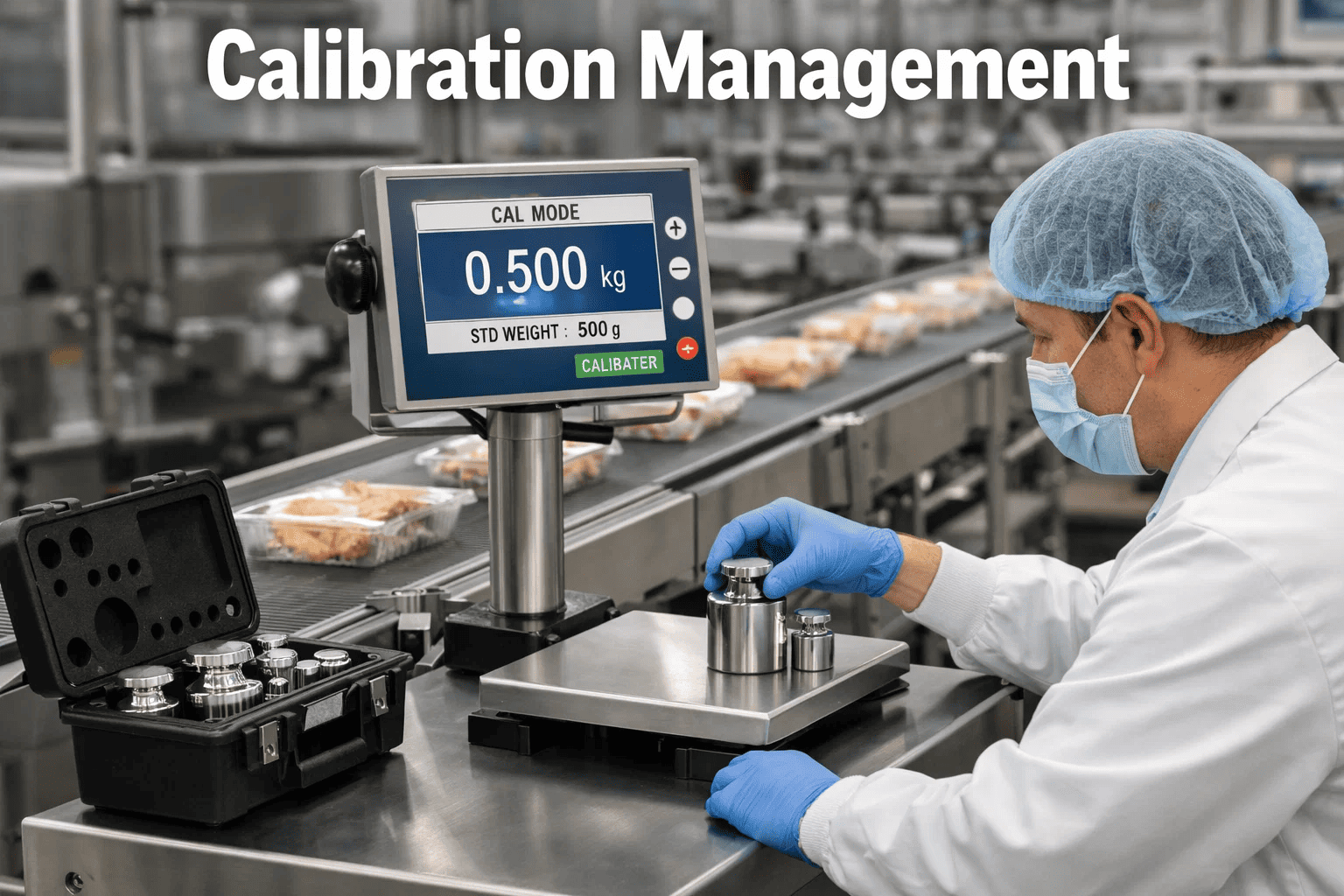
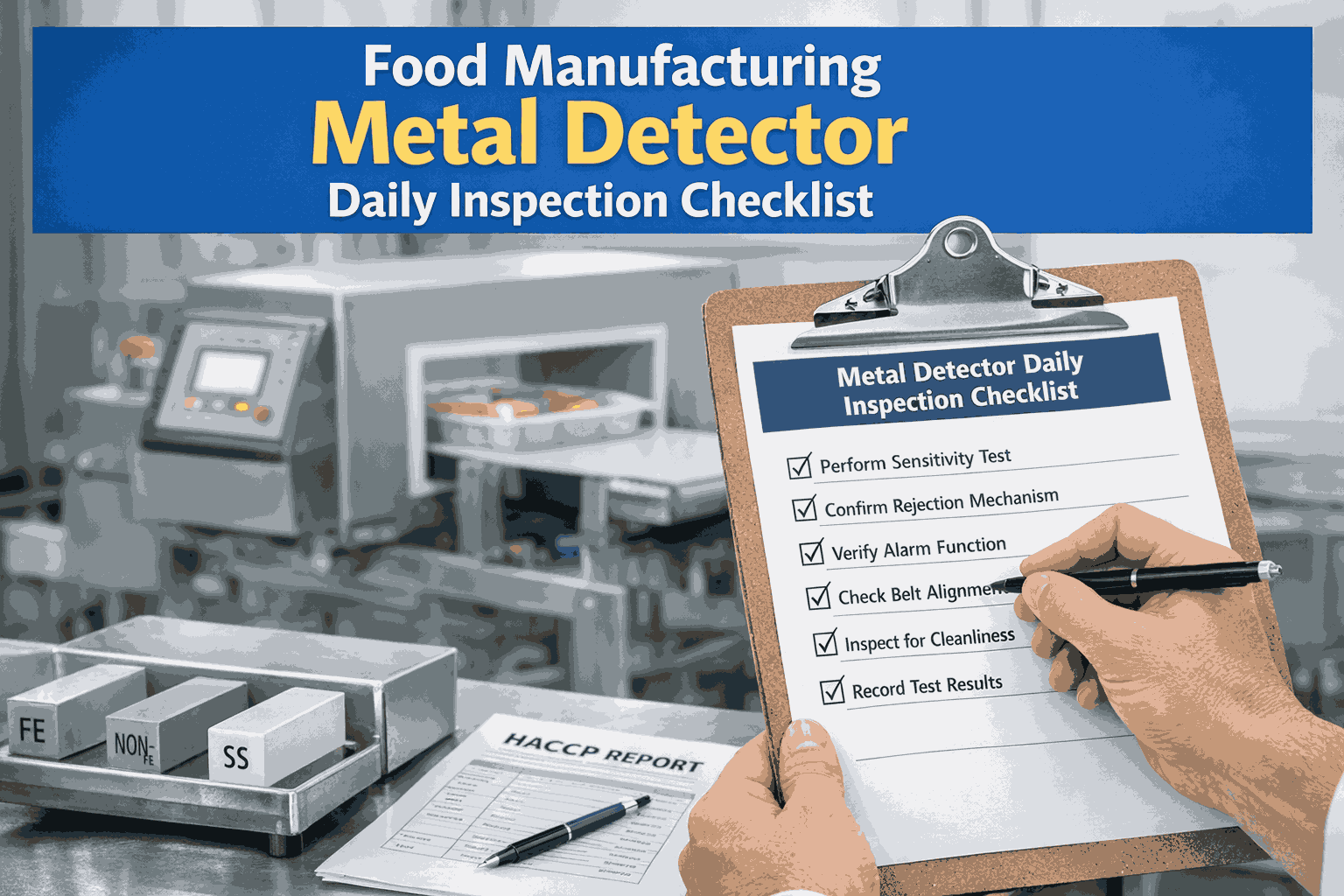
Calibration management in food manufacturing is the operational backbone of product safety, regulatory compliance, and quality assurance. Every scale, thermometer, pH meter, and metal detector on your production floor must perform within defined tolerances — and when they don't, the consequences range from product recalls to facility shutdowns. For QA managers overseeing instrument reliability across facilities in the US, UK, Canada, Germany, and the UAE, a structured Sign Up Free on OxMaint is no longer optional — it is the foundation of a defensible food safety program.
Automate Your Food Instrument Calibration Program
OxMaint delivers CMMS-based calibration scheduling, tolerance tracking, and audit-ready documentation — purpose-built for food manufacturing QA teams.
What Is Calibration Management in Food Manufacturing?
Calibration management is the systematic process of verifying, adjusting, and documenting the accuracy of measurement instruments used in food production. It ensures that critical control point (CCP) equipment — from checkweighers to inline thermometers — delivers readings that accurately reflect true process conditions.
In food manufacturing, measurement error is not an abstract quality concern. An uncalibrated scale that reads 3% high results in overfill losses worth tens of thousands annually. A thermometer drifting 2°C below actual temperature creates a pasteurization failure that endangers consumers. Calibration management closes these gaps through scheduled verification, traceable standards, and documented corrective action.
For QA managers in regulated markets — including FDA-regulated facilities in the US, BRC-certified plants in the UK, FSSC 22000 sites in Germany, and HACCP-compliant operations across Canada and the UAE — calibration documentation is also a core audit requirement. A well-run platform — Sign Up Free — transforms compliance from a reactive scramble into a continuous operational state.
Why Calibration Frequency and Tolerance Matter at the QA Level
Two parameters define the technical foundation of any calibration program: frequency and tolerance. Get either wrong and the entire quality control system built on top of those instruments becomes unreliable.
Calibration Frequency
How often you calibrate depends on instrument criticality, usage, and drift history. CCP scales may need daily checks; lab pH meters weekly. Set frequency based on risk — not convenience — and document the rationale for audit defence.
Calibration Tolerance
Tolerance is the acceptable error range between your instrument and the reference standard. Limits must come from process requirements — not manufacturer defaults. Any out-of-tolerance result requires documented corrective action and a product impact review.
Traceability to National Standards
Every reference standard must trace back to a national body — NIST (US), NPL (UK), PTB (Germany), or equivalents in Canada and UAE. Without this documented chain, your calibration records won't hold up under ISO 9001 or GFSI audit scrutiny.
Critical Instruments Requiring Calibration in Food Production
Food manufacturing environments contain diverse instrument types, each with distinct calibration requirements, failure modes, and food safety consequences. QA managers must understand the specific risks each instrument category presents.
Covers ingredient batch scales and checkweighers. Must meet legal Weights and Measures requirements in the US, UK, and Canada. Overweight means financial loss — underweight means regulatory risk.
Applies to probes, infrared sensors, and inline RTDs used in pasteurization and cold chain. Temperature drift at a CCP is one of the most serious calibration failures in food safety.
Critical for acidified foods, beverages, and fermented products. Two-point calibration with NIST-traceable buffers is standard. Electrodes degrade over time and must be replaced on schedule.
Verified using ferrous, non-ferrous, and stainless steel test pieces. Checks required at shift start, mid-shift, and end-of-run. Results must be documented to satisfy BRC and SQF requirements.
Directly affects weight labeling compliance in the US, UK, EU, and Canada. Calibration covers minimum, nominal, and maximum load points. UAE export facilities must keep these records for import authority review.
Used in CIP systems, retorts, and pasteurizers. Calibrated against traceable pressure standards. In Germany and the UK, statutory inspection rules apply on top of internal calibration requirements.
Calibration Documentation: What Audit-Ready Records Look Like
Calibration documentation food requirements are explicitly defined in GFSI-recognized standards and form a primary evidence category during third-party audits. Incomplete or inconsistently formatted calibration records are among the most frequently cited nonconformances across BRC, SQF, FSSC 22000, and IFS audits globally.
| Record Element | Required For | Standard Reference | Retention Period | Common Gaps |
|---|---|---|---|---|
| Instrument ID and Description | All regulated instruments | ISO 9001, BRC, SQF | Minimum 3 years | Missing serial numbers or location codes |
| Calibration Date and Due Date | All calibrated equipment | All GFSI standards | 3–5 years | Inconsistent date formats across sites |
| Reference Standard Details | All calibrations | ISO/IEC 17025 | Life of instrument | Traceability chain not documented |
| Tolerance Limits and Actual Results | All in-house calibrations | BRC, FSSC 22000 | 3 years minimum | Pass/fail only — no actual readings recorded |
| Out-of-Tolerance Corrective Action | Any OOT result | All GFSI, FDA 21 CFR | 3–5 years | Corrective action not linked to product review |
| Technician Signature / Authorization | All calibrations | BRC, SQF, IFS | Duration of record | Electronic records without audit trail |
A CMMS calibration tracking system eliminates documentation gaps by standardizing record formats, enforcing mandatory field completion, and time-stamping every entry with user credentials. For multi-site operations in Canada, Germany, and the UAE, centralized digital documentation removes the retrieval delays that turn audits into fire drills.
CMMS-Based Calibration Tracking and Scheduling
A Computerized Maintenance Management System with calibration management capability transforms instrument compliance from a calendar-driven manual process into an automated, exception-driven program. CMMS calibration tracking is now a baseline expectation in GFSI-certified food manufacturing facilities, and increasingly a requirement under retailer supplier codes of practice in the UK and Germany.
Automated Calibration Scheduling
A CMMS generates calibration work orders automatically based on defined intervals — calendar-based, usage-based, or condition-triggered. QA managers receive advance notifications before due dates, eliminating the manual diary systems that lead to overdue instruments reaching production lines. In facilities operating across multiple time zones — including UAE sites coordinating with UK and Canadian headquarters — automated scheduling removes human dependency from compliance timing.
Instrument Register and Asset Hierarchy
Every calibrated instrument is registered with full descriptive data — make, model, serial number, location, calibration procedure reference, tolerance specification, and reference standard assignment. The instrument register forms the master inventory auditors review first, and a CMMS maintains it in real time as instruments are added, relocated, or removed from service. Cross-site instrument registers in German and US facilities give QA directors portfolio-level visibility into calibration status.
Out-of-Tolerance Escalation Workflows
When a calibration result falls outside tolerance limits, the CMMS triggers an immediate escalation workflow — notifying QA management, placing the instrument out of service, and initiating a product impact assessment task. This structured response replaces the informal phone calls and email chains that leave corrective action undocumented. For FDA-regulated facilities in the US and FSA-overseen operations in the UK, documented corrective action is the difference between a minor observation and a major nonconformance.
Calibration Certificate Management
External calibrations performed by accredited laboratories generate ISO/IEC 17025-compliant certificates that must be stored, indexed, and retrievable on demand. A CMMS links certificates directly to instrument records — replacing paper filing systems and email archives with structured digital storage. When auditors request traceability documentation during BRC or IFS assessments, retrieval is immediate rather than requiring hours of archive searching.
How AI Vision Enhances Calibration Management in Food Manufacturing
AI Vision — the application of computer vision and machine learning to visual data — is introducing capabilities to food equipment calibration programs that were previously impossible without expensive laboratory infrastructure or specialist personnel on the production floor.
AI reads gauge displays, scale indicators, and thermometer readouts from camera images — eliminating manual transcription errors and speeding up calibration rounds.
AI spots early signs of instrument degradation — fouled electrodes, damaged scale platforms — before they cause a calibration failure or production stoppage.
AI checks test piece condition visually, ensuring your reference standards stay reliable — supporting high-frequency verification in UK and German retailer-audited facilities.
AI analyzes drift trends per instrument and recommends whether to extend or shorten calibration intervals — helping QA teams focus effort where it matters most.
Calibration Management Software and Platform Comparison
QA managers evaluating calibration management tools face a market that spans specialized standalone calibration software, integrated CMMS platforms, and ERP-embedded quality modules. The right platform depends on instrument count, site complexity, integration requirements, and audit standard commitments.
| Platform Type | Best Suited For | Key Capabilities | Integration Depth | Audit Readiness |
|---|---|---|---|---|
| Standalone Calibration Software | Labs, single-site QA teams | Certificate management, instrument register, due date tracking | Limited — standalone system | Moderate — certificate-focused |
| CMMS with Calibration Module | Multi-site food manufacturers | Scheduling automation, OOT workflows, maintenance integration, reporting | High — connects to maintenance, assets, and compliance | High — full record trail |
| ERP Quality Module | Large enterprise operations | Integrated with procurement and production; batch record linking | Very high — within ERP ecosystem | High — subject to ERP configuration quality |
| Paper-Based / Spreadsheet Systems | Very small facilities only | Manual records, calendar reminders | None | Low — retrieval and consistency risks |
| AI-Powered CMMS Platform | Growth-stage and enterprise food manufacturers | Automated scheduling, OOT escalation, AI briefings, predictive intervals, multi-site dashboards | High — API-ready, IoT-enabled | Very high — real-time compliance visibility |
OxMaint operates as an AI-powered CMMS with dedicated calibration management capabilities — built for food manufacturing QA teams managing diverse instrument portfolios across multiple sites. Sign Up Free to see how automated scheduling and out-of-tolerance workflows operate in practice.
Benefits and ROI of a Structured Calibration Management Program
The return on investment from implementing structured food equipment calibration management extends well beyond audit preparation. QA managers who quantify calibration program value present a compelling case to operations leadership and finance teams.
Complete, structured records eliminate the most common audit findings — overdue instruments, missing traceability, and undocumented OOT responses. Protects BRC and IFS certification grades.
Verified instruments reduce weight variation, temperature excursions, and pH drift — cutting rework and waste in ways that far outweigh the cost of running the calibration program.
In-tolerance calibration records at the time of production significantly reduce liability in any recall investigation — critical for Canada and UAE export documentation requirements.
Automated scheduling and mobile work orders cut admin time — freeing QA technicians in the US and Germany to focus on higher-value tasks instead of chasing paperwork.
Common Challenges in Food Manufacturing Calibration Programs
Even well-resourced QA teams encounter recurring obstacles that undermine calibration program integrity. Understanding these challenges — and the platform-level solutions that resolve them — is essential for QA managers building programs that withstand third-party scrutiny.
Incomplete Instrument Register
Problem: New or temporary instruments added during expansions are often missed.
Fix: Sign Up Free — a CMMS register with mandatory intake ensures every instrument is tracked from day one.
High-Frequency Verification Overload
Problem: Metal detectors and checkweighers need checks multiple times per shift — paper systems can't keep up.
Fix: Mobile digital workflows cut documentation time per check from minutes to seconds.
Lapsed Reference Standards
Problem: If your reference weights or buffer solutions expire, every calibration done with them becomes invalid.
Fix: CMMS auto-alerts for reference standard due dates prevent this silent compliance gap.
Inconsistency Across Sites
Problem: Different sites in UK, Canada, Germany, and UAE use different formats and tolerance definitions.
Fix: A centralized platform standardizes procedures while allowing local compliance configuration.
Best Practices for Food Instrument Calibration Programs
Risk-Rank Your Instrument Register
Not all instruments carry equal food safety consequence. Categorize instruments by criticality — CCP instruments, regulatory compliance instruments, quality instruments, and reference indicators — and apply calibration rigor proportionate to risk classification. This risk-based approach satisfies GFSI requirements while directing resource intensity toward instruments where drift has genuine safety or legal consequence.
Document Tolerance Rationale, Not Just Tolerance Values
Auditors increasingly require evidence that tolerance limits are derived from process requirements rather than assumed from manufacturer specifications. Document the rationale for each tolerance limit — citing process parameter requirements, product specification limits, or regulatory mandates — alongside the tolerance value in the calibration procedure. This level of documentation distinguishes mature programs from compliance-minimum approaches.
Conduct Annual Calibration Program Reviews
Review calibration intervals, tolerance limits, and reference standard assignments annually using accumulated drift data. Instruments with zero or minimal drift history over multiple calibration cycles may justify interval extension — freeing QA resource for higher-risk areas. Programs that never revisit interval assumptions accumulate inefficiency that limits the team's capacity for higher-value activities.
Train Calibration Technicians Beyond Procedure Compliance
Technicians who understand why calibration tolerances exist — not just how to execute the procedure — make better judgments about borderline results, anomalous readings, and instrument conditions that procedures do not explicitly address. Investing in calibration science fundamentals training pays sustained dividends in record quality, out-of-tolerance judgment, and audit response capability across US, UK, and Canadian food manufacturing sites.
Building a Scalable Calibration Management Program
For QA managers in growth-stage food manufacturing businesses — expanding from single-site operations to multi-facility portfolios across North America, Europe, and the UAE — scalability is the defining requirement of calibration management infrastructure. A program designed around paper binders and local spreadsheets cannot scale to manage hundreds of instruments across dozens of sites without proportional administrative overhead that ultimately creates compliance gaps.
Deploying a CMMS-based calibration tracking platform early in growth creates the infrastructure that scales with the business — maintaining compliance quality as instrument counts increase, sites multiply, and audit frequency intensifies. The investment in structured calibration management automation delivers compounding returns: each additional site and instrument added to the portfolio benefits from the same documented, automated, audit-ready program without requiring proportional expansion of the QA team managing it.
For food manufacturers committed to GFSI certification, retailer approval, and regulatory compliance across international markets, calibration management is not a cost center — it is a market access enabler. Book a Demo to see how a purpose-built CMMS delivers calibration scheduling, documentation, and compliance visibility at scale.
Ready to Modernize Your Food Calibration Program?
OxMaint gives QA managers automated calibration scheduling, out-of-tolerance escalation workflows, and audit-ready documentation — across every instrument, every site, every audit standard.
Frequently Asked Questions
How often should food manufacturing scales be calibrated?
Calibration frequency for food manufacturing scales depends on instrument criticality, usage intensity, and regulatory requirements. CCP-associated scales typically require daily verification checks and monthly full calibration. Non-critical scales may calibrate quarterly. Frequency decisions should be documented with risk-based rationale and reviewed annually against drift history data from calibration records.
What documentation is required for food equipment calibration under BRC Global Standards?
BRC Global Standards require a complete instrument register, documented calibration procedures for each instrument type, calibration records showing actual results against tolerance limits, evidence of traceable reference standards, and documented corrective action for any out-of-tolerance result. Records must be retained for a minimum period specified in the standard and must be retrievable on demand during third-party audits.
What is the difference between calibration and verification in food manufacturing?
Calibration is the full process of comparing an instrument to a traceable reference standard and adjusting it if necessary, with complete documentation of results. Verification is a simplified performance check — confirming the instrument reads within acceptable limits at defined points without adjustment. Both are valid control activities, but calibration provides the higher level of metrological assurance required for CCP instruments and regulatory compliance documentation.
How does a CMMS improve calibration management in food facilities?
A CMMS improves food facility calibration management by automating scheduling and notifications, standardizing record formats, enforcing mandatory field completion, triggering corrective action workflows for out-of-tolerance results, and maintaining a centralized instrument register with full calibration history. These capabilities eliminate the overdue instruments, incomplete records, and undocumented corrective actions that generate calibration-related audit nonconformances.
What should a food manufacturer do when an instrument fails calibration?
When an instrument fails calibration, the immediate response must include removing the instrument from service, documenting the out-of-tolerance result, initiating an assessment of all product produced since the last in-tolerance calibration, and implementing corrective action to restore instrument accuracy. The entire response — including product impact assessment outcomes and corrective action taken — must be documented and retained as part of the calibration record for the instrument.
Are calibration requirements different in the UK, Canada, Germany, and UAE?
Core calibration principles are consistent internationally, but specific regulatory instruments, traceability references, and documentation standards vary by jurisdiction. UK facilities reference NPL-traceable standards and comply with UKAS accreditation requirements. German operations align with PTB standards and DIN EN ISO requirements. Canadian facilities follow NRC-INMS traceability. UAE export facilities increasingly must meet destination country calibration documentation requirements. A configurable CMMS accommodates jurisdiction-specific requirements from a single platform.