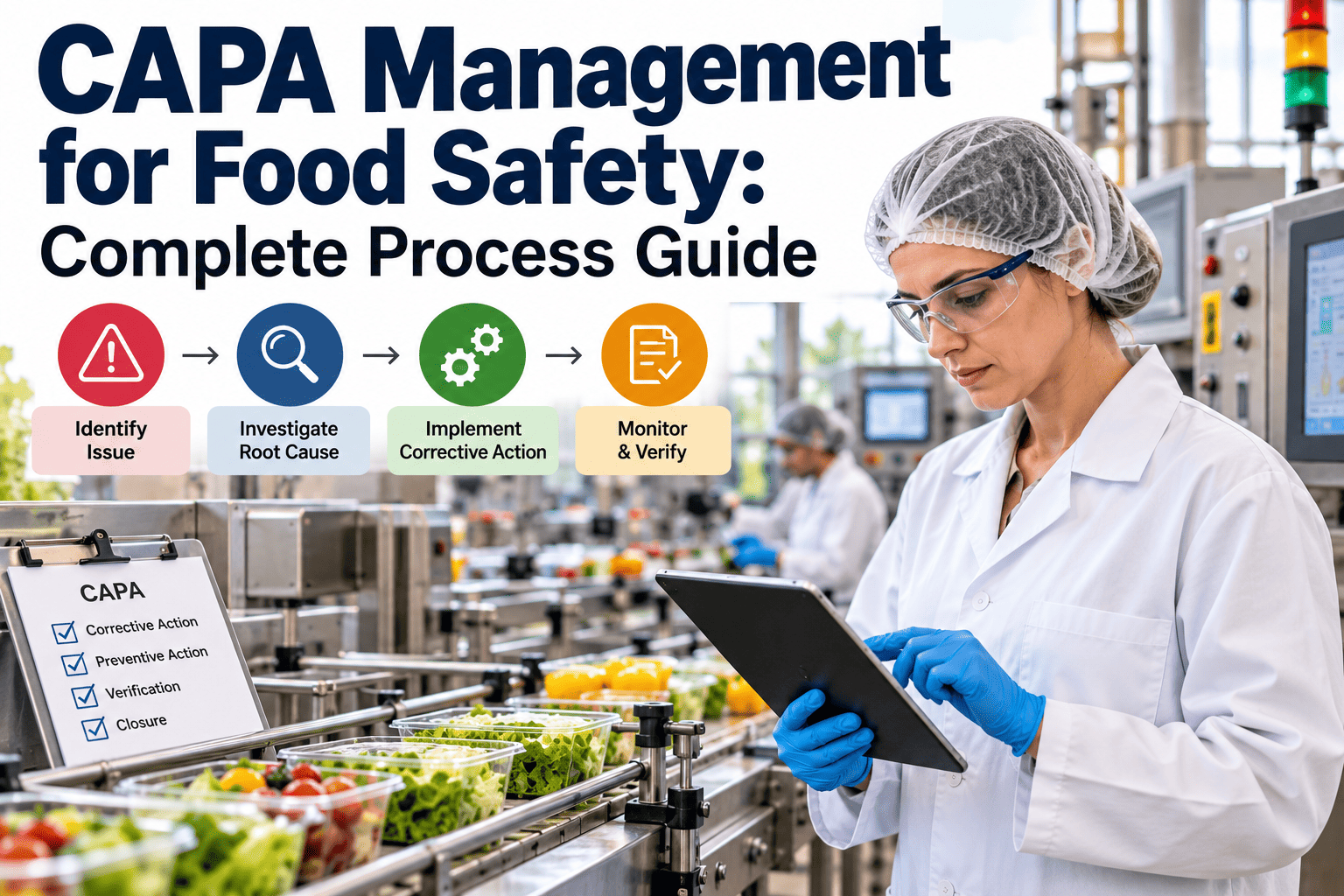
Most food plants do not struggle to open a corrective action. They struggle to close one properly. A deviation is logged, the product is dealt with, the operator is retrained, and the record is marked complete, yet the same issue appears again a few months later. Auditors working under GFSI-benchmarked schemes look straight past the quick fix and ask what caused the problem, what changed, and how you know it worked. A reliable CAPA process answers all three, and when maintenance findings feed it directly through maintenance work orders and asset history, the answers stop depending on memory.
CAPA Management for Food Safety: From Detection to Verified Effectiveness
Run corrective and preventive actions through one controlled path of detection, containment, root cause, action and effectiveness verification, so findings close for good instead of coming back.
Correction, Corrective Action and Preventive Action Are Not the Same Thing
Confusing these terms is the most common reason a CAPA record fails review. Each answers a different question, and a complete record usually contains all three.
- Hold, segregate, rework or dispose of affected product
- Stop the line or adjust the process
- Fixes the symptom, not the cause
- Based on a documented root cause
- Changes equipment, procedure, training or controls
- Includes verification that it worked
- Extends the fix to similar lines, assets and sites
- Driven by trends, risk reviews and near misses
- Acts before a nonconformity occurs
What Should Open a CAPA in a Food Plant
A CAPA program is only as complete as its intake. Findings reach the system from many places, and the plant needs a rule for which of them require a full investigation.
| Source of finding | Typical examples | Who raises it | Default depth |
|---|---|---|---|
| Monitoring deviation | Critical limit missed, record gaps, failed verification check | Operator or quality technician | Full root cause for any critical limit deviation |
| Audit finding | Internal, customer, certification or regulatory audit | Auditor through the quality lead | Full root cause, response to a set deadline |
| Customer complaint | Foreign material, label error, quality defect | Customer service or quality | Risk-based, full for safety-related complaints |
| Equipment failure or inspection | Seal failure, metal detector fault, calibration out of tolerance | Maintenance technician | Risk-based, linked to the asset record |
| Sanitation or environmental result | Failed swab, repeated positive trend | Sanitation or lab | Full root cause for repeat or trend findings |
| Near miss or employee report | Observed unsafe practice, almost-missed check | Any employee | Light review, escalate on pattern |
A Seven-Stage CAPA Process With Owners and Outputs
Clear stages with named owners prevent the common stall where a record sits open because nobody knows whose turn it is.
-
01Identify and logDescribe what happened, where, when and what was affected. Owner: whoever finds it. Output: a dated record with a unique number.
-
02Contain and correctProtect product and people first. Owner: production and quality. Output: hold or disposition records and the immediate correction taken.
-
03Assess risk and classifyRate severity and recurrence to decide investigation depth and deadlines. Owner: food safety lead. Output: classification and due date.
-
04Investigate root causeUse a structured method and look at why the monitoring system did not catch it sooner. Owner: a small cross-functional team. Output: documented root cause with evidence.
-
05Plan and implement actionsConnect each action to the cause it removes. Owner: named individuals with dates. Output: corrective and preventive actions with completion evidence.
-
06Verify effectivenessCheck after a defined period that the problem has not returned. Owner: someone independent of the fix. Output: a dated verification record with method and result.
-
07Close, trend and reviewFeed results into trend reviews and management review. Owner: quality leadership. Output: closure, trend data and updated procedures or training.
Choosing a Root Cause Method That Fits the Problem
Common techniques such as the five whys, fishbone diagrams and Pareto analysis each suit different situations. The method matters less than the discipline of evidence behind each conclusion.
| Method | Best used when | Strength | Watch out for |
|---|---|---|---|
| Five whys | A single failure with a fairly clear chain of events | Fast and easy to run on the floor | Stopping at operator error instead of the system behind it |
| Fishbone diagram | Many possible contributors across people, methods, machines and materials | Organizes team brainstorming | Listing causes without testing which ones are real |
| Pareto analysis | Repeated findings across lines, shifts or assets | Shows where effort pays off most | Needs consistent categories in the records |
| Timeline reconstruction | Complex events or complaints with unclear sequence | Exposes gaps between checks | Requires reliable time-stamped records |
Questions that separate a symptom from a root cause
- Would fixing this stop the problem for good, or only for this batch?
- Why did our monitoring or verification not detect it earlier?
- Could the same cause exist on another line, asset or site?
- Does the cause trace to a maintenance condition such as wear, calibration drift or a missed task?
- Is the cause stated as evidence, or as an assumption someone repeated?
Connect Corrective Actions to the Equipment That Caused Them
Oxmaint helps maintenance and quality teams raise corrective work orders from findings, link them to the asset history, and keep completion evidence in one traceable record.
Risk Matrix: How Much Investigation Does Each Finding Deserve?
Treating every minor miss as a full investigation clogs the system, while treating a critical one lightly invites repeat findings. A simple matrix sets proportionate depth.
Verifying Effectiveness: What Evidence Looks Like for Common Findings
Verification is the point where many programs fall short. Define the check, the period and the pass criteria when the action is planned, not when the record is about to be closed.
| Finding | Corrective action | How to verify | Evidence to file |
|---|---|---|---|
| Temperature deviation on a process line | Replace worn sensor, add calibration verification | Review process logs for a set period with no repeat deviation | Log review record, calibration results |
| Foreign material complaint | Repair damaged guard, adjust inspection frequency | Check inspection results and complaint trend | Inspection records, work order, complaint log |
| Repeated failed swab at one location | Correct drainage and sanitation method | Follow-up swabs and visual inspection over time | Swab results, revised procedure, training record |
| Missed preventive task on a critical asset | Reschedule, assign owner, add overdue alert | Confirm tasks completed on time over several cycles | Completion history, overdue report |
| Audit finding on incomplete records | Move records into a controlled system | Internal audit sample of completed records | Audit checklist, sample results |
What a Complete CAPA Record Contains
A reviewer should be able to read one record from start to finish without asking for anything else. The layout below shows the fields that make that possible.
How Auditors Test a CAPA Program
Reviewers rarely read one record in isolation. They sample several and look for the same chain in each, then ask what the pattern across records says about the system.
Questions they tend to ask
- Show me a CAPA from a few months ago and walk me through it
- How did you decide this needed a full root cause?
- How does the action connect to the cause you documented?
- When and how did you verify it worked?
- What did trending tell you across similar findings?
Patterns that attract findings
- Root cause recorded as operator error without further analysis
- Actions that retrain people but leave the process unchanged
- Records closed with no dated verification
- Overdue items with no owner or revised date
- No link between CAPA results and management review
Maintenance-Driven Root Causes and How Oxmaint Supports Them
Many food safety findings trace back to equipment: worn seals, drifting sensors, skipped lubrication or blocked drains. A maintenance system gives the CAPA team the history needed to see that.
- Repeated foreign material complaints on one line
- Temperature deviations after a sensor swap
- Failed swabs near a particular conveyor
- Work order history and repeat repairs on the asset
- Calibration and inspection results over time
- Missed or overdue preventive tasks near the event
Capabilities that map to the CAPA workflow
- Corrective maintenance work orders raised directly from a finding, with owner and due date
- Asset management that keeps repair, inspection and calibration history in one place
- Preventive maintenance schedules updated as a preventive action once the cause is known
- Inspection checklists used for verification checks after a fix
- Compliance records and reports that show completed and overdue actions
- Dashboards that help supervisors see which items are close to their deadlines
Measures That Show Whether CAPA Is Actually Preventing Recurrence
Counting closed records says little. These measures describe quality and speed, and they should be reviewed alongside trends.
Common CAPA Failure Patterns and What to Do Instead
Most weak programs fail in predictable ways. Recognizing the pattern in your own records is the quickest route to fixing it, and the fixes are mostly about discipline rather than software.
Patterns to watch for
- Every finding gets the same light treatment, so serious issues receive too little analysis
- Root cause is recorded as a person, not a condition in the system
- Actions are vague, such as remind staff or be more careful
- Owners and dates are missing, so records age quietly
- Verification is promised but never scheduled
- Equipment causes are noticed but never linked to maintenance records
Better habits to adopt
- Classify by risk at intake and set depth and deadlines accordingly
- Ask why the process allowed the error, and what evidence supports the answer
- Write actions that change a procedure, control, design or schedule
- Name one owner per action and review overdue items weekly
- Schedule the verification check when the action is approved
- Pull asset history into the investigation whenever equipment is involved
Who does what in a healthy CAPA program
| Role | Main responsibility | Typical output |
|---|---|---|
| Finder | Reports the issue promptly and protects product | Initial record and containment steps |
| Food safety lead | Classifies risk, approves depth, signs off closure | Classification and approval |
| Investigation team | Finds the root cause with evidence | Cause statement and supporting data |
| Maintenance | Provides asset history and carries out equipment fixes | Work orders and completion notes |
| Verifier | Checks independently that the problem stayed fixed | Dated verification record |
| Management | Reviews trends and resources systemic fixes | Management review decisions |
CAPA Food Safety FAQs
What is the difference between a correction and a corrective action?
A correction deals with the immediate problem, such as holding product. A corrective action removes the root cause so it does not recur, and it includes a check that it worked.
Does every deviation need a full root cause analysis?
Not necessarily. Define in your procedure which findings require one, with critical limit deviations and repeat issues at the top. Lower-risk items can use a lighter review.
How long should effectiveness verification take?
It depends on how often the issue could recur. Set the check and period when the action is planned, and record the date, method and result. Oxmaint can schedule that check as a task.
Where does maintenance software fit in a CAPA program?
It supplies equipment history and tracks the work orders that carry out the fix. Quality still owns classification and closure. Book a demo to see how the two connect.
How do I reduce overdue CAPAs?
Assign one owner per action, set realistic dates by risk class, and make overdue items visible to supervisors weekly. A free trial shows how reminders and dashboards support that.
Close Findings for Good With a Traceable Path From Cause to Proof
Link corrective actions to work orders, asset history and verification checks, so every finding shows its cause, its fix and the evidence that the problem stayed fixed.


