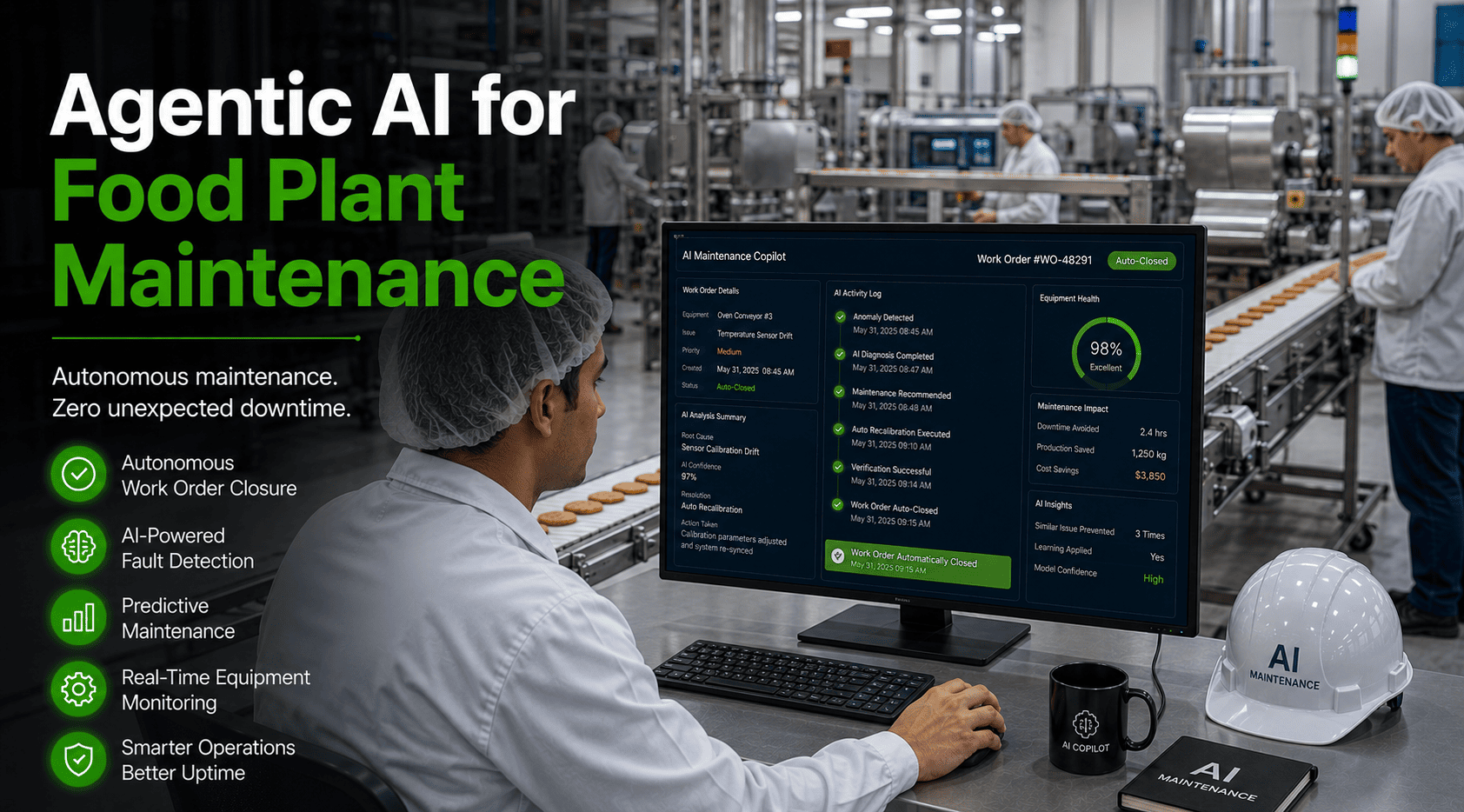
Work order management in food manufacturing plants is the backbone of every reliable maintenance operation — yet most facilities still rely on paper logs, spreadsheets, and radio calls that slow down response times and create compliance blind spots. When a filler line goes down mid-shift or a CIP system underperforms before a critical production run, the difference between a resolved issue and a regulatory failure often comes down to how fast a structured work order reaches the right technician. This guide breaks down the best practices that maintenance supervisors in food processing environments use to build faster, smarter, and audit-ready food plant maintenance workflows.
Why Work Order Management Fails in Food Manufacturing Environments
Most food plants don't have a maintenance problem — they have a visibility problem. Technicians are capable. Equipment is serviceable. But without a structured CMMS work order system for food processing, critical tasks fall through the cracks. Verbal requests get forgotten. Paper work orders pile up without priority ranking. Sanitation tasks and production maintenance compete for the same technicians with no clear routing logic.
The result: reactive maintenance cycles, repeat failures on the same equipment, and audit trails that don't hold up under FDA or SQF inspection. The facilities that outperform their peers on uptime and compliance are those that have replaced informal maintenance request processes with digital, structured, and automated work order management. Sign up for OxMaint to see how a structured CMMS work order system closes these gaps from day one.
The Core Components of an Effective Food Plant Work Order System
A high-performing food manufacturing work order system is not simply a digital version of a paper form. It is a structured workflow that captures the right information at intake, routes tasks to qualified personnel, tracks completion in real time, and generates documentation that satisfies both internal reporting and regulatory audit requirements.
Structured Maintenance Request Capture
Every work order starts with a request. In food plants, requests come from operators, supervisors, quality teams, and automated equipment alerts. A well-designed digital work order system for food plants standardizes intake across all sources — ensuring every request captures asset ID, failure description, location, urgency level, and any food safety implications before it enters the queue.
Priority-Based Work Order Routing
Not all maintenance requests carry the same urgency. A leaking valve on a pasteurizer demands immediate response; a worn conveyor belt guide may be scheduled for the next planned shutdown. Effective food plant maintenance workflow systems assign priority tiers — emergency, urgent, routine, and planned — and route work orders automatically to the technician with the right qualifications and current availability.
Mobile Work Order Completion on the Floor
Technicians working in a food processing environment cannot return to a desktop to update work order status. Mobile work orders for food plants allow technicians to receive assignments, access equipment history, record parts used, capture photo evidence, and mark tasks complete — all from a mobile device on the production floor, without leaving the job to update a system elsewhere.
Documentation and Compliance Sign-Off
Work order closure in food manufacturing is a compliance event, not just an administrative step. Every completed work order must capture the corrective action taken, parts and materials used, technician sign-off, and time stamps that satisfy HACCP, GMP, and food safety audit requirements. A CMMS that automates this documentation eliminates the manual data entry that creates gaps in audit trails.
Sanitation Scheduling and CMMS: Managing the Most Compliance-Critical Work Orders
Sanitation work orders occupy a unique position in food plant maintenance management. They are not optional, they are not deferrable, and their completion must be documented with a level of precision that production maintenance work orders rarely require. Sanitation scheduling in a CMMS platform transforms what is often a manual, shift-by-shift process into an automated, verifiable, and audit-ready workflow.
When CIP cycles, equipment teardown cleans, and environmental swab schedules are managed through the same CMMS platform as mechanical maintenance, supervisors gain a single source of truth for all operational compliance activities — eliminating the spreadsheet silos that create gaps between what was scheduled and what was actually completed. Book a demo to see how OxMaint handles sanitation scheduling and compliance documentation in a unified work order workflow.
| Work Order Type | Trigger Mechanism | Compliance Requirement | CMMS Automation Benefit |
|---|---|---|---|
| CIP Cycle Verification | Production run completion | HACCP / SQF documentation | Auto-generated post-run sanitation work order with checklist |
| Equipment Teardown Clean | Scheduled interval or product changeover | GMP and allergen control records | Interval-based scheduling with required sign-off fields |
| Environmental Swab Program | Calendar-based or risk-triggered | Listeria / pathogen monitoring records | Zone-mapped work orders with result capture and trend reporting |
| Preventive Mechanical Maintenance | Runtime hours or calendar frequency | Equipment maintenance logs | Auto-scheduled PM work orders with parts and procedure attached |
| Corrective Maintenance Request | Operator or supervisor report | Corrective action documentation | Digital intake with priority routing and real-time status tracking |
| Calibration Work Orders | Regulatory interval or equipment alert | Calibration certificates and records | Due-date alerts with certificate upload capability at closure |
Best Practices for Work Order Priority Routing in Food Processing Plants
One of the most impactful changes a maintenance supervisor can make is implementing a formal work order priority system for food manufacturing. Without priority tiers, technicians default to completing tasks by who asked loudest or which problem is most visible — not which issue poses the greatest risk to food safety, production continuity, or regulatory compliance.
Emergency — Immediate Response Required
Work orders classified as emergency include any failure that creates an active food safety risk, production line stoppage, or cold chain integrity breach. These work orders bypass the standard queue and alert the on-call technician immediately. Target response time: under 30 minutes. Examples: refrigeration failure, CIP system malfunction, allergen control breach.
Urgent — Same-Shift Resolution
Urgent work orders cover equipment degradation that will escalate to production impact within hours if unaddressed. These are routed to the first available qualified technician and should be completed within the same shift. Examples: packaging line speed reduction, conveyor belt slippage, temperature drift approaching limit.
Routine — Next Available Technician
Routine work orders address known issues that are not causing immediate production impact but need resolution within 24 to 72 hours. These are scheduled into the technician's daily queue based on availability and skill set. Examples: lubrication tasks, minor seal replacements, sensor recalibration.
Planned — Next Scheduled Shutdown
Planned work orders are deferred to the next scheduled maintenance window or production shutdown. These are pre-kitted with required parts and procedures so technicians can execute efficiently when the window opens. Examples: wear component replacement, motor bearing changes, major equipment overhauls.
How CMMS Work Order Automation Transforms Food Plant Maintenance
Manual work order processes create administrative overhead that maintenance supervisors cannot afford. Every minute a technician spends filling out paperwork, chasing down equipment history, or waiting for verbal task assignment is a minute not spent resolving the actual maintenance issue. CMMS work order automation for food plants eliminates this overhead by connecting maintenance request intake, routing, execution, and documentation into a single continuous workflow.
Mobile Work Orders: Empowering Food Plant Technicians on the Floor
Food processing environments are physically demanding and operationally fast-moving. Technicians move between production zones, cold stores, packaging areas, and utility rooms throughout every shift. Requiring them to return to a fixed terminal to receive work orders, access equipment history, or record completed tasks creates delays that compound across an entire maintenance team.
Mobile work order management for food manufacturing solves this by putting the full CMMS capability into a technician's pocket. When a work order is assigned, the technician receives an instant notification on their mobile device, can review the asset's full maintenance history, access the relevant procedure, scan the equipment QR code for confirmation, and complete the work order with photo documentation — all without leaving the production area. Sign up free and explore OxMaint's mobile-first work order experience built for food plant environments.
Building a Food Plant Work Order Management Implementation Roadmap
Transitioning from reactive, paper-based maintenance request handling to a structured digital work order system for food processing is achievable for facilities of any size — but it requires a clear implementation sequence to succeed. Start with OxMaint's CMMS platform and follow this practical roadmap to build a work order management system that delivers measurable results within the first 90 days.
Map Your Asset Register and Assign Work Order Categories
Before creating a single work order, build a complete asset register that includes every piece of production, sanitation, utility, and refrigeration equipment. Assign each asset to a work order category — mechanical, sanitation, calibration, or safety — so that incoming requests are routed and documented consistently from day one.
Define Priority Tiers and Routing Rules
Establish the four priority tiers — emergency, urgent, routine, and planned — and configure the routing rules that determine which technicians receive which work order types. Include qualification and certification requirements in routing logic so that food safety-critical tasks are only assigned to appropriately trained personnel.
Load Preventive Maintenance and Sanitation Schedules
Migrate all existing PM schedules and sanitation programs into the CMMS. Set trigger frequencies — calendar, runtime, or event-based — and attach procedure checklists and required parts to each scheduled work order template. This step converts your existing maintenance program from a static document into an active, auto-generating workflow.
Train Technicians on Mobile Work Order Completion
Conduct hands-on training sessions in the production environment where technicians will be using mobile work orders. Cover intake, execution, parts recording, photo capture, and digital sign-off. Pair training with a 30-day parallel period where both paper and digital processes run simultaneously to build confidence without operational risk.
Review KPIs and Optimize Routing Monthly
Use CMMS reporting to review work order backlog, average completion time by priority tier, repeat failure rate by asset, and overdue work order frequency every month. These metrics reveal where routing rules need adjustment, where technician capacity is constrained, and which assets are driving the highest maintenance burden — enabling continuous improvement of your food plant maintenance workflow.
Frequently Asked Questions: Work Order Management for Food Plants
What is work order management in food manufacturing?
Work order management in food manufacturing is the structured process of creating, prioritizing, assigning, executing, and documenting maintenance tasks across production, sanitation, refrigeration, and utility systems. An effective food plant work order system ensures every maintenance request — from corrective repairs to scheduled sanitation events — is tracked from intake to completion with a full audit trail that satisfies regulatory and internal compliance requirements.
How does a CMMS improve work order management in food plants?
A CMMS replaces paper-based and verbal maintenance request processes with a digital workflow that automates work order creation, routes tasks to the right technician by priority and qualification, enables mobile completion on the production floor, and generates compliance-ready documentation at closure. Food plants using a CMMS typically see reductions in mean time to repair, repeat failures, and audit finding frequency within the first year of deployment. Ready to experience the difference? Book a demo with OxMaint and see the platform live with your team.
How should food plants prioritize maintenance work orders?
Food plants should use a four-tier priority system: emergency (immediate food safety or production risk), urgent (same-shift resolution required), routine (resolved within 24–72 hours), and planned (deferred to next scheduled maintenance window). Each tier should have defined response time targets, routing rules, and escalation protocols that are enforced automatically by the CMMS rather than managed manually by supervisors.
Can sanitation scheduling be managed through a work order system?
Yes — and it should be. Managing sanitation schedules through the same CMMS platform as mechanical maintenance creates a unified compliance record that eliminates the documentation gaps between maintenance and sanitation departments. CMMS-based sanitation work orders can be triggered automatically by production run completion, calendar interval, or product changeover, and require technician sign-off and supervisor verification at closure — meeting HACCP, GMP, and SQF documentation standards.
What are the most important KPIs for food plant work order management?
The most impactful work order management KPIs for food manufacturing include: work order backlog size and age by priority tier, mean time to repair by asset class, preventive maintenance compliance rate (PM work orders completed on schedule versus deferred), repeat failure rate by equipment, overdue work order frequency, and planned versus reactive maintenance ratio. Tracking these metrics monthly enables continuous improvement of routing rules, technician capacity allocation, and PM scheduling strategy.
Is mobile work order management suitable for cold storage and processing areas?
Yes. Modern CMMS platforms designed for food manufacturing support offline mobile work order capability, allowing technicians to receive, execute, and complete work orders in cold stores, processing zones, and areas with limited wireless coverage. Work order data syncs automatically when connectivity is restored, maintaining a complete and accurate maintenance record without requiring technicians to exit cold environments to update task status.