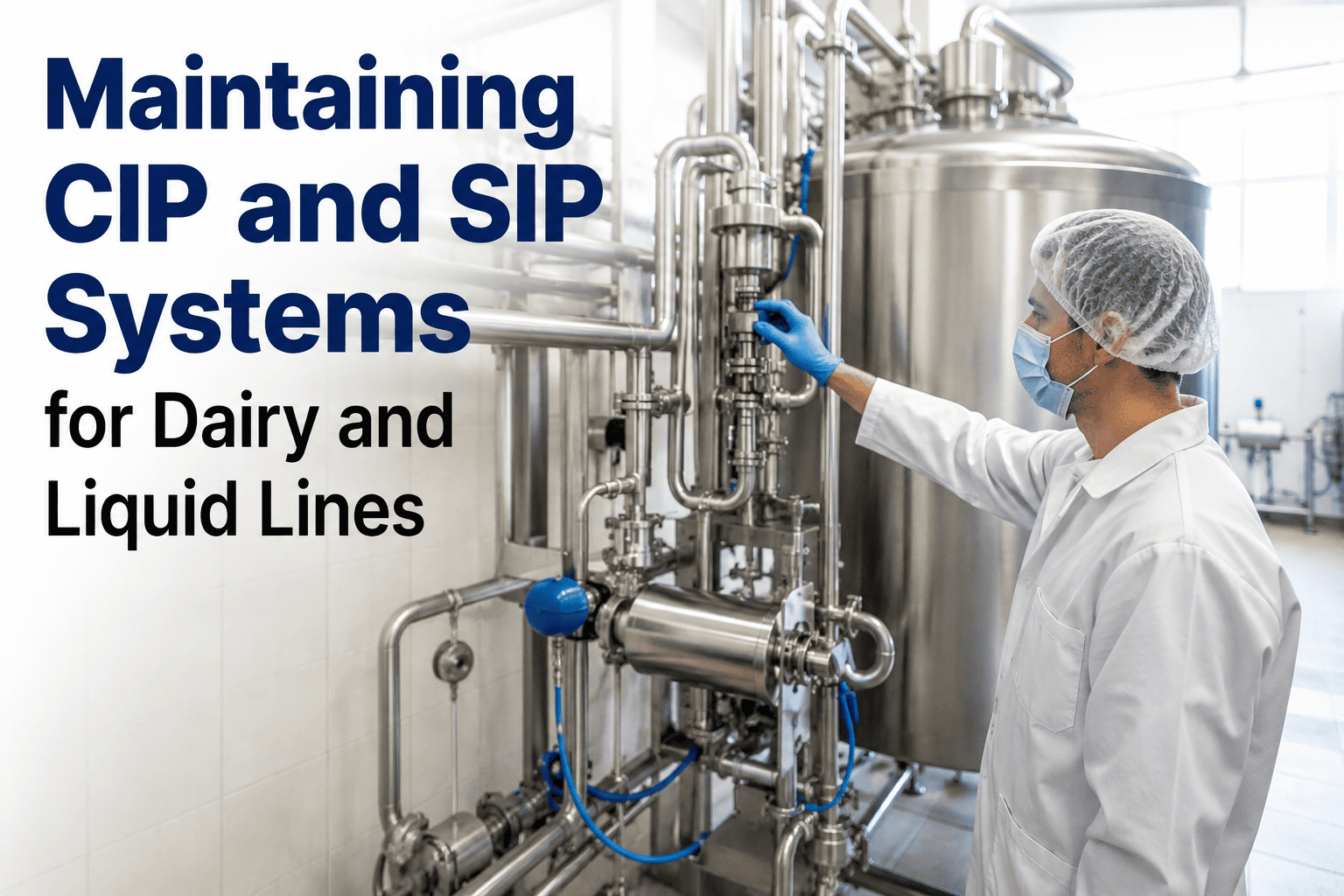
Clean-in-Place (CIP) and Sterilize-in-Place (SIP) systems keep dairy and liquid processing lines sanitary without ever opening a pipe or tank for manual scrubbing. A cycle can finish on schedule and print a clean report while still leaving biofilm behind if a spray ball has drifted off centre, a valve is not fully seating, or the wash never reached its set temperature. Because these systems run unattended and mostly out of sight, the gap between a completed cycle and an actually clean line is where failed swab tests, held batches and product recalls quietly start. Closing that gap takes a maintenance routine that checks every valve, sensor and nozzle on a fixed rhythm and can prove the result afterward. Sign in to OxMaint to run CIP/SIP checkpoints as scheduled work orders, or book a demo to see the full validation workflow.
Why It Costs More Than Water And Chemical
What An Unverified Cycle Actually Risks
3 parameters
Temperature, flow and chemical concentration must all hold together for a wash to count as validated
1 blocked nozzle
Is enough to leave a shadowed zone on a tank wall that no rinse ever reaches
Full re-run
Typical outcome when a swab test fails after a cycle that looked complete on the panel
Every batch
Sits on hold until the line can show a verified, logged clean and sterile result
A CIP or SIP controller only reports that a cycle ran, not that the surface got clean. Confirming coverage, contact time and sterilisation temperature still depends on people checking the right point at the right moment.
Map The Weak Points
Where CIP/SIP Cycles Actually Fail
Most failed cycles trace back to a small set of repeat offenders. Knowing them turns a generic wash check into a targeted inspection route.
Wash And Rinse Path
Spray balls out of alignment, partly clogged or spinning below design speed
Return pumps and drain valves that leave standing rinse water behind
Tank level and interface probes reporting a false empty or false full
Gasket wear at tri-clamp joints letting product bypass the wash path
Chemical dosing pumps drifting off their set concentration over time
Sterilization And Control
Steam traps stuck open, wasting steam without holding sterilizing temperature
Pressure reducing valves that let SIP pressure drift outside the set band
RTDs and thermocouples reading out of calibration at the coldest point
Conductivity sensors mistiming the changeover between rinse and chemical phase
Control valves that do not fully seat, letting live steam or caustic bypass
Two Checks, One Confirmed Result
How Reliable Teams Verify A Cycle
Visual And Mechanical Check
Confirm the hardware
A technician pulls the spray ball, checks nozzle rotation and clearance, and confirms valves seat and seal fully. This catches wear and blockages that a control panel never flags because the cycle still completes on time.
Sensor-Logged Validation
Confirm the parameters
Temperature, flow rate, contact time and chemical concentration are read at the far point of the circuit, not just at the supply tank, and logged against a checkpoint. A dip at the return line reveals a cycle that never fully reached spec.
Stop Trusting A Green Light On The Panel
OxMaint turns every CIP/SIP checkpoint into a mobile work order, logging spray ball condition, valve seating, temperature and concentration against the same record, so a verified clean is never just assumed.
The Verified Cycle Workflow
From Scheduled Check To Proven Clean
1
Schedule
Spray ball, valve and sensor checks are set per line on a fixed rhythm, tied to production hours rather than a wall calendar.
2
Inspect
The technician walks the checkpoint list on a phone, confirming nozzle coverage, valve seating and drain condition with a photo attached.
3
Validate
Temperature, flow and chemical concentration readings from the far point of the circuit are logged against the same checkpoint record.
4
Log
Any drift or worn part becomes an assigned work order routed to the right crew, closing the gap before the next scheduled cycle.
5
Verify
A follow-up reading or swab result confirms the fix held, sitting on the same record as the original finding.
Checkpoint Reference
Component, Risk And Check Frequency Guide
| Checkpoint |
Best Verification |
Risk If Missed |
Check Frequency |
OxMaint Action |
| Spray balls and nozzles |
Visual coverage plus rotation check |
Shadowed zones, repeat swab failures |
Weekly |
Checklist with photo per tank |
| Wash and steam control valves |
Seat and seal inspection |
Bypass, cross-contamination between lines |
Monthly |
Priority work order on wear |
| RTDs and thermocouples |
Calibration against reference probe |
False pass on a cycle that never reached spec |
Quarterly |
Calibration log per sensor |
| Chemical dosing pumps |
Titration or conductivity check |
Under-dosed wash, weak sanitization |
Monthly |
Recurring dosing verification task |
| Steam traps and PRVs |
Ultrasonic or condensate check |
Lost sterilizing temperature, wasted steam |
Quarterly |
Condition trend per trap |
| Tank level and interface probes |
Functional test against manual reading |
Incomplete drain, diluted next batch |
Quarterly |
Zone checklist with severity flag |
Frequencies are a starting point — tune them to your product risk category and audit history. Book a demo to build your checkpoint routes in OxMaint.
From The Plant Floor
What Sanitation And Reliability Leads Tell Us
“
Our CIP controller told us every cycle passed, but our swab results told a different story every few weeks. We were chasing failures after the fact instead of catching a worn spray ball or a slow valve before it mattered. Moving to checkpoint-based inspections with a logged reading at the far end of the circuit changed that. Now a drifting sensor or a partly clogged nozzle shows up as a work order days before it would have shown up as a held batch. Our micro results stopped surprising us.
What You Get
What OxMaint Brings To CIP/SIP Maintenance
Mobile Checklists
Checkpoints On A Phone
Technicians walk spray ball, valve, sensor and dosing checks per tank and line, logging photos and readings without a clipboard.
Work Orders
Every Drift Gets An Owner
A worn nozzle or an out-of-range temperature reading becomes an assigned repair routed to the right crew before the next cycle runs.
Verification
Before And After Proof
A follow-up reading or swab result is captured against the same record, so a fix is proven rather than assumed.
Recurring Routes
Checks On A Rhythm
Weekly spray ball checks, monthly valve and dosing checks, and quarterly calibration all run on their own schedule per line.
Analytics
Trend By Line And Tank
See which tanks fail swab tests most often and which components keep drifting, the data that justifies the next equipment upgrade.
History
Audit-Ready Records
Every checkpoint, reading and repair stays tied to its tank and date, ready to hand an auditor without digging through paper files.
Common Questions
Sanitation And Maintenance Teams Ask These
Does OxMaint replace our CIP/SIP controller or automation system?
No, your controller still runs the cycle. OxMaint is the checkpoint layer that verifies the hardware and readings behind that cycle and turns any drift into a tracked repair.
Sign in to set up your checkpoint routes.
Can a technician run spray ball and valve checks from the plant floor?
Yes. The checklist opens on a mobile device, and readings, photos and condition notes are logged at the tank without a return trip to a desk.
Book a demo to see the mobile flow.
How do we know a chemical dosing pump is actually holding concentration?
A titration or conductivity reading is logged against the pump checkpoint on a set schedule, so drift shows up as a work order well before a wash falls below spec.
Sign in to schedule dosing checks.
Can we prove a repaired valve or sensor is actually fixed?
How often should spray balls, valves and sensors be checked?
Spray balls are commonly checked weekly, valves and dosing pumps monthly, and sensor calibration quarterly, though high-risk lines often run tighter. OxMaint lets each rhythm be set per component.
Sign in to schedule recurring checks.
A Clean Report Is Not The Same As A Clean Tank
Plants that verify every CIP/SIP checkpoint catch wear before it becomes a held batch, pass audits without scrambling for records, and turn scattered wash logs into a provable clean. Free trial, no implementation fees, your first checkpoint routes live within days.



-system-maintenance-best-practices-for-food-and-beverage.png)
