-system-maintenance-best-practices-for-food-and-beverage.png)
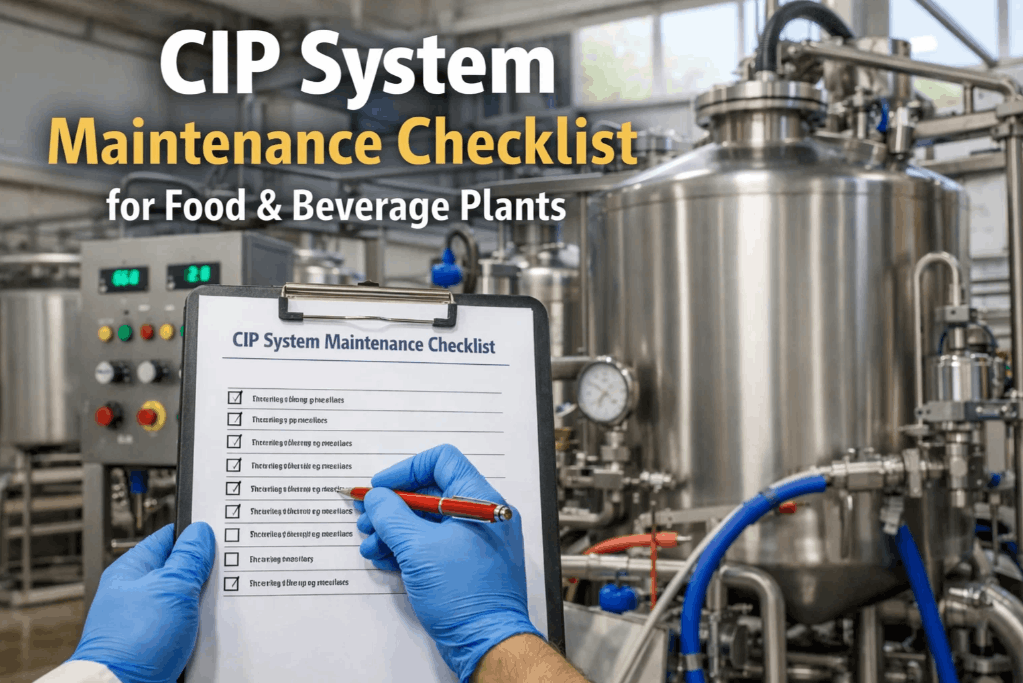
CIP system maintenance is the backbone of safe, efficient food and beverage production. When a clean-in-place system underperforms — whether from a worn pump seal, a partially blocked spray device, or a miscalibrated chemical dosing line — the consequences extend beyond equipment failure into product safety, regulatory compliance, and operational cost. This guide delivers actionable preventive maintenance frameworks, chemical monitoring protocols, and CMMS-driven strategies for sanitation and maintenance teams managing CIP assets in food and beverage plants across the US, UK, Canada, Germany, and the UAE. Sign Up — built for food production environments.
Automate Your CIP Maintenance Programme
OxMaint delivers CMMS-based CIP scheduling, chemical concentration tracking, and audit-ready documentation — purpose-built for food and beverage teams.
What Is a CIP System and Why Maintenance Defines Its Effectiveness
A clean-in-place system automates internal cleaning of pipelines, vessels, heat exchangers, and fillers without disassembly. A well-engineered CIP circuit delivers controlled sequences of pre-rinse, caustic wash, acid rinse, sanitiser, and final rinse — each at defined temperature, flow velocity, and chemical concentration.
The difference between a CIP system that protects product safety and one that creates false confidence is not design — it is maintenance. A programme running every cycle with degraded spray coverage, reduced pump pressure, or incorrect chemical concentration may pass a visual check while leaving biofilm in process pipework.
Food and beverage facilities under BRC, SQF, IFS, FSSC 22000, or FDA 21 CFR Part 117 must demonstrate that CIP systems are verified to function within validated parameters — elevating CIP maintenance from an operational task to a documented compliance function. Sign Up Free
CIP Pump Maintenance: The Pressure Behind Clean Circuits
CIP pumps deliver cleaning solution at the flow velocity needed to achieve turbulent flow — stripping soil from internal pipe surfaces. A pump degraded by wear or seal failure doesn't just clean slower; it may lose turbulent flow entirely, allowing biofilm to establish undetected.
Routine Pump Checks
- Verify discharge pressure and flow rate against validated baselines
- Visually inspect pump head and shaft for seal leakage
- Listen for bearing noise or cavitation signatures
- Assess mechanical seal condition weekly
- Lubricate bearing housings per manufacturer schedule
- Clean inlet strainers to prevent suction head loss
Deeper PM Tasks
- Measure impeller clearance — wear reduces pressure delivery
- Replace mechanical seals on high-cycle pumps quarterly
- Inspect and regrease bearings every quarter
- Test motor insulation resistance quarterly
- Compare pressure-flow curves against validation baseline
- Log all results in CMMS asset history for trend analysis
CIP Valve Maintenance: Flow Control and Contamination Prevention
Valves in CIP circuits direct flow sequences between wash, rinse, and sanitise stages — and provide hygienic closure that prevents cross-contamination. Both functions depend on mechanical integrity that degrades with cycle count, chemical exposure, and thermal cycling.
Seat & Seal Condition
Elastomer seals in butterfly, mix-proof, and seat valves degrade from chemical exposure and heat cycling. A seal that looks intact may have lost compression force — allowing leakage under pressure.
Actuator & Position Feedback
Automated CIP valves use pneumatic or electric actuators with position feedback switches to confirm open/closed states to the controller. Worn actuators or misaligned switches can report incorrect positions — completing a cycle without full cleaning.
Six CIP Sub-System Maintenance Essentials
CIP Supply and Return Pumps
Centrifugal and positive displacement CIP pumps require weekly flow and pressure verification against validation baselines, monthly impeller clearance checks, and quarterly full mechanical seal replacement on high-cycle lines. Pump performance curves should be trended in the CMMS to detect degradation before cycle performance is compromised.
Spray Devices and Rotating Heads
Static spray balls, rotating spray heads, and tank cleaning nozzles require weekly visual inspection for blockage, monthly flow pattern verification using dye tests or riboflavin fluorescence, and quarterly full removal and internal cleaning. Blocked orifices create shadow zones in vessel cleaning that CIP cycle completion data will not reveal without physical inspection.
Heat Exchangers
Plate and tubular heat exchangers in CIP heating circuits require monthly pressure drop monitoring to detect fouling that reduces heat transfer efficiency. Quarterly gasket inspection on plate exchangers is essential; a bypassing gasket allows CIP solution to mix with heating medium, contaminating the cleaning circuit. Annual hydraulic pressure testing validates mechanical integrity after thermal cycling stress.
Chemical Dosing Systems
Caustic, acid, and sanitiser dosing pumps and injection points require weekly concentration verification using conductivity measurement or titration, monthly calibration of dosing pump stroke volumes, and quarterly inspection of injection check valves that prevent back-siphoning of concentrated chemicals. Chemical concentration out of validated range is a direct CIP efficacy failure even when all other system components perform correctly.
CIP Tank and Vessel Systems
Caustic and acid recovery tanks require weekly level and concentration checks, monthly inspection of internal surfaces for corrosion and scale buildup, and quarterly agitator maintenance where fitted. Tank temperature sensors controlling heating elements should be calibrated monthly; temperature drift directly affects caustic and acid activity and can invalidate CIP cycle performance without triggering any automated alarm.
CIP Control and Instrumentation
Flow meters, temperature transmitters, conductivity sensors, and pressure transducers in CIP circuits require monthly calibration verification against reference instruments, with documented results maintained for audit purposes. Control system PLC parameters defining cycle times, temperatures, and chemical dosing sequences should be locked against operator modification, with change records maintained for any validated parameter updates.
Spray Device Maintenance: Where CIP Coverage Is Won or Lost
Spray devices deliver cleaning energy directly to vessel surfaces. A blocked or misaligned spray device wastes all upstream investment in pump pressure, heat, and chemistry — and rarely triggers an alarm, making routine inspection essential.
Static Spray Balls
Simple by design but prone to orifice blockage from mineral scale and product residue. A partially blocked spray ball creates a persistent shadow zone where CIP solution never reaches. In hard water areas like the UK and Germany, weekly inspection and monthly orifice cleaning is the minimum standard.
Rotating and Rotary Jet Spray Heads
Used in larger vessels across North America and the UAE for superior coverage. Key risks are bearing wear, drive nozzle damage, and rotation stalling mid-cycle. Monthly functional verification and quarterly full disassembly with bearing and drive nozzle inspection keeps these devices performing within validated parameters. Book a Demo
Heat Exchanger Maintenance in CIP Circuits
Heat exchangers bring CIP solution to the temperature needed for caustic and acid cycles to work. Insufficient temperature leaves protein and fat soils partially intact — causing product taints and elevated microbiological counts over time.
Fouling and Pressure Drop Monitoring
Fouling is self-reinforcing — scale reduces heat transfer, which causes more deposition. Monitor pressure drop monthly against a clean baseline to catch fouling early, before it affects CIP temperature delivery.
Gasket and Plate Integrity
Gasket elastomers must match the chemical regime — nitrile fails in nitric acid service, EPDM can swell in some sanitisers. Inspect quarterly and set replacement intervals from observed condition data, not manufacturer defaults. OxMaint's asset history makes this easy to track.
Chemical Concentration Monitoring and Management
CIP efficacy depends on operating within validated chemical concentration ranges — typically caustic at 1.5–3% NaOH and acid at 0.5–1.5%. Running outside these ranges invalidates the cycle regardless of all other parameters being correct.
Conductivity-Based Concentration Control
In-line conductivity sensors enable real-time automatic dosing adjustment. Clean probes weekly and calibrate monthly — a sensor reading 2% when actual concentration is 1.2% silently runs non-compliant cycles.
Manual Verification and Laboratory Titration
Supplement automated monitoring with manual titration weekly and after any chemical delivery or tank refill. Log results in the CMMS — plants in Canada, Germany, and the UAE are increasingly required to produce this trending data at audit. Sign Up Free
How AI Vision Enhances CIP System Maintenance
AI and computer vision give food and beverage plants a smarter way to monitor CIP performance — automatically, continuously, and without needing engineers on the floor. Especially useful for large facilities in the US, UK, UAE, and Canada where qualified staff are stretched across multiple circuits.
Automated Spray Coverage Verification
AI vision with UV light and cameras verifies spray coverage inside vessels during dye tests — automatically flagging blocked nozzles or coverage gaps without manual inspection of every tank.
✦ Saves hours of manual vessel inspectionReal-Time Heat Exchanger Fouling Detection
Thermal imaging AI detects uneven temperature zones on heat exchanger surfaces — giving early warning of fouling before pressure drop measurements show a problem. Plants in Germany and Canada report 30–45% less unplanned downtime.
✦ Catch fouling weeks before failurePump & Valve Condition Monitoring
Machine vision and acoustic AI detect early signs of bearing wear, seal leakage, and impeller degradation — triggering work orders only when thresholds are crossed, reducing unnecessary maintenance labour.
✦ Condition-based alerts, not guessworkCIP Cycle Performance Analytics
AI platforms analyse controller data streams — temperature curves, flow rates, conductivity profiles — to spot anomalies like gradual heat-up delays that signal equipment degradation. Alerts flow directly into OxMaint's CMMS workflow for fast action.
✦ Automated detection, zero manual analysisCIP Validation and Re-Validation Maintenance Requirements
CIP validation proves a specific cleaning protocol consistently achieves required cleanliness. It is not a one-time activity — validated parameters must be actively maintained to remain in force.
Maintaining Validated Parameters
Pump flow rates, spray coverage, chemical concentrations, temperatures, and cycle times define the validated envelope. Equipment wear or calibration drift outside this range triggers a re-validation requirement — not just a repair.
Change Control for CIP Equipment
The UK, Canada, and Germany require formal change control even for minor CIP modifications — a different seal grade or spray device brand. Train teams to recognise what triggers review, and configure the CMMS to flag relevant CIP work orders automatically.
CIP Maintenance Frequency Reference by Sub-System
| CIP Component | Daily / Per Cycle | Weekly / Monthly | Quarterly / Annual |
|---|---|---|---|
| CIP Supply Pump | Pressure & flow check, seal leak inspection | Inlet strainer clean, bearing lubrication | Mechanical seal replacement, impeller clearance measurement |
| Spray Balls (Static) | Visual blockage check post-cycle | Full removal and orifice cleaning; dye coverage test | Dimensional inspection, replacement if worn |
| Rotating Spray Heads | Rotation confirmation check | Flow pattern verification, bearing noise check | Full disassembly, bearing replacement, drive nozzle inspection |
| Plate Heat Exchanger | Inlet/outlet temperature check | Pressure drop monitoring vs. baseline | Gasket inspection and replacement, hydraulic pressure test |
| Chemical Dosing Pump | Concentration verification (conductivity) | Manual titration verification, check valve inspection | Dosing stroke calibration, diaphragm replacement |
| CIP Valves (Mix-Proof / Seat) | Actuator response check, leak detection | Position feedback switch verification | Seat and seal replacement, actuator diaphragm service |
| Conductivity / Temperature Sensors | Reading plausibility vs. manual check | Probe cleaning, calibration against reference | Full replacement if calibration drift exceeds tolerance |
| CIP Recovery Tanks | Level and concentration log | Internal surface inspection, agitator check | Full internal inspection, corrosion assessment, drain line clear |
CMMS for CIP Programme Management: Building an Audit-Ready System
A computerised maintenance management system transforms CIP maintenance from a programme dependent on individual knowledge and manual record-keeping into a systematic, searchable, and auditable function. For food and beverage plants operating under BRC, SQF, IFS, or FSSC 22000 requirements, the audit trail generated by a well-implemented CMMS is increasingly the difference between a major non-conformance and a clean certificate.
Asset Register and PM Task Libraries
Build a complete asset register — every pump, valve, spray device, sensor, and tank with unique IDs and criticality ratings. Attach a PM task library with defined frequencies, procedures, and acceptance criteria so work orders are specific and actionable.
Chemical Concentration Logging and Trending
Log concentration results against circuit and date. Trending catches gradual dosing drift before validated limits are breached — something a paper log cannot reliably detect.
Work Order Integration with Food Safety Records
Link every completed CIP task to the relevant HACCP or prerequisite programme element. Schedule a demo with OxMaint to see how this maps directly to BRC and SQF audit evidence requirements.
CIP Maintenance Software and Platform Comparison
| Platform / Capability | Paper-Based Systems | Generic CMMS | Food-Focused CMMS (OxMaint) |
|---|---|---|---|
| CIP Asset Hierarchy Management | Manual, inconsistent | Partial — not food-configured | Full circuit-level asset mapping with criticality |
| Chemical Concentration Logging | Paper log, no trending | Not designed for this | Built-in logging with automated trend analysis |
| Validation Parameter Tracking | Separate binder, gaps common | Custom fields only | Native validated parameter management |
| Food Safety Audit Trail | Difficult to demonstrate, searchable only manually | General work order records | Audit-ready dashboards mapped to BRC, SQF, IFS |
| Spare Parts Integration | Separate stores system | Basic inventory module | Consumption-linked auto-reorder from work orders |
| Mobile Access for Technicians | None | Varies by platform | Full mobile work order management |
| AI and Analytics Integration | None | Limited | Open API for condition monitoring and AI tools |
Common CIP Maintenance Failures and How to Prevent Them
Normalised Deviation from Validated Parameters
Small drifts — a pump at 92% flow, caustic at 1.2% instead of 1.5% — seem minor but collectively define a programme no longer delivering validated cleaning. CMMS trend tracking with alert thresholds stops gradual normalisation before it becomes a food safety issue.
Spray Coverage Assumptions After Component Change
Even a same-spec replacement spray device can have different coverage due to manufacturing tolerances. Always run a coverage verification test before returning any replaced device to validated service.
Inadequate Maintenance Competency for CIP Work
CIP maintenance requires mechanical, instrumentation, and food safety knowledge together. Document competency assessment for all CIP maintenance roles — assumed capability has caused measurable food safety near-misses across US, UK, and UAE facilities.
Best Practices for CIP Maintenance Programme Excellence
Integrate Maintenance and Sanitation Team Oversight
Joint review of cycle times, temperatures, chemical concentrations, and microbiological results creates the feedback loop that identifies whether failures originate from equipment condition or cleaning chemistry — not just one discipline alone.
Establish Performance Baselines at Commissioning
Document pressure-flow curves, pressure drop baselines, and spray coverage maps for every asset at commissioning. Without baselines, gradual degradation is invisible until failure. Store all baselines in the CMMS asset record — not separate binders.
Use Microbiological Data as a Maintenance Feedback Loop
Correlate adverse post-CIP swab results with system performance data from the same period. Linking elevated counts to equipment condition — not just sanitation procedure — is the defining practice of a mature CIP programme. Book a Demo
Take Control of Your CIP Maintenance Programme
OxMaint gives sanitation and maintenance teams one platform to plan, execute, and prove every CIP task — audit-ready across US, UK, Canada, Germany, and UAE plants.
Frequently Asked Questions: CIP System Maintenance in Food and Beverage Plants
How often should CIP pumps be serviced in food and beverage plants?
CIP pumps need daily pressure and flow checks against validated baselines, weekly inlet strainer cleaning and seal inspection, and monthly impeller clearance measurement. Mechanical seals on high-cycle lines should be replaced quarterly. Performance trends logged in a CMMS give the earliest warning of degradation.
What causes CIP spray device failures and how can they be prevented?
Most failures come from mineral scale blocking orifices, product residue buildup, or bearing wear in rotating heads. Weekly post-cycle inspection, monthly coverage verification with dye tests, and quarterly dimensional checks prevent the majority of failures. Always run a coverage test after any spray device replacement before returning to validated service.
How is chemical concentration monitored and maintained in CIP systems?
In-line conductivity sensors provide real-time concentration monitoring and require weekly cleaning and monthly calibration. Manual titration should supplement automated monitoring at least weekly and after any chemical delivery or tank refill. Both results should be logged in a CMMS to detect gradual concentration drift early.
What maintenance records are required for CIP systems under food safety audits?
Auditors under BRC, SQF, IFS, and FSSC 22000 expect a complete asset register, a PM schedule with defined frequencies, completed work orders with technician and date records, chemical concentration logs, and calibration records for all instruments. Digital CMMS records are increasingly preferred for their traceability and instant accessibility during inspections.
When does a CIP system modification require re-validation?
Re-validation is required whenever a change affects a validated parameter — including pump replacement, spray device substitution, heat exchanger changes, or modified chemical concentrations and cycle times. Even minor-seeming swaps like a different spray ball orifice pattern require coverage verification before return to service.
How can a CMMS improve CIP system maintenance in food and beverage plants?
A CMMS automates PM scheduling, maintains full asset histories, integrates chemical concentration and calibration records, and links spare parts consumption to work orders. Plants moving from paper-based systems consistently report fewer audit findings and earlier detection of equipment degradation affecting CIP cleaning outcomes.