When a food plant's CMMS and ERP system do not talk to each other, the same data gets entered twice — once by maintenance, once by procurement or finance — and the two records never match. CMMS ERP integration for food manufacturing plants eliminates that data gap by connecting maintenance work orders, parts consumption, labor hours, and asset downtime directly to the ERP modules that manage purchasing, inventory, costing, and production planning. The result is a single version of the truth: one system records the repair, the other records the cost, and both update automatically. Start a free trial on Oxmaint to see SAP and Oracle integration live on your asset data, or book a demo and we will walk through your specific ERP environment.
CMMS ERP Integration for Food Plants: SAP and Oracle Guide
How food manufacturers connect CMMS to SAP and Oracle ERP systems — eliminating double data entry, syncing parts inventory in real time, and giving operations teams a single version of maintenance cost, downtime, and asset health data.
What Is CMMS ERP Integration for Food Manufacturing?
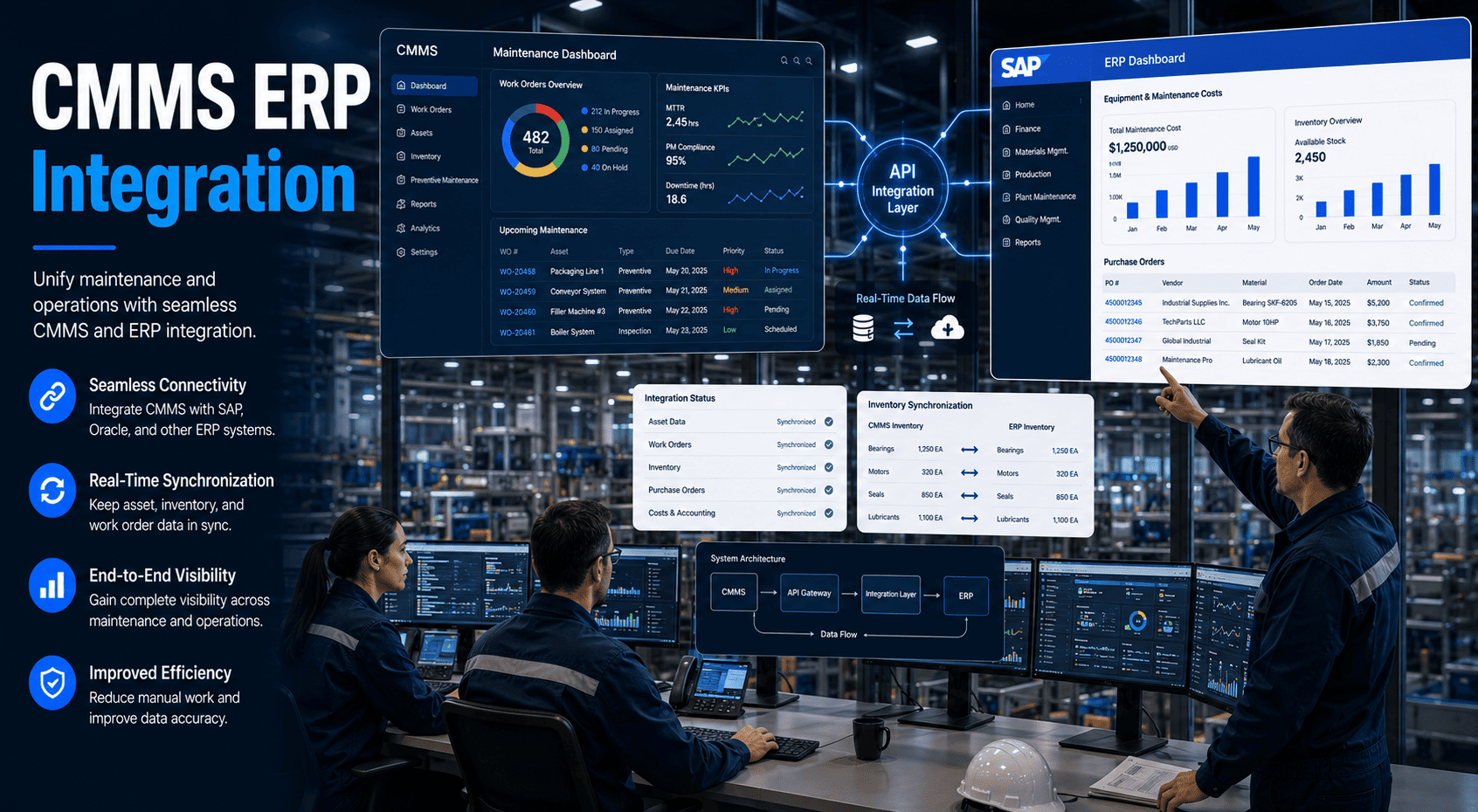
CMMS ERP integration is a live data connection between a Computerized Maintenance Management System and an Enterprise Resource Planning platform — allowing maintenance work orders, parts usage, labor hours, and asset downtime to flow automatically into ERP modules for procurement, inventory, finance, and production planning. In a food plant context, integration means a closed work order in the CMMS instantly posts a maintenance cost to SAP FI, triggers a parts replenishment order in SAP MM, and updates production scheduling in Oracle with the actual downtime duration — without anyone re-entering data.
For food manufacturers running SAP or Oracle, integration transforms the CMMS from a standalone maintenance tool into a connected operational layer. Procurement knows what parts are being consumed before the storeroom runs out. Finance sees maintenance cost by asset and by line in real time. Production planning gets accurate downtime data for capacity calculations. And maintenance managers stop spending hours reconciling spreadsheets between two systems that should have been talking all along. Explore Oxmaint's SAP integration in detail, or book a demo to map your specific ERP architecture to a working integration design.
What Gets Connected: The Integration Data Map
Why Disconnected CMMS and ERP Systems Hurt Food Plants
The financial impact of these gaps compounds over time — procurement overspend, inaccurate maintenance budgets, missed production capacity, and audit findings from mismatched records. Maintenance teams that connect CMMS to ERP eliminate these gaps at the source — explore Oxmaint's SAP integration or start a free trial to see how the connection is configured.
How Oxmaint Integrates with SAP and Oracle ERP
Oxmaint provides native integration with SAP PM, MM, EAM, and FI modules, as well as Oracle ERP and production planning systems. Integration is configured through the Oxmaint platform — not a custom development engagement — using pre-built API connectors and field mapping tools that most food plant IT teams can implement without external consultants.
Native connectors for SAP Plant Maintenance, Materials Management, Enterprise Asset Management, and Finance modules. Work order costs post to SAP FI automatically; parts consumption decrements SAP MM inventory in real time. See full SAP integration details.
When Oxmaint's AI flags a failure prediction, it can automatically create a SAP purchase requisition for the replacement component — so the part arrives before the breakdown, not after. Explore predictive maintenance capabilities.
Parts consumed on Oxmaint work orders sync instantly to the ERP inventory system — eliminating phantom stock, preventing duplicate orders, and giving procurement accurate consumption data for demand forecasting. See parts and inventory management.
Actual asset downtime recorded in Oxmaint syncs to SAP PP or Oracle production planning — so capacity models reflect real equipment availability, not assumed uptime. Planners stop committing to schedules the equipment cannot meet.
GMP inspection records, calibration logs, and corrective action documentation from Oxmaint can sync to SAP QM or Oracle quality modules — creating a unified compliance record across maintenance and quality systems. See safety and compliance features.
Oxmaint's analytics layer combines maintenance cost, downtime, and OEE data from the CMMS with financial and procurement data from the ERP — giving operations leaders a single dashboard for total maintenance performance. Explore analytics and reporting.
Disconnected Systems vs. CMMS ERP Integration
| Workflow | Before Integration (Disconnected) | After Integration (CMMS + ERP) |
|---|---|---|
| Work Order Costing | Manual re-entry into SAP FI after job completion — 2–3 day lag, frequent errors | Cost posts automatically on work order close — zero lag, zero rekeying |
| Parts Inventory | CMMS and SAP MM show different stock levels — phantom stock causes procurement errors | Single inventory count synced in real time — one source of truth across both systems |
| Purchase Orders | Maintenance raises a request; procurement manually creates PO — 3–5 day cycle | CMMS auto-triggers purchase requisition when stock drops below minimum — same day |
| Downtime Reporting | Downtime tracked in CMMS; production plans assume scheduled uptime — gap never reconciled | Actual downtime syncs to production planning — capacity models reflect real equipment state |
| Asset Records | New equipment entered separately in ERP and CMMS — two incomplete records that diverge over time | ERP asset creation auto-populates CMMS — single commissioning workflow, two systems updated |
| Maintenance Budget | Finance reports on ERP cost data; maintenance reports on CMMS data — numbers never match | One cost record, one system of truth — finance and maintenance looking at identical data |
ROI of CMMS ERP Integration in Food Manufacturing
The ROI of integration goes beyond data accuracy — it eliminates the organizational friction that slows every maintenance, procurement, and finance interaction in a disconnected environment. Food plants that integrate CMMS with ERP see faster procurement cycles, accurate maintenance budgets, and production planning that reflects equipment reality rather than assumed uptime. Calculate your ROI with Oxmaint, or book a demo to see a live integration walkthrough on your ERP stack.
Frequently Asked Questions
How does CMMS integrate with SAP for food manufacturing plants?
What is the difference between CMMS and SAP PM in a food plant context?
How long does it take to implement CMMS ERP integration for a food plant?
Can Oxmaint integrate with Oracle ERP as well as SAP?
Every day your CMMS and ERP run disconnected, your procurement team is ordering against phantom stock, your finance team is reconciling mismatched cost records, and your production planners are scheduling against uptime assumptions that have not been true for years. Oxmaint closes that gap — with native SAP and Oracle integration that goes live in days, not months.