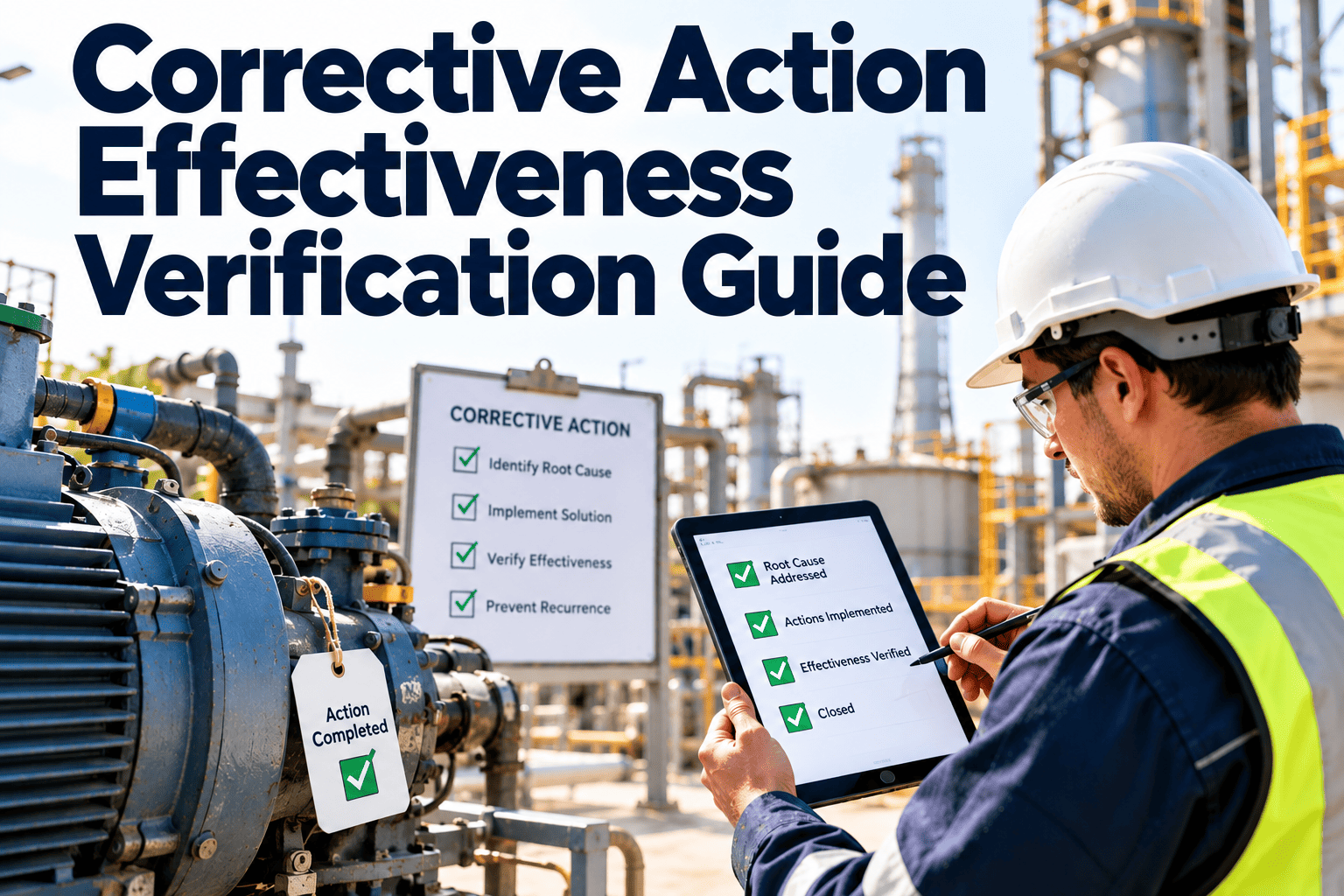
Closing a corrective action is easy. Proving that it worked is where most food safety systems stall. A form gets signed, a due date passes and the same nonconformance returns at the next audit under a slightly different description. Effectiveness verification is the step that tells you whether the fix held. This guide shows how to define success before work starts, choose the right check and timing, and record evidence that satisfies auditors, supported by a maintenance and work order platform.
Corrective Action Effectiveness Verification Guide
Move from signed off to proven. Set measurable success criteria, schedule the check and keep the evidence that shows the problem has not come back.
Closing an action is not the same as fixing the problem
Many corrective action logs record that something was done: a part replaced, a procedure rewritten, a person retrained. Fewer record whether the failure stopped. Without that second step, the log measures effort rather than results.
Why this gets attention in audits
Food safety schemes recognised by the Global Food Safety Initiative expect a documented root cause and evidence that corrective actions were effective. Auditors sample closed actions and look for repeat findings, so a thin closure record is easy to challenge.
Terms people mix up
- Correction: immediate fix of the nonconforming item or situation.
- Corrective action: removes the cause so it does not recur.
- Verification: confirms the action was carried out as planned.
- Effectiveness check: confirms the problem has not returned.
Where effectiveness checks usually fail
No success criterion
The action says improve cleaning but never states what result would prove improvement.
Checking too early
A check made the week after the fix cannot show whether a seasonal or intermittent problem has returned.
Same person verifies own work
The owner of the fix is the least likely to find its weakness.
Training treated as the fix
Retraining is often recorded as the action when the cause was equipment, design or process.
Evidence not retained
The check happened but the data, photo or record is not attached to the action.
Reopening is treated as failure
Teams avoid reopening actions, so weak fixes stay closed to protect the numbers.
Define success before the work begins
The best time to write the effectiveness check is when the action is raised. It forces the team to say what the problem is, how it will be measured and what good looks like.
| Problem type | Example success criterion | Typical verification method |
|---|---|---|
| Repeat equipment failure | No recurrence of the same fault on that asset over a defined period. | Review work order history for the asset and failure code. |
| Hygiene or swab failure | Consecutive passing results at the sampled locations after the change. | Trend environmental or ATP results over the agreed sampling plan. |
| Foreign material complaint | No further complaints or rejects linked to the same source in the review window. | Check detection logs, complaint records and line inspection findings. |
| Temperature excursion | Readings stay inside limits across normal peaks, defrost and load changes. | Review logger data and a calibrated reference check. |
| Missed procedure or record | Records complete and on time across a sample of shifts. | Observe practice and audit a defined number of records. |
| Audit nonconformance | The requirement is met in practice and no repeat finding appears. | Internal audit or targeted follow up inspection. |
A weak root cause makes any check meaningless
If the action addresses a symptom, the effectiveness check will either fail or pass for the wrong reason. Test the root cause by asking why until you reach something you can control and change.
Signs you stopped too early
- The root cause names a person rather than a condition or system
- The proposed fix is retraining or a reminder and nothing else
- Nobody can say why the failure was not detected earlier
- The same issue has been closed before with a similar action
- The cause cannot be tested or observed
Ask two kinds of why
- Why did it happen? This finds the occurrence cause.
- Why was it not caught? This finds the detection cause.
- Address both, then verify both.
Keep every corrective action and its proof together
Oxmaint turns corrective actions into trackable work orders with owners, due dates, checklists and attached evidence, so closure is backed by results.
Matching the check to the risk and the recurrence pattern
High risk, frequent trigger
Food safety critical issues that could recur within days. Check early and repeat. Use a short interval first, then a second look after a longer period.
High risk, rare trigger
Events such as seasonal or batch related problems. Wait for the conditions to recur, or simulate them, before trusting the fix.
Lower risk, frequent trigger
Housekeeping and minor record issues. Trend the data over several weeks and watch for the count falling and staying down.
Lower risk, rare trigger
One-off defects with a clear cause. A single follow up inspection may be enough, recorded with a date and a name.
There is no universal waiting period. Choose the interval from how the problem occurs, how serious it is and how long it takes for a repeat to show.
- Write the review date on the action
- Let a second person perform the check
- Record what was looked at, not only the verdict
A worked example, from finding to verified closure
This invented scenario shows how the stages connect. Details are illustrative only.
Finding
An internal audit finds product residue on a conveyor guard after clean down. The area is re-cleaned and released after inspection.
Root cause
The guard design traps product at a weld seam that spray cannot reach. The cleaning procedure was followed correctly.
Action and criterion
Maintenance modifies the guard. Success is defined as clean inspections and passing swabs at that location over the review window.
Interim check
Quality inspects after several clean downs and attaches photos. A second location with a similar weld is found and added to the plan.
Verified closure
Results meet the criterion, an independent verifier signs off and the equipment record shows the modification and its approval.
The closure gate: a simple decision path
Action completed on time?
If not, record the reason and revise the plan before any check is attempted.
Success criterion met?
Compare the evidence with the target written at the start.
Held through the review window?
Confirm the problem did not return across normal operating conditions.
Close with evidence
Attach data, sign by an independent verifier and file the record.
If any answer is no, reopen the action, revisit the root cause and set a new check. Reopening is a sign the system is working.
Weak and strong effectiveness statements side by side
Weak record
- Seal bar replaced. Problem solved.
- Operators retrained. Effective.
- Cleaning improved. Closed.
- No further issues noted.
Strong record
- Seal bar replaced. No seal failure logged on this line for the review period, checked by quality against reject records.
- Retraining plus a revised checklist. Observed ten shift handovers with complete records.
- Clean down method changed. Swab results at the listed sites passed on consecutive tests.
- Verified by a named person on a recorded date with data attached.
Evidence that stands up in an audit
Trend data
Counts, results or readings before and after the action, with dates.
Work order history
Equipment records showing no repeat fault, or showing a repeat that triggered reopening.
Photos and observations
Dated images or checklists showing the condition after the change.
Records sampled
A defined number of logs reviewed for completeness and accuracy.
Independent sign off
A named verifier who was not responsible for implementing the action.
Questions an auditor is likely to ask about a closed action
How do you know the root cause was correct?
Show the analysis method, the data used and who took part.
What did you decide good looked like?
Show the criterion written at the time the action was raised.
When and how was it checked?
Show the date, the method, the sample and the verifier.
Has anything similar happened since?
Show a search of related findings, complaints and work orders.
Was the change controlled?
Show approvals, updated procedures and revised records.
Did you look for the same risk elsewhere?
Show the extension to similar equipment, lines or sites.
Linking corrective actions to preventive maintenance
When the cause was equipment
- Add or change a preventive task so the failure is caught earlier.
- Update inspection checklists with the new check point.
- Record the modification in the asset history.
- Watch the failure code for repeats across similar machines.
When the cause was process or people
- Change the procedure, not just the reminder.
- Make the right action easier than the wrong one.
- Observe the new method in practice across shifts.
- Review again after a staffing or product change.
Roles and responsibilities
Sampling for effectiveness checks
A single good result does not prove a fix. Define what you will sample and how many observations convince you, before you look.
Practical sampling choices
- Cover more than one shift, product and day of the week
- Include the conditions that caused the original failure
- Check the least favourable location, not the easiest one
- Write the sample size in the action so the verifier cannot quietly shrink it
Keep it proportionate
- Safety critical issues justify wider sampling.
- Minor issues can use lighter checks.
- Record the reason for the chosen level.
Measuring the corrective action system itself
Repeat finding rate
Share of nonconformances that recur after closure. The most honest sign of effectiveness.
Overdue effectiveness checks
Checks that were planned but not completed by the target date.
Reopen rate
Actions reopened after failing a check. A rate of zero may mean checks are too soft.
Time to close with evidence
Elapsed time from raising an action to a verified closure.
When one action should become many
A good effectiveness check often reveals that the same weakness exists elsewhere. Treat that as a result, not an inconvenience, and extend the action to similar machines, lines and sites before the next audit finds them for you.
- Search for the same failure code on similar assets
- Update the preventive task template once, then apply it widely
- Record the extension as its own tracked action
- Share the lesson at the next shift briefing
How Oxmaint supports effectiveness verification
Corrective actions linked to equipment, sanitation or inspection findings are easier to verify when the underlying records are already organised by asset and date.
Relevant capabilities
- Corrective work orders with owner, due date and priority
- Follow up tasks scheduled for the effectiveness check date
- Asset history to confirm no repeat failure after the fix
- Inspection checklists with photos and notes as evidence
- Reports on overdue actions and repeat issues by asset or area
Scope note
- Oxmaint manages maintenance related actions and their evidence.
- Your quality management system may remain the master record for audit findings.
- Link the two with a shared reference number.
A thirty day plan to tighten verification
Days 1 to 7
Pull the list of actions closed in the last six months and note which have a stated success criterion.
Days 8 to 14
Re-check a sample of closed actions for repeat findings and reopen any that came back.
Days 15 to 21
Add a criterion and review date field to the action form and brief the people who raise actions.
Days 22 to 30
Schedule effectiveness checks as tracked tasks and report overdue ones in the next management review.
Frequently asked questions
What is an effectiveness check on a corrective action?
It is a planned review that confirms the problem has not returned after the action was completed. It uses evidence such as trend data, records or observation.
How long after the fix should we verify?
It depends on how often the problem occurs and how serious it is. Choose a window long enough for a repeat to show, and document the reasoning.
Can the person who fixed it also verify it?
It is better practice to use an independent verifier. This reduces bias and is easier to defend during an audit.
Can a CMMS track corrective action verification?
Yes, for maintenance related actions. Work orders, follow up tasks and asset history provide the evidence. You can book a demo to see the workflow.
What if the check fails?
Reopen the action, revisit the root cause and set a new action and check. Record the failed check so the history stays honest.
Close actions with proof, not hope
Write the success criterion up front, schedule the check and attach the evidence. Start with the actions that repeat most often and build the habit from there.