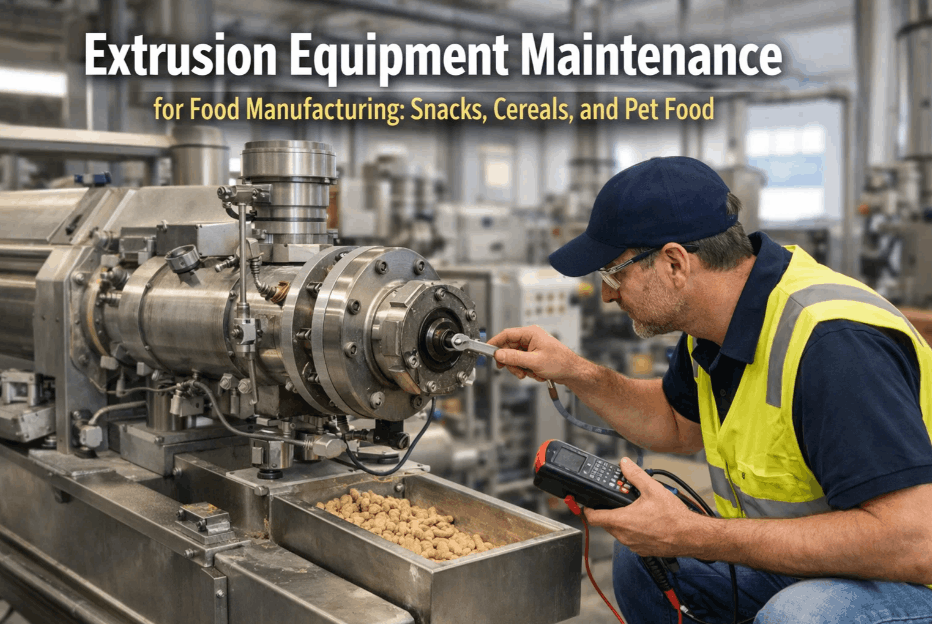
Food extrusion equipment maintenance is one of the most technically demanding disciplines in food manufacturing — and one of the most consequential. For snack, cereal, and pet food production lines, a single extruder failure can halt thousands of kilograms per hour of output, cascade into packaging and warehousing disruptions, and generate emergency repair costs that dwarf the investment of a structured preventive maintenance program. Plant engineers who master food extruder maintenance — at the barrel, screw element, die, and cutting system level — build production lines that consistently outperform on yield, uptime, and product quality.
Stop Losing Production to Unplanned Extruder Downtime
OxMaint gives extrusion plant engineers a purpose-built platform to schedule PM, track wear parts, and capture real-time data across every line — snacks, cereals, and pet food.
Understanding the Extrusion System in Food Manufacturing
Food extrusion is a continuous high-pressure, high-temperature forming process used to produce expanded snack pellets, breakfast cereals, textured protein, aquafeed, and dry and semi-moist pet food. The extrusion system is not a single machine — it is an integrated processing line where every upstream and downstream component directly affects extruder performance, product quality, and maintenance burden.
For plant engineers in the UK, Canada, Germany, and UAE — where food safety regulatory environments are demanding and line availability expectations are high — understanding the full system architecture is the foundation of effective maintenance strategy. Sign up free to start building your extrusion PM program today.
The Processing Line Architecture
A complete food extrusion line includes ingredient dosing, a preconditioner, the extruder barrel and screw assembly, a die and cutter, and downstream drying and coating systems. Each component has distinct wear mechanisms and maintenance requirements.
Single-Screw vs. Twin-Screw Extruders
Single-screw extruders suit dry pet food and consistent snack formulations. Twin-screw extruders handle high-moisture, high-fat, and variable recipes — but require more complex PM due to intermeshing element geometry and tighter alignment tolerances.
The 6 Core Subsystems Requiring Dedicated Maintenance Programs
A rigorous extrusion equipment maintenance program treats each subsystem independently — with its own PM schedule, inspection criteria, and wear thresholds. Book a demo to see how OxMaint structures subsystem PM across your lines.
Preconditioner
Monitors paddle wear, bearing condition, and steam port fouling. Paddle degradation directly affects moisture uniformity in the final product.
Extruder Barrel
Bore wear drives long-term cost. Inspection intervals must be set by tonnage throughput — not calendar time — especially for abrasive formulations.
Screw Elements
Flight tip wear and spline bore integrity are measured at every pulldown. Data-driven replacement reduces screw element costs by 20–35%.
Die Assembly
Land length erosion and orifice roundness affect expansion and cut quality. Die face cleaning on a fixed cycle prevents carbonized deposit buildup.
Cutting System
Knife sharpness and die gap are the highest-frequency wear variables. Blade replacement must be defined by formulation abrasivity and throughput rate.
Drive Train and Gearbox
Quarterly oil sampling and bearing vibration monitoring prevent gearbox failure — a capital event costing $80,000–$250,000 in parts and downtime.
Wear Parts Management: The Strategic Core of Extruder PM
Wear parts management for food extruders is not a procurement task — it is a production engineering discipline. Without a structured wear tracking and replacement program, plant engineers are forced into reactive purchasing, emergency freight costs, and unplanned downtime while waiting for screws, barrels, or dies that should have been stocked and scheduled.
Wear Rate Measurement Protocol
Every wear part should have a documented measurement baseline taken at installation and a defined re-measurement interval. For screw elements, flight tip diameter measured at 3 axial positions per element, recorded at each pulldown, builds a wear curve that predicts end-of-service life with high accuracy. The same principle applies to barrel bore diameter, die orifice diameter, and knife edge thickness measurements.
Key Performance Indicators for Extrusion Equipment Maintenance
KPI selection for extrusion maintenance must reflect the production economics of continuous, high-throughput food processing. Generic facility management metrics are insufficient — extrusion plant engineers need metrics that capture the relationship between equipment condition, process stability, and product quality output.
| KPI | What It Measures | Target Benchmark | Why It Matters |
|---|---|---|---|
| Extruder OEE (Overall Equipment Effectiveness) | Availability × Performance × Quality rate | > 82% food-grade lines | Single metric integrating uptime, throughput, and quality — the true production efficiency indicator |
| Unplanned Downtime Rate | Hours of unplanned stops per 1,000 operating hours | < 8 hours / 1,000 hrs | Directly measures PM program effectiveness in preventing reactive breakdowns |
| Screw Element Service Life (tonnes/set) | Cumulative throughput per screw element set before replacement | Formulation-specific baseline | Tracks metallurgy performance and identifies formulation abrasivity changes early |
| Die Orifice Wear Rate (mm/tonne) | Orifice diameter growth per tonne of throughput | Product spec-dependent | Predicts the point at which product diameter falls outside specification — enables scheduled die swap |
| PM Completion Rate | Scheduled PM tasks completed on time | > 92% | Foundational metric — if PM isn't running, all other maintenance metrics are at risk |
| Fines and Off-Spec Rate | Percentage of production failing shape, size, or density spec | < 1.5% by weight | Sensitive early indicator of cutting system, die, or process condition degradation |
| Spare Parts Fill Rate | Critical wear parts available in stock at time of need | > 98% | A stocked spare parts program is the primary prevention for extended unplanned downtime |
How AI Vision Enhances Extrusion Equipment Maintenance
AI Vision — computer vision powered by machine learning — is being deployed in food extrusion plants across the UK, Canada, Germany, and UAE. It enables automatic equipment and product monitoring without stopping the line. Try OxMaint free to integrate AI-powered maintenance into your extrusion operation.
Die Face and Cut Quality Monitoring
Cameras at the die face detect knife wear and orifice erosion in real time — catching shape deviation before a quality reject event occurs, enabling proactive cutting system scheduling.
Screw and Barrel Imaging at Pulldown
AI imaging automates dimensional wear measurement during pulldowns — eliminating subjectivity, reducing inspection time, and building a timestamped digital wear record per element.
Thermal Anomaly Detection
Thermal cameras on barrel zones and drive components detect bearing overheating and gearbox signature changes before mechanical failure — triggering automated maintenance alerts.
Full Line Condition Monitoring
AI Vision extends to the preconditioner, dryer, and coater — giving engineers a connected view of the entire line's condition, reducing total line downtime beyond the extruder alone.
Maintenance Software and Digital Tools for Extrusion Plant Engineers
The CMMS extrusion food platform selection directly determines how effectively a plant can execute, track, and continuously improve its maintenance program. Spreadsheet-based systems cannot maintain the data granularity — wear measurements, formulation-linked intervals, screw element history by serial number — that professional extrusion PM programs require.
| Platform Capability | Requirement for Extrusion PM | Without Digital System |
|---|---|---|
| Asset-Level PM Scheduling | Separate PM schedules per subsystem (barrel, screw, die, cutter, gearbox) | Missed intervals, bundled tasks, inconsistent completion |
| Tonnage-Based Trigger Logic | Automatically generate work orders at defined cumulative throughput thresholds | Calendar-based scheduling misaligned with actual wear rates |
| Wear Measurement Data Capture | Mobile capture of dimensional measurements with photo documentation at each pulldown | Paper-based records, measurement data lost, no wear trend analysis |
| Spare Parts Integration | Automatic inventory alerts when critical wear part stock falls below minimum level | Reactive purchasing, emergency freight, extended downtime |
| Downtime Analytics | Root cause categorization of every unplanned stop, linked to asset and failure mode | No actionable data, repeat failures, no improvement baseline |
| Multi-Line Portfolio View | KPI dashboard across all extruder lines for operations leadership | Fragmented reporting, leadership visibility gaps, delayed intervention |
A purpose-built extrusion maintenance platform connects these capabilities — enabling plant engineers to manage the full complexity of multi-line, multi-product extrusion operations with the data integrity and operational visibility that modern food manufacturing demands.
Preventive Maintenance Scheduling: Building the PM Calendar
An effective food extruder maintenance schedule cannot be imported from a generic CMMS template or copied from a competitor's SOP. It must be built from the specific intersection of your equipment, your formulations, your throughput rates, and your product quality requirements.
The Four PM Intervals Every Extrusion Line Needs
ROI of a Structured Extrusion Maintenance Program
The financial case for comprehensive extrusion PM is straightforward. Book a demo and we'll show you how OxMaint delivers measurable ROI from day one across snack, cereal, and pet food lines.
Downtime Reduction
One unplanned stop on a 3-tonne/hour snack line costs $15,000–$40,000/hour. PM programs targeting bearing failure, screw wear, and die blockage deliver measurable uptime gains within the first quarter.
Wear Parts Savings
Condition-based replacement driven by measured wear data reduces screw element and barrel costs 20–35% vs. fixed-interval replacement — savings that compound across multi-line operations.
Off-Spec Reduction
Structured die and cutting system PM eliminates equipment-driven quality failures — typically 30–50% of total off-spec events on lines without a formal PM program.
Capital Life Extension
Disciplined lubrication and vibration monitoring extends gearbox life from 8–12 to 18–25 years — representing $600K–$1.2M in deferred capital per four-line plant over a decade.
Audit Readiness
Digital maintenance records satisfy food safety certification requirements in Germany, Canada, and the UK — reducing audit prep time and supporting continuous regulatory compliance.
Energy Savings
Worn screws and barrels increase motor amperage. PM within design tolerances cuts extruder energy consumption 8–15% — significant savings on high-throughput lines.
Common Challenges in Extrusion Equipment Maintenance — and Practical Solutions
Inconsistent Pulldown Inspection Execution
When screw pulldown inspections rely on operator experience rather than a documented measurement protocol, dimensional data is inconsistent, wear trends cannot be tracked, and the early warning value of the pulldown is lost. Solution: Standardize every pulldown with a digital checklist in your maintenance platform that mandates measurement entry at defined locations before the work order can be closed.
Formulation Changes Without PM Interval Review
New pet food or cereal formulations with higher mineral content, increased fiber load, or alternative protein sources can dramatically increase wear rates — rendering existing replacement intervals inadequate. Solution: Build a formal change management review into your product development process that requires PM engineering sign-off on formulation changes affecting abrasivity, with adjusted wear intervals effective from the first production run.
Die Cleaning Deferred Under Production Pressure
Die cleaning cycles are frequently deferred when production scheduling pressure mounts — with the assumption that a brief extension of the cleaning interval carries manageable risk. In practice, carbonized deposit accumulation on die orifice lands accelerates erosion and creates pressure distribution imbalances that damage adjacent orifices. Solution: Define die cleaning intervals as non-deferrable in your SOP governance, with a formal escalation required for any extension beyond 10% of the scheduled interval.
No Linkage Between Quality Events and Equipment Condition
Quality rejections on extrusion lines are frequently investigated by quality teams without engineering input — and without reference to the current condition of the die, screws, or cutting system. This disconnection means equipment-driven quality failures are treated as process parameter problems, and the root cause remains unresolved. Solution: Integrate your maintenance platform with your quality management system so that every off-spec event automatically links to the equipment condition record at the time of production.
Reactive Spare Parts Purchasing
Purchasing screw elements, die inserts, or bearing sets only after failure generates emergency freight costs, extended lead time downtime, and premium pricing from suppliers who recognize the urgency. Solution: Use wear trend data from your maintenance system to generate forward-looking replacement forecasts, and convert critical wear parts purchasing from reactive to planned — typically reducing total wear parts spend 15–25%.
Building Standard Operating Procedures for Extrusion Maintenance
Extrusion maintenance SOPs are more complex than general facility maintenance procedures — they must capture precise measurement methods, torque specifications, reassembly sequences, and process parameter verification steps that directly affect food safety and product quality. Every SOP must be reviewed by both maintenance engineering and quality assurance before deployment.
Best Practices for Sustaining Extrusion Maintenance Excellence
The highest-performing extrusion maintenance programs share a set of operational habits and governance structures that prevent performance from regressing toward reactive chaos as production pressure, staffing changes, and formulation complexity increase over time.
Cross-Functional Maintenance Reviews
Monthly meetings that include maintenance, production, quality, and procurement — reviewing KPI trends, open corrective actions, upcoming planned pulldowns, and wear part stock status — prevent the silo behavior that allows equipment condition to deteriorate undetected. These reviews should be brief, data-driven, and action-oriented.
OEM Partnership for Interval Optimization
Original equipment manufacturers for extruder barrels, screw elements, and die assemblies have aggregate wear data across hundreds of installations. Building a formal data-sharing relationship — providing your wear measurement data in exchange for interval benchmarks and metallurgy recommendations — is a low-cost route to PM program optimization that most plant engineers underutilize.
Technician Certification and Competency Development
Screw element reassembly, die cleaning, and gearbox service require technicians with documented competency — not generalist maintenance skills. Build role-specific certification requirements into your maintenance job descriptions and onboarding programs. In Canadian and German manufacturing operations, formal competency documentation for food-contact maintenance tasks is increasingly a regulatory expectation.
Capital Planning Integration
Barrel and gearbox condition data from your maintenance platform should feed directly into your 3–5 year capital replacement forecast. Replacing gut-feel replacement estimates with data-driven asset condition projections gives your finance team higher confidence in maintenance capital budgets — and gives plant engineers the budget stability to execute planned replacements instead of emergency ones.
Extrusion equipment maintenance for food manufacturing is a precision engineering discipline that determines production availability, product quality consistency, and total cost of ownership across a facility's most capital-intensive assets. Plant engineers who build structured, data-driven PM programs — covering preconditioners, twin-screw extruders, die assemblies, and cutting systems with documented SOPs, wear tracking, and digital work order management — consistently outperform on every metric that matters to operations leadership and financial stakeholders.
OxMaint provides the maintenance management infrastructure that extrusion plant engineers need to implement and sustain this level of program — from asset-specific PM scheduling and mobile wear data capture to real-time KPI dashboards that keep every line performing at its best.
Ready to Build a World-Class Extrusion Maintenance Program?
OxMaint's platform gives your extrusion engineering team the tools to schedule PM by tonnage, track wear data per asset, and reduce unplanned downtime — across every line in your facility.
Frequently Asked Questions: Extrusion Equipment Maintenance
How often should twin-screw extruder elements be inspected in food manufacturing?
Twin-screw extruder elements should be measured at each screw pulldown, with pulldown intervals defined in cumulative metric tonnes of throughput rather than calendar time. Typical intervals range from 300 to 1,500 tonnes depending on formulation abrasivity. High-mineral pet food recipes may require pulldowns every 300–500 tonnes; low-abrasion cereal formulations may extend to 1,000–1,500 tonnes. Wear measurement data from each pulldown determines the actual replacement point — not a fixed interval.
What are the most critical wear parts to monitor in a food extruder?
The highest-priority wear parts are screw elements (flight tip diameter), barrel bore (clearance to screw flights), die inserts (orifice diameter and land length), and cutting knives (edge condition and gap to die face). These four components directly govern process pressure, product shape, and expansion characteristics — making their condition the primary determinant of both production efficiency and product quality compliance.
How does formulation change affect extruder maintenance intervals?
Formulation changes that increase ash content, fiber content, mineral inclusion rates, or alternative protein ingredients can increase wear rates on screw elements and barrel bore by 2–5x compared to a baseline corn or wheat-based recipe. Any significant formulation change should trigger a review of wear part replacement intervals, with accelerated first-pulldown measurement to establish the new wear rate baseline for that recipe.
What CMMS features are essential for extrusion plant maintenance management?
Essential CMMS capabilities for food extrusion operations include: asset-level PM scheduling with tonnage-based trigger logic, mobile work order completion with dimensional measurement data capture, screw element and wear part service history by serial number, spare parts inventory integration with minimum stock alerts, downtime root cause categorization by failure mode, and KPI dashboards displaying OEE, PM completion rate, and unplanned downtime trends by line.
How can AI Vision technology improve extrusion equipment maintenance?
AI Vision systems deployed on food extrusion lines provide continuous, automated monitoring of product quality at the die face — detecting the early-stage effects of knife wear, die erosion, and process condition changes before they generate specification failures or unplanned stops. During screw pulldowns, AI imaging can automate dimensional wear measurement and documentation. Thermal imaging with AI anomaly detection monitors drive components and barrel zones for developing faults. Together, these capabilities shift maintenance from scheduled inspection to continuous condition monitoring.



.png)

