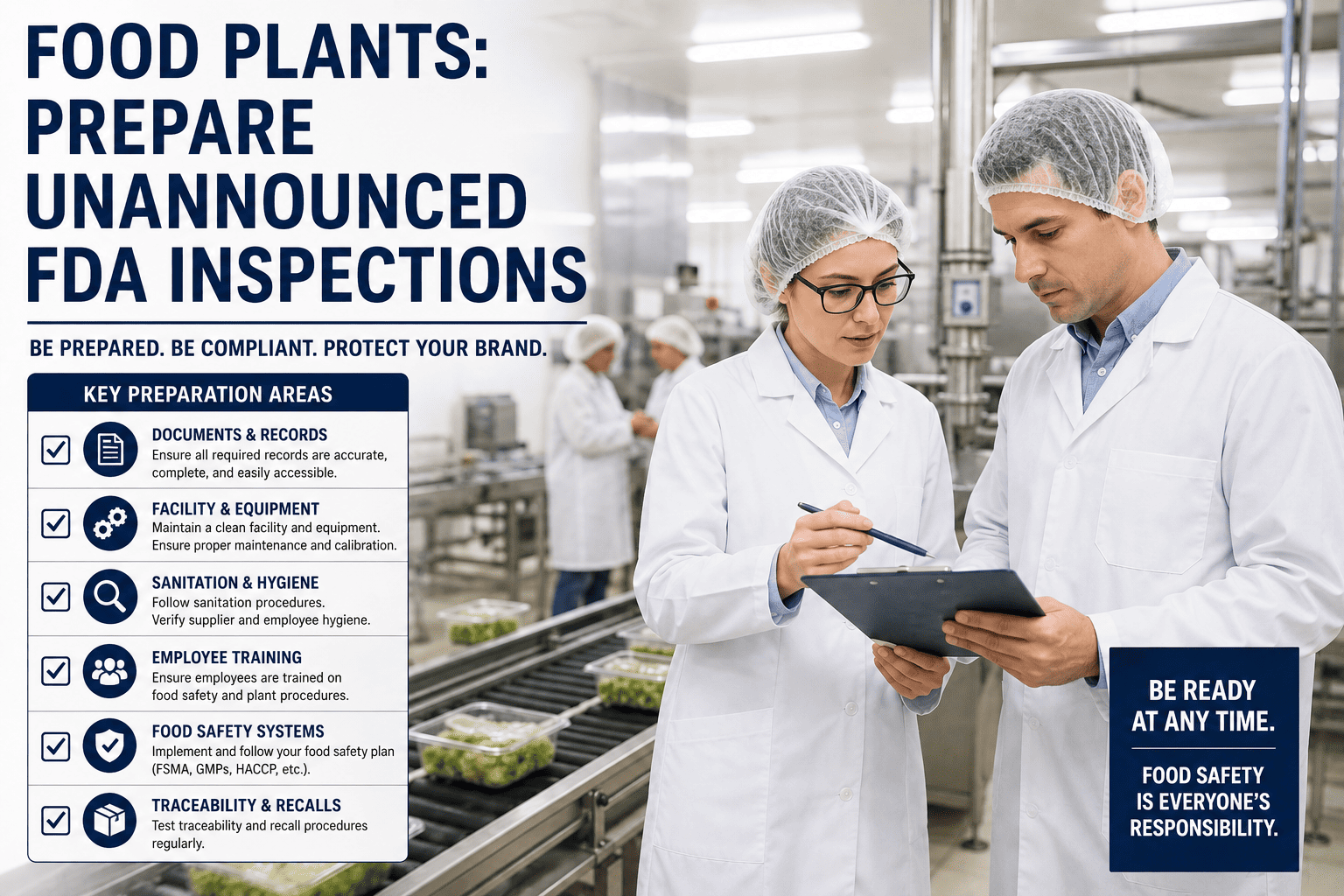
An FDA inspector arrived unannounced at a juice bottling facility in Florida, requesting maintenance records for filling line equipment dating back 18 months. The maintenance manager spent four hours retrieving documents from filing cabinets, spreadsheets, and a legacy work order system. Critical gaps emerged: calibration certificates for level sensors couldn't be located, preventive maintenance records showed inconsistent completion dates, and corrective action documentation for a fill volume deviation lacked required supervisor sign-off. The resulting Form 483 observations required six months of intensive remediation effort and delayed a planned facility expansion by nine months. Facilities maintaining filling line compliance FDA / USDA documentation through integrated CMMS systems respond to inspector requests within minutes, demonstrating the systematic control regulators expect and avoiding the observations that derail business operations.
FDA 21 CFR Part 117 and USDA FSIS regulations require food manufacturers to maintain equipment in sanitary condition and demonstrate that maintenance activities support food safety. For filling lines, this means documented procedures for equipment maintenance, calibration records with traceability, corrective action documentation when deviations occur, and evidence of management oversight. The documentation burden is substantial, but facilities that build compliance into their daily maintenance workflows find audits become routine validations rather than stressful scrambles.
Sign up to build audit-ready maintenance documentation or book a demo to see how Oxmaint automates FDA/USDA compliance for filling line maintenance.
Regulatory Compliance
FDA / USDA Compliance for Filling Line Maintenance
Build audit-ready documentation systems that demonstrate systematic maintenance control to FDA and USDA inspectors.
Of FDA 483s Cite Equipment Maintenance Deficiencies
First-Pass Audit Success with CMMS Documentation
Reduction in Audit Preparation Time
2 yr
minimum
Record Retention Required by FDA
Understanding FDA and USDA Requirements for Filling Line Maintenance
FDA regulations under 21 CFR Part 117 (Preventive Controls for Human Food) and USDA FSIS regulations require food manufacturers to maintain equipment in a manner that prevents contamination and ensures food safety. For filling line equipment, regulators expect documented evidence that maintenance activities are planned, executed consistently, and verified effective.
The regulatory framework doesn't prescribe specific maintenance frequencies or procedures. Instead, it requires facilities to establish and follow procedures appropriate to their equipment and products, then demonstrate through documentation that those procedures are consistently executed. This approach gives facilities flexibility but places the burden of proof on the manufacturer during inspections.
43%
of FDA Form 483 observations in food manufacturing cite equipment maintenance deficiencies. Common findings include lack of documented maintenance procedures, missing calibration records, incomplete corrective action documentation, and inability to demonstrate management review of maintenance activities.
Successful compliance requires thinking like an inspector: Can you demonstrate what maintenance is required? Can you prove it was completed? Can you show what happened when problems occurred? Can you evidence that management reviews the program? Facilities that can answer "yes" to these questions with documented proof rarely receive significant observations.
Sign up for Oxmaint to build the documentation foundation FDA and USDA inspectors expect.
Required Documentation for Filling Line Compliance
FDA and USDA inspectors evaluate maintenance programs through documentation review. Each documentation type serves a specific compliance purpose and must meet regulatory expectations for content, completeness, and accessibility.
Written procedures defining what maintenance is performed on each filling line component, how it's performed, and at what frequency.
Required Elements
Equipment identification and scope
Step-by-step maintenance instructions
Frequency and scheduling basis
Acceptance criteria and verification
Responsible personnel qualifications
Documentation of instrument calibration with traceability to national standards, including as-found and as-left conditions.
Required Elements
Instrument identification and location
Calibration date and next due date
Reference standard with traceability
As-found and as-left readings
Technician signature and date
Complete records of all maintenance activities including preventive, corrective, and emergency work with timestamps and outcomes.
Required Elements
Work request date and description
Equipment identification
Work performed and parts used
Completion date and technician
Verification of completion
Documentation of equipment failures, root cause analysis, corrective actions taken, and verification of effectiveness.
Required Elements
Problem description and discovery date
Root cause investigation
Corrective actions implemented
Effectiveness verification
Management review and approval
Evidence that personnel performing maintenance are qualified through documented training on procedures and equipment.
Required Elements
Employee identification
Training topic and date
Training method and materials
Competency assessment
Trainer qualification
Documented evidence of management oversight including review of maintenance metrics, trends, and program effectiveness.
Required Elements
Review meeting date and attendees
Metrics reviewed (PM completion, breakdowns)
Trends and analysis
Decisions and action items
Management signatures
Automate Your Compliance Documentation
Oxmaint generates audit-ready documentation automatically from daily maintenance activities, eliminating gaps inspectors find.
Filling Line Compliance Checklist
Use this checklist to evaluate your filling line maintenance program against FDA and USDA expectations. Each item represents documentation or practices inspectors commonly request during audits.
Complete equipment list with unique identifiers
Equipment specifications and manuals accessible
Food contact surface materials documented
Sanitary design verification records
Equipment change control documentation
Written PM procedures for all filling equipment
PM schedule with defined frequencies
PM completion records with dates and signatures
PM completion rate tracking (target: 95%+)
Overdue PM escalation procedure
Instrument list with calibration requirements
Calibration procedures with acceptance criteria
Calibration schedule and status tracking
NIST-traceable reference standards
Out-of-tolerance investigation procedure
Equipment failure investigation procedure
Root cause analysis methodology documented
Corrective action tracking system
Effectiveness verification requirements
Trend analysis of recurring failures
Record Retention Requirements
FDA and USDA regulations specify minimum retention periods for maintenance records. Maintaining records beyond minimums provides additional protection during extended investigations.
Preventive Maintenance Records
2 years
2 years
3 years
Calibration Certificates
2 years past expiry
2 years past expiry
Life of equipment + 2 years
Corrective Action Records
2 years after closure
2 years after closure
5 years
Training Records
Duration of employment + 2 years
Duration of employment + 2 years
Employment + 3 years
Management Review Minutes
2 years
2 years
5 years
Equipment Change Records
Life of equipment
Life of equipment
Life + 2 years
Never Worry About Record Retention Again
Oxmaint automatically maintains compliant record retention with secure, searchable archives accessible instantly during audits.
Common Compliance Violations and Prevention
Understanding common FDA and USDA observations helps facilities proactively address gaps before inspectors find them. These violations appear frequently in Form 483s and FSIS Noncompliance Records.
Maintenance activities performed but not documented, or records missing required information such as dates, signatures, or verification of completion.
Prevention
Use digital work orders requiring all fields before closure
Implement supervisor verification step for completed work
Conduct weekly audits of record completeness
Instruments used beyond calibration due dates, missing traceability to national standards, or lack of out-of-tolerance investigation procedures.
Prevention
Automated calibration due date alerts
Block equipment use when calibration expired
Document investigation for all out-of-tolerance findings
Equipment failures documented without root cause investigation or corrective action. Recurring problems without evidence of systematic resolution attempts.
Prevention
Require root cause field on all breakdown work orders
Track repeat failures and escalate to CAPA
Verify corrective action effectiveness before closure
No evidence that management reviews maintenance program performance, approves procedures, or responds to adverse trends in equipment reliability.
Prevention
Monthly management review meetings with documented minutes
KPI dashboards reviewed and signed by management
Procedure approval signatures from appropriate management level
Audit Preparation Best Practices
Facilities that treat every day as audit day rarely struggle during actual inspections. These practices ensure continuous audit readiness rather than last-minute scrambles.
1
Maintain Real-Time Documentation
Document maintenance activities as they occur, not hours or days later. Real-time documentation through mobile devices ensures accuracy and demonstrates systematic control to inspectors.
2
Organize Records for Quick Retrieval
Structure documentation so any record can be retrieved within minutes. Inspectors interpret long delays in producing records as evidence of poor control over the maintenance program.
3
Conduct Internal Audits
Perform quarterly self-assessments against FDA/USDA expectations. Finding and fixing gaps internally is far better than having inspectors discover them during official audits.
4
Train Your Audit Response Team
Designate personnel responsible for responding to inspector requests. Train them on what records exist, where they're located, and how to retrieve them professionally and efficiently.
5
Keep an Audit Binder Current
Maintain a summary binder with program overview, recent metrics, organizational charts, and index to detailed records. This demonstrates program organization and facilitates inspector orientation.
6
Address Gaps Immediately
When gaps are identified through internal audits or near-misses, document corrective actions and complete them promptly. A history of proactive gap closure demonstrates mature quality culture.
Frequently Asked Questions: FDA/USDA Compliance
What specific maintenance records do FDA inspectors request most often?
FDA inspectors most commonly request calibration records for filling equipment, preventive maintenance schedules and completion records, corrective action documentation for equipment failures, training records for maintenance personnel, and evidence of management review. Having these readily accessible significantly streamlines inspections.
How do we demonstrate adequate management oversight of maintenance?
Management oversight is demonstrated through documented review meetings, signed approval of procedures and changes, review of maintenance KPIs with evidence of response to adverse trends, and approval signatures on corrective action closures. Monthly management review meetings with documented minutes are the gold standard.
Can electronic records satisfy FDA documentation requirements?
Yes, electronic records are fully acceptable under 21 CFR Part 11 when they include appropriate controls for data integrity, audit trails, and electronic signatures.
Sign up for Oxmaint to implement a 21 CFR Part 11 compliant maintenance documentation system with complete audit trails.
What happens if an instrument is found out of calibration?
When an instrument is found out of tolerance, you must investigate the impact on product produced since the last known good calibration, document the investigation and conclusions, take corrective action on affected product if necessary, and implement preventive measures to avoid recurrence. The investigation and its conclusions must be documented.
How often should we conduct internal compliance audits?
Best practice is quarterly internal audits of the complete maintenance compliance program, with monthly spot-checks of specific elements like PM completion rates and calibration status. Annual comprehensive audits by personnel independent of the maintenance function provide additional assurance.
Build Audit-Ready Compliance Today
Oxmaint transforms filling line maintenance into a documented, compliant system that satisfies FDA and USDA inspectors while reducing your administrative burden.



.png)


