
Incomplete maintenance documentation in food manufacturing is no longer just an operational oversight — it is a direct regulatory liability that can trigger FDA Form 483 citations, forced recalls, facility shutdowns, and penalties that cost millions. In 2024, the FDA issued over 3,000 Form 483s across regulated industries, with more than 60% tied to inadequate procedures, poor documentation practices, and quality system failures. For food plants still relying on paper logs, disconnected spreadsheets, or manually-entered shift records, the compliance time bomb is already ticking. This page explores exactly where the documentation gaps are, what they cost, and how digital maintenance traceability platforms like Oxmaint defuse the risk before the auditor arrives.
The Compliance Time Bomb: Incomplete Maintenance Documentation in Food Manufacturing
Your HACCP plan exists. Your SOPs are written. Your team follows the procedures — most of the time. But when the FDA inspector walks in unannounced and asks for six months of CCP equipment maintenance logs, calibration records, and CAPA closure documentation — can you produce it in 15 minutes? If the answer is anything other than yes, the time bomb is already counting down.
None of these feel catastrophic in the moment. That's exactly why they're dangerous.
A maintenance technician addresses a pasteurizer issue at 11 PM. The fix works. The next shift starts at 6 AM. Nobody formally logs the corrective action or links it to the CCP equipment record. The FDA asks about that asset's maintenance history three months later. The gap is visible, attributable, and citable.
A temperature probe on a CCP chiller was last formally calibrated 14 months ago. Maintenance knows it's performing correctly — but the calibration record in the binder has no scheduled follow-up date, no technician signature on the last entry, and the binder is two rooms away from where the inspector is standing.
A deviation on Line 2 triggered a corrective action request. Quality wrote it in one system. Maintenance tracked the physical repair in a different work order platform. The root cause analysis was emailed. None of these are linked. The CAPA is technically "open" in the compliance system — and the auditor finds it.
Preventive maintenance on a filling line was scheduled for Week 12. Production was running hot and it was pushed to Week 14. The equipment performed fine. But the PM log shows a two-week gap — and under FSMA PCHF, every CCP-adjacent piece of equipment has a monitoring and verification requirement that the gap potentially violates.
It sounds almost too obvious — but paper-based records are physically fragile. A facility audit in 2024 found that three years of sanitation and CCP equipment records had been partially destroyed by a pipe leak in the records room. Reconstruction from memory was attempted. The FDA did not accept it.
ALCOA+ is the FDA's data integrity standard. It applies to every maintenance log, CCP record, calibration entry, and CAPA document in your facility. Paper systems fail multiple criteria by design.
Every entry must be traceable to the specific person who made it. Anonymous log entries or "maintenance team" attributions fail this requirement.
Records must be readable at the time of entry and permanently. Faded ink, water damage, or handwriting that cannot be deciphered fails this criterion.
Records must be created at the time the event occurs — not reconstructed from memory after the fact. Backdated entries are an immediate enforcement risk.
The first-capture record must be preserved. Re-transcribed or copied records that replace originals are a data integrity violation.
Records must correctly reflect actual conditions at the time of the event. Estimated or approximated values in maintenance records are not acceptable.
The "plus" additions require that records are always complete, consistently maintained, permanently stored, and immediately available on FDA request. Paper systems routinely fail on enduring and available.
OXmaint replaces disconnected paper logs and spreadsheet records with a single, audit-ready digital maintenance platform — where every work order, PM task, calibration record, and corrective action is timestamped, attributed, linked to equipment, and retrievable in seconds.
Every maintenance task is logged with a named technician ID, timestamp, equipment tag, and completion status. Records cannot be backdated or edited without a tracked override. Every entry meets the FDA's Attributable, Contemporaneous, and Original requirements by default.
OXmaint connects your PM schedule directly to CCP-designated assets. When a PM is overdue, the system flags it — before an inspector does. Every completed PM generates a timestamped record automatically linked to the equipment's compliance file.
When a deviation is logged, OXmaint automatically creates a CAPA workflow — assigned to a named owner, with a required completion date and root cause field. No CAPA is left open. Every corrective action is linked to the triggering deviation and the affected equipment record.
When an FDA inspector arrives, you produce any date range of maintenance records, calibration logs, PM histories, or CAPA documentation in under 60 seconds. Filter by equipment, line, date range, or regulation type. The binder-flipping era is over.
Store all calibration records digitally, linked to specific assets with required recalibration dates. The system proactively alerts your team when calibration is due — before the interval lapses and before it becomes a citation.
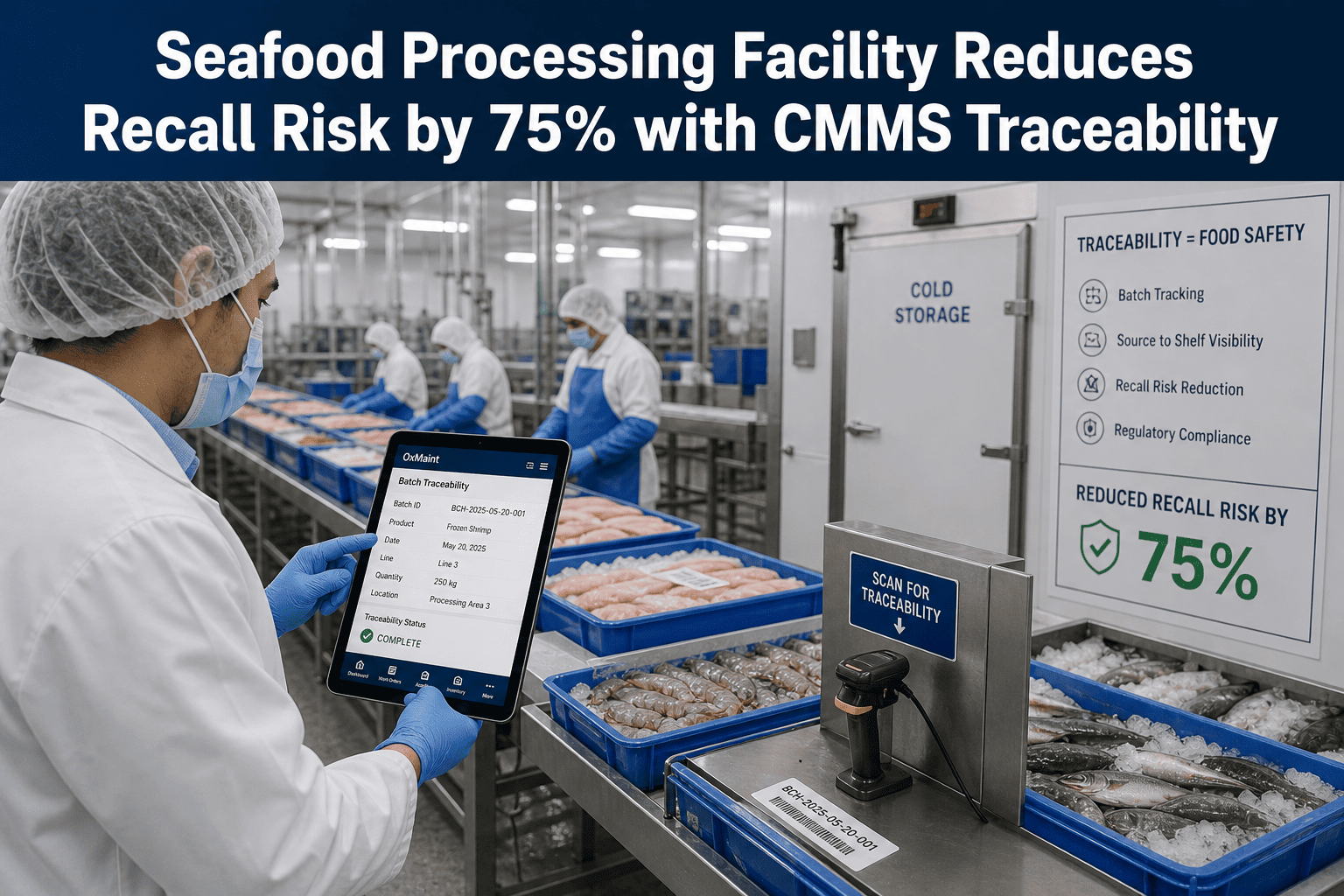
OXmaint logs maintenance events at the lot and batch level — creating the traceable link between equipment condition and product output that FSMA 204 requires. When the FDA requests traceability data within 24 hours, you have it, structured and complete.
The FDA inspector asked for 90 days of CCP equipment maintenance logs and calibration records at 9 AM on a Tuesday. We pulled them in OXmaint in about three minutes, filtered by equipment and date. The inspector made a note of it. We did not receive a single documentation citation. Before OXmaint, that same request would have taken us two days and we still would have found gaps.
Stop Managing Compliance Risks. Start Eliminating Them.
The next FDA inspection does not announce itself. The next audit gap will not wait for your next scheduled documentation review. OXmaint gives food manufacturing teams a single, audit-ready platform where every maintenance record, calibration log, PM task, and CAPA is timestamped, attributed, linked, and retrievable in seconds — not hours.
A Form 483 is issued by an FDA investigator at the conclusion of an inspection when conditions are observed that may constitute violations of the FD&C Act. Incomplete, unattributed, missing, or backdated maintenance records directly trigger documentation-related citations — which made up more than 60% of Form 483s issued in FY2024. If the facility fails to respond adequately within 15 business days, the observation can escalate to a public FDA Warning Letter.
Under FSMA's Preventive Controls for Human Food rule (21 CFR Part 117), food manufacturers must maintain records of all monitoring activities, corrective actions, verification procedures, and calibration of monitoring instruments. Records must be retained for a minimum of two years, must meet ALCOA+ data integrity standards, and must be producible upon FDA request within 24 hours under FSMA 204.
Paper records fail multiple ALCOA+ criteria — they are physically fragile (fire, water, physical deterioration), cannot be proven contemporaneous when entered, are difficult to search and retrieve quickly, and are prone to illegibility and incomplete attribution. FDA investigators flagged data integrity and recordkeeping as the single most common documentation failure in 2024–2025 inspections, and paper systems are structurally incapable of preventing most of these failures.
FSMA 204 is the FDA's Food Traceability Final Rule, requiring manufacturers of high-risk foods to maintain Key Data Elements (KDEs) at each Critical Tracking Event (CTE) and make them available to the FDA within 24 hours. For maintenance teams, this means that equipment condition records, lot-level production logs, and any maintenance event that could have affected product safety must be digitally traceable and immediately retrievable — a requirement that paper-based systems cannot meet.
OXmaint digitizes every element of the maintenance compliance record — work orders, PM schedules, calibration logs, corrective actions, and CAPA workflows — in a single platform where each entry is automatically timestamped, attributed to a named user, and linked to the relevant equipment asset. When an FDA inspector arrives, compliance records for any date range, any equipment, or any production line can be exported in under 60 seconds, fully meeting ALCOA+, FSMA 204, SQF, BRCGS, and ISO 22000 documentation standards.
Most food manufacturing facilities are fully operational on OXmaint within 24 hours of signing up. The platform is designed for maintenance teams — not IT departments — with configurable equipment hierarchies, pre-built compliance form templates, and an onboarding process that maps to your specific CCP assets and regulatory requirements. Book a live demo to see a facility-specific walkthrough of the setup process.




.png)

