Food safety failures cost the industry billions every year — and the most dangerous ones happen too fast for the human eye to catch. AI vision cameras for food safety are rewriting the rules of quality control on production lines, catching contaminants, packaging defects, and mislabeled products at machine speed with accuracy no manual inspection team can match. From raw ingredient intake to final packaging, computer vision is now the most reliable layer of protection between your production floor and a costly recall. Sign up free to connect AI-powered inspection data directly with your maintenance and quality workflows.
Connect AI vision inspection alerts to automated CMMS work orders — reduce downtime, protect product quality, and stay ahead of compliance requirements with OxMaint.
Why Traditional Food Line Inspection Is No Longer Enough
Manual visual inspection has been the backbone of food production quality control for decades — but its limitations are increasingly hard to justify. Human inspectors fatigue, miss subtle defects under variable lighting, and cannot keep pace with modern high-speed production lines running thousands of units per minute. Regulatory bodies including the FDA and EFSA are raising the bar on traceability and contamination documentation, and consumer tolerance for product quality failures is lower than ever. Get started with OxMaint to bring real-time inspection control to your facility.
The result is growing adoption of automated visual inspection for food production — systems that use high-resolution cameras, structured lighting, and AI-driven image analysis to assess every unit on the line, every second it runs. Unlike legacy machine vision systems that rely on rigid rule-based detection, modern AI inspection food platforms use deep learning models that adapt to product variation, lighting changes, and new defect types without reprogramming from scratch.
How AI Vision Cameras Work on Food Production Lines
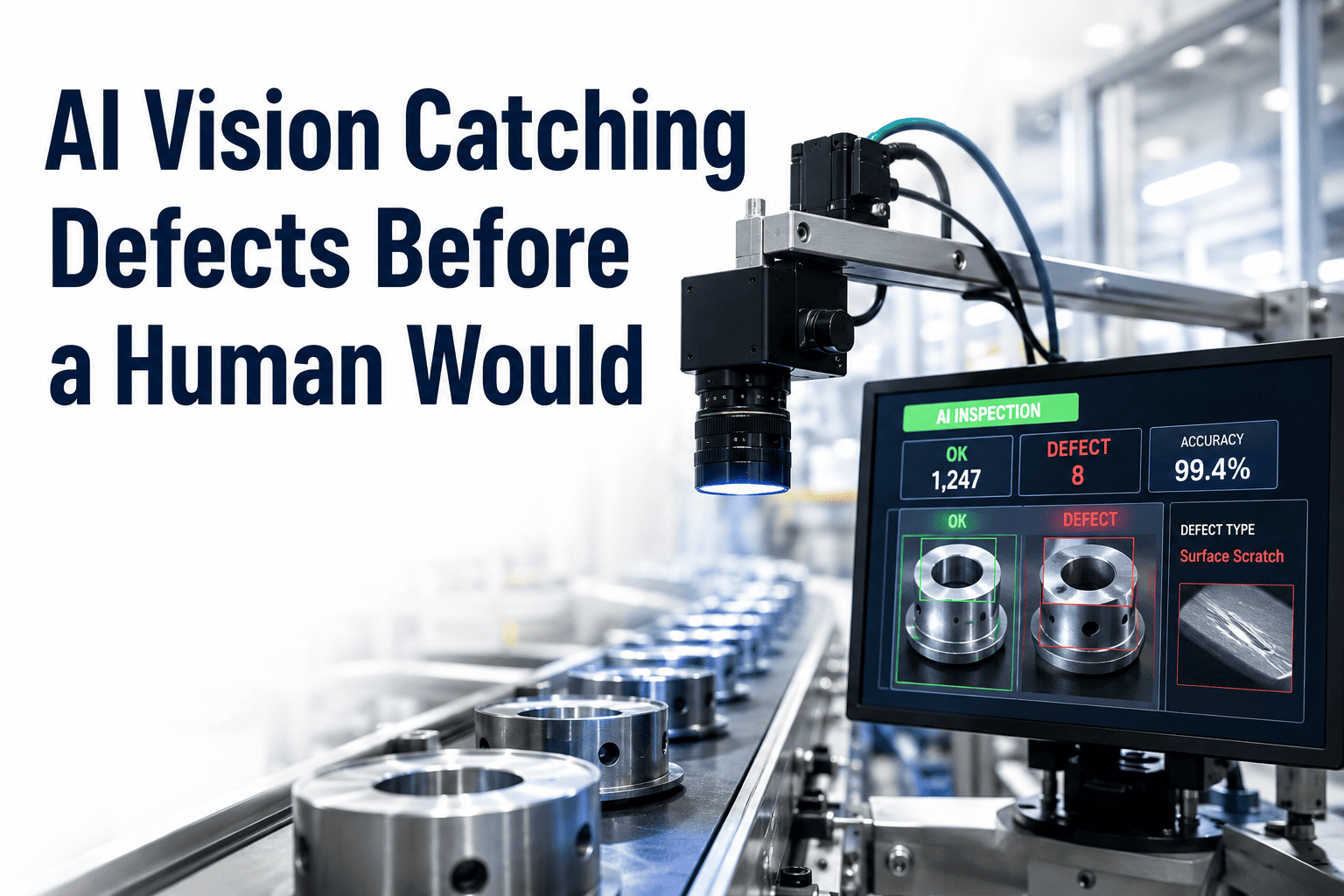
An AI vision camera food safety system combines hardware and software into a continuously learning inspection layer. Industrial-grade cameras capture high-resolution images of every product unit as it moves along the conveyor. These image streams feed into an AI inference engine that analyzes each frame in real time, triggering rejection mechanisms or maintenance alerts when anomalies are detected. Book a demo to see how OxMaint connects vision data to your CMMS workflows.
Image Capture and Illumination
High-speed cameras with structured UV, infrared, and visible-spectrum lighting capture multi-angle product images at full line speed for consistent defect visibility.
AI Model Inference and Classification
Deep learning models classify each image in milliseconds — detecting foreign objects, surface defects, fill anomalies, seal failures, and label errors simultaneously.
Real-Time Rejection and Alert Generation
Non-conforming products are ejected automatically. The system logs defect type, timestamp, and image evidence — creating a fully traceable quality record for every run.
CMMS Integration and Maintenance Triggering
When defect rates signal equipment degradation, the AI vision system pushes alerts to the CMMS, auto-generating prioritized work orders before a failure disrupts the line.
Continuous Model Improvement
AI models retrain continuously on live production data, improving accuracy and expanding defect coverage as new product formats or packaging types are introduced.
Key Applications of Computer Vision in Food Production
Computer vision food production technology addresses multiple quality and safety challenges at once. AI vision platforms monitor several critical control points across a single production line, consolidating all inspection data into one unified quality record.
Foreign Object Identification
Detects glass, metal, plastic, bone, and insect matter at thresholds well below traditional X-ray — including low-density contaminants invisible under standard lighting.
Surface and Texture Analysis
Catches mold, bruising, discoloration, and cracks at line speed. AI models distinguish cosmetic variation from real defects, cutting false rejection waste significantly.
Seal and Packaging Defect Detection
Identifies seal failures, damaged cartons, dented cans, and film wrinkles in real time — stopping compromised products before they reach distribution.
Label Accuracy and Compliance
Verifies barcodes, expiry dates, allergen declarations, and label placement on every unit — preventing mislabeling errors that trigger costly market withdrawals.
Volume and Fill Conformance
Checks fill levels in transparent containers against defined tolerances, catching underfill conditions that drive consumer complaints and regulatory non-conformances.
Defect-Rate Maintenance Signals
Rising defect patterns linked to a specific asset trigger CMMS work orders automatically — enabling predictive maintenance before a line stoppage occurs.
AI Vision vs. Traditional Inspection: A Performance Comparison
The operational case for automated food inspection is strongest when measured against the documented limits of manual and legacy methods. The table below compares AI vision camera systems across the dimensions that matter most to food quality and operations leaders.
| Inspection Dimension | Manual Inspection | Legacy Machine Vision | AI Vision Camera |
|---|---|---|---|
| Throughput capacity | Low — fatigues at high speed | Medium — rule-limited | High — full line speed |
| Defect type coverage | Visible defects only | Configured defect types only | Multi-class simultaneous detection |
| Foreign object detection | Unreliable | Metal/dense objects only | Low-density and multispectral detection |
| Label and barcode verification | Spot check only | Basic barcode read | Full label compliance verification |
| Traceability documentation | Manual logs, incomplete | Basic rejection counts | Image-evidenced per-unit records |
| Maintenance signal generation | None | None | Defect-pattern CMMS integration |
| Model adaptability | Training dependent | Reprogramming required | Continuous learning and retraining |
CMMS Integration: Connecting Quality Data to Maintenance Action
One of the most transformative capabilities of modern AI food manufacturing quality platforms is closing the loop between inspection data and maintenance response. In most facilities today, quality and maintenance teams operate in silos — inspection findings rarely trigger structured maintenance actions unless catastrophic failure occurs. AI vision systems connected to a CMMS change this entirely. Sign up for OxMaint to see how inspection data and maintenance response work together on a single platform.
When AI vision detects a statistically significant increase in a specific defect category, it evaluates whether the pattern is linked to an upstream equipment asset — distinguishing equipment degradation from product or ingredient variation.
Quality-triggered alerts are pushed to the CMMS automatically, creating prioritized work orders with defect evidence, affected asset, and recommended inspection scope — eliminating manual handoff delays between quality observation and maintenance response.
After maintenance is completed, the AI vision system monitors post-intervention defect rates to confirm the corrective action worked — refining the model's ability to link defect patterns with specific failure modes over time.
Every quality event, maintenance trigger, and corrective action is logged in a unified audit trail satisfying FSMA, BRC, SQF, and GFSI documentation requirements — with zero manual record-keeping overhead.
Food Safety Compliance Benefits of AI Vision Monitoring
Regulatory pressure on food manufacturers is intensifying globally. FSMA, EU Food Information Regulation, and GFSI-recognized standards all require documented evidence of process control, preventive hazard analysis, and corrective action management. Food quality vision systems provide the continuous monitoring and automated documentation that manual inspection programs structurally cannot deliver at scale. Book a demo to explore how OxMaint supports your compliance and audit requirements.
Implementation Roadmap for AI Vision Camera Deployment
Deploying AI food production camera systems successfully requires a structured approach aligned to specific line configurations, product portfolios, and quality control priorities. Facilities that phase implementation by criticality achieve faster ROI and higher team adoption than those attempting enterprise-wide rollout in a single project.
Inspection Gap Assessment
Map current inspection coverage against known quality failure modes and recall history. Identify critical control points where manual inspection provides insufficient coverage — typically high-speed lines, allergen lines, and complex packaging operations.
Camera System and AI Platform Selection
Select vision hardware matched to product characteristics — line speed, product size range, surface properties, and packaging materials. Evaluate AI platform vendors on model training methodology, defect class coverage, and CMMS integration capability.
Model Training and Validation
Train AI models on your specific product portfolio using curated defect sample libraries. Validate model performance against defined detection thresholds and false-rejection rate targets before go-live, ensuring documentation satisfies GFSI requirements.
CMMS and Quality System Integration
Configure bidirectional integration between the AI vision platform and CMMS to enable quality-triggered maintenance work order generation. Map defect alert thresholds to specific equipment assets and define escalation protocols for quality events requiring immediate line intervention.
Continuous Performance Optimization
Establish monthly review cycles evaluating detection accuracy, false rejection rates, and maintenance trigger effectiveness. Use production defect data to continuously retrain models as new product lines or packaging formats are introduced.
The Future of AI Vision in Food Manufacturing Quality
The trajectory of AI vision camera technology in food manufacturing points toward fully integrated, line-wide quality intelligence systems that correlate inspection data with equipment health, environmental monitoring, and supply chain traceability in real time. Next-generation platforms will move beyond defect detection to predictive quality modeling — identifying the upstream conditions likely to produce failures before production begins. Sign up for OxMaint to start building this foundation at your facility today.
Food manufacturers that invest in AI vision inspection infrastructure now are laying the data foundation for this broader quality intelligence capability. The combination of per-unit inspection records, equipment performance correlation, and CMMS integration creates a feedback loop that continuously improves both product quality and production reliability.
OxMaint connects AI vision inspection alerts with real-time CMMS workflows — giving food quality and operations teams a single platform for inspection data, maintenance response, and compliance documentation across every production line.
Frequently Asked Questions
What is an AI vision camera in food safety?
An AI vision camera in food safety is a networked industrial camera system combined with a deep learning inference engine that analyzes product images in real time on a food production line. Unlike traditional machine vision systems with fixed rule sets, AI vision platforms use trained neural network models to detect contaminants, defects, label errors, and packaging failures simultaneously — with the ability to continuously improve detection accuracy through ongoing model retraining.
How does AI vision detect food contaminants?
AI vision systems detect food contaminants by analyzing product images captured under multiple lighting spectra — including visible light, near-infrared, and UV — against trained models that recognize the visual signatures of foreign objects. Multispectral imaging extends detection to low-density contaminants like plastic film, glass fragments, and insect matter that are invisible to standard cameras and undetectable by metal detection equipment alone.
Can AI vision cameras integrate with CMMS systems?
Yes. Modern AI vision platforms support API-based integration with CMMS systems, enabling defect pattern data to automatically trigger maintenance work orders when rising defect rates indicate equipment degradation. This integration reduces the time between quality signal detection and corrective equipment intervention from days to minutes.
What food safety regulations require automated inspection documentation?
FSMA requires documented preventive controls and corrective action records at critical control points. GFSI-recognized standards including BRC and SQF require validated inspection systems with documented performance records. EU Food Information Regulation mandates allergen declaration accuracy traceable to production records. AI vision systems satisfy these requirements by generating per-unit inspection records with full audit trails.
What is the ROI of deploying AI vision cameras on food production lines?
ROI from AI vision camera deployment typically comes from reduced product recall costs, lower product waste from improved false rejection rates, reduced manual inspection labor, and CMMS-integrated predictive maintenance that prevents equipment-related stoppages. Facilities with historically high recall frequency or complex allergen line management typically achieve ROI within 12 to 18 months of full deployment.