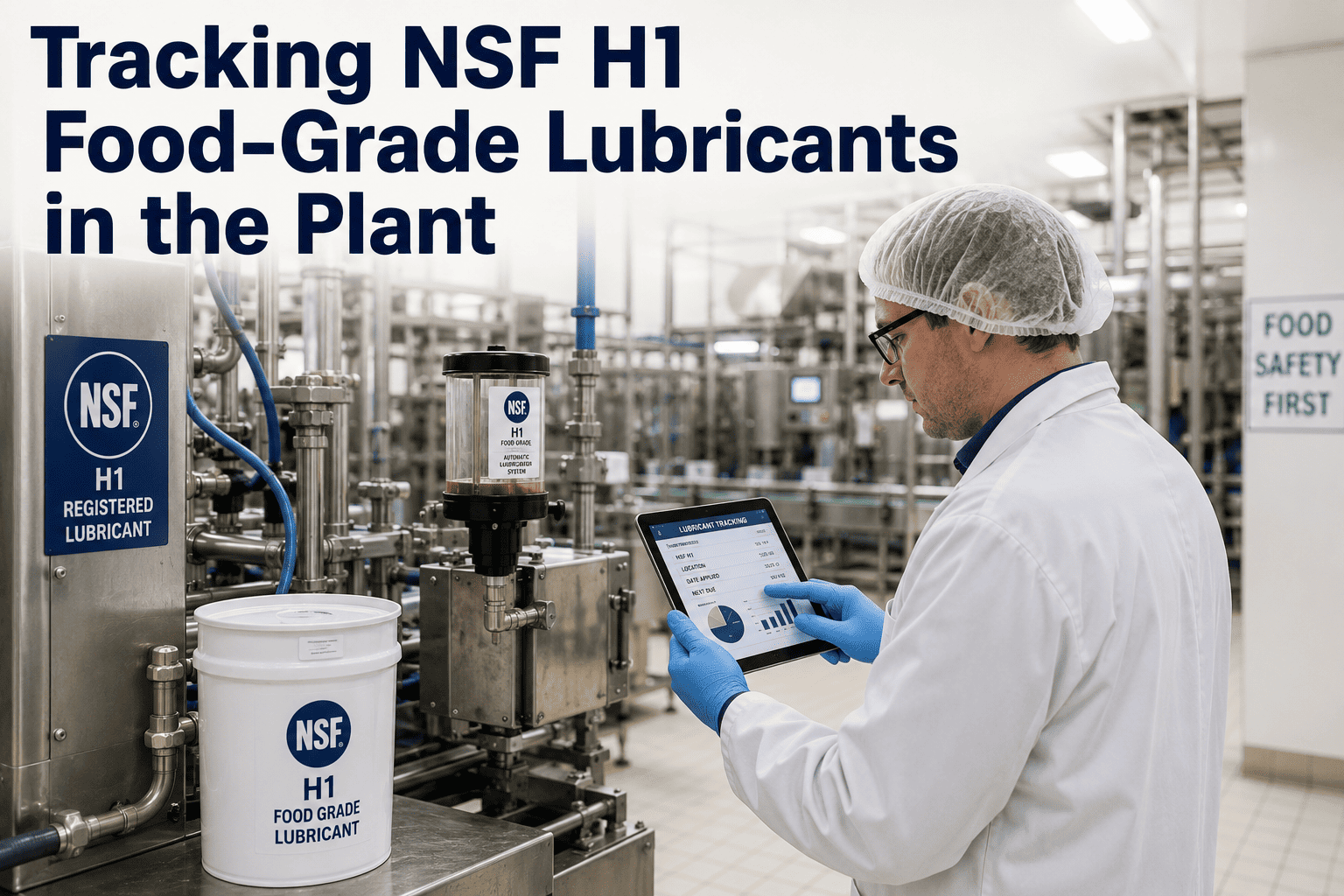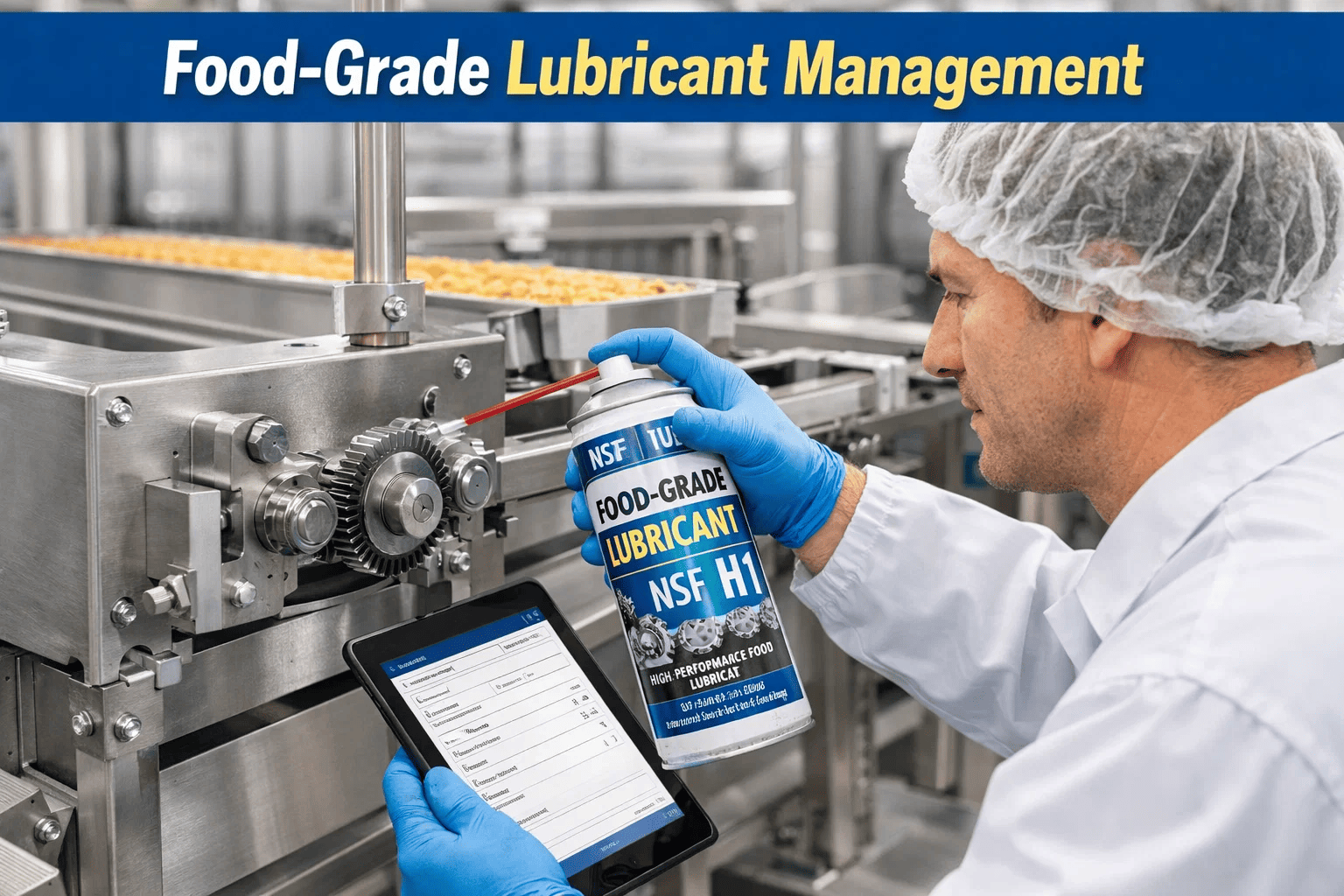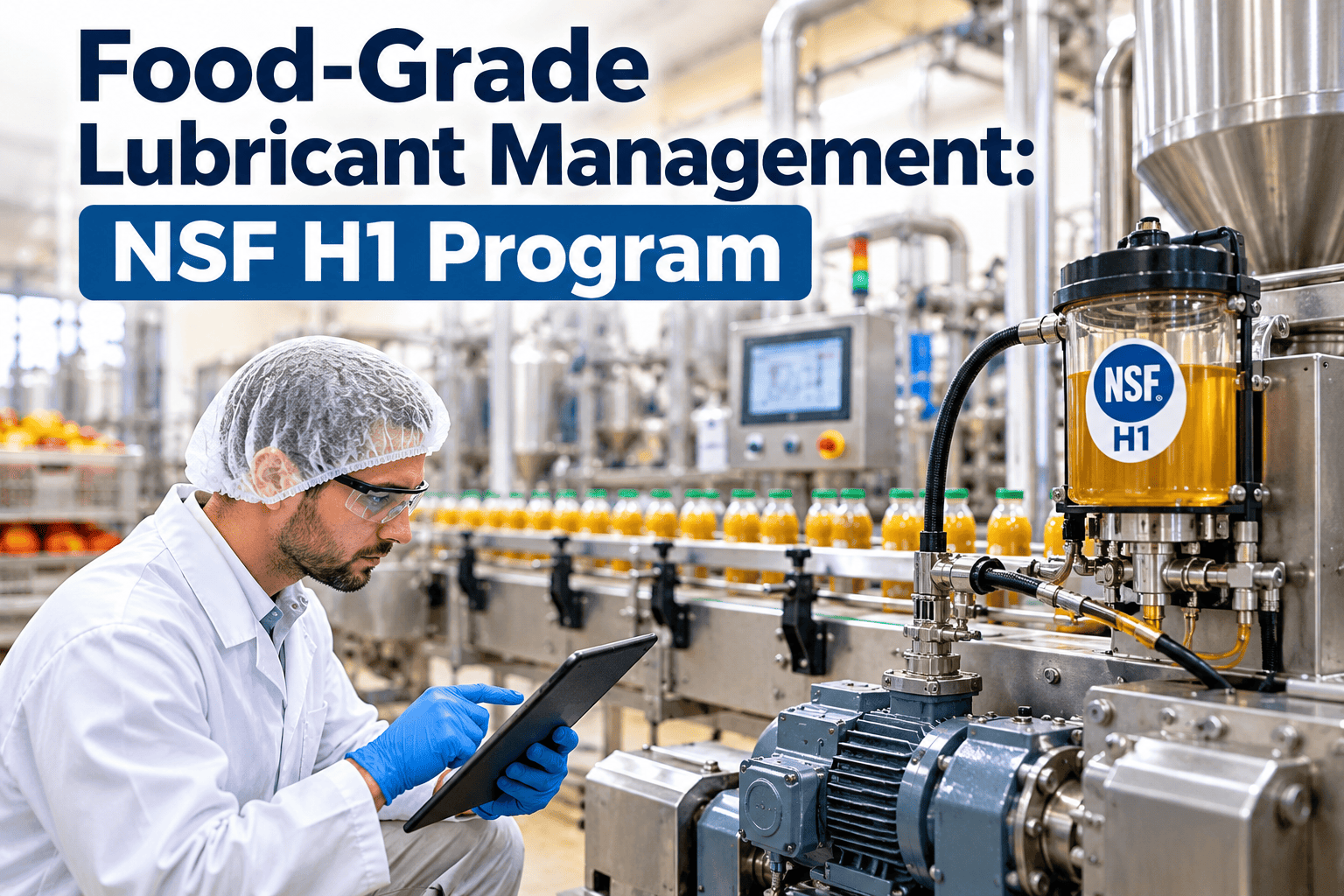
A grease gun is one of the smallest tools in a food plant and one of the easiest to misuse. A mislabeled cartridge, a shared nozzle or an over-greased bearing can put the wrong lubricant at a point where incidental food contact is possible, and nobody notices until an auditor asks for proof. Choosing an NSF H1 product is only the first step. The harder part is controlling what is bought, stored, applied and recorded, point by point and shift by shift, which is where modern maintenance management software starts to earn its place.
Food-Grade Lubricant Management: An NSF H1 Program That Holds Up on the Plant Floor
Control which lubricant is approved, stored, applied and recorded at every lubrication point, so food-grade intent becomes documented daily practice instead of a purchasing decision that fades on the shop floor.
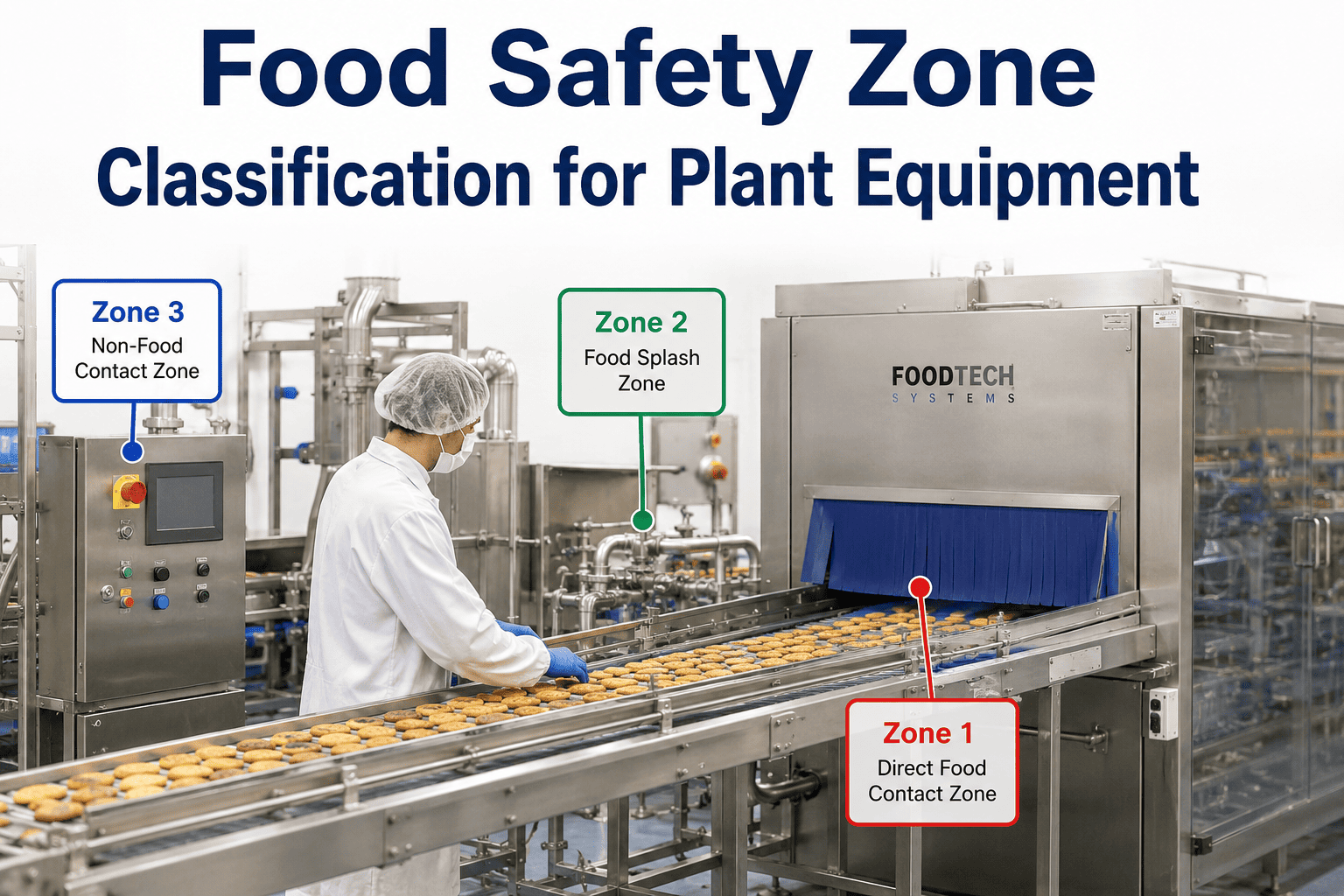
Know the Contact Zones Before Buying Another Cartridge
Food grade is a category, not a single product type. Each category answers a different question about how close a lubricant may get to product, and a plant program has to map every lubrication point to the right answer before any grease is selected.
| Category | Contact with food | Typical use in a plant | Program control point |
|---|---|---|---|
| 3H | Direct contact intended | Release agents on food contact surfaces | Restricted to named points, tracked as a controlled product |
| H1 | Incidental contact possible | Greases, hydraulic fluids and gear lubricants on equipment near open product | Default choice for points in or above the production zone |
| H2 | No contact possible | Equipment where product can never be reached | Needs a documented contact-risk decision per point |
| H3 | Soluble oils | Cleaning and rust prevention on hooks and trolleys | Kept separate from greases and oils in stores |
| HT-1 and HT-2 | Incidental contact allowed or not allowed | Heat transfer fluids | Matched to the system and its leak exposure |
Five facts that shape the program
- H1 products are formulated to the FDA rule in 21 CFR 178.3570 for incidental contact, with a 10 ppm limit on lubricant base oil that may be present in food. Treat leaks and over-greasing as food safety events, not housekeeping.
- The USDA discontinued its lubricant registration program in 1998. Registration today runs through third parties such as NSF, and its White Book directory is the usual place to verify a product.
- A registration reviews formulation and label. It does not judge how a product is stored, transferred or applied in your plant, so the program around the product matters as much as the product.
- ISO 21469 certification goes beyond ingredients by covering hygiene in design, manufacture and packaging. Many plants write H1 registration or ISO 21469 certification, or both, into purchasing rules.
- Markets differ. Titanium dioxide, for example, is not considered safe as a food additive in the EU, so lubricants meant for European markets are made without it. Exporters should confirm requirements with the supplier.
Where Food-Grade Programs Break Down: Six Handoffs
Most failures are not caused by a bad product. They happen at the handoffs between buying, storing, transferring and applying, where one person's assumption replaces another person's verification.
-
01 PurchaseFailure: a look-alike tub from a general supplier is bought because the approved one is out of stock.Control: buying limited to products on the approved register.
-
02 ReceivingFailure: a distributor substitutes a product without notice and it goes straight to the shelf.Control: label and registration status checked on receipt, before the item enters stores.
-
03 StorageFailure: food-grade and industrial products sit together in similar tubs and cartridges.Control: separate, labeled storage with a defined location for each product.
-
04 TransferFailure: grease is moved to unlabeled containers or loaded into shared guns and pumps.Control: dedicated, labeled, color-coded tools that stay with one product.
-
05 ApplicationFailure: the wrong point is greased, or too much grease is pushed past the seals.Control: point-level instructions that state product, method and quantity source.
-
06 RecordsFailure: the task happens but is logged in a notebook, later, or not at all.Control: completion recorded on the work order at the time of the task.
Five Assumptions That Weaken an H1 Program
Teams that have switched to H1 products often relax too early. These are the beliefs that quietly reopen the gaps the switch was meant to close.
The Lubricant Register: One Approved List, Verified and Controlled
The register is the backbone of the program. It tells purchasing what may be bought, tells technicians what may be applied, and tells auditors how every product earned its place.
Fields every register entry needs
- Product name, manufacturer and category (H1, H2, H3, 3H or heat transfer fluid)
- Registration or certification status, and where and when it was verified
- Base oil, thickener type, viscosity or consistency grade
- Approved assets and lubrication points for the product
- Compatibility notes and products it must never be mixed with
- Container label, color code and dedicated tool assignment
- Storage location and safety data sheet reference
- Approver, approval date and next review date
Approval gate for any new product
- A technician or supervisor raises a request that names the point and the reason.
- Maintenance verifies registration or certification status against the current listing.
- Equipment manufacturer guidance and compatibility are checked and noted.
- Quality or food safety approves the product for that contact zone.
- The product is added to the register, labeled and set up in inventory before first use.
Turn Your Approved Lubricant List into Scheduled, Recorded Work
Oxmaint helps maintenance teams link assets, lubrication tasks, work orders and inventory in one place, so approved products and completed tasks are recorded where supervisors and auditors can find them.
From Lubrication Point to Logged Task
A program becomes real when each lubrication point has a named product, a method and a record. The sample route card below shows the level of detail that removes guesswork on the floor.
| Lubrication point | Asset | Approved product | Method | Verification on completion |
|---|---|---|---|---|
| Drive bearing, wash-down zone | Product transfer conveyor | H1 grease listed in the register | Dedicated gun, wipe fitting first, remove excess | Task closed on mobile with leakage note |
| Gearbox fill point | Mixer drive | H1 gear oil listed in the register | Dedicated transfer can, sealed after use | Level check recorded, sight glass condition noted |
| Hydraulic reservoir | Press or filler unit | H1 hydraulic fluid listed in the register | Top-up from labeled container only | Quantity added drawn from inventory |
| Overhead trolley track | Hanging line | Product assigned per contact-risk decision | Applied by authorized technician | Sign-off by supervisor |
Controls at the point of application
- Color-coded, labeled guns, pumps and nozzles are dedicated to one product and never swapped between food-grade and industrial products.
- Fittings are cleaned before greasing so dirt and old grease are not pushed into the bearing.
- Quantity and interval come from the equipment manufacturer and recorded condition history, not from a plant-wide rule of thumb.
- Excess grease is removed and any weep or leak is raised immediately as a corrective work order.
- Containers are never decanted into unlabeled vessels, and open cartridges are closed and stored in their assigned place.
- The technician records completion, product used and any anomaly before moving to the next point.
Risk Matrix: Where Lubricant Mistakes Cost the Most
Not every error carries the same consequence. Ranking risks helps maintenance and quality teams spend review time where a mistake would reach product or an audit finding.
| Risk | Likely trigger | Consequence | Level | Primary control |
|---|---|---|---|---|
| Non-food-grade product at an incidental-contact point | Look-alike container or unclear point instructions | Possible product hold and investigation | Critical | Register-based instructions and dedicated, coded tools |
| Lubricant leak over open product | Over-greasing or worn seals | Contamination risk and unplanned stop | Critical | Quantity limits, leak inspections, corrective work orders |
| Cross-contamination through shared tools | One gun used for several products | Mixed products and compatibility problems | High | Dedicated tools and cleaning rules |
| Incompatible grease mixed during changeover | Switching products without a plan | Premature bearing wear, repeat failures | High | Supplier and OEM review, planned purge on a work order |
| Unverified product in stores | Substitution on delivery | Audit finding on chemical control | High | Receiving check against the register |
| Missing application records | Paper notes or end-of-shift logging | Inability to prove control on request | Moderate | Completion recorded on the work order |
Converting a Plant to H1: A Practical Changeover Sequence
Plants rarely switch every point at once. A staged sequence keeps equipment protected while the highest-risk points move to food-grade products first.
-
1Inventory every lubrication point and product in useWalk the plant with asset lists and record what is actually being applied today, including products found in toolboxes and on shelves that nobody listed.
-
2Rank points by proximity to open productPoints above or beside exposed product move first. Points that can never reach product are documented and can follow later.
-
3Select equivalents with supplier and manufacturer inputMatch base oil, thickener, viscosity and temperature range, and confirm the choice is acceptable for the equipment and its seals.
-
4Plan purge and relubrication during scheduled downtimeWhere compatibility is uncertain, schedule flushing or purging as a planned work order instead of squeezing it into a break.
-
5Remove superseded products from the floor and storesOld greases left in toolboxes are the most common route back to mixed products, so retire them and their tools together.
-
6Verify, then update the register and instructionsConfirm the new product is in use at each converted point and revise the task instructions so the change is permanent.
Audit Readiness: Questions Asked and Records That Answer Them
Food safety schemes differ in wording, but chemical control, including lubricants, is a regular part of plant reviews. Preparing the answers in advance turns an audit from a scramble into a retrieval exercise.
Questions reviewers commonly raise
- Which lubricants are approved for use, and who approved them?
- How do you know each product is food grade for its contact zone?
- Where are food-grade products stored, and how are they kept apart?
- How are tools and containers identified and controlled?
- Can you show who lubricated a specific point and when?
- What happens when a lubricant leak is found near product?
Records that answer them
- The lubricant register with verification dates and approvals
- Registration or certification evidence filed with each product
- Storage and handling inspection results
- Tool assignment and color-code lists
- Completed lubrication work orders by asset and date
- Corrective work orders raised for leaks, with closure notes
How Oxmaint Supports Lubrication Control
Oxmaint does not replace the register or the judgment of your quality team. It gives the program a place to live, so approved products, scheduled tasks and completed records stay connected to the assets they belong to.
Capabilities that map to this program
- Preventive maintenance scheduling for recurring lubrication, oil checks and reservoir top-ups.
- Work orders with checklists that name the approved product and method for each point.
- Asset management that keeps lubrication details attached to the equipment, not to a person's memory.
- Inspection tasks for leaks, seal condition and storage checks, with corrective work orders raised from findings.
- Inventory tracking so purchasing and stores follow the approved list.
- Compliance records and dashboards that show completed and overdue lubrication work at a glance.
Measures That Show Whether the Program Is Working
Pick a small set of measures, review them on a regular cadence and set targets based on your own baseline rather than a borrowed benchmark.
A Quick Plant-Walk Checklist for Maintenance and Quality
Use this short walk-through to check whether the program is visible on the floor, not only in documents. Run it together so findings are shared the same day.
Stores and handling
- Food-grade products are stored apart from industrial products and clearly labeled
- Every container in use matches an entry in the register
- No unlabeled or decanted containers are found at machines
- Dedicated tools carry the correct color code and are clean
Equipment and points
- Fittings and fill points are labeled with the approved product
- No grease or oil weeps are visible above or beside open product
- Recent lubrication work orders match what is visible on the machine
- Any point without an assigned product is raised for review
Food-Grade Lubricant Management FAQs
Is an H1 lubricant required everywhere in a food plant?
Not everywhere. H1 is intended where incidental contact is possible, while H2 is limited to places where contact cannot happen. Document the decision for each point and keep it with the asset in Oxmaint.
What is the difference between NSF H1 registration and ISO 21469 certification?
H1 registration reviews formulation and label against FDA rules. ISO 21469 also covers hygiene in design, manufacture and packaging. Many plants accept either, so set the rule in your purchasing policy.
How often should food-grade lubrication tasks be scheduled?
Intervals come from the equipment manufacturer and your own condition history, not a universal number. Build them as recurring preventive tasks and adjust from recorded findings.
Can food-grade and non-food-grade lubricants be mixed during a changeover?
Treat mixing as a risk, because compatibility depends on base oil and thickener. Confirm with the supplier and manufacturer, plan any purge as a work order, and book a demo to see how it is scheduled.
What records should be ready for a food safety audit?
Keep the approved register, verification evidence, point-level instructions, completed task history and storage checks together. A free trial shows how these records sit in one system.
Make Food-Grade Lubrication a Controlled, Recorded Routine
Bring your approved lubricant list, lubrication schedules, work orders and inventory into one maintenance system, so every point is greased with the right product and every task leaves a record you can show.