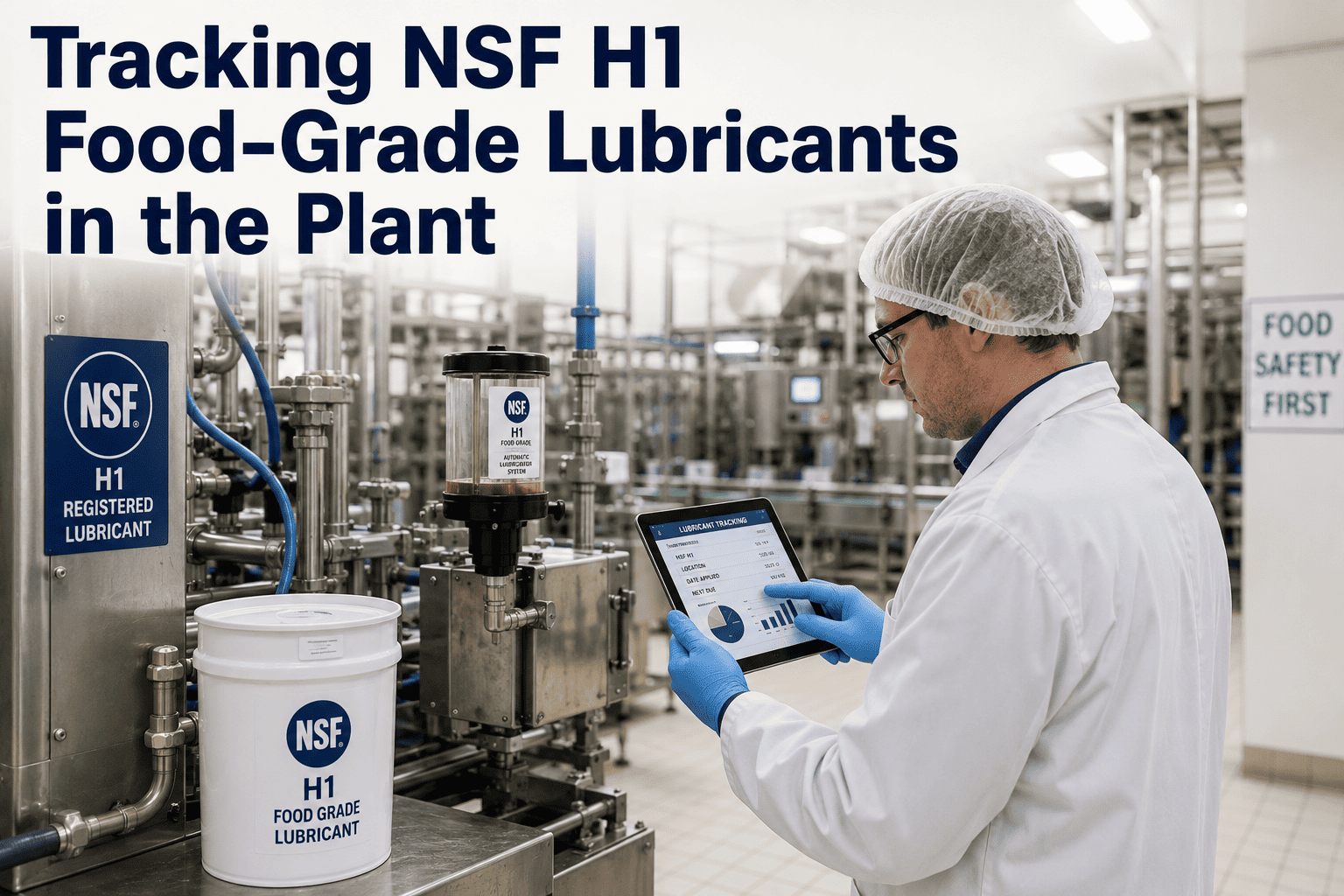
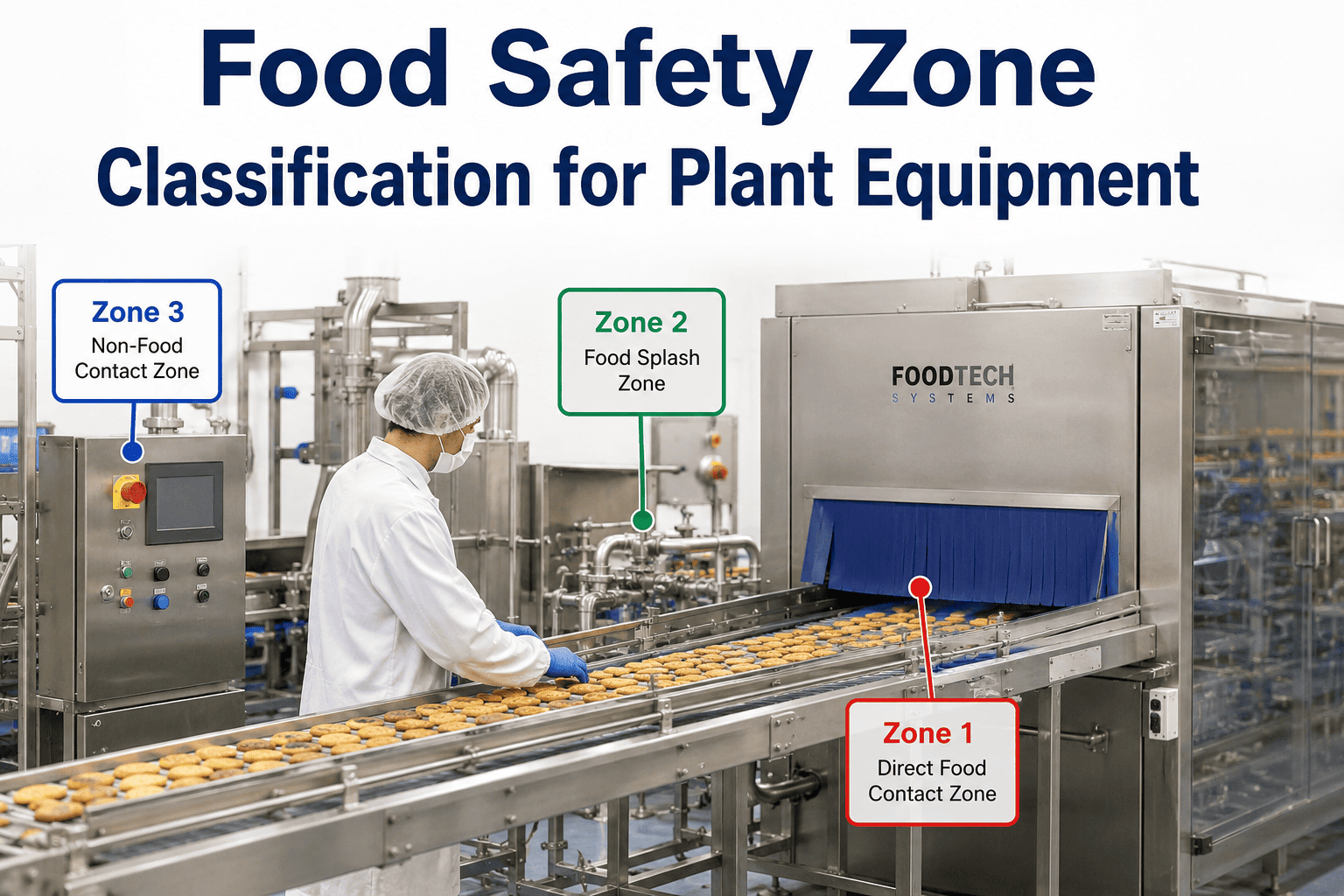
Every food processing facility operates under an unspoken certainty: lubricant contact with product isn't a question of if, but when. Chains drip. Seals fail. Bearing housings weep grease into product zones. The difference between a contained incident and a $10 million recall comes down to one question — was the lubricant NSF H1-registered? A CMMS built for food-grade tracking makes that answer auditable, enforceable, and automatic. Start a free trial to lock lubricant specifications to every equipment record, or book a demo to see NSF-compliant lubrication workflows configured for your plant.
Food Safety Compliance
Food-Grade Lubricant Management: Ensure NSF H1 Compliance with CMMS
Digital lubricant tracking, NSF H1 verification, zone-based product control, and audit-ready documentation — the compliance framework that prevents contamination before it reaches the production line.
$10M
Average direct cost of a single food recall due to contamination
10 ppm
Maximum allowable H1 lubricant in food — exceeding this triggers mandatory recall
12,000+
NSF H1-registered lubricants globally — each requiring specific product verification
60%
U.S. food manufacturers still using non-food-grade lubricants in production zones
Wrong Lubricant, Wrong Location — One Substitution Away from Recall
NSF H1 compliance isn't validated by good intentions or verbal reminders. It requires linked product records, zone-based restrictions, and automatic verification at the point of task execution. Paper-based systems can't enforce this. Spreadsheets can't audit it. Start a free trial to see digital lubricant tracking configured for your facility, or book a demo to walk through zone mapping and NSF registration verification workflows.
NSF H1 registration confirms that a lubricant meets FDA 21 CFR 178.3570 formulation requirements — tasteless, odorless, physiologically inert, safe for incidental food contact up to 10 parts per million. Registration does not prevent technicians from using the wrong product, applying excess quantities that migrate past seals, or substituting a similar-looking H2 industrial lubricant when the H1 product runs out. Those failures happen at the task execution level, and they require system-level controls to prevent. Understanding the H1 standard is the first step. Enforcing it at every lubrication point is where CMMS-based tracking becomes non-negotiable. To explore how digital tracking prevents substitution errors and ensures zone compliance, book a demo or start a free trial to see the system in action.
H1
NSF H1 — Incidental Contact
Used in food zones where incidental contact may occur. Must comply with FDA 21 CFR 178.3570. Contamination limited to 10 ppm maximum. Most critical classification for production equipment.
H2
H2 — No Food Contact
For equipment with zero possibility of food contact — closed systems, non-production zones. Any H2 contamination of food triggers immediate condemnation. Not food-grade.
H3
H3 — Soluble Rust Prevention
Edible oil-based rust preventatives for hooks, trolleys, and transport equipment. Must be cleaned off surfaces before food contact. Derived from food-safe ingredients.
3H
3H — Direct Contact Release
Release agents for grills, pans, baking surfaces — approved for direct food contact. Prevents sticking during processing. Primarily used in meat and baking operations.
Lubricant contamination incidents rarely result from malicious intent or gross negligence. They result from predictable, preventable execution failures that paper-based systems cannot structurally prevent. A technician grabs the wrong grease gun. A substitute product gets approved verbally but never documented. Excess grease forces past a seal during an over-application. These are system design failures, not human failures — and they require system-level controls to eliminate. For a detailed walkthrough of how digital systems prevent each pathway, start a free trial or book a demo to see product lockout and zone enforcement in action.
⚠
Product Substitution Without Verification
Technician uses an industrial H2 lubricant in an H1-required zone because the specified product is out of stock. No NSF registration check occurs.
⚠
Over-Application Past Seals
Excess grease applied beyond recommended quantity forces lubricant past bearing seals into product contact zones. Even H1 lubricant above 10 ppm violates limits.
⚠
Cross-Contamination from Dispensing Tools
Grease gun or oil can used for multiple lubricant types carries H2 residue into H1 application points. Tool segregation not enforced.
⚠
Missed Relubrication Schedules
Lubrication tasks run past due date, causing bearing failure and catastrophic lubricant release during production. Paper schedules and verbal reminders inadequate.
⚠
New Product Introduction Without Approval
Vendor switches lubricant formulation or introduces new SKU without quality approval. NSF registration number changes but procurement continues ordering.
⚠
Zone Designation Errors
Equipment reclassified from non-contact to incidental-contact zone during line reconfiguration. Lubrication specification not updated to H1 requirement.
Food-grade lubricant compliance is enforced through linked product records, zone-based restrictions, and automatic verification workflows. Every equipment record carries its NSF classification requirement. Every lubrication task links to a specific registered product with NSF number verification. Zone restrictions block task completion when product-to-zone mismatch is detected. Quantity limits prevent over-application. This is structural prevention — not procedural hope. Start a free trial to configure zone mapping and product lockout for your facility, or book a demo to see the enforcement workflow in action.
Product Registry
NSF-Registered Product Database
Master lubricant inventory with NSF registration number, H1/H2/H3 classification, viscosity grade, and approved equipment list. Every product verified before use authorization.
Zone Mapping
Equipment Zone Classification
Every asset tagged with food contact zone designation — H1 required, H2 acceptable, or direct contact. Zone changes trigger automatic lubrication specification review.
Task Linkage
Product-to-Task Assignment
Lubrication work orders pre-populated with specific NSF-registered product. Substitution requires quality approval and new NSF verification before task completion.
Quantity Control
Application Quantity Limits
Exact grease shots or oil volume specified per lubrication point. Technicians record actual quantity applied. Excess application flagged for seal inspection.
Schedule Enforcement
Automated PM Generation
Lubrication tasks auto-generate based on calendar days, production hours, or cycle count. Overdue tasks escalate to supervision. Zero missed intervals.
Audit Trail
Complete Execution History
Every lubrication event captures product used, NSF number, quantity applied, technician ID, timestamp, and zone verification. Exportable for GFSI and FDA audits.
The structural difference between paper-based and digital food-grade lubricant management isn't convenience or efficiency. It's enforceability. Paper systems rely on procedural discipline — technicians following instructions correctly every time, without shortcuts, without substitutions, without memory failures. Digital systems rely on structural controls — wrong products physically blocked, zone mismatches flagged before task completion, substitutions requiring documented approval. One system hopes for compliance. The other enforces it. See the difference by exploring a free trial or scheduling a demo of the enforcement workflow.
Product specifications written on equipment label or PM sheet — fades, tears, becomes illegible over time
NSF product locked to equipment record with registration number, classification, and approved quantity — immutable digital record
Technician selects lubricant from shelf based on memory or visual similarity — no verification step enforced
Work order pre-populated with exact product name and NSF number — wrong product selection blocks task completion
H1/H2 zone boundaries exist on blueprints — not enforced at point of task execution
Zone classification embedded in asset record — system flags H2 product in H1 zone before task sign-off
Substitutions approved verbally or via email — no traceability when contamination is discovered months later
Product substitution requires quality approval workflow with documented justification and new NSF verification
Lubrication schedules tracked on wall calendar or spreadsheet — tasks slip past due date with no escalation
PM tasks auto-generate with defined frequency — overdue tasks escalate to supervision and management dashboard
Audit evidence assembled retroactively — collect paper PM sheets, interview technicians, reconstruct product usage from purchase orders
Complete audit trail exportable instantly — every lubricant application with product, NSF number, quantity, technician, timestamp
The $10 million average recall cost is direct expense only — product destruction, logistics, public notification, regulatory response. It does not include brand damage, lost distribution, customer defection to competitors, legal exposure, or the quarters of revenue required to regain lost market position. A 2018 study found 5% of food manufacturers incurred over $100 million in combined direct and indirect costs from a single recall. The financial impact justifies significant investment in prevention. More importantly, it justifies the shift from procedural controls that fail under pressure to structural controls that enforce compliance automatically. To see how digital tracking prevents the execution failures that trigger recalls, book a demo or start a free trial configured for your facility.
$10M
Average Direct Costs
Product destruction, removal from distribution, public notification, regulatory coordination, crisis team assembly
$100M+
Total Impact (5% of Cases)
Includes brand damage, lost shelf space, customer defection, legal settlements, multi-year revenue recovery
86,000 lbs
Turkey Recall Volume
Single non-food-grade lubricant exposure — consumers reported intestinal discomfort, off-color product, mandatory recall issued
500,000 lbs
Ham Contamination Incident
Gear lubricant taint — customers reported burning throat sensation lasting three hours, complete batch condemned
Lubricant contamination is not theoretical risk management. It is documented regulatory history. The cases below represent known, publicly reported incidents — the visible fraction of a much larger population of internal contamination events caught before distribution. Many companies transition to food-grade programs only after experiencing contamination firsthand. The structural controls that prevent these incidents — product lockout, zone enforcement, NSF verification — are standard CMMS functionality. Their absence is a choice, not a technical limitation. Explore how digital systems prevent these failure modes by reviewing a free trial or scheduling a demo of the enforcement workflow.
2000
Sliced Turkey (USA)
86,000 pounds recalled after non-food-grade lubricant exposure during processing. Consumer complaints of off-color, off-odor turkey and temporary intestinal discomfort.
2000
Canned Baby Food (UK)
Consumer reported tar-like odor. Environmental health analysis confirmed lubricant contamination. Full batch recall and plant investigation.
2002
Milk Powder (Denmark)
1,100 tons contaminated by worn gearbox axle leaking oil with iron particles into packaging line. Gray tint detected by customer in Thailand. Complete production hold.
2002
Medicine Tablets (USA)
FDA inspection revealed black lubricant specks with metal particles in tablets. Traced to upper cam lubricant entering die cavity. Spotting dated back to 1983.
2002
Smoked Ham
Nearly 500,000 pounds recalled due to gear lubricant taint. Customers reported bad taste and burning throat sensation lasting up to three hours.
2002
Soft Drinks (Australia)
Big Thirst brand recalled — five flavors in 1.25L bottles. Food Standards Australia warned lubricant may cause irritation if consumed.
Food-grade lubricant compliance operates under a three-layer framework. FDA 21 CFR 178.3570 defines allowable ingredients and establishes the zero-tolerance standard for non-food-grade contamination. NSF H1 registration confirms products meet FDA requirements through independent third-party verification. ISO 21469 certification extends beyond formulation to include manufacturing facility GMP compliance and quality management systems. Understanding this hierarchy matters because compliance is validated differently at each level — and auditors expect documented evidence of verification at all three. The CMMS role is capturing that verification automatically at the task execution level and making it exportable for audit. To see how product records link to FDA, NSF, and ISO documentation, start a free trial or book a demo to review the compliance documentation workflow.
FDA
21 CFR 178.3570
Regulatory Basis
Defines allowable ingredients for incidental food contact lubricants. Establishes zero-tolerance for non-food-grade contamination under Food Safety Modernization Act.
Key Requirements
Lubricants must be odorless, colorless, tasteless, physiologically inert. Maximum 10 ppm mineral oil in food. Silicone-based limited to 1 ppm.
NSF
H1 Registration
Verification Standard
Independent third-party registration confirming formulation complies with FDA 21 CFR 178.3570. Product listed in NSF White Book — global reference for food-grade lubricants.
Scope Limitation
Registration validates formulation only — not manufacturing facility, quality systems, or proper application. Certificate renewed through periodic audits.
ISO
ISO 21469 Certification
Comprehensive Standard
Covers formulation, manufacturing, packaging, and application hygiene. Requires ISO 9001-certified production facility and documented GMP compliance.
Global Recognition
Mandatory in Brazil for imported/exported lubricants. Considered strictest certification worldwide. Accepted by EU regulators and GFSI schemes.
Can we use H2 lubricants in equipment located near but not touching food production lines?
No. Zone designation is determined by possibility of incidental contact — not proximity. If equipment failure, seal leakage, or overspray could result in lubricant reaching product contact surfaces, H1 classification is required regardless of normal operating distance. The conservative approach: any equipment in a food production room requires H1 unless physically isolated with zero contact pathway. CMMS zone mapping should reflect worst-case contact scenarios, not ideal operating conditions. Explore zone classification workflows by reviewing
a free trial or scheduling
a demo of the system.
If we detect H1 lubricant in product above 10 ppm, is the entire batch condemned or can we dilute it?
The entire batch is condemned. Dilution is not acceptable under FDA regulations. The 10 ppm limit applies to the concentration as consumed — not the concentration before corrective blending. Any batch exceeding 10 ppm must be discarded entirely. This is why over-application prevention through exact quantity specification in lubrication work orders is critical. Even H1-registered lubricants violate limits when applied in excess and forced past seals into product zones. CMMS quantity controls prevent this at task execution.
Start a free trial to see quantity enforcement workflows.
Does NSF H1 registration expire, and who is responsible for tracking renewal dates?
NSF registration is renewed through periodic audits of the lubricant manufacturer — not annually, but triggered by formulation changes or scheduled recertification. The food processor is responsible for verifying current registration status before use. A product previously H1-registered can lose registration if the manufacturer changes formulation or fails an audit. CMMS lubricant inventory should capture NSF registration number and verification date. When new lubricant lots are received, registration status should be reconfirmed against the NSF White Book before inventory activation. This verification step should be embedded in the receiving workflow, not reliant on supplier assurance. To see how CMMS systems automate registration verification,
book a demo or explore
a free trial.
What documentation do GFSI auditors expect to see for lubricant compliance?
GFSI schemes require documented evidence of three controls: approved lubricant list with NSF registration numbers, zone classification map showing H1-required areas, and execution records proving specified products were used at each lubrication point. Auditors verify this through equipment inspection, product comparison to approved list, and work order review. Paper systems fail when work orders show product name but no NSF number, when substitutions lack documented approval, or when execution dates cannot be traced to specific equipment. Digital CMMS systems pass when every completed lubrication task exports with product name, NSF registration number, zone verification, quantity applied, technician ID, and timestamp. That complete record — exportable instantly — is what GFSI compliance requires. See the documentation output by scheduling
a demo or reviewing
a free trial.
Product Locked. Zone Verified. NSF Confirmed. Every Task, Every Time.
Oxmaint enforces food-grade lubricant compliance at the structural level — product-to-equipment lockout, zone-based restrictions, NSF registration verification, quantity controls, and complete audit trail export. No substitutions without approval. No H2 products in H1 zones. No missed relubrication schedules. Free trial, no implementation fees, full GFSI documentation package.