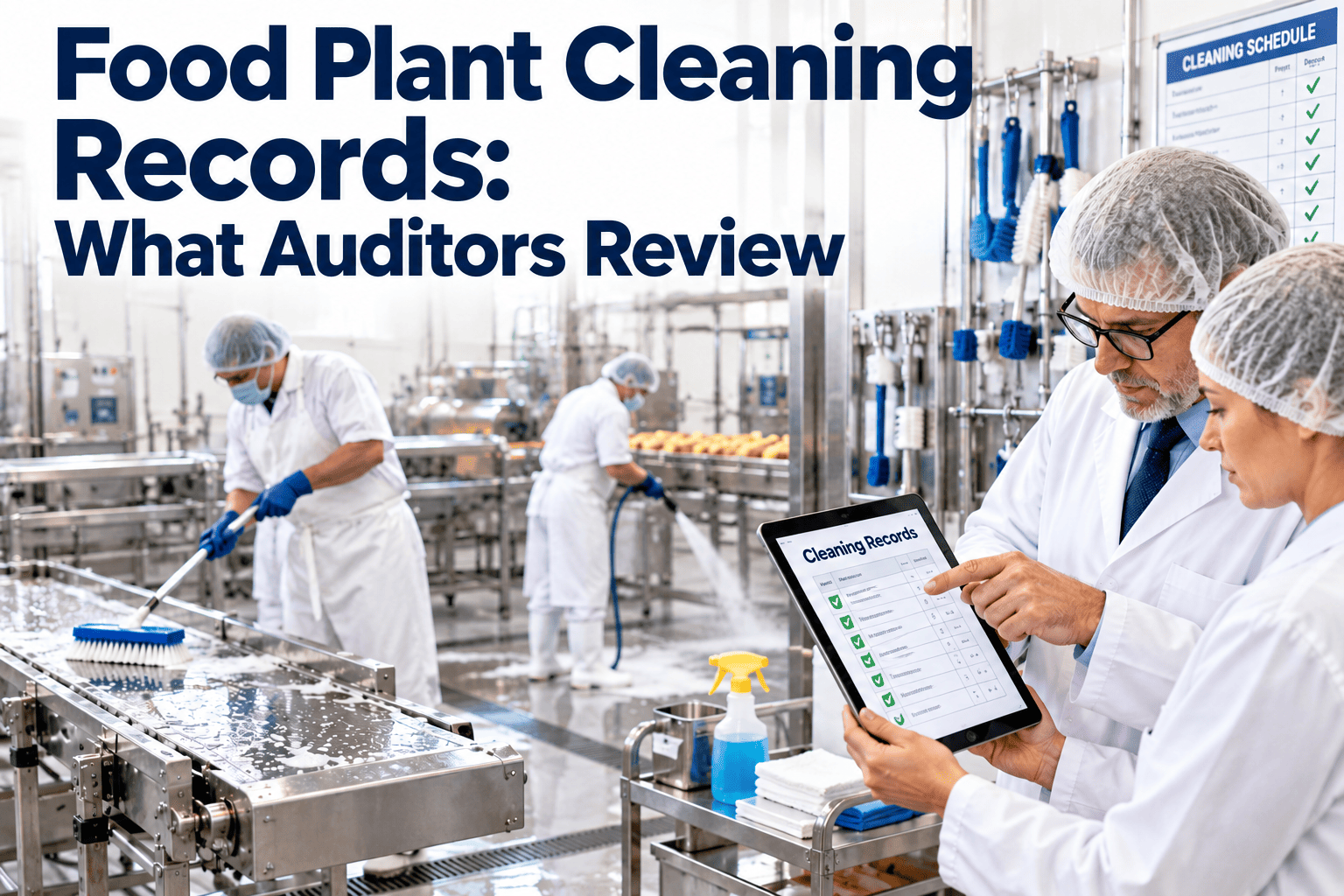
Auditors rarely start with the cleaning schedule itself. They pick a line, a date and a piece of equipment, then ask to see proof that it was cleaned, who did it, what was used, who checked it and what happened when something failed. Cleaning records that are incomplete, unsigned or hard to retrieve turn a routine request into a long search and often into a finding. This article explains what auditors typically review in food plant cleaning records and how to keep them complete and easy to find, with notes on how a CMMS-based record system supports that.
Food Plant Cleaning Records: What Auditors Review
Know which sanitation records get checked, where plants lose them and how to keep every entry complete, signed and retrievable on request.
PlanSchedule and procedure
DoSigned cleaning entry
CheckPre-operational inspection
ProveSwab or ATP result
FixCorrective action closed
How an auditor actually samples your records
1
Pick a point in time
The auditor chooses a date, a shift or a line, often at random or from something seen on the floor. If records are filed by month and by department, this request can take far too long.
2
Trace the task to the schedule
They compare the completed task against the written procedure and the master sanitation schedule to confirm the frequency, method, chemical and contact time were followed.
3
Look for the person and the time
A record needs a name, a date and a time. Initials that nobody can match to a trained employee, or entries all written in the same handwriting at the same time, raise doubts about the whole file.
4
Follow the verification
They look for an independent check, such as a pre-operational inspection signed by someone other than the cleaner, and any swab or ATP results linked to the same task.
5
Test the corrective action
Failures are expected occasionally. What matters is that the record shows re-cleaning, a re-test, a decision about product on hold and a named person who closed it.
Records auditors commonly ask to see
| Record | What it must show | Typical weak point |
|---|---|---|
| Master sanitation schedule | Area, equipment, frequency, method and responsible role | Schedule differs from what the floor actually does |
| Daily cleaning log | Task done, date, time, name, chemical and concentration | Blank boxes, pre-filled entries or missing shift |
| Pre-operational inspection | Result by area, inspector name, release for production | Same person cleans and inspects |
| Chemical records | Product used, strength check, safety data sheet on file | Concentration never recorded |
| Verification results | ATP, swab or allergen test linked to a task and location | Results kept in a lab file with no link to the task |
| Corrective actions | Fault, action, re-test, product decision, closure date | Open items with no owner or date |
| Training records | Who was trained on which procedure and when | Cleaner not trained on the task signed off |
| Equipment-related sanitation | Teardown and reassembly records for complex equipment | Maintenance and sanitation records kept separately |
Anatomy of a record that survives an audit
Complete entry
- Equipment or area identifier, not just a description such as "line 2".
- Procedure reference and revision.
- Date and start and end time.
- Chemical, concentration and contact time.
- Cleaner name and signature.
- Verifier name, result and release decision.
- Notes on any deviation and the corrective action reference.
Entry that creates questions
- Initials only, with no signature list to match them.
- Ticks with no time or concentration.
- Corrections written over the original entry.
- Verification signed before the cleaning was finished.
- Entries for equipment that was not running that day.
- Comments such as "ok" when a result was expected.
- Late entries with no explanation.
See how task, record and verification stay linked
Review a cleaning task from assignment to sign-off and corrective action in one record.
Where cleaning records go wrong
GapWhy it happensAudit exposure
Missing signaturesPaper sheets taken to wet areas, finished at the end of the shift from memoryHigh
Pre-filled or batch-filled logsPressure to keep up with production, no easy way to log at the point of workHigh
Verification with no link to the taskLab results held separately from sanitation filesHigh
Open corrective actionsNo owner, no due date, no reminderHigh
Missing concentration or contact timeField not mandatory on the formMedium
Out-of-date procedure referencedRevisions not distributed to the floorMedium
Slow retrievalRecords filed by date in binders across officesMedium
Illegible handwritingWet hands, gloves, cold roomsLower
Validation, verification and monitoring are not the same record
Monitoring
Was the task done as written?
The daily cleaning log: who did what, with which chemical and at what strength. It is a record of routine execution.
Verification
Is the program working today?
Visual inspection, ATP readings, microbiological swabs and allergen tests that check results after cleaning, with named reviewers.
Validation
Can this method work at all?
Evidence, gathered at the outset or after a change, that the chosen method, chemical and contact time can achieve the required result on that equipment.
Certification schemes and the regulations that apply to your products use these words with care, so check the language your certification body expects and keep each kind of evidence labelled correctly.
Digital cleaning records: what changes and what does not
Paper-based process
- Entries rely on handwriting and memory at the end of the shift.
- Supervisors review sheets days later, if at all.
- Missing items are found during the audit, not during the week.
- Corrective actions live on separate forms.
- Retrieval means finding the right binder.
Digital work order process
- Tasks are assigned with a due time and the procedure attached.
- Required fields prevent a task from closing with blanks.
- Overdue and incomplete tasks show up on a dashboard the same day.
- Corrective actions are raised directly from a failed check.
- Records can be searched by line, equipment, date or person.
Whichever format you choose, test it with an unannounced sample before the audit, because a system that looks complete on a dashboard can still hide blank fields, shared logins or entries made long after the work. The principle is unchanged: the person who did the task records it at the time, and an independent person verifies it. Software removes the friction, adds time stamps and makes missing records visible while there is still time to fix them.
Where a CMMS fits into sanitation records
Recurring cleaning tasksScheduled work orders by line, area or equipment with the procedure attached and a named role responsible.
Pre-operational inspectionsInspection checklists with pass or fail results and required comments on failure.
Corrective actionA failed inspection can open a corrective work order, assign it, track it and close it with evidence.
Maintenance and sanitation togetherEquipment teardown, repair and return-to-service steps can sit beside cleaning records on the same asset.
ReportingDashboards for overdue tasks, completion by shift and open corrective items before the auditor arrives.
Oxmaint supports scheduling, work orders, asset records, inspections, mobile completion and reporting, so sanitation tasks can be tracked in the same system as maintenance. Confirm with your quality team which records must remain in your food safety system and which can be managed in the maintenance system.
A weekly review routine that prevents audit surprises
Monday
Review the previous week's incomplete or late tasks and assign owners for any gaps.
Midweek
Sample three records at random and trace each from schedule to verification, as an auditor would.
Thursday
Check that every open corrective action has a named owner, a date and a re-test planned.
Friday
Confirm procedures are current and that any change has been communicated and trained.
Special cases that need their own records
Allergens
Changeover cleaning
When a line switches between products with different allergen profiles, auditors look for the changeover procedure, the person who cleaned, the verification method and the release decision before production resumed. A generic daily entry rarely satisfies this question.
Contractors
Third-party sanitation crews
Outside crews must follow the same procedures and sign the same records. Keep their training evidence, chemical approvals and entry into the plant on file, and make sure their completed tasks appear in the same system as your own staff.
Equipment
Teardown and reassembly
Complex fillers, slicers and conveyors need disassembly steps, inspection of hidden parts and confirmation that guards and fasteners are back in place. This is where maintenance and sanitation records meet and where gaps are easy to create.
Questions auditors tend to ask, and the evidence behind them
Show me what was cleaned on this date.A filtered view of completed tasks for the line and date, including time stamps and names, rather than a stack of paper sheets.
Who is allowed to verify this task?A role list or authorization matrix, with training records showing the verifier is competent to judge the result.
What did you do when this test failed?A linked corrective action with re-clean, re-test, decision on product and a closing signature and date.
How do you know the procedure is the current one?Document control showing the revision, approval date and evidence that the floor was notified and trained.
How do you review these records yourself?Management review notes, weekly audit samples and trend reports that show someone is watching the program rather than filing it.
Ownership: who is responsible for each part of the record
Floor and supervisors
- Complete each task at the time of work, not at the end of the shift.
- Record deviations immediately and notify the supervisor.
- Check that equipment and areas are marked as clean and released.
- Escalate missing chemicals, broken tools or blocked access that prevents the task.
Quality and maintenance leaders
- Maintain procedures and keep the master schedule aligned with the floor.
- Review verification results and trends, not just individual passes.
- Make sure equipment repairs trigger a cleaning and re-verification step.
- Sample records weekly and close open corrective actions on time.
Making retrieval fast
A
Use one identifier per asset
If the schedule, the cleaning log and the maintenance record each call the same machine something different, a search by equipment will miss entries. A single asset ID removes that problem.
B
Store results with the task
Attach swab, ATP and allergen results to the cleaning work order or inspection. An auditor can then follow one thread from schedule to proof without opening three systems.
C
Practise the request
Ask a colleague to request records for a random line and date, and time how long it takes to produce them. The exercise shows where the filing system fails long before an external auditor does.
What to do when a cleaning record is missing
Do this
- Raise a deviation and record exactly what is missing and why.
- Inspect the area or equipment and verify it before it is released.
- Interview the people on shift and document what they confirm.
- Find the cause, such as a missing tablet, an unclear schedule or a staffing gap, and fix it.
- Review the previous and following days for the same pattern.
Avoid this
- Filling in the entry later as though it was done on time.
- Copying the previous day's entry to make the sheet look complete.
- Letting the same person who missed the entry approve the correction.
- Closing the issue without checking whether product was affected.
- Waiting for the audit to raise the question.
Trends that show your program is under control
Completion
The share of scheduled cleaning tasks closed on time, by shift and by line.
First-pass
Pre-operational inspections that pass without re-cleaning, tracked over time.
Closure time
How long corrective actions stay open, and which areas generate repeats.
Record quality
Entries with missing fields caught by weekly sampling before an external audit.
Checklist before the next audit
Every area and equipment item on the master schedule has a current procedure.
Each cleaning entry includes name, date, time, chemical and strength.
Pre-operational inspections are signed by someone independent of cleaning.
Swab, ATP and allergen results link back to the task and location.
Failed checks show re-clean, re-test and a product decision.
Cleaner training records match the procedures they signed.
Late or corrected entries carry a reason, date and name.
A request for any date can be answered in minutes rather than hours.
Cleaning records FAQs
How long should cleaning records be kept?
Retention depends on regulation, the certification scheme and your customers' requirements. Confirm the period with your quality team and keep records easy to retrieve for that full time.
Can the same person clean and verify?
Independent verification is the safer practice because it shows a second person confirmed the result. Define who may verify each task and record their name.
Are electronic signatures acceptable?
Generally yes when they identify the person, record the time and cannot be altered unnoticed. Check your scheme and customer rules, or book a demo to see how entries are secured.
What do I do about a missed cleaning entry?
Do not back-fill silently. Record the gap, assess whether the task was done, verify the area and document the corrective action and reason.
Can maintenance software manage sanitation tasks?
Yes, scheduled work orders and inspections suit recurring cleaning and verification tasks. You can get started with one line to test it.
Keep every cleaning record complete, signed and ready to find
Link tasks, inspections and corrective actions so an auditor's request takes minutes, not a morning.