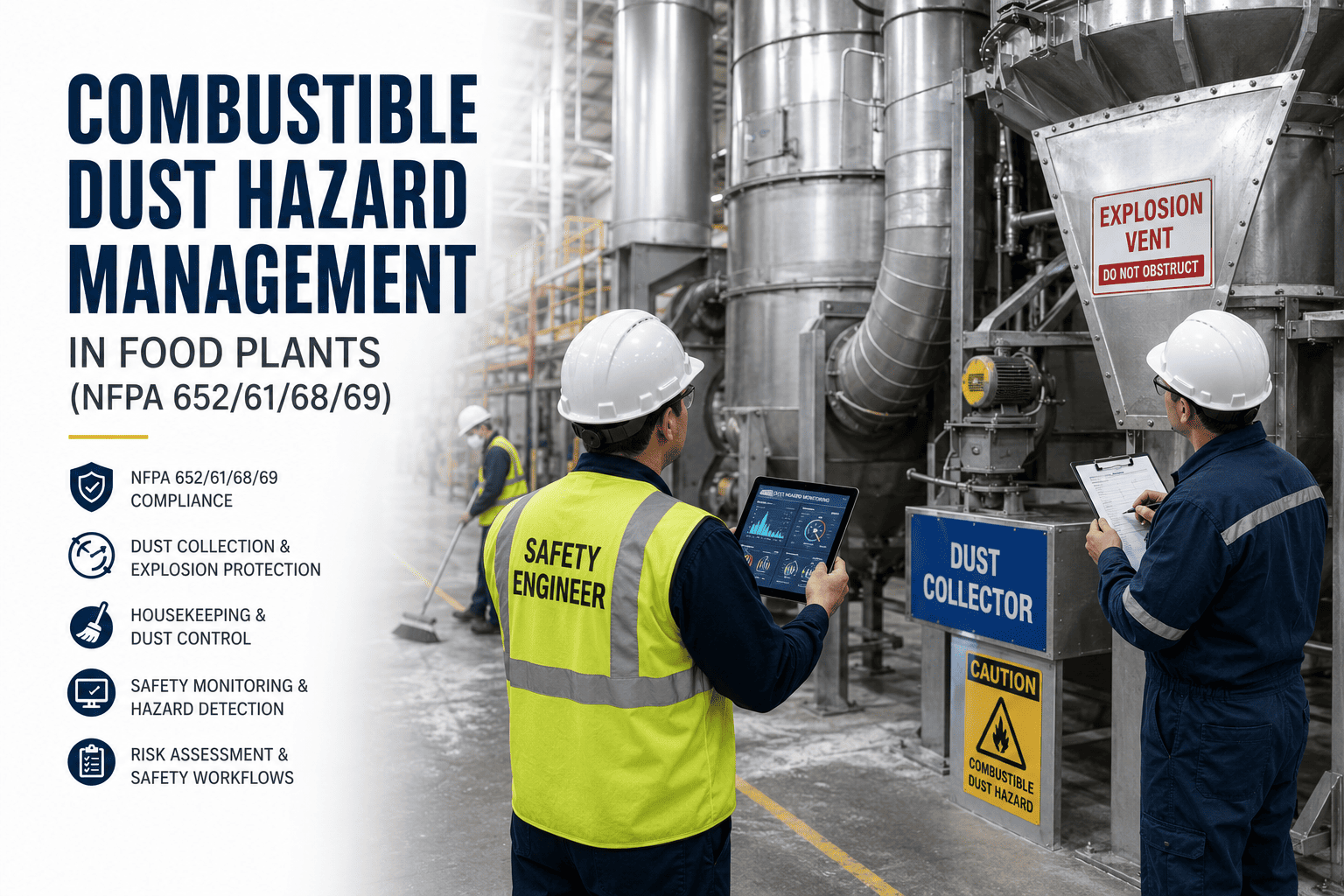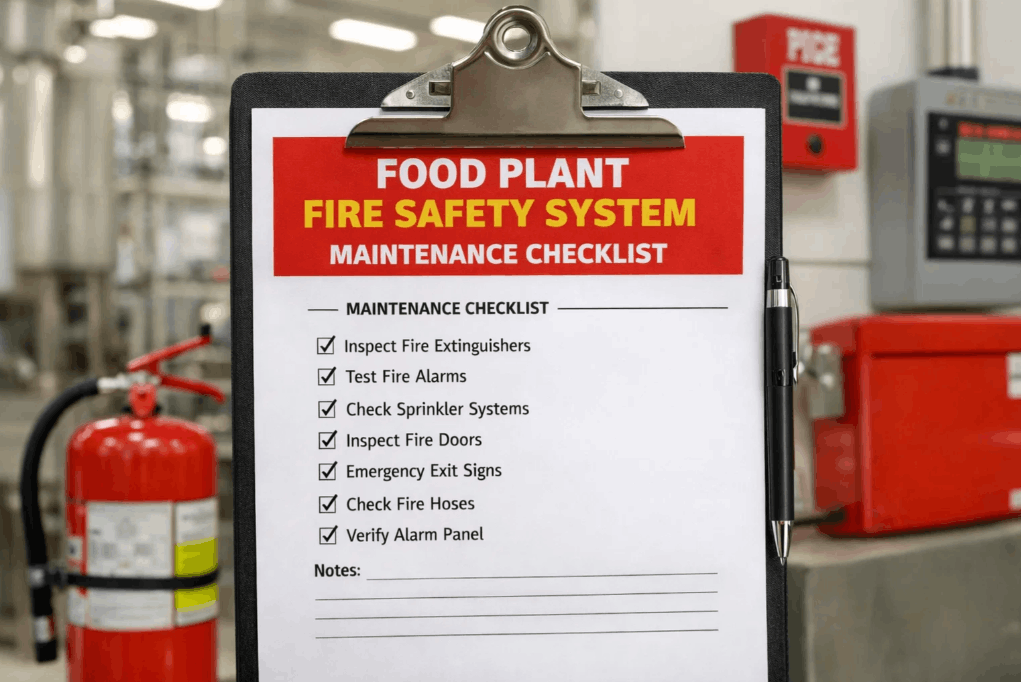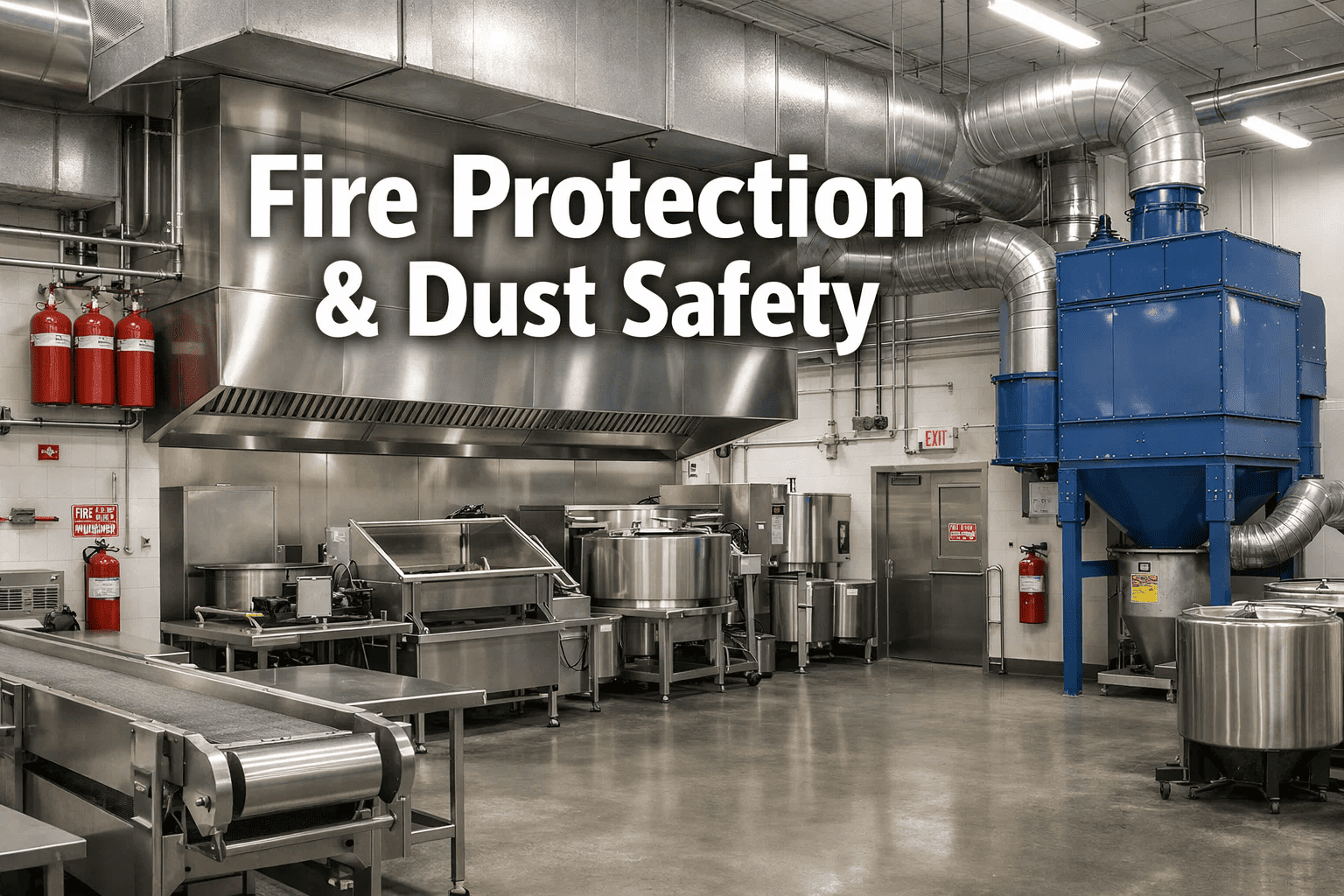
Fire in a food plant does not start with an alarm — it starts with deferred maintenance. A grease-laden kitchen hood exhaust duct that has not been cleaned on schedule. A dust collector pulse jet system with blocked valves. A combustible dust layer accumulating on overhead surfaces because the housekeeping inspection programme exists on paper but not in practice. The food processing industry ranks among the top sectors for combustible dust incidents, and NFPA data shows that facilities without documented inspection programmes are 3.4x more likely to experience a fire event than those with structured, CMMS-managed inspection schedules. Kitchen hood fires, dust collector explosions, and spontaneous combustion events in grain and flour handling are not unpredictable — they are the predictable consequence of maintenance gaps that a properly managed inspection programme prevents. OxMaint's fire protection inspection module schedules every hood cleaning, every dust hazard assessment review, every suppression system test, and every housekeeping inspection — creating the documented compliance trail that NFPA, OSHA, and your insurer all require.
Food Plant Fire Protection: Kitchen Hoods, Dust Collection, and NFPA Compliance
CMMS-managed fire safety inspections — from NFPA 96 kitchen hood maintenance and NFPA 652/660 combustible dust compliance to suppression system testing and documented Dust Hazard Analysis management.
The Two Fire Risks Every Food Plant Must Manage
Food plants face two fundamentally different fire hazard categories, each governed by separate NFPA standards, requiring different inspection protocols, and demanding distinct maintenance approaches. Treating them as one generic "fire safety" programme is the most common compliance gap auditors find — and the most dangerous one. Understanding the distinction is the first step toward a maintenance programme that actually prevents fires rather than just documenting the risk. Wondering how your inspection programme measures up? Start a free trial and book a demo to see how OxMaint manages both in a unified fire safety dashboard.
Common Food Plant Materials and Their Dust Explosion Risk
Not all food dusts are created equal — some are moderately combustible, while others are violently explosive. The Kst value (deflagration index) determines how quickly a dust explosion develops, and directly influences the protection system design required. Food plants that handle any of these materials without a completed Dust Hazard Analysis are operating in violation of NFPA 652/660 and are exposed to catastrophic risk.
Every Missed Fire Safety Inspection Is a Liability Multiplier. OxMaint Prevents Them All.
OxMaint schedules every hood cleaning, every dust collector inspection, every suppression system test, and every housekeeping verification — creating the documented compliance record that NFPA, OSHA, and your insurer require to prove your fire prevention programme is not just planned but executed.
The Complete Fire Safety Inspection Programme
A compliant fire safety programme in a food plant is not a single inspection checklist — it is a layered system of daily, weekly, monthly, and semi-annual activities across multiple hazard categories. OxMaint manages every layer with automated scheduling, structured inspection forms, and escalation protocols that ensure nothing gets missed regardless of shift coverage or personnel changes. See this in practice — start a free trial and book a demo to walk through the fire safety module.
No Documentation vs. CMMS-Documented: The Compliance Gap
The difference between a facility that claims fire safety compliance and one that can prove it during an OSHA inspection, insurance audit, or post-incident investigation is entirely about documentation. Paper-based inspection logs are legally adequate but operationally fragile — they cannot prevent missed inspections, they cannot trend performance over time, and they disappear when the filing cabinet gets reorganized.
The Financial Case for Fire Prevention Maintenance
Fire prevention is the maintenance activity with the highest ROI in food manufacturing — because the cost of failure is so catastrophic that even modest prevention spending generates enormous risk-adjusted returns. Insurance premiums alone can fund the entire fire safety maintenance programme when documented compliance earns the available premium reductions.
Frequently Asked Questions
What is a Dust Hazard Analysis (DHA) and does our food plant need one?
A Dust Hazard Analysis is required by NFPA 652 (now consolidated into NFPA 660) for any facility that handles, processes, or manufactures combustible powders — including flour, sugar, starch, spices, grain, milk powder, and cocoa. The DHA identifies potential fire and explosion hazards from combustible dust, evaluates existing safeguards, and must be reviewed every 5 years or whenever process changes occur. If your food plant handles any powdered material, you almost certainly need a DHA. OxMaint tracks DHA completion dates, links them to process change management, and alerts when reviews are due.
How often must kitchen hood suppression systems be inspected under NFPA 96?
NFPA 96 requires kitchen hood fire suppression systems to be inspected and serviced by qualified personnel at least every 6 months. High-volume cooking operations or those with solid-fuel equipment (wood-fired ovens, charbroilers) may require more frequent inspections. Inspections must include nozzle coverage verification, agent level checks, manual pull station testing, automatic fuel/power interlock testing, and documentation of all findings. OxMaint schedules these inspections automatically and generates the structured inspection forms that ensure every required element is checked and documented.
What are the key differences between NFPA 652 and NFPA 660?
NFPA 652 (Standard on the Fundamentals of Combustible Dust) has been consolidated into NFPA 660 (Standard for Combustible Dusts and Particulate Solids). NFPA 660 combines the foundational requirements of NFPA 652 with industry-specific standards into a single comprehensive document. For food plants, NFPA 61 (Standard for the Prevention of Fires and Dust Explosions in Agricultural and Food Processing Facilities) remains the primary industry-specific standard. OxMaint's inspection templates are aligned with current NFPA 660 and NFPA 61 requirements, so your inspection programme stays compliant as standards evolve.
How does OxMaint help with insurance audits for fire protection compliance?
Insurance auditors reviewing fire protection compliance need documented evidence that inspections were performed on schedule, findings were addressed with corrective actions, and all fire protection systems were tested and maintained. OxMaint generates complete inspection history reports — showing every hood cleaning, every dust collector inspection, every suppression system test, and every housekeeping verification with dates, findings, corrective actions, and digital sign-offs. These reports export in PDF format and typically satisfy insurer requirements within minutes rather than the hours or days that paper-based evidence compilation requires.
Fire Prevention Is Maintenance. Maintenance Is Documentation. OxMaint Is Both.
OxMaint schedules every fire safety inspection, documents every test result, tracks every corrective action, and generates the compliance evidence that NFPA, OSHA, and your insurer require — so your fire prevention programme is not just planned, but proven.