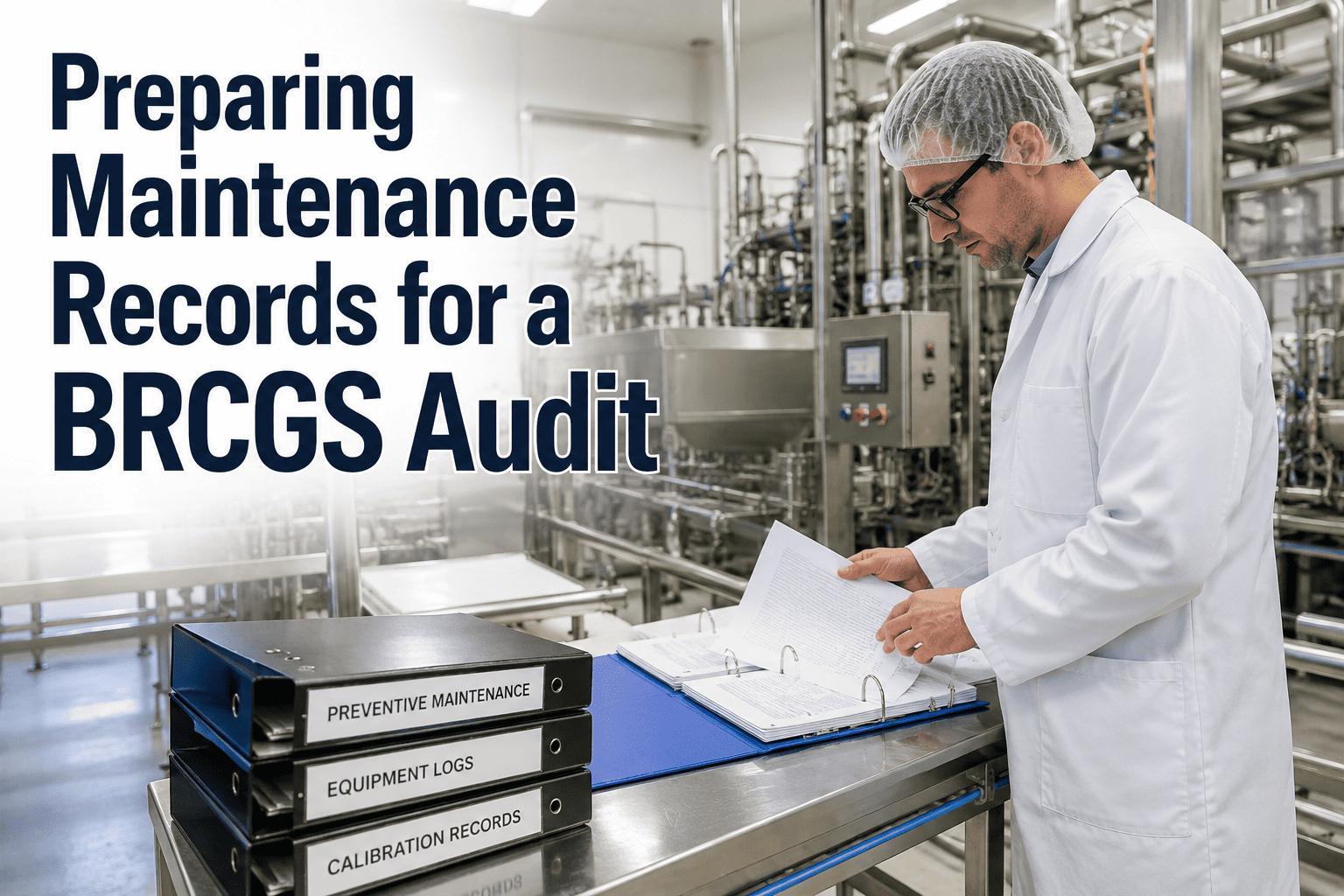
SQF Code Edition 9 requires not just that maintenance is performed — it requires that maintenance is documented, scheduled, traceable, and available for auditor review within minutes. An SQF auditor who asks to see preventive maintenance records for the past 12 months expects to find every scheduled task completed on time, every corrective action closed with evidence, every calibration certificate filed against the specific instrument ID, and every pest control service report attached to the inspection record it corresponds to. Maintenance teams running paper-based systems spend 3–5 days scrambling to assemble this documentation before every audit cycle — and still find gaps that generate observations or non-conformances. Start a free trial to see how OxMaint generates a complete SQF-ready maintenance documentation package from your live PM records — available any day, at any time, without preparation.
Average time food plants spend assembling maintenance documentation before each SQF audit — industry survey 2024
34%
Of SQF audit non-conformances relate to maintenance documentation gaps — not actual maintenance failures — SQFI data 2023
$180K
Average cost of SQF certification suspension — lost contracts, re-audit fees, emergency corrective actions
Edition 9
Current SQF Code requires documented maintenance programs, calibration schedules, and corrective action management under Module 11
SQF Code Context
What SQF Auditors Look for in Maintenance Records
SQF Code Edition 9 Module 11 places specific documentation requirements on maintenance and calibration programs. Auditors examine PM schedules, calibration records, pest control logs, sanitation records, and corrective action management as interconnected elements of a functioning food safety management system. A PM schedule that lists tasks is not sufficient: the auditor wants evidence that each task was completed on time, by a qualified person, with documented findings, and that any deficiencies raised a corrective action that was subsequently closed.
Six SQF Maintenance Documentation Categories — All Required
01
Preventive Maintenance Records
Completed PM work orders for all food-contact and food-safety-related equipment — including task description, completion date, technician name, and findings. Minimum 12-month retention under SQF Code.
02
Calibration Certificates
Calibration records for all measuring devices that affect product safety — thermometers, scales, pH meters, metal detectors, checkweighers. Traceable to instrument ID, calibration date, and NIST-traceable standard.
03
Corrective Action Records
Every maintenance-related deficiency must generate a documented corrective action with root cause, immediate action, preventive action, responsible person, due date, and closure evidence. Open CARs at audit time are major findings.
04
Pest Control Documentation
Pest control service reports, trap logs, pest activity records, corrective actions, and annual bait station maps — all maintained as a continuous, dated record. Gaps in weekly trap logs are auditable deficiencies.
05
Sanitation and Hygiene Records
Sanitation verification records confirming pre-operational and post-operational cleaning of food-contact surfaces. Swab results, visual inspection sign-off, and chemical concentration verification are all auditable records.
06
Equipment Maintenance Schedules
Documented PM schedules showing all equipment, task descriptions, responsible person, and frequency — with evidence that tasks were performed on schedule. Ad-hoc maintenance is not a substitute for a structured program.
SQF auditors are not checking whether your equipment works — they are checking whether your management system is producing the records that prove your food safety program is operating. Documentation gaps expose a system that is not functioning as written, regardless of actual maintenance quality.
Pain Points
Four Documentation Failures That Generate SQF Non-Conformances
01
Calibration Certificate Gaps
An instrument found overdue for calibration at audit time generates a minor non-conformance. An instrument that was out of calibration during production requires a product safety assessment covering all product made in the affected period — which can escalate to a product hold. Digital calibration tracking with 30-day advance alerts prevents the gap before it reaches audit.
A PM task not completed on schedule is not automatically a non-conformance — but only if the reason for the delay is documented, the rescheduled date is recorded, and a supervisor has authorized the extension. An unexplained gap in the PM record — no completion date, no deferred date, no reason — is a system failure finding, not just a missed task.
04
Corrective Action Root Cause Depth
SQF auditors read corrective actions. A corrective action that describes the symptom and the fix — "bearing failed, bearing replaced" — does not satisfy Module 11 requirements, which require root cause analysis. The depth of root cause documentation differentiates facilities at SQF certification grade boundaries.
Before vs After
Manual Documentation vs OxMaint SQF-Ready Records
SQF Requirement
Paper / Manual Approach
OxMaint Digital System
PM completion records
Paper work orders filed by date — not by equipment. Gaps easy to miss, auditor search is manual and slow.
PM records linked to equipment asset. Instantly filterable by equipment, date, technician, and completion status.
Calibration certificate filing
Certificates filed in binders by date — no link to instrument ID. Overdue instruments only discovered manually.
Certificates attached to instrument asset record. Overdue instruments flagged 30 days before deadline.
Corrective action management
Paper CARs in folder — no escalation, no due date tracking. Open CARs discovered at audit review.
Digital CARs with due date, responsible person, and auto-escalation. Overdue CARs surfaced automatically to supervisor.
Pest control log continuity
Paper trap logs — missing weeks create gaps. Contractor reports filed separately from internal logs.
Digital trap logs with timestamped entries. Contractor reports attached to service visit work orders.
Pre-operational inspection records
Paper sign-off sheets — difficult to search. Gaps in record visible only on manual page-by-page review.
Digital pre-op checklist with timestamp and technician ID. Missing days immediately visible in calendar view.
SQF audit package preparation
3–5 days of manual compilation across multiple filing systems — under pressure before audit window
SQF audit package filtered by date range and record type — complete in under 20 minutes, available any day of the year
ROI & Results
What Digital SQF Documentation Management Delivers
20 min
SQF Audit Package Generation
vs 3–5 days manual preparation — available any day of the year, not just when the audit date is known
Zero
Open Corrective Actions at Audit
Auto-escalation ensures all CARs are closed with evidence before audit window — the most impactful SQF documentation metric
34%
Reduction in Documentation Non-Conformances
Structural improvement from digital records eliminating log gaps, missing signatures, and lost calibration certificates
$180K
SQF Suspension Cost Avoided
Average cost to a mid-size food manufacturer of SQF certification suspension — lost key accounts, re-audit fees, emergency projects
FAQ
SQF Maintenance Documentation — Common Questions
How long must maintenance records be retained to satisfy SQF Code Edition 9?
SQF Code Edition 9 requires maintenance and calibration records to be retained for a minimum of 12 months — or longer if required by customer or regulatory requirements, or by the shelf life of the product manufactured. For products with shelf lives beyond 12 months (some ambient products, frozen foods), the retention period should extend beyond the product shelf life to enable traceability in the event of a product safety concern. OxMaint maintains digital records indefinitely with no automatic deletion — records are archived and remain searchable by equipment ID, date, or technician even beyond the minimum retention period. Start a free trial to configure your record retention policy in OxMaint and verify all records meet SQF retention requirements.
What is the SQF requirement for metal detector and X-ray calibration and testing?
SQF Code Edition 9 Module 11 requires that all product safety measuring devices — including metal detectors and X-ray inspection equipment — are calibrated on a defined schedule that is documented and traceable. For metal detectors, this means test records using approved HACCP test pieces at all operating sensitivity levels at defined frequencies. The test record must identify the test piece type and size, the machine ID, the test result, and the technician. Calibration of the underlying instrument must be performed by a qualified technician with a NIST-traceable reference, and the certificate must be linked to the specific machine serial number.
What does SQF expect when a corrective action cannot be closed within the original due date?
SQF Code accepts that corrective actions may require extended timelines for complex root causes — but the extension must be documented. When a CAR cannot be closed on time, the responsible person must document: the reason for the extension, what interim control measures are in place to manage the risk during the extended period, the revised due date, and the approving authority. An open CAR with no extension documentation at audit time is treated as an unclosed non-conformance — regardless of whether genuine progress has been made. OxMaint's corrective action workflow includes an extension request process that documents the reason, interim controls, and revised date. Book a demo to see OxMaint's corrective action management workflow including extension documentation.
Can maintenance contractors perform SQF-required maintenance tasks, and how should their work be documented?
Yes — SQF Code permits contracted maintenance services, but the documentation responsibility remains with the food manufacturer. This means: the contractor's qualifications must be documented, the work performed must be documented with sufficient detail to satisfy the PM record requirements, and the food manufacturer must verify the work and sign off on the return-to-service record. OxMaint supports contractor-assigned work orders that can be completed and submitted by external technicians via the contractor portal — with the facility's authorized person reviewing and confirming the work before the task is marked complete.
Make Every Day an Audit-Ready Day — Not Just the Week Before the Auditor Arrives
OxMaint structures your PM records, calibration certificates, corrective actions, and pest control documentation into a continuous, searchable, audit-ready record — so your SQF audit package is generated in 20 minutes, any day of the year.
PM and calibration records linked to equipment ID — instantly searchable by auditors
Auto-escalated corrective actions — zero open CARs at audit time
Full SQF Module 11 audit package in under 20 minutes
Used by operations teams managing 10,000+ assets · Live in days, not months · No heavy implementation required