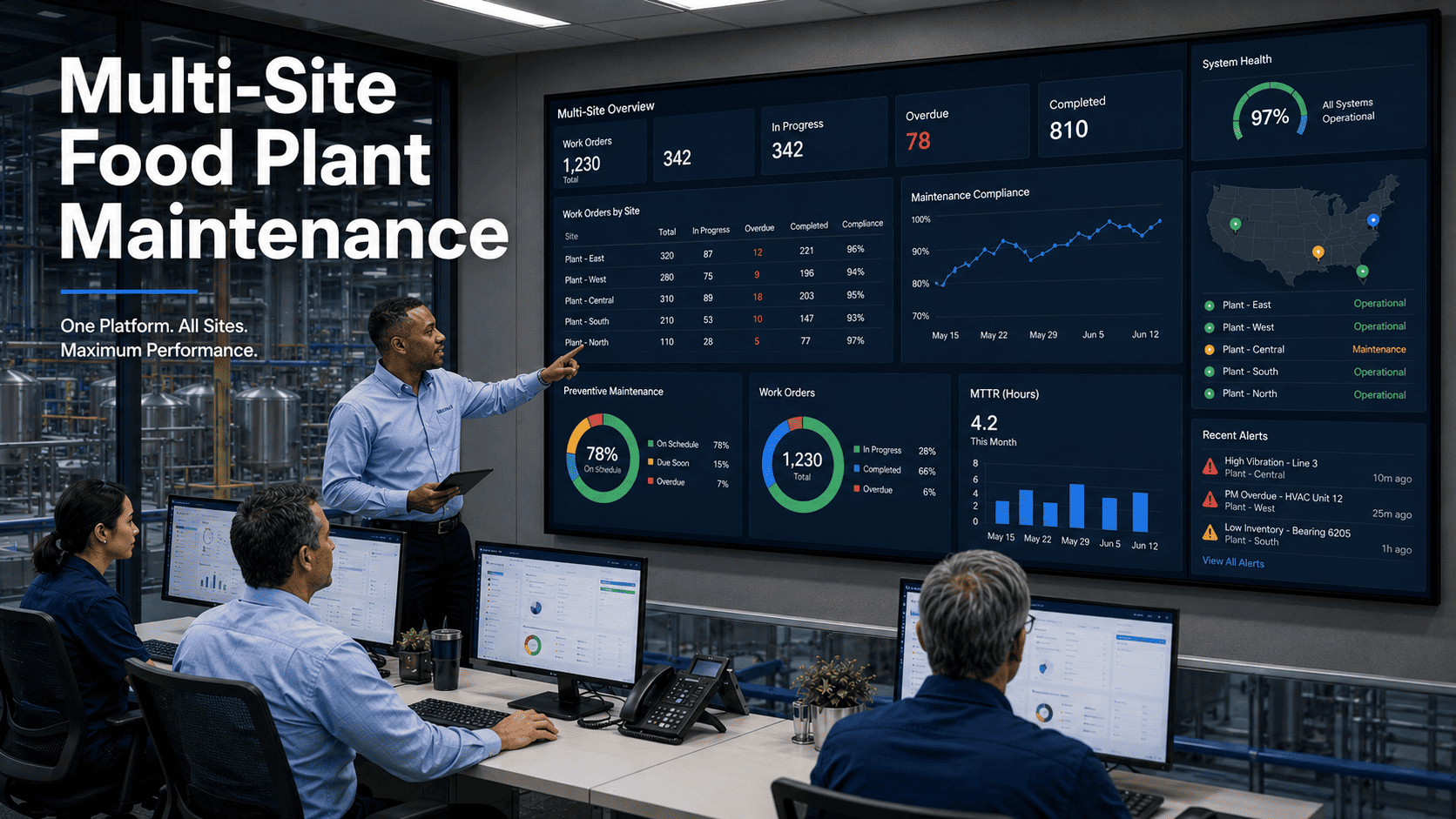
Coordinating maintenance across multiple food-production lines is where lean maintenance teams either hold the plant together or get torn apart by competing emergencies. When four processing lines share the same three technicians, a single unplanned filler fault on Line 3 can starve Lines 1, 2, and 4 of parts within minutes, and the weekly PM backlog balloons past 60 open work orders. A CMMS built for multi-line food plants reframes that chaos into sequenced dispatch, shared resource allocation, and cross-line PM clustering that lifts OEE by 8–14 points. See how OxMaint handles it when you Start Free Trial today.
Multi-Line Maintenance Coordination Guide · 2026
When three technicians cover five production lines, who gets the wrench first?
Without a cross-line CMMS, maintenance becomes a firefighting triage between competing emergencies — fillers, ovens, sealers, and packaging all screaming for the same two hands. Coordinated multi-line scheduling flips that into planned dispatch, shared parts pools, and PM windows that protect every line's OEE.
The Cost Of No Coordination
What uncoordinated multi-line maintenance actually costs a food plant
A mid-sized food plant running 4–6 processing lines typically carries 1 maintenance technician per 40 assets. When dispatch is reactive and PMs are scheduled line-by-line in silos, three structural problems compound — and each one shows up on the P&L within a single quarter.
Worked Example
A 180-asset frozen-meals plant in the Midwest ran five packaging and processing lines with four technicians and a paper-and-Spreadsheet PM system. Fillers on Lines 2 and 4 shared the same positive-displacement pump rebuild kit, but procurement ordered per-line, so Line 2 ran the kit dry while Line 4's sat in a locked crib. Average MTTR across the plant sat at 94 minutes, and PM compliance hovered at 58%. Within 90 days of deploying a cross-line CMMS with shared BOM pools and staggered PM windows, the plant cut MTTR to 41 minutes, lifted PM compliance to 91%, and recovered roughly $610K in annualized downtime cost — against a CMMS spend of under $24K/year.
The 4-Stage Coordination Model
How a multi-line CMMS sequences dispatch, resources, and PMs
Coordination is not one feature — it is four interlocking workflows that the CMMS orchestrates across every line simultaneously. Each stage feeds the next, so a dispatch decision on Line 1 automatically reshuffles PM priority on Line 5.
Priority-Weighted Dispatch
Every open work order across all lines is scored on a weighted matrix: production impact (units/hr at risk), food-safety criticality (CCP proximity), downtime duration, and parts availability. The CMMS surfaces the top-priority job to the right technician in real time — no whiteboard arguments, no shift-handover gaps.
Cross-Line Resource Allocation
Technicians, tools, calibration kits, and spare parts are pooled in a single resource ledger visible to every line supervisor. When Line 3's sealer goes down, the CMMS shows whether the one spare thermal-print head is in the crib, on Line 1's PM cart, or on order — and rebooks it to the higher-priority job automatically.
Staggered PM Clustering
Instead of every line's weekly PM landing on Tuesday morning, the CMMS staggers PM windows across the week and clusters same-asset-type PMs (e.g., all five fillers' quarterly gearbox inspections) into a single technician block — cutting setup time by up to 35% and freeing 6–9 technician-hours per week.
Shared Reliability Feedback
Failure codes, MTBF trends, and root-cause notes flow into one asset-knowledge base regardless of which line generated them. A recurring bearing failure on Line 2's conveyor triggers a predictive inspection recommendation on Lines 1, 4, and 5 that share the same OEM model — closing the loop between dispatch and continuous improvement.
PM Scheduling Timeline
A staggered 5-line PM calendar that protects every shift
The grid below shows how a coordinated CMMS lays out weekly PMs across five processing lines so no two high-criticality PMs collide for the same technician, and so sanitation windows (CIP/COP) are never interrupted. Each row is a line; each gold block is a scheduled PM block.
Resource Allocation Formula
The dispatch-priority score that replaces gut-feel triage
When three work orders land within the same 10-minute window across different lines, the CMMS ranks them using a transparent weighted formula. Production supervisors and maintenance leads see the same score, so dispatch decisions are defensible and audit-ready.
Priority Score (PS) per open work order, all lines:
PS = ( I × 0.40 ) + ( S × 0.25 ) + ( D × 0.20 ) + ( P × 0.15 )
Where I = production impact (units/hr at risk, 0–100 scale), S = food-safety criticality (CCP proximity, 0–100), D = downtime duration so far in minutes, P = parts availability index (0 = not in crib, 100 = in stock). Higher PS = dispatch first.
Worked Example — Tuesday 09:14
- Line 2 Filler Bearing seize, 18 min downtime, 4,200 units/hr at risk, CCP-adjacent, part in crib → PS = 92.4
- Line 4 Sealer Film jam, 6 min downtime, 1,800 units/hr at risk, no CCP, part on order → PS = 38.7
- Line 5 Packer Sensor drift, 0 min downtime yet, 900 units/hr at risk, part in crib → PS = 29.1
Technician is dispatched to Line 2; Line 4's jam is auto-flagged for the next available window in 35 minutes; Line 5's sensor is bundled into Wednesday's calibration block.
Siloed vs Coordinated
Multi-line coordination: before and after a cross-line CMMS
The table below maps the operating profile of a typical 4-line food plant running siloed, line-by-line maintenance against the same plant after 90 days of CMMS-driven cross-line coordination. Every row is a measurable KPI — not an aspiration.
| KPI / Operating Metric | Siloed Line-by-Line | Cross-Line CMMS | Delta |
|---|---|---|---|
| Mean time to repair (MTTR) | 94 min | 41 min | −56% |
| PM compliance rate | 58% | 91% | +33 pts |
| Unplanned downtime per line / week | 42 min | 14 min | −67% |
| Technician cross-line travel hrs / week | 11.4 hrs | 3.2 hrs | −72% |
| Spare parts duplicate orders / quarter | 27 | 4 | −85% |
| Overall equipment effectiveness (OEE) | 61% | 74% | +13 pts |
| Audit-ready work order closure rate | 49% | 96% | +47 pts |
Coordination Benefits
What changes the week your CMMS goes cross-line
The shift from siloed to coordinated maintenance is felt on the floor within the first full production cycle. These are the four benefit tiles operators and maintenance leads report most consistently inside the first 30 days.
Faster Dispatch, Fewer Arguments
Priority scores replace shift-handover debates. Technicians see their next job, the parts waiting, and the line context — before they walk to the floor.
PM Compliance Without Overtime
Staggered clustering fits weekly PMs into regular shift hours, cutting weekend overtime calls by up to 60% and pushing PM compliance above 90%.
One Parts Pool, Zero Hoarding
A shared BOM and crib ledger stops line technicians from hiding critical spares in their own lockers. Duplicate orders drop 70–85% inside one quarter.
Reliability That Compounds
Failure codes from one line's breakdown trigger predictive inspections on every sister asset. MTBF climbs 20–35% across the plant in six months.
Ready When You Are
See your five lines coordinated from one maintenance dashboard
Spin up a free OxMaint workspace, import your asset register, and watch staggered PMs and priority dispatch go live across every line in under a week.
Frequently Asked Questions
Multi-line CMMS coordination, answered
The five questions food-plant maintenance managers ask most often before rolling out a cross-line CMMS — with specific, practical answers.
How does a CMMS prioritize dispatch when multiple lines go down at once?
Every open work order is scored on a weighted matrix — production impact (40%), food-safety criticality (25%), downtime duration (20%), and parts availability (15%). The technician sees a ranked queue, not a shouting match. If a filler seize on Line 2 scores 92 and a film jam on Line 4 scores 38, Line 2 wins the wrench and Line 4 is auto-scheduled for the next 35-minute window.
Can a multi-line CMMS work with fewer than five technicians?
Yes — it is built for exactly that constraint. Plants with three technicians covering five lines see the biggest gains, because staggered PM clustering and shared parts pools recover 6–9 technician-hours per week that were previously lost to travel and duplicate effort. You can Start Free Trial and configure your technician pool in the setup wizard.
What happens to PM schedules when an unplanned breakdown interrupts them?
The CMMS does not cancel the PM — it rebaselines it. The interrupted PM is pushed to the next available staggered slot within 48 hours, and every downstream PM on that line and its shared-resource lines is automatically re-laid so no two high-criticality PMs collide. Supervisors get a single rebaseline notification, not a cascade of emails.
Does cross-line coordination help with food-safety audits and CCP records?
Substantially. Every PM, corrective action, and parts replacement is time-stamped, line-tagged, and tied to the asset's CCP relationship. Audit-ready closure rates typically jump from under 50% to above 95% because the CMMS refuses to close a work order without the required verification fields. Book a walkthrough via Book a Demo to see the audit export.
How long does it take to roll out CMMS-driven multi-line coordination in a food plant?
A 4–6 line plant with a clean asset register can be live in 5–7 working days: day 1–2 asset and BOM import, day 3 PM staggering and dispatch rules, day 4 technician onboarding, day 5–7 parallel running with the old system. Measurable MTTR and PM-compliance gains appear inside the first 30 days; full OEE uplift typically lands at the 90-day mark.
Start Coordinating Today
Stop choosing which line gets the wrench. Coordinate all of them.
Deploy OxMaint across every processing line and turn competing emergencies into sequenced, auditable, cross-line maintenance — in under a week.
Free 14-day trial · No credit card