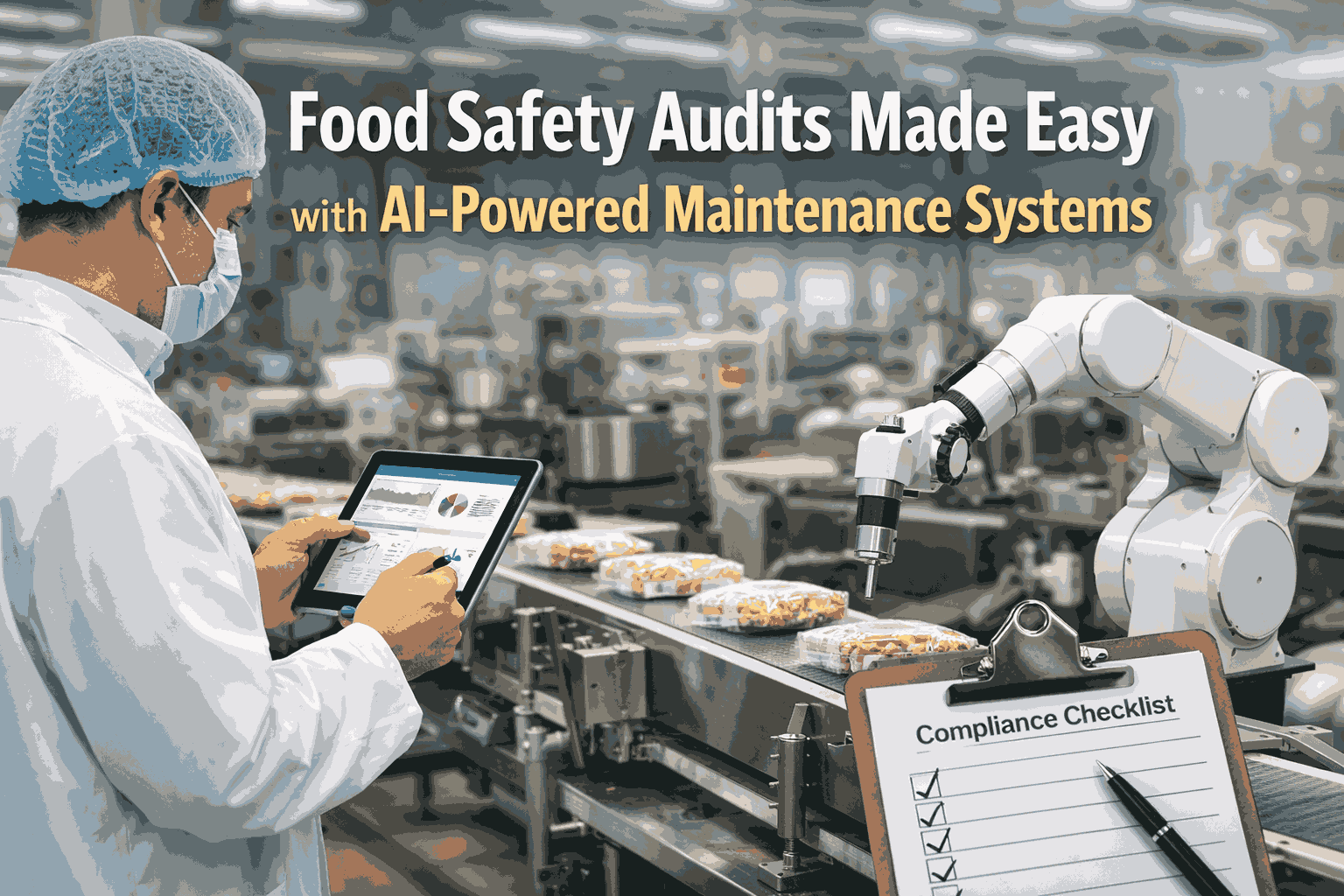
The FDA inspector doesn't call ahead. They arrive, ask for your records, and within hours your entire compliance posture is either an asset or a liability. Most food manufacturers spend weeks scrambling to assemble documentation that should have been building itself automatically — every day, on every shift, from every piece of monitored equipment. In 2026, that scramble is no longer necessary. AI-powered maintenance systems are turning food safety audits from the most stressful event of the year into the most routine one.
The Audit Problem Nobody Talks About
Your Audit Problem Starts Long Before the Inspector Walks In
Food safety audits — whether FDA, SQF, BRC, or internal — are not tests of what you know. They are tests of what you can prove. The most compliant facility in the country fails an audit the moment it cannot produce the right documentation at the right moment. And documentation failures are overwhelmingly not caused by non-compliance — they are caused by manual systems that depend on people to capture, organize, and retrieve data under pressure.
Under FSMA's Preventive Controls rule, food manufacturers must demonstrate that Critical Control Points are actively monitored, that deviations are identified and corrected, and that the entire system is functioning as designed. A binder of paper logs and a spreadsheet assembled the week before inspection does not demonstrate a functioning system. It demonstrates retroactive record assembly — which FDA inspectors are trained to recognize.
The shift the FDA made with FSMA was not just about what you must do — it was about what you must be able to prove you did, in real time, at any moment of any day.
Manual vs. AI-Powered Audit Readiness
Two Approaches to the Same FDA Inspection — One Outcome Is Very Different
Manual Documentation System
How most food plants operate today
Maintenance logs handwritten on paper, transferred to spreadsheets weekly — if remembered
Temperature records require manual walkthrough and entry — shift-dependent, inconsistent
CAPA items tracked in email threads — no central status, no automated closure verification
Equipment calibration due dates tracked in a shared calendar that someone manages manually
Audit prep takes 1–3 weeks of staff time, pulling people from production to compile records
Gaps in documentation only discovered during the audit — too late to correct without triggering observations
Oxmaint AI Maintenance System
Audit-ready every day, automatically
Every maintenance task timestamped automatically — technician, action, outcome, asset logged on completion
IoT sensors capture temperature, vibration, and process parameters continuously — no manual entry, no gaps
CAPA items auto-generated from AI alerts — tracked, assigned, escalated, and closed in one system
Calibration schedules automated with alerts — never overdue, always documented with results
Audit package generated on demand — complete records for any asset, date range, or regulatory standard in minutes
Gaps identified and corrected in real time — no surprises on inspection day because every day is inspection day
What AI Tracks for You
Every Record an Auditor Will Ask For — Built Automatically
01
Preventive Maintenance Records
Every scheduled PM task — lubrication, filter changes, belt inspections, sensor calibrations — logged with technician ID, completion time, and outcome. If a task is overdue, the system escalates automatically. FDA inspectors looking for your PM compliance record get a complete, uninterrupted chain of documentation going back to day one.
02
Temperature and CCP Monitoring Logs
Continuous sensor data from pasteurizers, cold storage, cooking equipment, and any other CCP-linked asset. Not spot-checked. Not shift-entered. Captured every minute, timestamped, and stored. When an auditor asks for three months of pasteurizer temperature compliance data, it takes two minutes to generate — not two days.
03
Deviation Detection and CAPA Documentation
When a parameter deviates from its control limit, the system creates a deviation record, triggers a corrective action workflow, assigns it to the responsible person, tracks progress, and documents closure — all automatically. This is exactly what FSMA requires under Preventive Controls: evidence that deviations are identified, corrected, and that corrections are verified.
04
Equipment Calibration and Verification Records
Calibration due dates, calibration results, out-of-tolerance findings, and recalibration documentation — all managed in one place with automatic scheduling and alerts. The most common Form 483 observation in food plants is equipment used outside its calibrated range. This single documentation stream eliminates that risk entirely.
05
Sanitation and Cleaning Verification Logs
Sanitation task completion, chemical concentrations, contact times, and post-cleaning ATP verification results — all captured in the same system. CIP pump performance monitored via IoT sensors provides physical evidence that cleaning reached specified flow rates and temperatures, not just that someone clicked "complete" on a checklist.
06
Work Order History and Asset Audit Trail
Every work order ever created for an asset — planned, predictive, reactive, emergency — with full history of who did what, when, and what was found. When an auditor asks about the maintenance history of a specific pasteurizer, every intervention going back years is retrievable in seconds. This is the asset audit trail that turns a potential observation into a demonstrated control.
One System. Every Audit Type You Face.
Oxmaint's AI maintenance records satisfy documentation requirements across every standard your facility operates under.
FDA / FSMA
Preventive Controls documentation, CCP monitoring records, CAPA tracking, and supply chain verification logs — all in scope, all automated.
SQF (Safe Quality Food)
Equipment maintenance records, calibration schedules, internal audit documentation, and corrective action evidence for SQF Level 2 and Level 3 certification.
BRCGS
Planned maintenance records, emergency repair logs, equipment condition assessments, and documented PM completion rates for BRC Global Standards compliance.
HACCP Internal Audits
CCP monitoring logs, limit deviation records, corrective action documentation, and verification records — the complete HACCP evidence package, ready instantly.
The ROI of Audit Readiness
What Audit Failures Actually Cost — and What Preventing Them Is Worth
The Real Cost of a Failed Audit
FDA reinspection fees (FY2025 rate)
$340/hr of FDA work time
Internal compliance remediation project
$50,000 – $250,000
Product recall triggered by a safety gap
$10M average industry cost
Staff time assembling audit documentation
40–120 hours per audit
Brand damage from public warning letter
Unquantifiable — permanent
What Oxmaint Delivers
Zero
Documentation gaps — every record captured automatically, every day
<5 min
Time to generate a complete audit package for any asset or date range
100%
Calibration compliance — automated scheduling eliminates overdue equipment
365
Days per year in full audit-ready status — not just the week before inspection
See Your Compliance Dashboard in Action
Oxmaint shows you your audit readiness score in real time — every asset, every record, every open CAPA. Know where you stand before the inspector does.
The FSMA 2026 Context
The Regulatory Environment Is Tightening. Your Documentation System Needs to Keep Up.
FSMA 204 Traceability Rule
Extended to July 2028 — But the Smart Move Is Now
The FDA extended FSMA 204 compliance to July 2028, but retailers like Walmart and Kroger are already requiring full traceability from all suppliers — regardless of the federal deadline. Facilities that build digital documentation infrastructure now will satisfy both regulatory and customer requirements, while those that wait will face a compressed, high-pressure implementation timeline. The extension buys time. It does not reduce the requirement.
FDA Inspection Intensity
High-Risk Facilities Must Be Inspected Every 3 Years — and Inspectors Are Better Prepared
FDA is mandated to inspect every high-risk domestic food facility at least once every three years. Despite resource constraints in 2025, inspection intensity for facilities with prior observations is increasing. Inspectors in 2026 are specifically looking for data integrity — whether your digital records are consistent, continuous, and tamper-evident. Manual systems that have been digitized retroactively are increasingly obvious to trained reviewers.
Bacteria Recalls at 5-Year High
Regulatory and Commercial Pressure Are Moving in the Same Direction
Bacteria-related food recalls reached a five-year high in 2024. Consumer trust in government food safety assurance hit a record low in the same period. The result: major retail customers are independently auditing suppliers more aggressively than ever — requiring audit-ready documentation as a condition of supply agreement. Compliance is no longer just a regulatory requirement. It is a commercial prerequisite for major retail shelf placement.
Getting Started
From Paper Logs to Audit-Ready in 30 Days
1
Map Your Audit Requirements
Identify every record your facility is required to produce — by regulation, certification standard, and customer requirement. This becomes your documentation baseline. Most facilities discover they are managing 8–12 separate documentation streams that can be unified in one system.
2
Deploy Sensors on CCP-Linked Equipment
Install IoT sensors on every asset tied to a Critical Control Point — pasteurizers, cold storage, CIP systems, cooking equipment. These sensors create the continuous monitoring record that FSMA requires and that manual systems cannot reliably produce. Installation takes hours, not days.
3
Configure Automated PM and CAPA Workflows
Build your PM schedule into the system. Configure CAPA workflows for your deviation response process. Connect alert thresholds to your HACCP control limits. Within two weeks, the system is actively building your compliance record — automatically, on every shift, with no manual intervention.
4
Monitor Your Live Audit Readiness Score
Your Oxmaint dashboard shows audit readiness in real time — open CAPAs, overdue calibrations, PM completion rates, and documentation gaps — before they become inspection findings. You know your compliance posture every day, not just the day before an audit.
Our last FDA inspection took three hours. The inspector asked for two years of pasteurizer maintenance records, calibration logs, and every CAPA we had opened in the past 18 months. We pulled everything in under ten minutes. She said it was the most organized documentation package she had seen. That used to take us two weeks to prepare.
Food Safety Manager, Beverage Manufacturing Facility
73%
Reduction in audit preparation time reported by Oxmaint customers
Zero
Documentation-related Form 483 observations for facilities using full digital maintenance tracking
42%
Average maintenance cost reduction — compliance and efficiency improve together
Audit Readiness Starts Today
Your Next Audit Should Be the Easiest One You've Ever Had.
Oxmaint's AI maintenance platform builds your compliance record automatically — every task, every sensor reading, every deviation and corrective action — so your documentation is always complete, always current, and always ready. Stop preparing for audits. Start passing them before they begin.
Live in 24 hours
FSMA and HACCP ready out of the box
Cancel anytime


.png)


