On a Wednesday morning in March, a frozen dessert production line in Columbus, Ohio ground to a halt when a
glycol chiller compressor seized without warning. The maintenance team had replaced the same unit just nine
months earlier, but no one could locate the service records, warranty documents, or the original failure report.
Twelve hours of unplanned downtime and $53,000 in spoiled inventory later, the plant manager asked one question:
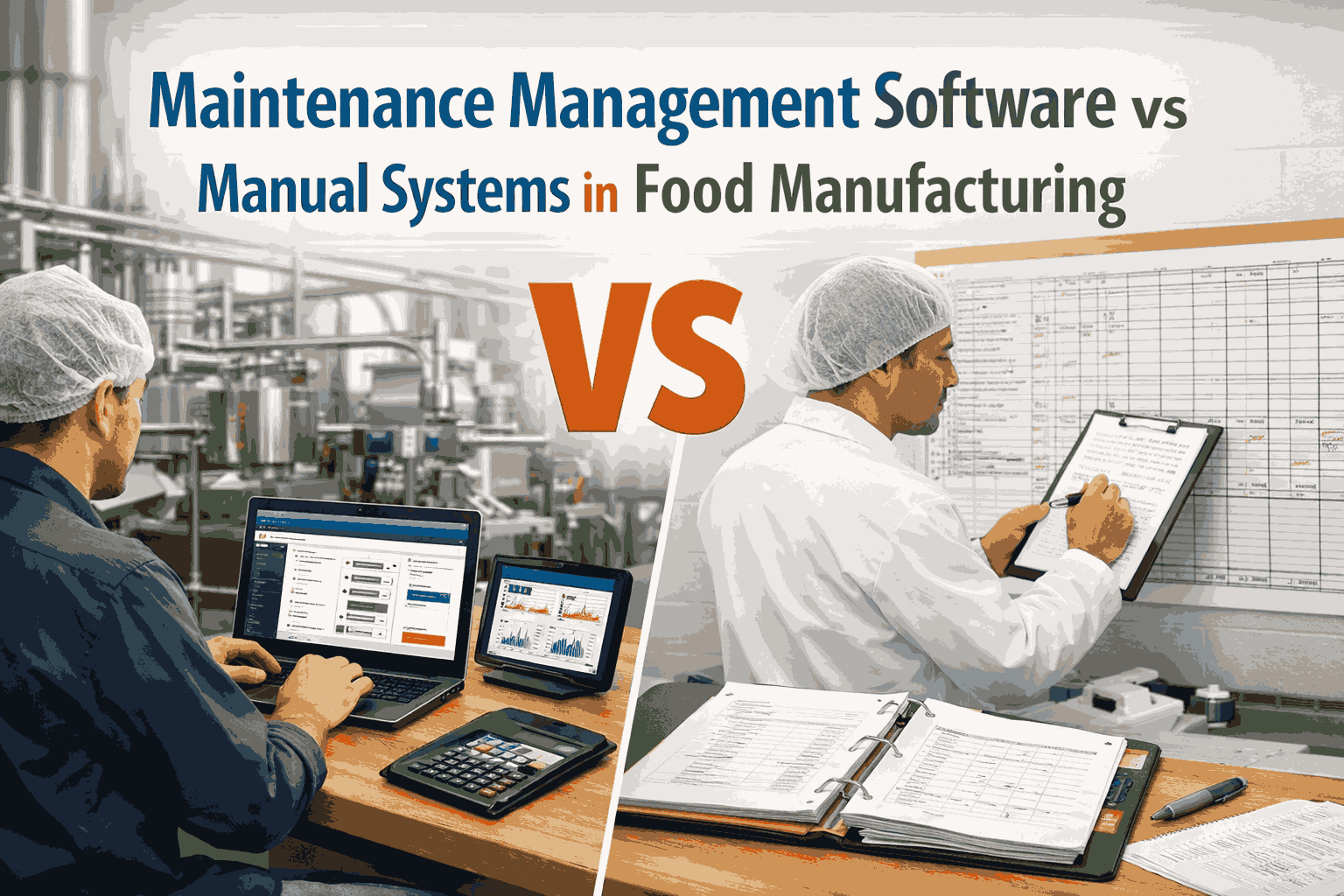
how did we lose track of everything? That facility was running maintenance the way most food plants still do, on
paper logs, scattered spreadsheets, and institutional memory that walks out the door with every shift change.
Digital maintenance systems for food manufacturing exist to eliminate exactly this kind of
preventable catastrophe.
Across the food and beverage sector, maintenance teams manage an average of 340 discrete assets per facility,
each with unique inspection intervals, regulatory documentation, and failure histories. Yet industry surveys
consistently show that 62% of food manufacturing plants still rely on manual tracking methods that leave
critical maintenance data fragmented or inaccessible. The gap between what maintenance teams know
and what they can actually retrieve at the moment of need is where breakdowns, compliance violations, and costly
production losses originate.
Sign up for
Oxmaint to digitize the maintenance of transform your operations, or schedule a demo to align it with your vision.
and extends equipment life.
Digital Maintenance Technology
Digital Maintenance Systems Transforming Food Manufacturing Operations
Centralized asset intelligence, automated compliance workflows, and real-time
visibility across every production line
Reduction in Unplanned Downtime
Work Order Completion Rate
4.2x
Return on Investment
Within First 18 Months
Why Food Manufacturing Maintenance Is Failing Without Digital Systems
Food production facilities operate under a uniquely demanding set of constraints. Equipment must meet sanitary
design standards, cleaning protocols generate accelerated wear on seals and gaskets, temperature-controlled
environments stress refrigeration components around the clock, and regulatory agencies require documented proof
that every critical asset is maintained on schedule. Paper-based systems and disconnected spreadsheets simply
cannot keep pace with this complexity.
The consequences are measurable. When a pasteurizer heat exchanger plate develops micro-cracks that go undetected
because the last inspection record was filed in a binder that nobody can find, the result is not just an
equipment failure. It is a product hold, a potential recall investigation, and a compliance gap that an FDA
auditor will flag during the next unannounced visit. Smart facility maintenance systems consolidate every data
point, from vibration baselines to lubrication records, into a single accessible platform where nothing falls
through the cracks.
62%
of food manufacturing plants report that fragmented maintenance records have
contributed to at least one compliance finding in the past three years. Plants that adopted digital asset
tracking reduced documentation-related audit findings by an average of 83% within the first year of
implementation.
Critical Monitoring Capabilities in Food Plant Maintenance Software
A digital maintenance platform for food manufacturing must capture data across six distinct operational domains.
Each monitoring capability addresses a specific failure mode category that traditional tracking methods
consistently miss.
Complete cradle-to-retirement documentation for every production asset, capturing purchase dates,
warranty windows, service intervals, and cumulative repair costs to drive replacement timing
decisions.
Key Data Points
Installation date, OEM specifications, serial numbers
Warranty expiration and extended service agreements
Cumulative maintenance cost versus replacement threshold
Enables
Capital expenditure planning based on actual asset condition
Elimination of redundant repairs on end-of-life equipment
Automated generation, assignment, and tracking of corrective and preventive work orders with priority
escalation, parts reservation, and completion verification built into every workflow.
Key Data Points
Request source, priority level, assigned technician
Parts consumed, labor hours, root cause classification
Completion timestamps with photo documentation
Enables
Elimination of verbal or handwritten maintenance requests
Real-time backlog visibility for scheduling decisions
Automated capture and organization of every maintenance action that carries regulatory significance,
from CIP validation logs to HACCP-related equipment inspections and calibration certificates.
Key Data Points
FDA, USDA, and SQF audit trail documentation
Calibration records with due-date alerting
Sanitation verification with timestamped sign-offs
Enables
Audit-ready documentation retrievable in under 60 seconds
Automated alerts for overdue compliance tasks
Real-time tracking of critical spare parts with automated reorder triggers, vendor lead time
integration, and consumption analytics that prevent both stockouts and excess inventory carrying
costs.
Key Data Points
Current stock levels, minimum thresholds, reorder points
Vendor pricing, lead times, alternative part cross-references
Consumption rates linked to specific equipment and failure types
Enables
Reduction of emergency procurement and expediting fees
Accurate maintenance budgeting based on actual usage trends
Calendar-based and meter-based preventive maintenance scheduling that adapts to actual production
hours, seasonal demand cycles, and equipment condition data rather than fixed arbitrary intervals.
Key Data Points
Equipment runtime hours, production cycle counts
Seasonal production schedule integration
Technician availability and skill-matching parameters
Enables
Maintenance windows aligned with planned production gaps
Elimination of over-maintenance on lightly used equipment
Automated KPI dashboards tracking MTBF, MTTR, PM compliance, wrench time, and cost-per-asset metrics
with trend visualization that transforms raw data into actionable maintenance strategy insights.
Key Data Points
Mean time between failures by asset class and line
Planned versus reactive maintenance ratio trending
Technician productivity and work order aging metrics
Enables
Data-driven justification for capital and staffing requests
Identification of chronic failure patterns across asset groups
See How Digital Maintenance Systems Work for Food Manufacturing
Discover how a centralized maintenance platform eliminates the paper trails, missed inspections, and
scattered records that cost food plants thousands in avoidable downtime and compliance gaps every year.
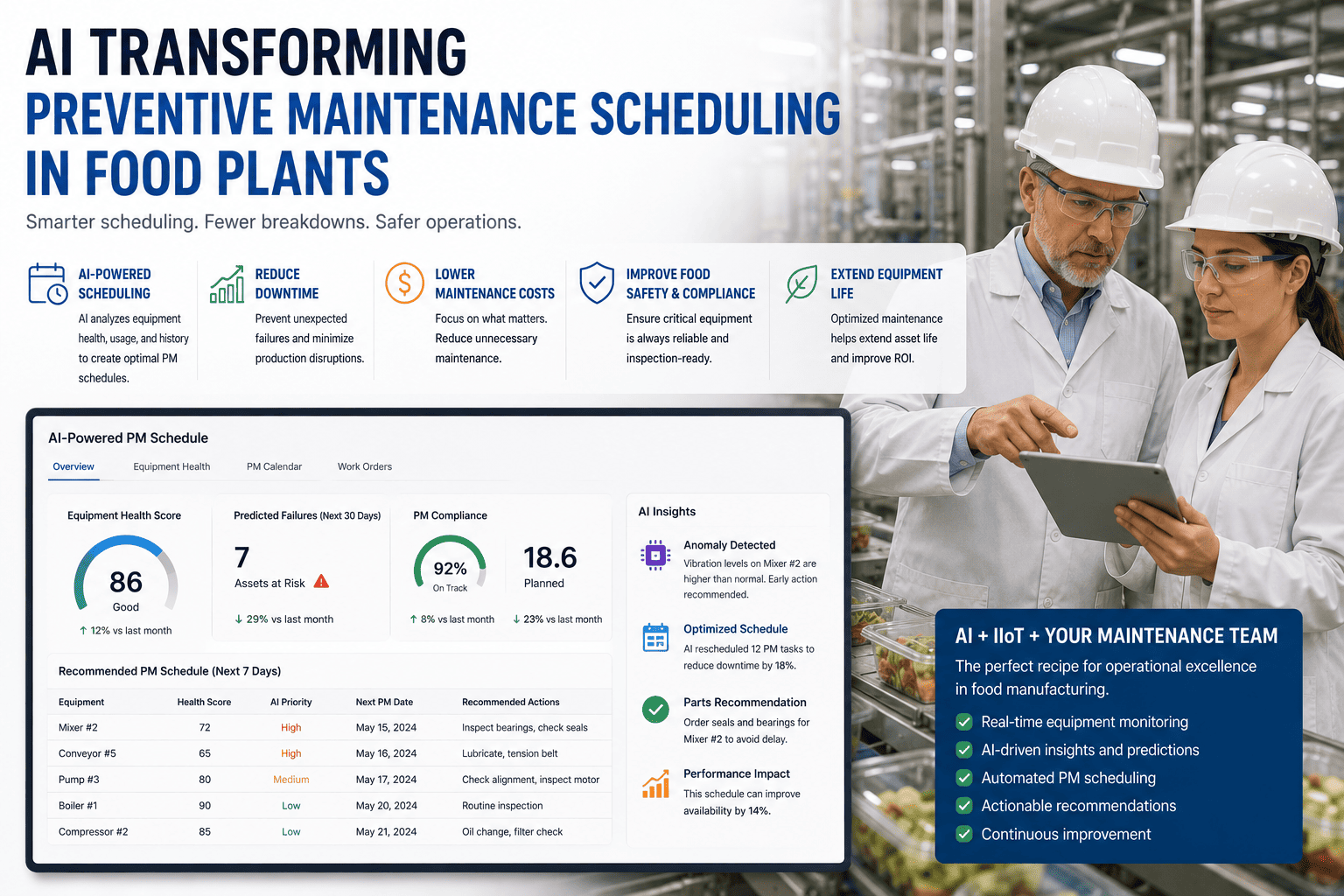
How Digital Maintenance Automation Transforms Food Factory Operations
Transitioning from manual maintenance tracking to an integrated digital platform follows a structured
progression. Each phase builds on the previous one, creating compounding improvements in equipment reliability,
team efficiency, and regulatory readiness.
01
Asset Registry Digitization
Every piece of production equipment is cataloged with operating parameters,
OEM documentation, nameplate data, and maintenance history. This foundational step eliminates the
information silos that cause duplicate work orders and misidentified parts requests.
02
Preventive Schedule Configuration
Maintenance intervals are mapped to manufacturer recommendations,
regulatory requirements, and actual operating conditions. Calendar triggers and runtime meters
generate work orders automatically, ensuring no inspection window passes unnoticed.
03
Mobile Workflow Deployment
Technicians receive, execute, and close work orders from mobile devices on
the plant floor. Photo documentation, barcode scanning, and digital checklists replace clipboards
and handwritten notes, capturing richer data with less effort.
04
Compliance Automation
Regulatory documentation workflows are configured to match FDA, USDA, SQF,
and BRC requirements. Every completed maintenance action generates a timestamped, tamper-proof
record that is instantly retrievable during audits.
05
Inventory and Procurement Integration
Spare parts consumption is linked directly to work order completion.
Automated reorder triggers prevent stockouts on critical components while consumption analytics
identify opportunities to consolidate vendors and negotiate volume pricing.
06
Performance Analytics Activation
With structured data flowing from every maintenance activity, KPI
dashboards reveal patterns invisible to manual tracking: chronic failure modes, underperforming
asset classes, and scheduling inefficiencies that erode both uptime and budget.
Common Maintenance Failures Digital Systems Prevent in Food Plants
Food manufacturing equipment fails in predictable patterns. Digital maintenance systems capture the early warning
indicators that paper-based tracking consistently misses, providing maintenance teams with actionable advance
notice before failures disrupt production.
Detectable Indicators
Progressive increase in chain tension adjustment frequency logged in
work orders
Sprocket tooth wear measurements trending beyond OEM tolerances
Increasing lubrication consumption rates captured by inventory
tracking
Failure Impact
Chain derailment causing product spillage, line shutdown averaging 6-8
hours, and potential contamination requiring sanitation revalidation
Detectable Indicators
Increasing frequency of temperature excursion alarms documented in
logs
Rising amp draw readings captured during scheduled electrical
inspections
Compressor runtime hours exceeding baseline cycle ratios
Failure Impact
Cold storage temperature loss requiring emergency product relocation,
potential inventory condemnation valued at $35,000-$120,000
Detectable Indicators
Seal integrity test rejection rates trending upward across
consecutive shifts
Increasing frequency of manual alignment adjustments logged by
operators
Mounting bolt torque values drifting below specification during PM
checks
Failure Impact
Compromised package integrity leading to product returns, shelf-life
reduction, and potential recall investigation
Detectable Indicators
Cleaning cycle durations extending beyond established baselines
Chemical concentration inconsistencies flagged in sanitation
verification logs
Valve actuator response time degradation recorded during calibration
checks
Failure Impact
Incomplete sanitation requiring re-cleaning, production delay of 4-6
hours, and ATP swab failures triggering hold-and-investigate protocols
Detectable Indicators
Minor product weeping around seal faces noted during shift
walkthroughs
Flow rate deviations captured by process instrumentation trending
Increasing seal flush water consumption tracked against baseline
Failure Impact
Catastrophic seal blowout causing product loss, environmental cleanup,
potential injury risk, and 8-14 hour emergency repair
Detectable Indicators
Thermal scan readings showing progressive temperature rise at
connection points
Breaker trip frequency increasing and documented in electrical
maintenance logs
Insulation resistance test values declining across consecutive
inspection cycles
Failure Impact
Electrical fire risk, complete line shutdown, potential facility
evacuation, and insurance investigation delaying restart by days
Your Implementation Roadmap Starts with a Conversation
Every food manufacturing facility has unique equipment, workflows, and compliance requirements. A 30-minute
consultation maps your specific needs to a deployment plan that delivers measurable results within the first
quarter.
Integration Capabilities for Maintenance Workflow Software in Food Industry
A digital maintenance platform delivers maximum value when it connects with the existing operational technology
and business systems that food manufacturing facilities already depend on. These integration pathways ensure
maintenance data flows seamlessly across the organization.
ERP
ERP and Financial Systems
Bi-directional data exchange with enterprise resource planning systems ensures maintenance costs are
accurately captured in financial reporting, purchase orders flow through established approval
workflows, and asset depreciation schedules reflect actual equipment condition.
Automated purchase requisition generation from work orders
Real-time maintenance cost allocation by cost center
Asset capitalization and depreciation synchronization
IOT
IoT Sensor and SCADA Platforms
Direct ingestion of sensor data from vibration monitors, temperature probes, pressure transmitters,
and flow meters enables condition-based maintenance triggers that supplement calendar-based
schedules with real-time equipment health intelligence.
Automated work order generation from sensor threshold breaches
Historical trend data overlaid with maintenance event timelines
Dashboard visualization of equipment condition across all lines
QMS
Quality Management Systems
Seamless connection with quality management platforms links equipment maintenance status to product
release decisions, ensuring that no product is shipped from a line where critical maintenance or
calibration activities are overdue.
Equipment qualification status visible in quality workflows
Calibration certificate tracking linked to measurement instruments
Non-conformance reports automatically triggering maintenance
investigation
PLC
Production Scheduling Systems
Integration with production planning and scheduling tools ensures maintenance windows are coordinated
with planned changeovers, seasonal production shifts, and customer order priorities to minimize the
operational impact of planned downtime.
Maintenance windows synchronized with production changeovers
Shutdown scheduling aligned with seasonal demand patterns
Real-time equipment availability status for production planners
Best Practices for Digital Maintenance System Adoption in Food Manufacturing
Successful implementation depends as much on organizational approach as it does on technology selection. These
six practices distinguish food manufacturing facilities that achieve rapid adoption and sustained ROI from those
that struggle with incomplete digital transitions.
1
Start with Critical Assets First
Focus initial digitization efforts on the 20% of equipment that
generates 80% of downtime and compliance risk. Demonstrating rapid wins on high-impact assets builds
organizational momentum and justifies expansion to secondary systems.
2
Involve Technicians in Configuration
The people who perform maintenance daily understand which checklist
items matter, which parts fail most often, and where existing procedures have gaps. Their input during
system setup produces workflows that reflect operational reality rather than theoretical ideals.
3
Establish Data Quality Standards Early
Define naming conventions, failure code taxonomies, and required
fields before launch. Inconsistent data entry in the first 90 days creates analytical noise that
undermines confidence in the platform and limits the value of trend reporting.
4
Align with Regulatory Requirements from Day One
Configure compliance documentation workflows during initial setup
rather than retrofitting them later. Building regulatory requirements into standard work order templates
ensures that audit readiness is a default outcome, not an afterthought.
5
Set Measurable KPIs Before Launch
Define baseline metrics for PM compliance, MTBF,
reactive-to-preventive ratio, and work order completion rate before going live. Without documented
starting points, it becomes impossible to demonstrate the improvements that justify continued
investment.
6
Schedule Monthly Data Review Sessions
Dedicate 60 minutes per month to reviewing maintenance analytics with
cross-functional stakeholders. Regular review cadence transforms maintenance data from a record-keeping
exercise into a strategic decision-making tool that drives continuous improvement.
Frequently Asked Questions About Digital Maintenance Systems for Food Manufacturing
How long does it take to implement a digital maintenance system in a food
manufacturing facility?
Most food manufacturing facilities achieve full operational deployment within 10-16
weeks, depending on the number of assets and complexity of compliance requirements. A phased approach
starting with a single production line pilot allows teams to validate workflows before scaling
facility-wide, reducing risk and accelerating adoption. OxMaint's implementation framework is designed
specifically for food industry environments where production cannot be interrupted during the transition.
What ROI can a food plant expect from switching to digital maintenance tracking?
Food manufacturing facilities typically see a 4x-5x return on investment within the
first 18 months, driven by reductions in unplanned downtime, improved labor efficiency, lower spare parts
costs, and fewer audit findings. The largest savings consistently come from preventing the one or two
catastrophic equipment failures per year that cause product loss valued at $50,000 or more per incident.
Can digital maintenance software help with FDA and SQF compliance documentation?
Absolutely. Every maintenance action completed through the platform generates a
timestamped, attributable record that satisfies FDA 21 CFR Part 117, SQF, BRC, and FSSC 22000 documentation
requirements. Calibration tracking, sanitation verification, and equipment qualification records are
organized for instant retrieval during audits, eliminating the hours of preparation that paper-based systems
require.
How does maintenance workflow software integrate with existing food plant equipment
and systems?
Modern food plant maintenance software connects with SCADA systems, IoT sensor
platforms, ERP systems, and quality management tools through standard API integrations. This means sensor
threshold breaches can automatically generate work orders, maintenance costs flow directly into financial
reporting, and equipment qualification status is visible to quality teams in real time without manual data
transfer.
What if our maintenance team is not comfortable with technology?
The most successful implementations focus on making the digital system easier than
the paper process it replaces. Mobile-first interfaces designed for technicians wearing gloves, barcode
scanning instead of manual data entry, and photo documentation that replaces written descriptions all reduce
the learning curve. Most maintenance teams report full comfort within two to three weeks of daily use.
Start
a free trial to see how intuitive it is.
Is predictive maintenance possible through digital asset tracking in food industry
facilities?
Yes. Once a digital maintenance platform captures structured data over time, failure
patterns and degradation trends become visible that are impossible to detect with manual tracking.
Predictive maintenance systems for food plants use this historical data combined with real-time sensor
inputs to forecast equipment failures weeks before they occur, enabling planned interventions that cost a
fraction of emergency repairs.
Transform Your Food Manufacturing Maintenance Operations
Every day without centralized digital maintenance tracking is another day of
fragmented records, missed inspections, and preventable failures quietly eroding your production output and
compliance readiness. The transition takes weeks, not months, and the results compound from day one.