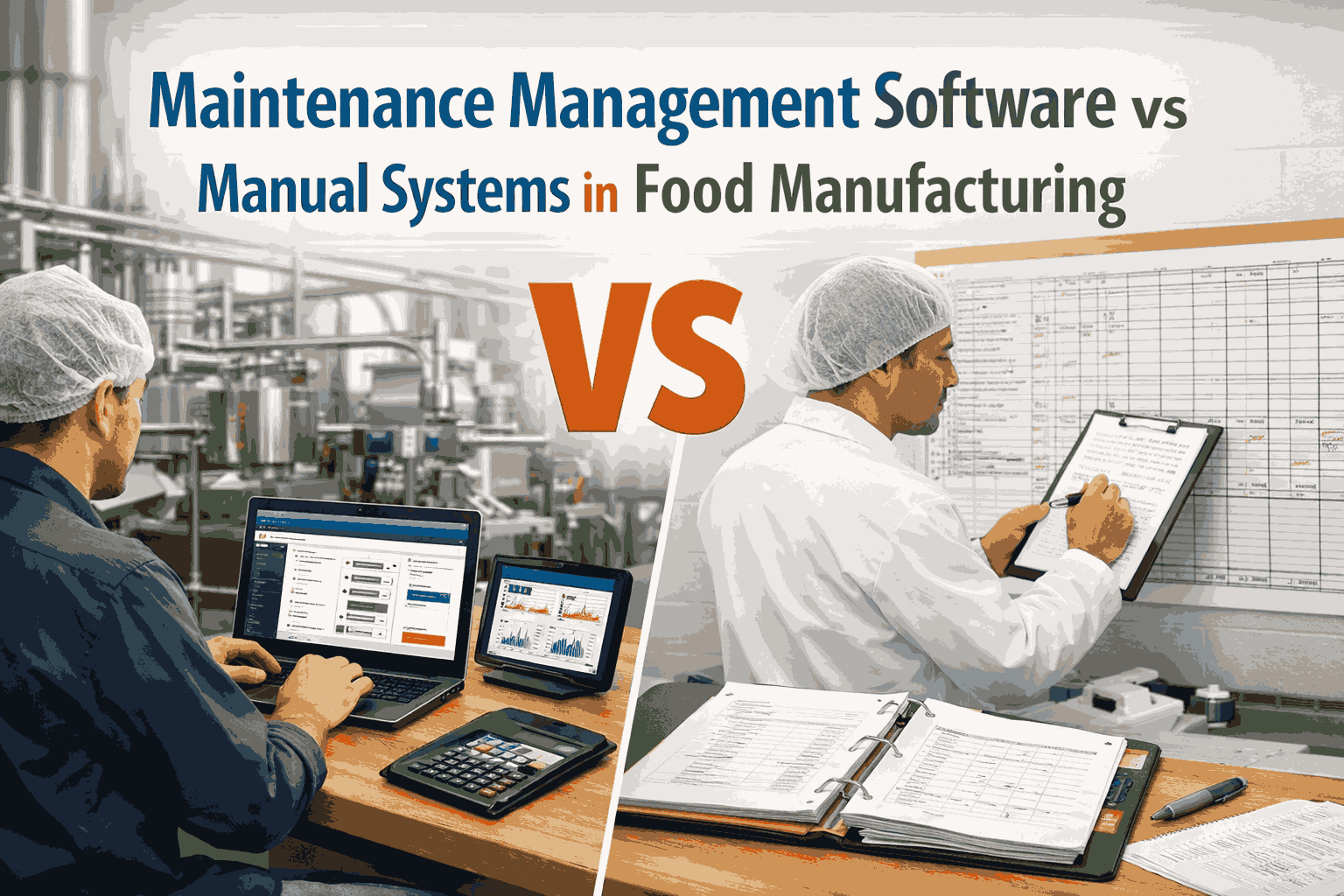
Food recalls cost the U.S. food industry an estimated $1.92 billion in direct recall expenses in 2024 alone — based on 422 recall events at an average of $10 million per event, according to Loftware's analysis of FDA Enforcement Report data. That figure excludes lawsuits, regulatory fines, brand damage, and lost contracts. Most of those 422 recalls were preventable. AI-driven recall prevention systems are already stopping them — before they start. See how Oxmaint protects your plant.
AI-Driven Recall Prevention Systems in Food Manufacturing
In 2024, 296 food recalls were issued across FDA and USDA — with hospitalizations more than doubling and deaths rising from 8 to 19 compared to the previous year. The total number of recalls barely changed. The severity exploded. The plants that avoided recalls were not luckier. They were better equipped — with AI systems that caught contamination precursors before they reached product.
Where Food Recalls Actually Come From — and Where AI Intervenes
Understanding recall prevention requires understanding what actually causes recalls. The vast majority trace back to equipment failures, process deviations, and documentation gaps — all of which AI-driven maintenance and compliance systems directly address, long before any product reaches consumers.
Nearly half of 2024 FDA recalls were label-related, with 83.85% involving undeclared allergens. These trace to equipment malfunctions (valve failures creating cross-contact pathways), process deviations (filler running wrong product), and documentation failures (allergen declarations not updated). AI monitoring detects valve position anomalies and cross-contamination pathway formation before allergen cross-contact occurs.
Listeria grows in cold environments — exactly where dairy, meat, and RTE food plants operate. Growth is enabled by equipment failures (refrigeration degradation, seal failures creating harborage points) and sanitation gaps (CIP cycle deviations). AI temperature monitoring detects refrigeration degradation before temperature excursions create growth windows. CIP cycle monitoring catches deviations from validated parameters before harborage develops.
Remaining recalls split across bacterial contamination (temperature control failures, cross-contamination) and physical contamination (metal debris from bearing failures, foreign material from equipment wear). AI vibration analysis detects bearing degradation 2–3 weeks before metal shedding begins. Temperature monitoring prevents the excursions that enable bacterial growth. Physical contamination from equipment is structurally preventable with AI pattern detection.
How AI Recall Prevention Works — Layer by Layer
AI recall prevention is not a single tool. It is a layered system where each layer catches what the layer below it missed. Oxmaint implements all four layers in a single platform that goes live in 48 hours.
Equipment Failure Prevention
AI predictive analytics monitor vibration, temperature, pressure, and current draw continuously. Anomalies detected 2–4 weeks before failure trigger prioritized work orders. Equipment that doesn't fail doesn't contaminate product. Metal debris from a seized bearing, lubricant from a failing seal, temperature excursion from a degraded compressor — all prevented at the equipment level before any food safety risk exists.
Real-Time Process Monitoring
Continuous sensor monitoring of critical control points — pasteurizer temperature, refrigeration performance, CIP cycle parameters, allergen barrier pressure differentials — with immediate alert on deviation. What HACCP monitoring procedures specify as "monitoring at critical control points" is implemented in real time with automated documentation, replacing manual check sheets that leave gaps between readings.
Tamper-Evident Compliance Records
Every sensor reading, alert, work order, and corrective action is automatically timestamped and stored in tamper-evident format — simultaneously serving as FSMA Preventive Controls documentation, HACCP CCP monitoring records, and GMP sanitation verification. The documentation that proves control was exercised is generated as a byproduct of operating the system, not as a separate administrative burden.
Rapid Containment and Traceability
If a contamination event does occur despite all preventive layers, Oxmaint's complete digital maintenance and process history enables immediate root cause identification and precise scope definition. The equipment state, maintenance history, CCP readings, and process parameters for any time window are accessible in seconds — enabling targeted containment rather than blanket recall, and satisfying FDA's increasingly aggressive requirements for recall scope documentation.
Two Plants, Same Equipment Failure — Two Completely Different Outcomes
This scenario is based on a common failure mode in dairy processing — refrigeration compressor degradation — and illustrates the outcome difference between a plant running traditional maintenance and one running Oxmaint's AI recall prevention system.
Five Real-World Scenarios: How AI Recall Prevention Stops Events Before They Start
Each case below represents a documented failure mode and industry outcome pattern — drawn from FDA enforcement data, food industry research, and published AI deployment results across food manufacturing facilities. These are the situations your maintenance program will face. The column on the right shows what changes when AI is watching.
A mid-size Midwest dairy facility operating three pasteurizer lines experienced a progressive pump seal failure on Line 2 over approximately 19 days. The seal degraded gradually — allowing microscopic lubricant ingress into the product stream and creating a harborage point at the seal housing where Listeria monocytogenes established. Manual inspections occurred weekly and found nothing abnormal at the surface level. By the time elevated somatic cell counts in downstream product signaled a quality deviation, the contamination had already been packaged across multiple production runs. A voluntary Class II recall covering 84,000 units followed. Direct costs: product destruction $290,000, testing $42,000, regulatory response and corrective action documentation $110,000. Total: $442,000, plus the loss of two retail accounts representing $1.8M in annual revenue.
AI continuous pressure differential monitoring on the pump seal circuit would have detected the seal's increasing leak-by resistance within the first 3–5 days of degradation — when the deviation from baseline was still less than 4% but statistically significant against 6 weeks of operating history. A prioritized work order would have been generated with the specific diagnostic: pump seal pressure differential trending outside contextual normal range. A technician inspection during the next planned washdown window (within 48 hours) would have confirmed early seal wear. Seal replacement: $85. Technician time: 1.5 hours. Zero product exposure. CIP cycle integrity monitoring running simultaneously would have verified no contamination pathway was established during the brief anomaly window, providing the documentation needed to confirm no product safety concern — eliminating the recall investigation before it could begin.
A ready-to-eat snack facility in Pennsylvania running 168 hours per week experienced a conveyor drive bearing failure that shed metal fragments into the product stream over a 6-hour production window before a line operator noticed unusual noise. By that point, 3 production runs totalling approximately 48,000 retail bags had been packed and were already in the distribution DC. A Class I voluntary recall was issued after a consumer complaint reported finding a metal fragment approximately 4mm in length in a purchased bag — the type of physical contamination that triggers mandatory FDA involvement under FSMA's Reportable Food Registry requirements. The recall covered the entire production date code range — a precautionary scope decision made because the facility could not precisely document when the bearing began fragmenting. Direct product and logistics cost: $680,000. FDA corrective action response: $95,000. Legal reserve: $250,000. Total first-year impact: $1.025M.
AI vibration analysis would have detected the bearing's characteristic degradation signature approximately 18–21 days before the catastrophic failure event. In documented RTE facility deployments, bearing failures of this type produce a progressively increasing vibration harmonic at 2–3× the rotational frequency that is statistically detectable against the machine's established baseline long before any audible noise or surface-visible wear is present. Oxmaint would have generated a work order at Day 3 of anomaly detection — flagging the specific conveyor, the vibration pattern, and a severity assessment indicating intervention within 7 days. The bearing would have been replaced during a scheduled weekend line-change window at a parts cost of $140 and approximately 2 hours of labor. The AI-generated maintenance record would have documented the bearing condition at replacement — creating an evidence record that no product contamination could have occurred during the intervention period. Total cost: $140 parts + $92 labor. Production loss: zero.
A ground beef processing facility in Texas operating two cold storage rooms and a blast chill tunnel experienced progressive refrigeration compressor degradation over approximately 28 days. The degradation was gradual — the compressor cycled normally but at reduced efficiency, allowing cold storage temperatures to creep from a setpoint of 34°F to 41–42°F during peak afternoon loads when ambient temperatures were highest. Manual temperature logs recorded at shift start (6 AM) consistently showed acceptable temperatures because the system had recovered overnight. The afternoon temperature excursions went undocumented. After a Salmonella outbreak investigation traced back to the facility across 14 confirmed cases in three states, FDA's review of the HACCP records revealed the manual monitoring gap. The facility's inability to demonstrate continuous temperature control during the implicated production period meant the FDA defined the recall scope as all product produced across a 12-day window. Recall scope: 2.4 million pounds of ground beef. Direct costs exceeded $8.7M. The facility was closed for 6 weeks for remediation.
Continuous refrigeration monitoring would have caught the compressor efficiency degradation at Day 8 — when the contextual anomaly first appeared as afternoon temperatures running 1.8°F above the load-adjusted predictive baseline for that ambient temperature and production load combination. A work order for compressor inspection would have been generated automatically. A technician inspection would have identified the worn valve plate causing reduced compression efficiency. The repair — a $380 valve plate replacement — would have occurred within 72 hours of anomaly detection, well before temperatures reached a level capable of supporting pathogen growth. Critically, Oxmaint's continuous temperature logging would have created an unbroken digital record of every 5-minute temperature reading across the entire cold storage period — eliminating the manual monitoring gap that FDA used to expand the recall scope. Even if the compressor had been missed, precise digital records would have demonstrated exactly which production windows had temperature anomalies, limiting any recall scope to a fraction of what the undocumented gap required.
A specialty bakery producing both peanut-containing and peanut-free product lines on shared equipment experienced a gradual allergen barrier valve failure. The pneumatically-actuated diverter valve separating the peanut and peanut-free ingredient lines began seating incompletely — a degradation that developed over approximately 11 days of cycle fatigue. Visual inspection could not detect the incomplete closure because the valve appeared fully closed in static inspection. The leak-by was small enough to be undetectable by taste or visual inspection at the product level but sufficient to trigger a peanut allergen positive on retail-level lot testing initiated after a consumer complaint of an allergic reaction. FDA's investigation found no documentation of valve function verification between weekly manual inspections. The allergen cross-contact was determined to have affected 5 production runs across 3 days before the valve failed completely and triggered an alarm. Class I recall: 31,000 units. Direct costs: $520,000. The facility's GFSI certification was suspended pending investigation.
Pressure differential monitoring on the allergen barrier valve circuit would have detected the valve's incomplete seating by Day 3 of degradation — as the pressure differential across the closed valve began trending downward from its established baseline, indicating increasing leak-by. At this detection point, the valve had not yet allowed detectable allergen transfer across the barrier. A work order would have been generated: allergen barrier valve pressure differential below contextual baseline — inspect for complete seating. The technician inspection would have found the valve seat wear and ordered a replacement valve actuator ($220 part). Valve replacement completed during changeover window: 90 minutes. Zero product exposure during the degradation period — confirmed by the AI pressure monitoring record showing the barrier was compromised at a level below allergen transfer threshold when intervention occurred. GFSI auditors reviewing the incident record would see a properly functioning allergen control system that detected and corrected a developing issue before any food safety consequence — the best possible audit outcome.
A juice and beverage facility in California running daily CIP cycles on its filler and pasteurizer circuits experienced a chemical dosing pump failure that caused four consecutive CIP cycles to run at 40% of validated caustic concentration. The failed pump passed its weekly manual inspection because it was tested at ambient temperature, not under the thermal cycling conditions of an actual CIP run. Manual CIP records showed cycle completion with a checkbox — not chemical concentration data. The under-concentration CIP cycles allowed a microbial biofilm to establish in a filler line dead leg, resulting in Escherichia coli contamination in three production runs across two days. A Class I recall of approximately 18,000 cases of juice was issued. The facility's voluntary recall notification to FDA triggered an inspection that found 11 additional FSMA documentation deficiencies, resulting in a Warning Letter and required third-party audit program. Total regulatory and recall cost: $1.4M over 18 months.
Oxmaint's CIP cycle monitoring would have detected the chemical dosing anomaly on the first under-concentration cycle — as the pH reading in the caustic return circuit deviated from the validated range that characterizes a properly dosed cycle. An immediate alert would have been generated: CIP caustic concentration below validated range — cycle not meeting specification. The CIP cycle would have been flagged as incomplete in the compliance record before any production resumed on the affected circuit. A technician would have identified the failed dosing pump (replacement cost: $340) and the circuit would have been re-cleaned at full validated concentration before any production restart. The failed cycle would be documented as a deviation with corrective action in Oxmaint — creating a complete record that demonstrates the facility identified and corrected the deviation before any product exposure occurred. In an FDA inspection reviewing this record, the response would demonstrate exactly what FSMA Preventive Controls requires: a functioning system that detected a deviation and corrected it before food safety consequences materialized. Zero recalls. Zero Warning Letter. Zero E. coli exposure.
How AI Recall Prevention Strengthens Your Regulatory Position
The FDA's 2024 Investigations Operations Manual expanded the definition of Zone 2 contamination areas and made recall scope decisions significantly more aggressive. In 2025, both FDA and DOJ signaled increased willingness to pursue criminal sanctions when food companies ship product that causes illness. AI recall prevention strengthens your position at every point of regulatory interaction.
FSMA Preventive Controls
AI monitoring creates the continuous proof of control that FSMA requires — not documentation prepared in advance of an inspection, but a complete, tamper-evident record of every preventive control action taken contemporaneously. Under FDA's data integrity guidance, contemporaneous digital records created by the assigned technician at the point of action satisfy the documentation standard that manual records increasingly fail to meet.
HACCP Critical Control Points
Every CCP — pasteurization temperature, refrigeration holding, CIP cycle completion, allergen control barrier — is monitored in real time with automated logging. HACCP monitoring records exist continuously, not just at manual check intervals. This eliminates the documentation gaps that regulators identify as the most common HACCP program deficiency in food facility inspections.
Recall Scope Limitation
When a contamination event does occur, the precision of Oxmaint's digital process history directly limits recall scope. FDA increasingly pushes for broader recall definitions when companies cannot demonstrate exactly when and where a deviation occurred. Complete digital records of equipment state, temperature readings, CCP parameters, and maintenance activities for any time window narrow the scope of what must be recalled — saving millions in unnecessary product destruction.
DOJ Liability Protection
DOJ's stated willingness to pursue criminal sanctions focuses on companies that ship product known to cause illness without adequate preventive controls. AI recall prevention systems provide the documented evidence of active, functioning preventive controls that distinguishes companies operating in good faith from those that knowingly took inadequate measures. Complete AI monitoring and maintenance documentation is the strongest available protection against criminal exposure in food safety incidents.
How AI Recall Prevention Systems Work — Questions Answered
The Next Recall Your Plant Doesn't Have Is Worth $10M+. Oxmaint Makes That Possible.
Food manufacturers using AI recall prevention systems don't avoid recalls because they got lucky. They avoid them because the equipment failures that cause contamination are caught weeks before any product is at risk — and because the compliance documentation that limits recall exposure exists automatically, every day, for every asset.