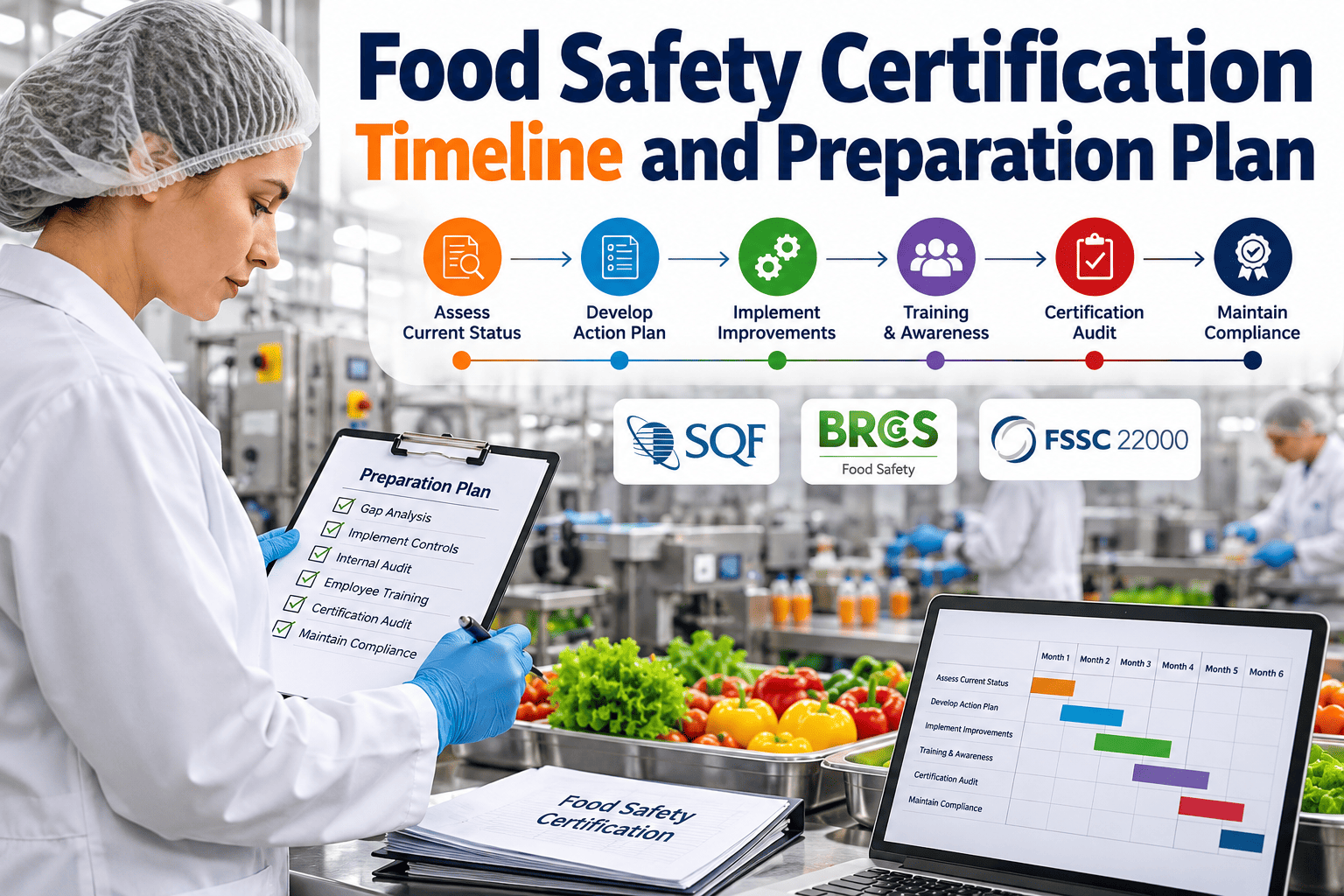
Certification rarely fails because a plant lacks effort. It fails because the workload is underestimated, owners are unclear and records are assembled in the final weeks. A food safety certification timeline turns the project into dated steps with named owners and the evidence each step must produce, from the first gap assessment to the certification audit. This guide sets out a practical preparation plan for GFSI-recognized schemes, and shows where Oxmaint maintenance management software helps with the equipment, inspection and corrective action records auditors ask to see.
Food Safety Certification Timeline and Preparation Plan
Plan the steps, owners and records needed from gap assessment through to the certification audit.
The hidden effort behind certification
- Documents exist, but nobody has checked them against the standard clause by clause.
- Records are kept in several places, so evidence takes days to assemble.
- Equipment maintenance, calibration and sanitation records have gaps nobody noticed.
- Training is delivered but not recorded in a way an auditor can verify.
- Corrective actions stay open because owners and deadlines were never set.
Certification timeline by phase
Durations depend on plant size, existing systems and the scheme you choose. Treat the ranges below as planning guides and agree dates with your certification body.
1. Scope and gap assessment
- Confirm scheme, site scope and certification body
- Score each clause as met, partial or missing
- Name an owner for every gap
2. Documentation
- Write or revise the food safety plan and procedures
- Set up document control and version history
- Define record forms and retention
3. Implementation and training
- Roll out procedures on the floor
- Train and record competency
- Start generating real records
4. Internal audit and review
- Audit the full system against the standard
- Close findings with corrective actions
- Hold management review
5. Certification audit and close-out
- Host the auditor with evidence ready
- Respond to nonconformities by the deadline
- Plan ongoing maintenance of the system
Who owns what, and what proves it
| Workstream | Typical owner | Evidence an auditor expects |
|---|---|---|
| Food safety plan and hazard analysis | Food safety lead | Approved plan, team records, review dates |
| Equipment maintenance and calibration | Maintenance manager | Preventive schedules, completed work orders, calibration records |
| Sanitation and pre-op checks | Sanitation supervisor | Cleaning schedules, inspection results, verification |
| Training and competency | HR or quality | Matrix, attendance, assessments |
| Corrective and preventive action | Quality manager | Root cause, owner, due date, verified closure |
| Management review | Site leadership | Agenda, decisions and follow-up |
Build the evidence as you go, not in the last month
Schedule maintenance and inspection tasks in Oxmaint so certification records accumulate from day one.
How Oxmaint supports the equipment side of certification
Final-month readiness checklist
Decide the target before you build the plan
The timeline depends on which GFSI-recognized scheme you pursue and what your customers require. Confirm scope, site type and audit options with your certification body early, since it affects every later step.
Customer needs
- Which scheme do key customers require?
- Is a specific level or module expected?
- Are there contract deadlines?
Site scope
- Which products and processes are included?
- Are outsourced processes in scope?
- Do multiple buildings need audits?
Resources
- Who leads the project full time?
- Is external consulting needed?
- What budget covers training and audit fees?
What a useful gap assessment produces
A gap assessment is only useful if it ends in a prioritized action list. Score each clause, attach evidence you already have and note what is missing.
| Status | Meaning | Next step |
|---|---|---|
| Met | Procedure, records and practice all agree | Note the evidence location |
| Partially met | Procedure exists but records or practice are incomplete | Fix the weakest element and assign an owner |
| Not met | No procedure or no evidence of practice | Write, implement and train, with a due date |
| Not applicable | Clause does not apply to the site | Record the justification |
Spreading the work so one person is not buried
- Quality and food safety: hazard analysis, document control, internal audit and management review.
- Production: following procedures, completing records and supporting verification.
- Maintenance: equipment schedules, calibration, repairs and sanitary design fixes.
- Sanitation: cleaning programs, pre-op inspection and verification results.
- Purchasing: supplier approval, specifications and incoming checks.
- HR: training plans, competency and induction records.
Evidence takes time to accumulate
Auditors expect to see records over a period, not a single week of paperwork. Starting early means you have a history to show, rather than a pile of recent entries.
What to expect during the certification audit
- Opening meeting. The auditor confirms scope, schedule and who will be interviewed.
- Document and record review. Plans, procedures and records are sampled for completeness and consistency.
- Floor walk. The auditor checks practice against documents, including equipment condition and hygiene.
- Interviews. Operators and supervisors explain what they do and why.
- Closing meeting. Findings are presented, and any nonconformities get a deadline for response.
Closing findings and keeping certification alive
Respond to findings
- Identify root cause
- Record correction and corrective action
- Provide evidence to the certification body
Maintain the system
- Keep records current every day
- Run internal audits on schedule
- Hold regular management reviews
Prepare for surveillance
- Review changes to the standard
- Update procedures and training
- Refresh the hazard analysis
Using Oxmaint to run the maintenance workload
Certification projects add many recurring checks. A maintenance management system schedules them, assigns them and keeps the evidence in one place.
- Schedule preventive and calibration tasks by asset, with named owners and due dates.
- Complete inspection checklists on mobile devices so records are dated and attributable.
- Raise corrective work orders for audit findings and track them to closure.
- Store service history against each machine so auditors can trace repairs quickly.
- Use reports to review overdue tasks before management review.
An illustrative 24-week milestone plan
This is a planning example, not a rule. Adjust it to your plant, scheme and audit date.
| Weeks | Milestone | Evidence produced |
|---|---|---|
| 1 to 2 | Project kickoff, scope agreed, team named | Project charter, team list |
| 3 to 4 | Gap assessment completed | Scored clause list and action register |
| 5 to 8 | Food safety plan and procedures drafted | Draft documents under version control |
| 9 to 12 | Procedures approved and rolled out | Signed documents, communication records |
| 10 to 16 | Training delivered and recorded | Attendance sheets and competency checks |
| 12 to 20 | Records generated through daily operation | Maintenance, sanitation and monitoring records |
| 18 to 21 | Internal audit and corrective actions | Audit report, closed actions |
| 22 | Management review and mock recall | Minutes, traceability test results |
| 24 | Certification audit | Auditor report and response plan |
Common reasons preparation runs late
Plan hours as carefully as money
Audit fees and training costs are easy to budget. The larger cost is usually staff time, especially for the project lead and the maintenance and sanitation teams.
- Block recurring weekly time for the project meeting and for document review.
- Allow production supervisors time to complete new records without rushing.
- Plan shutdown windows for equipment repairs found during the gap assessment.
- Schedule training around shifts so every operator can attend.
- Reserve time in the final month for the internal audit, corrective actions and evidence checks.
Making the internal audit a real rehearsal
Cover everything
- Audit every clause at least once
- Include night and weekend shifts
- Sample records across several months
Use independent auditors
- Do not audit your own area
- Check practice on the floor, not just paper
- Interview operators as an auditor would
Close findings
- Assign an owner and date to each
- Address root causes, not only symptoms
- Verify that fixes work before the audit
Walk the plant like an auditor
Auditors notice equipment condition quickly. A walk-through with maintenance, sanitation and quality before the audit finds problems while there is still time to fix them.
Evidence to have ready on audit day
- Current food safety plan, hazard analysis and procedures with version history.
- Organization chart, team lists and training matrix with records.
- Preventive maintenance schedules, completed work orders and calibration records.
- Sanitation schedules, verification results and corrective actions.
- Supplier approvals, specifications and incoming inspection records.
- Internal audit reports, management review minutes and a mock recall result.
Adjusting the timeline to your size
- Small plants: one person often wears several hats, so protect project time and consider outside help for the gap assessment.
- Larger plants: more areas and shifts mean more training and more records, so start rollout early and pilot in one area.
- Multi-site groups: build one core system, then adapt it per site, and track each site against the same milestones.
- Plants with existing certification: focus on gaps against the new scheme rather than rebuilding everything.
Simple measures for the project lead
Certification timeline questions
How long does food safety certification take?
It varies with plant size and existing systems. Many plants plan several months, then confirm dates with their certification body.
What is a gap assessment?
A clause-by-clause comparison of your current system against the standard, showing what is met, partial or missing.
Which records do auditors look at in maintenance?
They commonly review preventive schedules, repair history and calibration records. Oxmaint can hold these in one place.
How are nonconformities handled?
Record the root cause, correction and preventive action, then verify closure by the deadline the certification body sets.
Can I see how this works for my plant?
Yes, you can book a demo and walk through your equipment and records.
Walk into your certification audit with evidence ready
Organize maintenance, inspections and corrective actions in Oxmaint, or book time to plan your timeline.