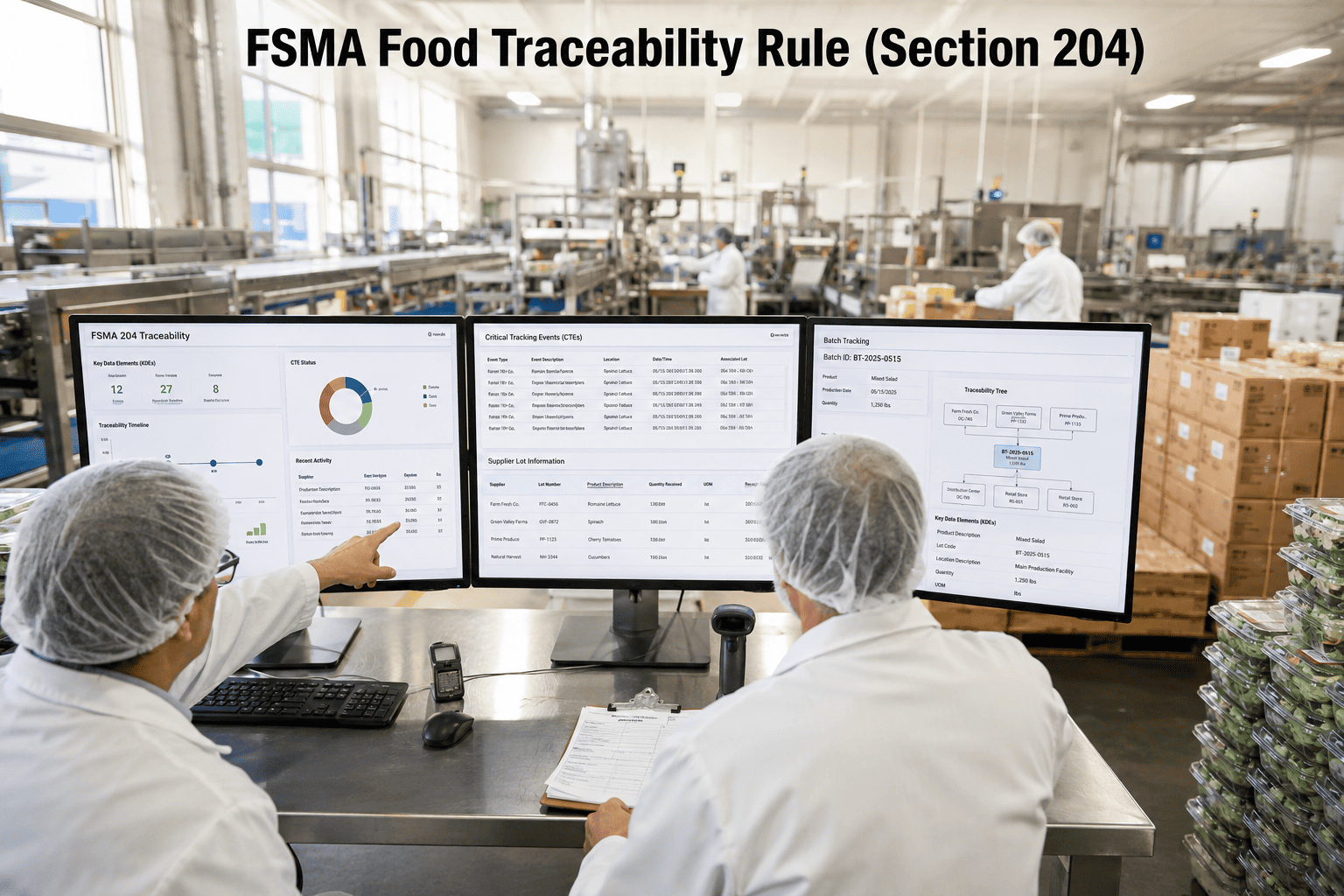
Food manufacturers operating under FDA oversight face a compliance deadline that cannot be ignored — FSMA Section 204, the Food Traceability Rule, mandates electronic lot-level recordkeeping across the entire supply chain for foods on the Food Traceability List (FTL). Facilities that rely on spreadsheets, paper logs, or disconnected systems are exposed to recall chaos, FDA warning letters, and the catastrophic cost of a traceback failure averaging $10 million per incident. A modern CMMS bridges the gap between equipment-level records and supply chain traceability — capturing Key Data Elements at every Critical Tracking Event, automatically, in audit-ready format — start a free trial to see how Oxmaint structures your food facility's compliance workflow, or book a demo and we will map your KDE/CTE capture process against your current asset and production structure.
See how much compliance risk you can eliminate from your food facility — in under 30 minutes.
- Real-time KDE capture at every Critical Tracking Event
- Lot-level traceability linked to equipment work orders
- Audit-ready FSMA documentation generated automatically
Used by food operations teams managing 10,000+ assets — live in days, not months.
No heavy implementation required. Works across multi-site food portfolios.
FSMA COMPLIANCE BY THE NUMBERS
The Scale of FSMA Section 204 Exposure
UNDERSTANDING THE RULE
What Is the FSMA Food Traceability Rule (Section 204)
FSMA Section 204 — formally codified as 21 CFR Part 1, Subpart S — is the FDA's most comprehensive food traceability mandate to date. It requires food manufacturers, processors, packers, and holders handling foods on the Food Traceability List (FTL) to maintain detailed electronic records of Key Data Elements (KDEs) at each Critical Tracking Event (CTE) across the supply chain. The rule moves traceability from voluntary best practice to enforceable federal law, with full compliance required by January 2026.
A Critical Tracking Event is any point in the supply chain where a food changes hands, is transformed, or enters a new phase — growing, receiving, transformation, creation, and shipping are the five defined CTEs under the rule. At each CTE, specific Key Data Elements must be captured: traceability lot codes, location identifiers, dates, product descriptions, and quantities. Failure to capture, store, or produce these records on demand constitutes a violation regardless of whether a contamination event occurred.
For food manufacturers, the compliance challenge is operational, not just administrative. KDEs must be captured at the equipment level — which line ran which lot, under which conditions, maintained to what standard. A CMMS that connects equipment maintenance records to production lot data closes the traceability gap at the point where most facilities are exposed — start a free trial to see how Oxmaint links your equipment work orders to FSMA-required KDE records, or book a demo and we will show you the exact workflow.
REGULATORY FRAMEWORK
Core KDE/CTE Concepts Every Food Manufacturer Must Master
Growing / Harvesting CTE
The first traceability point for raw agricultural inputs. KDEs include lot code, harvest date, geographic location, and commodity description — captured before the food enters a processing facility.
Receiving CTE
Triggered when a food on the FTL is received at a facility. KDEs require the traceability lot code, quantity, unit of measure, location description, and the date received — all must be retained electronically.
Transformation CTE
The most complex CTE for manufacturers — triggered when raw inputs are converted into a new food. New traceability lot codes must link to all input lot codes, equipment used, and production date/time.
Creation CTE
Applies when a food on the FTL is created without transformation of a traceable input — such as packaging a harvested food. KDEs must capture the new lot code, location, and originating source lot data.
Shipping CTE
Triggered at every outbound shipment of an FTL food. KDEs include lot code, quantity, recipient identity, ship date, and product description. These records must be transmittable to the next supply chain party.
Traceability Lot Code (TLC)
The primary identifier linking a food product to its full history. The TLC must be assigned at the first CTE and carried forward through every transformation — it is the spine of Section 204 compliance.
Traceability Lot Code Source Reference
Links the current TLC to the TLC of input foods used in transformation. This parent-child lot linkage is what allows FDA to trace contamination upstream through multiple processing steps in under 24 hours.
Location Description (LD)
A precise identifier for the facility, farm, or site where a CTE occurred. Under Section 204, location data must be specific enough for FDA to physically locate the originating source — GPS or FDA facility registration number required.
Mastering these eight elements is the foundation of Section 204 compliance — and the point where disconnected paper systems begin to fail. Teams that automate KDE capture through a CMMS avoid the manual errors that trigger FDA scrutiny — start a free trial to see how Oxmaint structures KDE capture within your maintenance and inspection workflow.
COMPLIANCE GAPS
The Pain Points Exposing Food Manufacturers to FSMA Section 204 Risk
No Electronic Lot-Level Records
Over 60% of mid-size food manufacturers still rely on paper logs or basic spreadsheets for lot tracking. Under Section 204, records must be electronically retrievable and transmittable within 24 hours — paper systems cannot meet this standard and carry significant penalty risk.
Broken Traceability at Transformation
The Transformation CTE is where most manufacturers lose the lot chain. When multiple input lots are blended or cooked into a new product, linking all parent TLCs to the new output TLC is complex — and almost impossible without automated CMMS-linked production records.
Equipment Maintenance Gaps Void Traceability
A contamination event often traces to equipment failure — a sanitization lapse, a temperature excursion, a worn seal. Without a maintenance record linked to the production lot, manufacturers cannot demonstrate due diligence and face heightened recall liability estimated at $30,000–$100,000 per day in remediation costs.
Supplier Lot Data Siloed from Internal Systems
Receiving CTEs require supplier TLCs to be captured and stored in a system accessible during FDA traceback. Most facilities receive supplier lot data via email or PDF and never integrate it with production records — creating a visible audit gap that FDA inspectors flag in 43% of routine FSMA inspections.
Audit-Ready Documentation Takes Weeks
When FDA requests traceability records, manufacturers have 24 hours for electronic records and the ability to quickly compile the full traceability chain. Facilities without integrated CMMS and traceability systems spend days pulling records from multiple sources — a response failure that escalates regulatory action automatically.
No GMP Inspection Link to Production Lots
GMP-compliant inspections must be logged against specific equipment and linked to production runs to satisfy Section 204's implicit standard of care. Disconnected inspection systems — even digital ones — leave manufacturers unable to show the FDA a continuous record from incoming raw material to outbound shipment lot.
These compliance gaps are not theoretical — they are the exact failure points FDA inspectors target during traceback investigations. Teams that integrate CMMS-based maintenance records with lot tracking see 65% faster audit response times — start a free trial to close these gaps in your facility, or book a demo to see how Oxmaint maps your existing workflow to Section 204 requirements.
OXMAINT SOLUTION
How Oxmaint Closes the FSMA Section 204 Compliance Gap
KDE-Linked Work Order Templates
Every work order in Oxmaint can be structured to capture Key Data Elements — traceability lot codes, equipment identifiers, operator records, and timestamps — at the point of maintenance. No separate data entry required. KDE fields are embedded directly into GMP inspection and PM work orders, creating an automatic audit trail from equipment action to production lot.
Transformation CTE Lot Linkage
Oxmaint's asset hierarchy — Portfolio, Property, System, Asset, Component — maps directly to food production line architecture. Transformation CTEs are captured at the System and Asset level, linking parent lot codes from receiving to output lot codes at packaging. The full parent-child lot chain is stored electronically and retrievable in under 60 seconds.
GMP-Compliant Inspection Scheduling
Schedule and execute GMP-compliant pre-operational, operational, and post-operational inspections tied to specific production lines and equipment assets. Each inspection record is date-stamped, operator-attributed, and linked to the active production lot — providing the continuous maintenance-to-lot linkage FDA requires under Section 204 implicit due diligence standards.
Supplier Lot Integration at Receiving CTE
Receiving CTEs are captured in Oxmaint's mobile-first interface at the point of goods receipt — supplier TLC, quantity, date, and location description are recorded and stored against the asset or storage location receiving the input. Supplier lot data is immediately linked to downstream production records, eliminating the silo that creates audit gaps.
24-Hour Audit Response Package
When FDA requests traceability records, Oxmaint generates a complete audit response package — all KDEs across all CTEs for any specified lot, with linked maintenance and inspection records — in a single export. Response time drops from days to under one hour, meeting the Section 204 standard without emergency data gathering under pressure.
Multi-Site Portfolio Traceability
Food manufacturers operating across multiple processing facilities can manage all site traceability records within a single Oxmaint portfolio. Cross-site lot flows — where an input processed at Site A ships to Site B for further transformation — are tracked with full chain-of-custody across facilities, giving VP Operations a single-pane compliance view across the entire production network.
These capabilities are built for food manufacturing operations that cannot afford a compliance failure — start a free trial and deploy your first KDE-linked work order template within the first session, or book a demo and we will build your facility's Section 204 workflow live on screen.
BEFORE VS AFTER
Manual Traceability vs CMMS-Integrated FSMA Compliance
| Compliance Area | Without CMMS Integration | With Oxmaint CMMS |
|---|---|---|
| KDE Capture Method | Manual paper logs or spreadsheets — prone to omission, illegibility, and version control errors | Embedded KDE fields in digital work orders — captured at point of action, timestamped, operator-attributed |
| Transformation Lot Linkage | Parent lot codes manually noted on batch records — frequently incomplete or missing when multiple inputs are used | Automatic parent-child lot linkage at Transformation CTE — all input TLCs linked to output TLC in a single record |
| Equipment Maintenance Link | Maintenance records stored separately from production lot data — no traceable connection between equipment action and product batch | Every PM, repair, and inspection is asset-tagged and production-lot-linked — full maintenance-to-lot chain available on demand |
| Supplier Lot Data | Received via email/PDF, filed in separate folders — not searchable or linkable to internal production records | Supplier TLCs captured at Receiving CTE in mobile interface — immediately linked to downstream transformation and production records |
| FDA Audit Response Time | 2–5 business days to compile records from multiple systems, physical files, and personnel — frequently exceeds 24-hour window | Complete audit package generated in under 60 minutes — all KDEs, CTEs, maintenance records, and inspection logs in one export |
| Multi-Site Visibility | Each facility maintains independent records — cross-site lot flows are untraceable and create automatic compliance gaps | Single-portfolio view across all processing sites — cross-site lot flows tracked with full chain-of-custody across facilities |
| GMP Inspection Records | Inspection logs stored by date only — no link to production lot, equipment asset, or specific CTE | Inspections scheduled and executed against specific assets and active production lots — continuous audit trail from line to lot to shipment |
| Compliance Cost Trajectory | Increasing cost as FDA enforcement ramps — manual remediation during inspections costs $30,000–$100,000 per event | Structured compliance posture reduces remediation costs by 60–70% — proactive record integrity eliminates emergency data recovery |
The difference between a compliant audit response and an FDA warning letter is often measured in minutes of record retrieval time. Teams that consolidate FSMA traceability into a single CMMS system reduce their inspection response risk by over 65% — start a free trial to build that structure into your facility today.
MEASURED OUTCOMES
ROI and Results: CMMS-Driven FSMA Compliance in Food Manufacturing
These are not aspirational benchmarks — they are the outcomes food operations teams achieve when they replace siloed paper traceability with an integrated CMMS. Teams switching to Oxmaint see measurable compliance ROI within the first 30 days — start a free trial to begin building your FSMA record structure today, or book a demo to see your specific facility's compliance gap analysis on screen.
COMMON QUESTIONS
FSMA Section 204 and CMMS: Questions Food Manufacturers Ask
Does a CMMS satisfy the electronic recordkeeping requirements of FSMA Section 204
Yes — provided the CMMS captures and stores the specific Key Data Elements required at each Critical Tracking Event in electronic format that is accessible and transmittable on FDA request. A CMMS like Oxmaint that embeds KDE fields directly into work orders, inspection records, and receiving logs satisfies the electronic recordkeeping standard. The critical requirement is that records must be producible within 24 hours and linkable across the full supply chain — from incoming ingredient lot through transformation to outbound shipment. A general-purpose spreadsheet or disconnected work order system does not satisfy this requirement even if records are nominally digital.
Which foods are on the FDA Food Traceability List and does my facility need to comply
The FDA Food Traceability List (FTL) includes 16 categories of high-risk foods: fresh cut fruits and vegetables, shell eggs, nut butters, ready-to-eat deli salads, soft cheeses, sprouts, leafy greens, fresh herbs, tomatoes, peppers, cucumbers, melons, tropical tree fruits, mollusks, finfish, and crustaceans. If your facility grows, packs, manufactures, processes, or holds any food on this list, you are subject to Section 204 requirements. Manufacturers who transform FTL ingredients into new products — even if the final product is not itself on the FTL — must still maintain Transformation CTE records for the input ingredients throughout the transformation process. Consult your regulatory counsel for a definitive applicability determination specific to your product lines.
What is the difference between a KDE and a CTE under FSMA Section 204
A Critical Tracking Event (CTE) is a specific activity or step in the food supply chain where a food changes status, ownership, or form — the five defined CTEs are Growing, Receiving, Transformation, Creation, and Shipping. A Key Data Element (KDE) is a specific piece of information that must be recorded at a given CTE. Different CTEs require different KDEs — for example, a Receiving CTE requires the traceability lot code, quantity, unit of measure, location description, and date received, while a Transformation CTE requires all of these plus the traceability lot codes for every input ingredient used. Think of CTEs as the events and KDEs as the data fields required to document each event. Your CMMS must be configured to prompt for the correct KDEs at each type of CTE that occurs in your facility's operations.
How does Oxmaint handle traceability across multiple food processing sites in a single portfolio
Oxmaint's Portfolio hierarchy — Portfolio, Property, System, Asset, Component — maps directly to multi-site food manufacturing operations. Each processing facility is configured as a Property within the portfolio, with production lines as Systems and individual pieces of equipment as Assets. When a lot processed at one site ships to a second site for further transformation, the Shipping CTE record at Site A is linked to the Receiving CTE record at Site B within the same portfolio — maintaining the full chain of custody across facilities in a single traceable record chain. VP Operations and Directors of Food Safety gain a single-pane view of all KDE records across the entire manufacturing network, enabling portfolio-level compliance reporting and rapid cross-site lot isolation when a recall event occurs.
TAKE ACTION BEFORE JANUARY 2026
Stop Risking a $10 Million FSMA Traceback Failure
Turn every CTE, every lot, every inspection into audit-ready electronic records with Oxmaint — built for food manufacturers who cannot afford a compliance gap.
- Real-time KDE capture at every Critical Tracking Event
- Lot-level traceability linked to equipment maintenance records
- Complete FSMA audit response package in under 60 minutes
Used by food operations teams managing 10,000+ assets. Live in days, not months. No heavy implementation required.
Works across multi-site food portfolios. See measurable compliance structure in the first 30 days.



-what-food-manufacturers-must-do-now.png)


