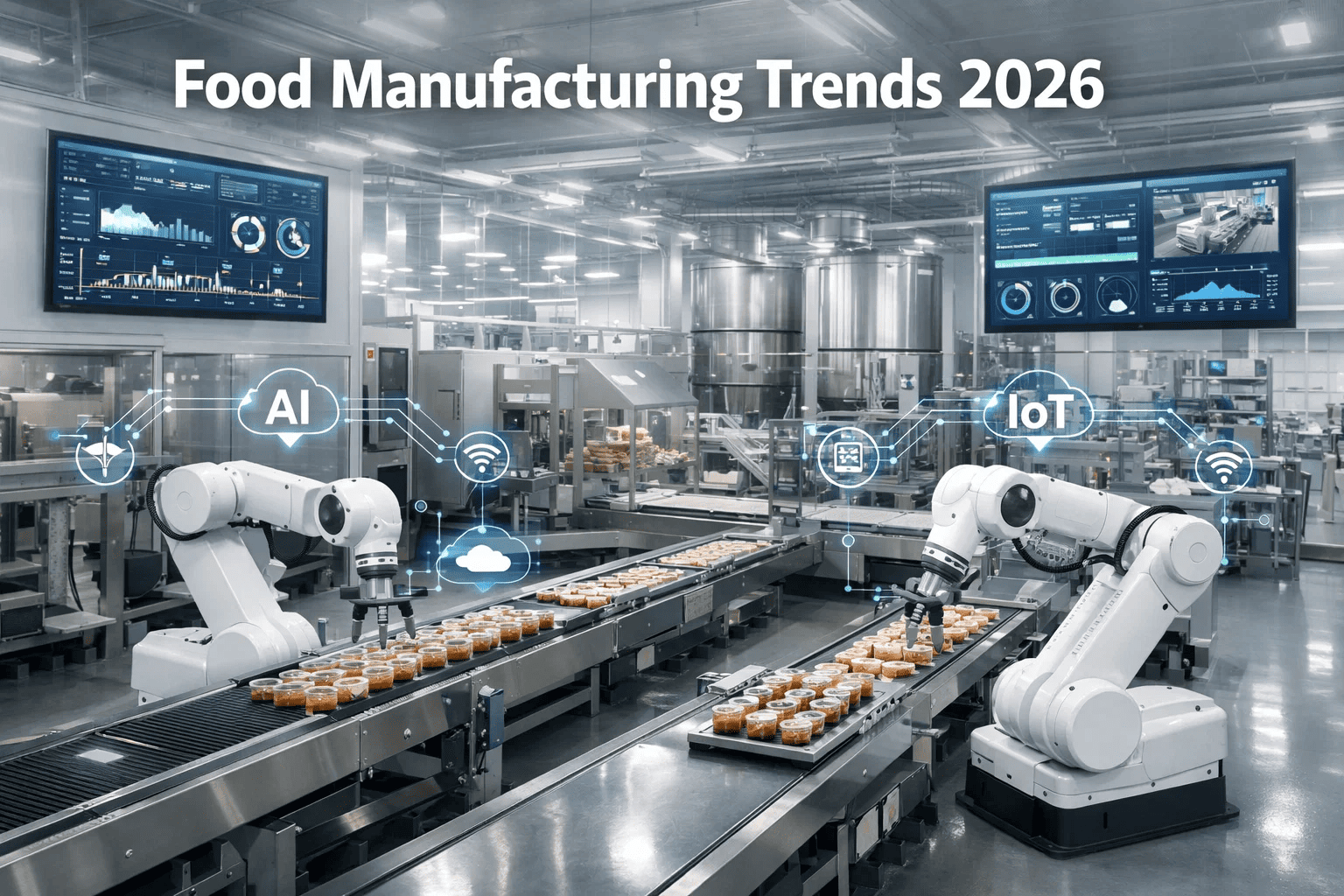
In 2026, a large snack manufacturing plant in Ohio noticed a troubling pattern: production volumes were rising, but profitability was falling. After a digital audit, the root cause became clear — outdated systems and disconnected equipment were slowing operations. Sign up for Oxmaint to bring AI-powered monitoring, predictive maintenance, and smart factory intelligence into your production environment. Once the facility implemented these solutions, production efficiency increased by 38% within one year and quality defects dropped significantly.
The Future of Food Manufacturing
Is Already Here
AI, IoT, and smart automation are reshaping how food gets made — cutting downtime, reducing waste, and giving manufacturers a real competitive edge. Here's what it means for your facility.
A large snack manufacturing plant in Ohio was growing fast — but their profits weren't. Despite rising production volumes, the numbers kept getting worse. Equipment would break down without warning, maintenance crews were constantly reactive, and quality rejects were piling up at the end of the line. After a thorough digital audit, the root cause became undeniable: their systems were too old and too disconnected to keep up with modern demands.
Within 12 months of implementing AI-powered monitoring and IoT-connected equipment analytics, the results were dramatic.
The lesson wasn't complicated: facilities that wait to modernize are handing their market share to those that don't. Smart factories aren't just more efficient — they're more resilient, more compliant, and simply better run.
Think of Food Industry 4.0 as the moment your factory gets a nervous system. Machines start talking to each other. Problems surface before they become crises. Managers make decisions backed by real data, not gut feeling.
Artificial Intelligence in Production
AI analyzes thousands of data points per second — catching patterns no human could spot — to predict failures, optimize recipes, and flag quality issues before products leave the line.
IoT-Connected Equipment
Tiny sensors attached to your mixers, conveyors, ovens, and packaging lines send real-time data about temperature, vibration, pressure, and speed — giving you a live window into every machine's health.
Collaborative Robotics
Modern robots work alongside teams to handle repetitive, high-volume tasks like sorting, packaging, and palletizing — reducing strain and human error simultaneously.
Blockchain for Full Traceability
From the farm field to the store shelf, blockchain creates an unbreakable audit trail. When a recall happens, you can pinpoint the source in minutes — not days — and protect your brand.
These are the most common pain points food manufacturers deal with every day — and what changes when you modernize.
These aren't future concepts — they're being deployed in facilities across the globe today. Here's a plain-language breakdown of each.
Imagine getting a text that says "your oven motor will fail in 48 hours" — before anything goes wrong. That's predictive maintenance. By continuously analyzing vibration, temperature, and usage data, AI can spot the early warning signs of equipment failure that humans simply can't detect.
A digital twin is a virtual copy of your entire production line — running in real time. You can test changes, simulate new product runs, or model the impact of a new piece of equipment without ever touching the physical floor. It's a risk-free sandbox for operations decisions.
Smart packaging embeds tiny sensors into product packaging that monitor temperature, humidity, and freshness throughout the supply chain. Retailers and logistics partners can verify product integrity in real time, and consumers can scan a code to see exactly where their food came from.
Cameras equipped with machine learning models inspect thousands of products per minute — catching color defects, size inconsistencies, foreign objects, and labeling errors with far greater accuracy than any human team. Products are flagged and diverted automatically, with zero line stoppage.
Sustainability isn't just good PR — it directly cuts operating costs. AI energy management systems track water, electricity, and raw material usage at a granular level, identifying where waste happens and automatically adjusting processes to use less while maintaining output quality.
The technologies already in deployment are just the start. Industry analysts are watching a new wave: autonomous micro-factories that reconfigure for different products within hours, AI-driven formulation systems that optimize nutritional profiles and cost simultaneously, and fully closed-loop waste systems.
The most competitive food factories in the next decade will be AI-driven and fully connected.
Facilities that adopt predictive analytics, automated monitoring, and smart maintenance systems today will outperform traditional plants in efficiency, compliance, and cost control. The gap is already widening.
Smart manufacturing isn't just for large enterprises. Every size and type of food facility stands to gain — and the earlier you start, the bigger the advantage.
Large-Scale Manufacturers
Running multiple lines across facilities? Centralized AI monitoring gives you unified visibility and control that siloed systems simply can't provide.
Mid-Size Food Processors
Competing with bigger players means every efficiency gain matters. Predictive maintenance and quality automation help you punch above your weight without adding headcount.
Fresh & Perishables Producers
Tight shelf life windows make real-time quality monitoring and cold chain tracking non-negotiable. Smart systems protect margins and reduce costly recalls.
Specialty & Artisan Brands
Consistency is your brand promise. AI quality control and recipe optimization help maintain the standards your customers expect, even as you scale up.
Compliance-Heavy Operations
Organic, kosher, halal, FSMA-regulated? Digital record-keeping and audit-ready reporting turn compliance from a headache into a competitive advantage.
Sustainability-Focused Facilities
Meeting ESG targets and reducing your carbon footprint requires the kind of granular resource tracking that only smart systems can deliver reliably.
Quantifying the return on investment is easier than most facilities expect. Here are the averages reported by early adopters in the food manufacturing sector.
Typical ROI Metrics — First 12–18 Months Post-Implementation
Based on aggregated data from facilities that implemented AI monitoring and predictive maintenance platforms in 2023–2025.
You don't have to transform everything at once. Most successful implementations follow a phased approach that starts generating value quickly without disrupting operations.
Digital Audit & Baseline Measurement
Before any sensors go in, you need to know where you stand. A digital audit maps your current equipment, identifies the highest-risk failure points, and establishes baseline metrics for OEE, downtime, and quality defects.
IoT Sensor Deployment & Platform Setup
IoT sensors are installed on priority equipment. Your team is connected to a centralized monitoring platform where all data streams are visible in real time. Most installations require minimal downtime and no major infrastructure changes.
AI Model Training & Predictive Alert Activation
The AI needs time to learn what "normal" looks like for your specific equipment. During this phase, the platform builds baseline models and starts generating predictive alerts — this is where you start catching problems before they become emergencies.
Workflow Automation & Team Training
With predictions proving accurate, you build automated workflows: auto-generated work orders, mobile notifications for technicians, compliance-ready reporting for auditors. Your team shifts from reactive to proactive.
Expansion Across Lines & Continuous Improvement
With the core system proven and paying back, most facilities expand sensor coverage, integrate quality inspection systems, and start using production analytics dashboards for strategic planning. By the 12-month mark, most facilities have achieved full payback.
Oxmaint is built specifically for food manufacturing — combining predictive maintenance, real-time monitoring, and compliance tools in a single connected platform.
Real-Time Equipment Monitoring
Every machine on your floor streams performance data continuously. Temperature spikes, vibration anomalies, and unusual runtime patterns are flagged the moment they appear — before anyone has to walk the floor.
Predictive Maintenance Automation
AI algorithms analyze operational patterns and issue early warnings when equipment is showing signs of wear or stress. Your maintenance team knows what needs attention days in advance, not hours after failure.
Smart Compliance Tracking
Every critical parameter — temperature logs, machine cycles, inspection records — is automatically captured and stored in an audit-ready format. FSMA, SQF, or BRC audits become straightforward instead of stressful.
Mobile Maintenance Workflows
When a machine needs attention, the right technician gets a notification on their phone with a complete work order — what to check, what parts may be needed, and what the machine's recent data shows. No paper, no radio chatter.
Production Analytics Dashboards
Live dashboards give operations managers a clear view of efficiency, downtime causes, quality trends, and energy usage across every line and shift — enabling faster decisions grounded in actual data.
AI Decision Support
Beyond monitoring, Oxmaint surfaces actionable recommendations — optimal maintenance windows, resource allocation suggestions, and early-warning trend analysis — so managers can act with confidence, not guesswork.
From floor managers to plant directors, here's how teams describe the impact of making the switch to smart manufacturing.
We used to spend more time reacting to problems than actually running the plant. Now our maintenance team is scheduled out two weeks ahead and we haven't had an unplanned shutdown in four months. That alone more than paid for the system.
Our last audit took two days of prep work. The one after we implemented Oxmaint took about 45 minutes. The auditor actually complimented us on our documentation. That never happens in food manufacturing.
I was skeptical — we've bought software before that promised a lot and delivered a dashboard nobody used. This is different. Our supervisors actually check it every morning. It's changed how we start every shift.
Real questions we hear from operations teams exploring smart factory technology for the first time.
Build the Smart Food Factory Your Operation Deserves
Oxmaint helps food manufacturers implement predictive maintenance, AI monitoring, and connected production intelligence — all in one platform. Start reducing downtime, improving quality, and running audits without stress.