In September 2024, a Wisconsin cheese manufacturer completed a transformation that seemed impossible eighteen
months earlier. Their maintenance team—accustomed to clipboards, paper logs, and reactive firefighting—now
manages 147 pieces of production equipment through mobile devices that predict failures before they occur,
generate compliance documentation automatically, and coordinate maintenance activities across three shifts
without a single manual handoff. The result? Unplanned downtime dropped 71%, quality deviations fell 84%, and
FDA audit preparation time decreased from five days to forty minutes. This facility didn't replace its workforce
or install completely new equipment—they implemented digital transformation across existing
operations, fundamentally changing how humans and machines collaborate to produce safe food efficiently.
The digital transformation food manufacturing movement represents the most significant
operational shift since the introduction of automated production lines in the 1960s. Today's food facilities
face unprecedented pressures—razor-thin profit margins averaging 2-6%, increasingly complex regulatory
requirements from FDA FSMA and global certification bodies, chronic skilled labor shortages, with 23% of
maintenance technicians retiring within five years, and consumer demands for transparency extending from farm to
fork. Traditional analog approaches—paper-based HACCP logs, scheduled preventive maintenance regardless of
actual equipment condition, siloed data systems that don't communicate—cannot scale to meet these converging
challenges.
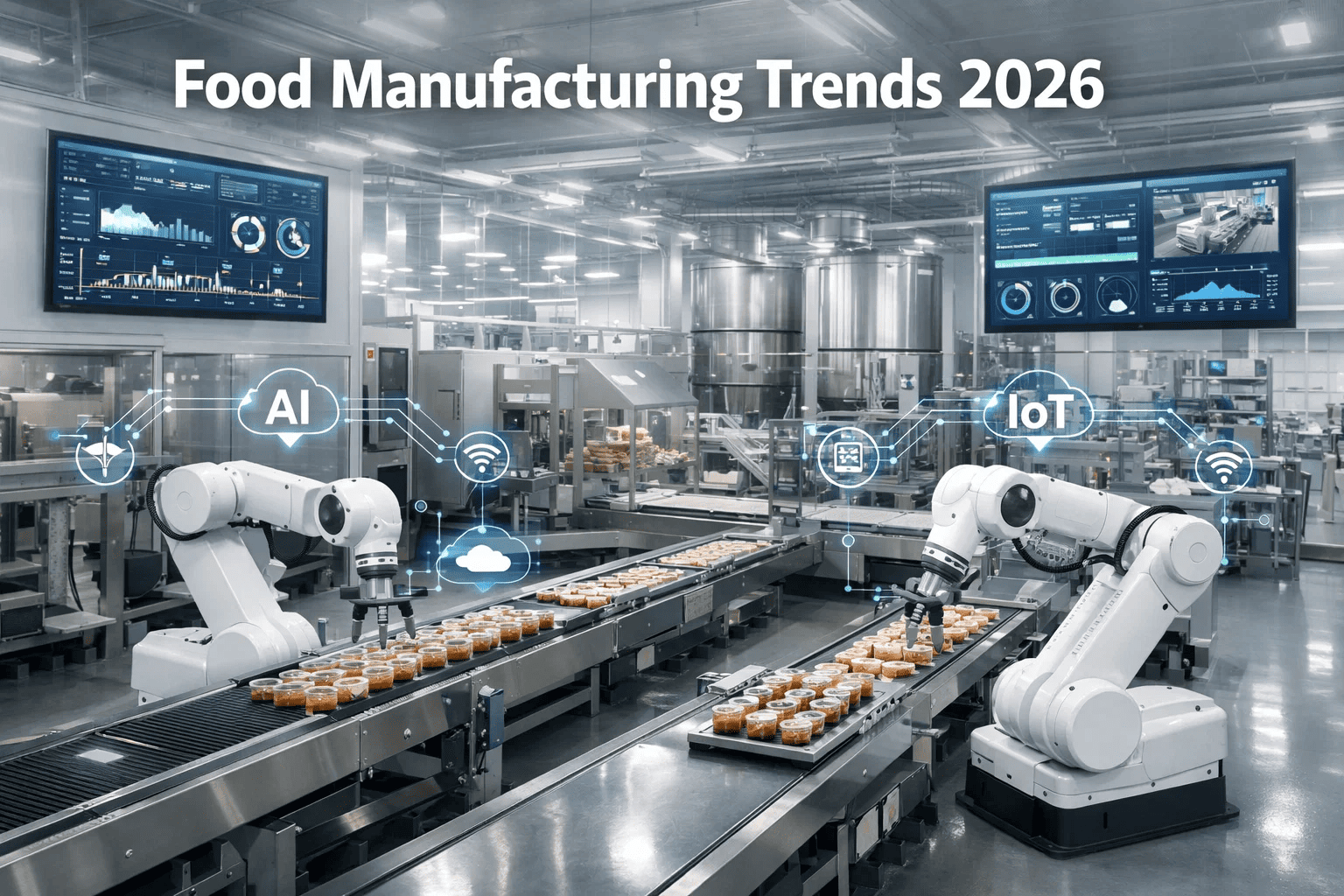
Forward-thinking food manufacturers are responding by embracing Industry 4.0 technologies that connect equipment,
people, and processes through integrated digital platforms. IoT sensors continuously monitor critical parameters
replacing periodic manual checks. AI-powered analytics identify patterns humans cannot detect across millions of
data points. Cloud-based CMMS systems enable maintenance coordination from anywhere, transforming how
distributed teams collaborate. Mobile applications put real-time information and decision support tools directly
in technicians' hands on the production floor. The transformation isn't simply about adopting new tools—it's
about reimagining food manufacturing operations for an era where data-driven intelligence amplifies human
expertise rather than replacing it. Start your digital transformation →
Industry 4.0 / Smart Factory Technology
Digital Transformation Trends Reshaping Food Manufacturing
How IoT, AI, and integrated platforms are revolutionizing maintenance,
compliance, and operational efficiency
Facilities Planning
Digital Investment
Downtime
Reduction Achieved
Data Accuracy
Improvement
18-24
months
Typical Full
ROI Timeline
Why Digital Transformation Matters for Food Manufacturing
Food manufacturing operates at the intersection of complex production processes, stringent regulatory compliance,
and unforgiving quality standards where a single mistake can trigger multi-million dollar recalls, severe
regulatory penalties, and permanent brand damage. Traditional operational approaches—reactive maintenance,
manual documentation, siloed information systems—created acceptable results when margins were higher,
regulations simpler, and labor more abundant. That era has ended.
Today's food facilities manage exponentially more complexity with fewer resources. A typical mid-size plant
monitors 200+ compliance data points daily across HACCP, FDA, USDA, and third-party certification requirements.
Maintenance teams juggle 50-80 critical assets requiring different service intervals, spare parts inventories,
and specialized knowledge. Quality control laboratories process thousands of test results requiring correlation
with production conditions, ingredient lots, and equipment performance. Supply chains demand real-time
traceability linking every finished product package back through processing, ingredient receipt, and supplier
certifications. The volume of decisions, documentation, and coordination required exceeds human capacity to
manage effectively using analog tools.
$2.1B
Global food and beverage manufacturers investing in Industry 4.0
technologies annually, with digital transformation budgets growing 23% year-over-year as facilities
recognize that competitive survival requires operational modernization beyond incremental process
improvements.
Six Digital Technologies Transforming Food Manufacturing
Wireless sensors continuously monitor equipment health, environmental conditions, and process
parameters—replacing periodic manual checks with real-time data streams that detect developing
issues before they impact production or product quality.
KEY APPLICATIONS:
Temperature and humidity monitoring across cold chain zones
Vibration analysis for predictive maintenance on rotating
equipment
Energy consumption tracking identifying efficiency opportunities
Door status and access monitoring for security and compliance
BUSINESS IMPACT:
89% reduction in product losses from undetected temperature
excursions
2-4 week advance warning of equipment failures through trend
analysis
Automated compliance documentation eliminating manual log
creation
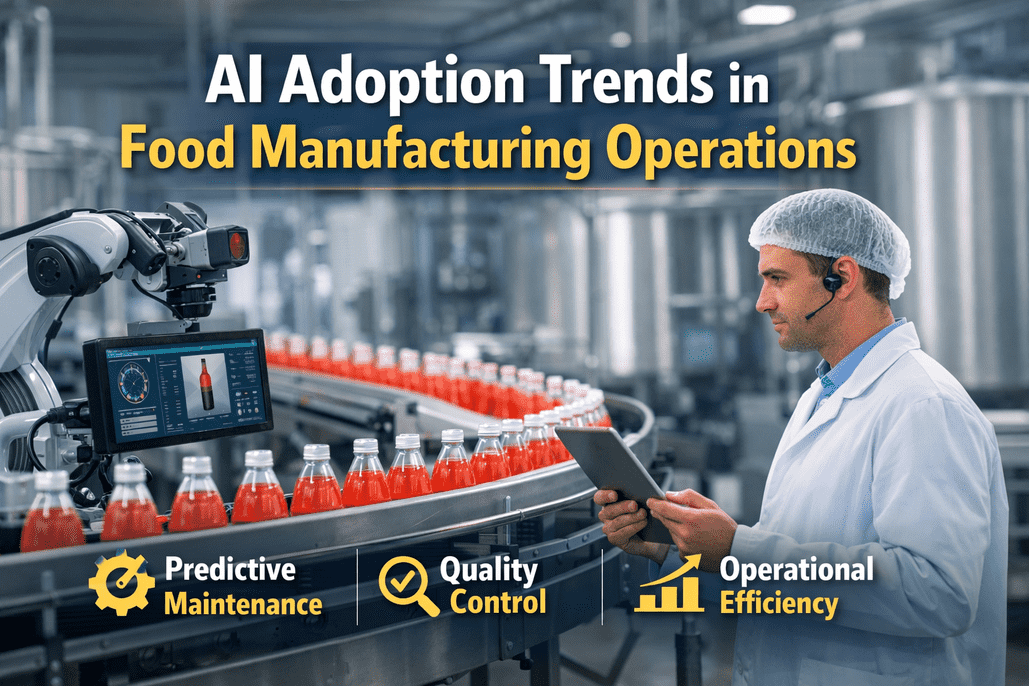
AI algorithms analyze historical patterns across thousands of data points identifying correlations
between equipment behavior, environmental conditions, and failure modes—predicting maintenance needs
with accuracy impossible through human observation alone.
KEY APPLICATIONS:
Predictive maintenance modeling based on actual equipment
degradation
Quality deviation pattern recognition linking defects to root
causes
Energy optimization through process parameter adjustments
Demand forecasting improving production planning accuracy
BUSINESS IMPACT:
67% reduction in unplanned downtime through early intervention
34% maintenance cost savings optimizing service timing
Root cause identification reducing recurring quality issues by
78%
Modern computerized maintenance management systems accessible from any device, anywhere enable
distributed teams to coordinate activities, access equipment histories, and document work without
being tethered to office computers or paper systems.
KEY APPLICATIONS:
Mobile work order management on production floor tablets and
phones
Preventive maintenance scheduling with automatic task generation
Spare parts inventory tracking with reorder point automation
Equipment history documentation accessible during troubleshooting
BUSINESS IMPACT:
85% faster maintenance response eliminating communication delays
Complete audit trails satisfying FDA and certification
requirements
28% reduction in spare parts inventory through usage optimization
Smartphones and tablets transform into powerful operational tools putting real-time data, standard
operating procedures, equipment manuals, and decision support directly in workers' hands at the
point of need rather than requiring trips to offices or file cabinets.
KEY APPLICATIONS:
Digital checklists guiding inspections with photo documentation
Barcode/QR code scanning linking physical assets to digital
records
Push notifications alerting teams to critical conditions requiring
response
Offline capability maintaining functionality during connectivity
loss
BUSINESS IMPACT:
92% improvement in data collection accuracy and completeness
Elimination of data transcription errors from paper to computer
systems
Real-time visibility enabling immediate decision-making without
delays
Business intelligence platforms transform raw operational data into actionable insights through
dashboards, trend analysis, and automated reporting—making complex patterns visible to humans who
can then make informed strategic decisions.
KEY APPLICATIONS:
OEE tracking across production lines identifying bottlenecks
KPI dashboards showing real-time performance versus targets
Trend analysis revealing gradual efficiency degradation over time
Comparative benchmarking between shifts, lines, or facilities
BUSINESS IMPACT:
Data-driven decision making replacing intuition and guesswork
Early identification of performance trends enabling proactive
responses
Transparency creating accountability across operational teams
Application programming interfaces connect previously siloed systems—CMMS, ERP, quality management,
inventory control—enabling data flow between platforms that eliminates manual data entry,
synchronizes information, and creates unified operational views.
KEY APPLICATIONS:
CMMS-ERP integration synchronizing work orders and parts
consumption
Quality system correlation with equipment maintenance histories
IoT sensor data feeding into maintenance and compliance platforms
Automated reporting distributing information to stakeholders
BUSINESS IMPACT:
Single source of truth eliminating conflicting information
sources
Cross-functional visibility enabling better collaborative
decisions
Workflow automation reducing administrative overhead by 60%
Transform Your Operations With Integrated Digital Tools
Oxmaint brings IoT sensors, AI analytics, mobile operations, and cloud-based maintenance management into a
single integrated platform designed specifically for food manufacturing. Start with one capability and
expand as you prove value—no rip-and-replace required.
5-Phase Digital Transformation Roadmap
Assessment and Strategy Development
Month 1-2
Evaluate current operational maturity across maintenance, compliance,
and production management
Identify pain points costing the most money or creating highest
operational risks
Define success metrics—what improved outcomes justify investment
Select first-phase technology focus based on quick wins and strategic
importance
Secure executive sponsorship and cross-functional stakeholder buy-in
Pilot Implementation
Month 3-5
Deploy chosen technology in limited scope—one production line, single
facility zone, or specific equipment type
Train pilot team deeply on new tools, workflows, and success behaviors
Document pilot results rigorously—baseline versus post-implementation
performance
Identify configuration adjustments, training gaps, and process
improvements
Build internal champions who experienced benefits firsthand and can
advocate to peers
Facility-Wide Rollout
Month 6-9
Expand pilot technology across entire facility incorporating lessons
learned
Implement phased training approach ensuring all shifts and personnel
gain proficiency
Establish governance structure defining roles, responsibilities, and
escalation paths
Begin capturing ROI metrics demonstrating value delivered versus
investment
Communicate success stories internally building momentum for additional
transformation
Technology Stack Expansion
Month 10-15
Add complementary technologies based on initial foundation—IoT + CMMS,
then add AI analytics
Integrate systems through APIs creating unified information flow and
eliminating data silos
Automate workflows connecting separate tools—temperature alerts
auto-generating maintenance work orders
Deploy advanced capabilities like predictive maintenance models trained
on accumulated historical data
Expand digital transformation to adjacent functional areas—quality,
supply chain, production planning
Optimization and Innovation
Month 16+
Continuously refine system configurations, alert thresholds, and
workflows based on operational feedback
Leverage accumulated data for advanced analytics identifying subtle
efficiency opportunities
Benchmark performance against industry standards demonstrating
competitive advantages achieved
Explore emerging technologies—computer vision for quality inspection,
autonomous mobile robots for material handling
Share transformation journey externally positioning organization as
industry innovation leader
Start Your Digital Journey With Proven Technology
Oxmaint provides the integrated platform food manufacturers need to modernize operations without disrupting
production. Start small with mobile maintenance or IoT monitoring, prove value quickly, then expand
systematically. Join 420+ facilities transforming how they operate.
Building an Integrated Digital Ecosystem
COR
Core CMMS Platform
Cloud-based computerized maintenance management system serves as the operational hub coordinating
work orders, equipment records, preventive maintenance schedules, spare parts inventory, and
compliance documentation across all facility activities.
Mobile-first design enabling field documentation without desktop
computers
Equipment hierarchy matching facility structure and operational
organization
Automated preventive maintenance scheduling with calendar
integration
Complete audit trails satisfying FDA and certification
requirements
SNS
IoT Sensor Infrastructure
Wireless sensor networks continuously monitor temperature, humidity, vibration, energy consumption,
and other critical parameters—feeding real-time data into CMMS and analytics platforms replacing
periodic manual checks with continuous awareness.
Battery-powered sensors lasting 2-5 years without maintenance
Multiple connectivity options: Wi-Fi, LoRaWAN, cellular,
Bluetooth
Automated alert generation when parameters exceed thresholds
Cloud data storage providing historical trend analysis
ANL
Analytics and AI Layer
Machine learning models analyze operational data identifying patterns, predicting failures,
optimizing maintenance timing, and providing decision support that augments human expertise with
computational pattern recognition across massive datasets.
Predictive maintenance models trained on facility-specific
equipment history
Anomaly detection highlighting unusual conditions requiring
investigation
Root cause analysis correlating failures with operational
conditions
Optimization recommendations for energy consumption and
efficiency
ECO
Enterprise System Connections
API integrations connect CMMS platforms to ERP systems, quality management software, inventory
control, and other enterprise applications—enabling data flow between previously siloed systems and
creating unified operational visibility.
ERP synchronization for work order costing and parts consumption
Quality system integration correlating deviations with
maintenance events
Production scheduling coordination for planned maintenance
windows
Supply chain visibility linking equipment performance to
material flows
Frequently Asked Questions
What is digital transformation in food manufacturing and how does it differ
from traditional automation?
Digital transformation extends beyond automating individual production
processes to creating connected, intelligent operational ecosystems. Traditional automation replaces manual
labor with machines performing repetitive physical tasks—filling containers, sealing packages, moving
materials. Digital transformation connects machines, people, and processes through data networks enabling
predictive maintenance, quality correlation analysis, automated compliance documentation, and real-time
operational visibility. The shift is from "faster manual processes" to "fundamentally different operational
capabilities" impossible without digital intelligence.
How long does digital transformation typically take and what does the
investment timeline look like?
Most facilities achieve meaningful transformation over 18-36 months through
phased implementation. Initial pilot deployments (3-5 months) prove value in limited scope with modest
investment ($25K-$75K). Facility-wide rollout (6-9 months) expands capabilities requiring larger investment
($100K-$250K). Technology stack integration and optimization (12-24 months) builds full digital ecosystem.
Total investment for mid-size facilities typically ranges $200K-$500K over three years, with ROI achieved
within 18-24 months as operational savings accumulate. Transformation is a journey, not a project—continuous
improvement and capability expansion extend indefinitely.
Will digital transformation eliminate jobs or can existing staff adapt to new
technology-driven roles?
Digital transformation eliminates tedious administrative tasks while creating
higher-value roles requiring human judgment, creativity, and problem-solving. Technicians spend less time
filling out paperwork, more time performing preventive maintenance preventing failures. Quality personnel
spend less time compiling reports, more time analyzing patterns driving continuous improvement. The
workforce shift is from reactive firefighting and documentation burden to proactive problem prevention and
data-driven optimization. Most facilities maintain or increase total employment while dramatically improving
job satisfaction as workers escape administrative drudgery to focus on expertise application.
What are the biggest risks or failure modes in digital transformation
initiatives and how can we avoid them?
The primary failure mode is organizational resistance, not technical problems.
Initiatives fail when organizations underinvest in change management, training, and communication—expecting
technology alone to drive behavioral change. Other common pitfalls include scope creep attempting too much
simultaneously, inadequate executive sponsorship allowing competing priorities to derail projects, poor
vendor selection choosing tools that don't integrate well, and insufficient measurement making value
invisible. Avoid failure through realistic scoping, sustained executive engagement, comprehensive training
programs, proven technology selection, and relentless value communication.
Start your transformation with expert guidance →
How do we justify digital transformation investment when margins are already
tight and budgets constrained?
Digital transformation addresses the margin problem rather than being
constrained by it. Facilities operating on 2-6% margins cannot afford NOT to transform—traditional
approaches cannot deliver the efficiency gains, waste reduction, and compliance efficiency required to
remain competitive. Build investment justification by quantifying current waste: unplanned downtime costs,
product losses from quality deviations, labor hours consumed by manual documentation, energy waste from
inefficient equipment operation. Digital transformation typically self-funds within 18-24 months through
operational savings that exceed technology costs. The real risk is falling behind competitors who transform
first and establish sustainable cost advantages through superior operational efficiency.
Begin Your Digital Transformation Journey Today
Every day operating with analog tools and disconnected systems represents
missed opportunities to prevent failures, eliminate waste, and improve efficiency. Digital transformation isn't
a futuristic concept—it's a present-day operational necessity as food manufacturers face intensifying
competitive pressures, tightening margins, and escalating complexity.
Oxmaint provides the integrated platform specifically designed for food
manufacturing digital transformation. Start small with mobile maintenance or IoT monitoring, prove value
rapidly, then expand systematically building the connected intelligent operations defining competitive advantage
in modern food production. Join 420+ facilities already transforming how they manufacture safe, high-quality
food products efficiently.