Food safety failures don't announce themselves. A temperature excursion in a blast chiller, an unchecked pH deviation in a fermentation tank, a missed sanitation verification on a packaging line — each of these represents a critical control point failure that can trigger a product recall, a regulatory shutdown, or worse. For decades, HACCP compliance has been managed through paper logs, spreadsheet templates, and manual supervisor checks — a system that is structurally incapable of catching the failures it was designed to prevent. Computerized Maintenance Management Systems with native HACCP automation are fundamentally changing this equation, replacing reactive paper trails with real-time monitoring, automated deviation alerts, and audit-ready digital records that are generated automatically as production runs.
See HACCP automation in action at your facility
OxMaint helps food manufacturers and processors automate critical control point monitoring, log deviations instantly, and generate audit-ready HACCP records — with zero manual paperwork.
Understanding HACCP and Why Manual Compliance Breaks Down
The Hazard Analysis and Critical Control Points framework was developed in the 1960s for NASA's food supply program and has since become the global standard for food safety management. At its core, HACCP is a preventive system — it identifies the points in a food production process where biological, chemical, or physical hazards can be controlled, establishes critical limits for each control point, and mandates continuous monitoring, corrective action, verification, and documentation. The seven HACCP principles are not suggestions; they are the operational backbone of regulatory compliance under FDA's Food Safety Modernization Act, USDA FSIS requirements, and international standards including Codex Alimentarius.
The structural weakness of manual HACCP programs lies in the gap between when monitoring occurs and when data becomes actionable. A temperature log filled out every two hours means that a CCP excursion can go undetected for up to 120 minutes. A paper corrective action form filed at the end of a shift means that the root cause investigation begins hours after the deviation occurred. Audit documentation assembled from handwritten logs, scanned forms, and disconnected spreadsheets introduces transcription errors and creates traceability gaps that regulators and third-party auditors consistently flag. When a recall investigation demands complete production records for a specific lot, manual systems routinely fail to deliver the speed and completeness that modern food safety expectations require. Sign up free to see how OxMaint closes these compliance gaps automatically.
What CMMS-Driven HACCP Automation Actually Looks Like
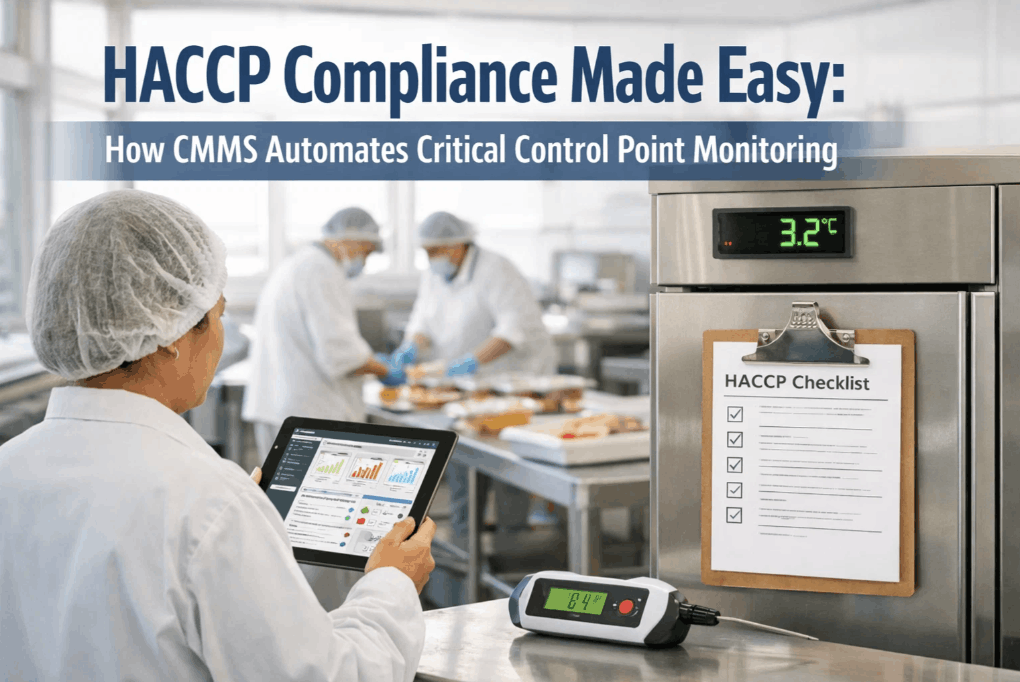
A CMMS platform with HACCP automation capability integrates directly with the monitoring equipment, sensors, and data sources at each critical control point and transforms raw operational data into structured compliance records in real time. Rather than relying on a technician to walk to a monitoring station, read a dial, and transcribe a value onto a paper form, the system captures the measurement automatically, evaluates it against the configured critical limit, and triggers the appropriate response — all within seconds of the measurement occurring. This is not incremental improvement on manual compliance; it is a fundamentally different operational model.
Automated CCP Data Capture
IoT sensors and connected monitoring equipment feed temperature, pH, Aw, pressure, and flow rate readings directly into the CMMS at configurable intervals — from continuous streaming to scheduled sampling — without any manual data entry requirement.
Real-Time Critical Limit Evaluation
Each incoming data point is automatically evaluated against the critical limits defined in the HACCP plan. The system distinguishes between values within the critical limit, approaching the critical limit (triggering preventive alerts), and exceeding the critical limit (triggering immediate corrective action workflows).
Deviation Alerts and Escalation
When a CCP deviation is detected, the CMMS immediately notifies designated personnel through configurable alert channels. Escalation rules ensure that unacknowledged alerts automatically advance to supervisory and management contacts, preventing critical deviations from going unaddressed.
Corrective Action Workflow Initiation
Deviation events automatically generate structured corrective action records linked to the specific CCP, production run, lot number, and shift. Corrective action forms are pre-populated with deviation data, guiding the responding team through defined response protocols and capturing all actions taken for the compliance record.
Verification Task Generation
Following corrective action completion, the CMMS automatically schedules and assigns verification tasks to confirm that the corrective action was effective and that the CCP has returned to within critical limits — creating the documented verification trail required by HACCP Principle 6.
Audit-Ready Record Generation
Every monitoring event, deviation, corrective action, and verification is automatically compiled into structured compliance records with timestamps, user attribution, and lot traceability. Audit reports can be generated on demand for any date range, production line, or CCP.
Critical Control Points Where CMMS Automation Delivers the Most Value
HACCP plans vary by product category, production process, and regulatory jurisdiction, but several CCP categories appear consistently across food manufacturing operations and represent the highest-impact targets for CMMS automation deployment. Book a demo to see live CCP monitoring in action.
Thermal Processing Controls
Time-temperature combinations are the most universally critical CCP category in food safety. Whether the application is pasteurization, cooking, retorting, or blast chilling, the CMMS continuously monitors temperature against defined critical limits and logs every reading with timestamps. Deviations in heating processes trigger immediate holds on affected product and initiate documented hold-and-evaluate procedures. Deviations in chilling applications generate rapid-response alerts before pathogen growth risk accumulates. The system maintains complete continuous temperature records for every batch — the foundation of thermal process validation documentation.
Metal Detection and Foreign Object Controls
Metal detectors and X-ray inspection systems at critical points in the production line generate high-frequency pass/fail signals that the CMMS captures and logs. The system tracks rejection rates, identifies patterns that may indicate equipment calibration drift, schedules mandatory test piece verification checks at defined intervals, and alerts supervisors when verification checks are overdue or when rejection rates exceed normal operating parameters. Complete detection records with calibration verification logs are maintained automatically for every production run.
pH and Water Activity Monitoring
For acidified foods, fermented products, and reduced-moisture items, pH and water activity (Aw) are primary pathogen control mechanisms. CMMS integration with inline pH analyzers and Aw monitoring instruments captures measurement data at configurable intervals throughout production. Critical limit excursions automatically place affected production on hold pending corrective action, preventing non-conforming product from advancing in the production process. Trend analysis tools in the CMMS enable quality teams to identify gradual process drift before deviations occur.
Allergen Cross-Contact Prevention
Allergen management CCPs require documented sanitation verification and scheduling controls to prevent cross-contact between allergen-containing and allergen-free production runs. The CMMS manages allergen changeover workflows — scheduling and verifying cleaning procedures, requiring sign-off on sanitation completion before allergen-free production can commence, and maintaining complete changeover records with timestamps and responsible party attribution. Scheduling controls prevent allergen-free runs from being released for production until all required sanitation verifications are confirmed in the system.
CMMS vs. Manual HACCP: Capability Comparison
The operational differences between CMMS-automated and manual HACCP programs are most clearly understood through a direct capability comparison across the dimensions that matter most to food safety performance and audit readiness.
| HACCP Function | Manual System | CMMS Automation |
|---|---|---|
| CCP Monitoring Frequency | Scheduled manual checks (typically every 1–4 hours) | Continuous or configurable automated data capture |
| Deviation Detection Speed | Up to several hours after excursion begins | Seconds from excursion detection to alert |
| Corrective Action Initiation | Supervisor notified at next check or shift review | Automated workflow triggered at moment of deviation |
| Documentation Completeness | Dependent on staff diligence; transcription errors common | Automatic, timestamped, user-attributed records |
| Audit Report Generation | Manual assembly from multiple sources; hours or days | On-demand generation for any date range or CCP |
| Verification Scheduling | Manual scheduling; prone to missed or delayed tasks | Automated task generation with escalation rules |
| Trend Analysis Capability | Manual spreadsheet analysis; limited and retrospective | Real-time dashboards and predictive deviation alerts |
| Lot Traceability | Paper-based; slow to assemble during recall events | Instant lot-linked records across all CCPs |
| Regulatory Inspection Readiness | Documentation gaps common; assembly time required | Complete structured records immediately accessible |
Building Audit Readiness Into Daily Operations
Regulatory inspections and third-party food safety audits — whether conducted under GFSI-benchmarked schemes like SQF, BRC, FSSC 22000, or IFS, or by FDA or USDA inspectors — evaluate both the design of the HACCP plan and the effectiveness of its ongoing implementation. The documentation trail is not a bureaucratic add-on; it is the primary evidence of system effectiveness. CMMS platforms with HACCP automation architecture produce this evidence as a natural byproduct of normal operational monitoring rather than as a separate administrative task.
When an FDA inspector or SQF auditor requests CCP monitoring records for a specific production date, a CMMS-enabled operation can generate a complete, timestamped, lot-linked report in minutes. When a corrective action record is requested, the system produces the deviation event data, the responding personnel's documented actions, the verification outcome, and the preventive action taken — all in a single structured document. This operational confidence is the difference between an audit that validates system effectiveness and one that surfaces systemic documentation failures. Sign up free and build audit readiness into every production run.
Integrating CMMS HACCP Automation with Broader Food Safety Management Systems
HACCP automation does not operate in isolation within a well-designed food safety management system. The most effective CMMS implementations connect CCP monitoring data to adjacent food safety functions — supplier qualification, sanitation management, equipment calibration, pest control, and environmental monitoring — creating a unified compliance data environment where all food safety-critical activities are tracked, documented, and reportable from a single platform.
Equipment calibration is a direct prerequisite for CCP monitoring validity. If the thermometer used to monitor a pasteurization CCP is out of calibration, every temperature reading it has generated is compromised. CMMS platforms that manage calibration schedules alongside CCP monitoring create an automatic link between calibration status and monitoring record validity — flagging records generated by out-of-tolerance equipment and triggering recalibration workflows before monitoring data integrity is affected. Sanitation verification records for allergen changeover CCPs integrate with production scheduling to enforce prerequisite completion before non-conforming production sequences can begin. Supplier qualification records link to incoming material CCPs, ensuring that raw material acceptance criteria are evaluated against documented supplier performance data. Book a demo to explore how OxMaint unifies your entire food safety compliance environment.
Implementation Path: From Manual HACCP to Automated Compliance
HACCP Plan Digitization and CCP Configuration
Begin by digitizing the existing HACCP plan within the CMMS — configuring each CCP with its critical limits, monitoring frequency requirements, corrective action procedures, and verification requirements. This step also involves mapping the HACCP plan structure to the CMMS data architecture and identifying the integration points with monitoring equipment.
Sensor and Equipment Integration
Connect monitoring equipment and IoT sensors to the CMMS data layer. For operations without existing connected monitoring equipment, this phase includes sensor procurement and installation planning. For operations with existing PLCs, SCADA systems, or data historians, this involves API integration or data bridge configuration to feed existing monitoring data into the CMMS.
Alert and Escalation Rule Configuration
Define the alert thresholds, notification channels, and escalation sequences for each CCP. Configure both preventive alerts (approaching critical limits) and corrective action triggers (exceeding critical limits). Establish escalation rules that advance unacknowledged alerts through supervisor and management contacts on defined timelines.
Corrective Action Workflow Design
Build structured corrective action workflows in the CMMS for each CCP deviation scenario. Workflows should guide responders through defined response steps, capture all actions taken with timestamps and user attribution, and automatically trigger verification task assignment upon corrective action completion.
Team Training and Parallel Operation
Train production, quality, and supervisory teams on the CMMS interface for CCP monitoring, deviation response, and verification task completion. Run the automated system in parallel with existing manual processes during an initial validation period to confirm data accuracy and workflow effectiveness before transitioning fully to CMMS-based compliance.
Audit Report Validation and Go-Live
Conduct a mock audit using CMMS-generated compliance reports before full go-live, verifying that all required HACCP documentation elements are present, complete, and structured to meet applicable regulatory and certification scheme requirements. Address any documentation gaps before retiring the manual system.
Ready to automate your HACCP compliance program?
OxMaint helps food manufacturers and processors digitize HACCP plans, automate CCP monitoring, and generate audit-ready compliance documentation — from pilot plant to enterprise scale.
Frequently Asked Questions
What is HACCP compliance software?
HACCP compliance software is a digital platform that automates the monitoring, documentation, corrective action management, and reporting functions required under the HACCP food safety framework. It replaces paper-based HACCP logs and manual monitoring processes with real-time data capture, automated alerts, and structured compliance records that are immediately available for regulatory inspections and third-party audits.
How does a CMMS automate critical control point monitoring?
A CMMS with HACCP automation capability integrates with temperature sensors, pH analyzers, metal detectors, and other CCP monitoring equipment to capture measurement data automatically at configurable intervals. The system evaluates each data point against defined critical limits, triggers alerts and corrective action workflows when deviations are detected, and generates timestamped compliance records without requiring manual data entry.
Can CMMS-based HACCP records satisfy FDA and USDA inspection requirements?
Yes. CMMS-generated HACCP records that include complete CCP monitoring data, deviation events, corrective action documentation, and verification records with timestamps and user attribution satisfy the recordkeeping requirements under FDA's Food Safety Modernization Act and USDA FSIS regulations. Organizations should verify that their CMMS implementation captures all required data elements for their specific regulatory context.
What types of food operations benefit most from CMMS HACCP automation?
Meat and poultry processing, dairy production, seafood processing, ready-to-eat food manufacturing, juice and beverage production, and any food operation regulated under mandatory HACCP requirements benefits significantly from automation. Higher-volume operations with multiple simultaneous CCPs, facilities operating across multiple shifts, and organizations targeting GFSI certification see the largest measurable impact from automated CCP monitoring and documentation.
How long does it take to implement CMMS-based HACCP automation?
A single-facility implementation covering a defined set of CCPs typically requires eight to sixteen weeks from system configuration to validated go-live, depending on the complexity of the HACCP plan and the scope of equipment integration required. Operations with existing connected monitoring equipment and well-documented HACCP plans can achieve go-live more quickly than those requiring new sensor infrastructure or HACCP plan revision.
Does CMMS HACCP automation support GFSI certification schemes like SQF and BRC?
CMMS platforms that generate complete, timestamped, lot-linked HACCP monitoring and corrective action records directly support the documentation requirements of SQF, BRC Global Standard for Food Safety, FSSC 22000, IFS Food, and other GFSI-benchmarked schemes. Facilities should confirm with their CMMS provider that the system's record architecture aligns with the specific documentation requirements of their target certification scheme.