A food processing facility in Wisconsin failed a surprise FDA audit — not because of a recipe issue or contamination event, but because HVAC maintenance records were incomplete. Three HEPA filters in the packaging clean room had exceeded their replacement interval by 11 weeks. Positive pressure differentials in two zones had drifted below specification. Nobody had noticed because nobody had a system tracking it. The recall risk was real, the corrective action cost was significant, and the root cause was entirely preventable. A structured CMMS-driven HVAC maintenance programme on OxMaint tracks every filter, every pressure zone, and every inspection interval — so your facility stays compliant before the auditor arrives, not after. Food plant HVAC is not a background utility — it is an active food safety control. Book a demo to see how OxMaint manages your food facility environmental controls.
Food Safety / Environmental Control
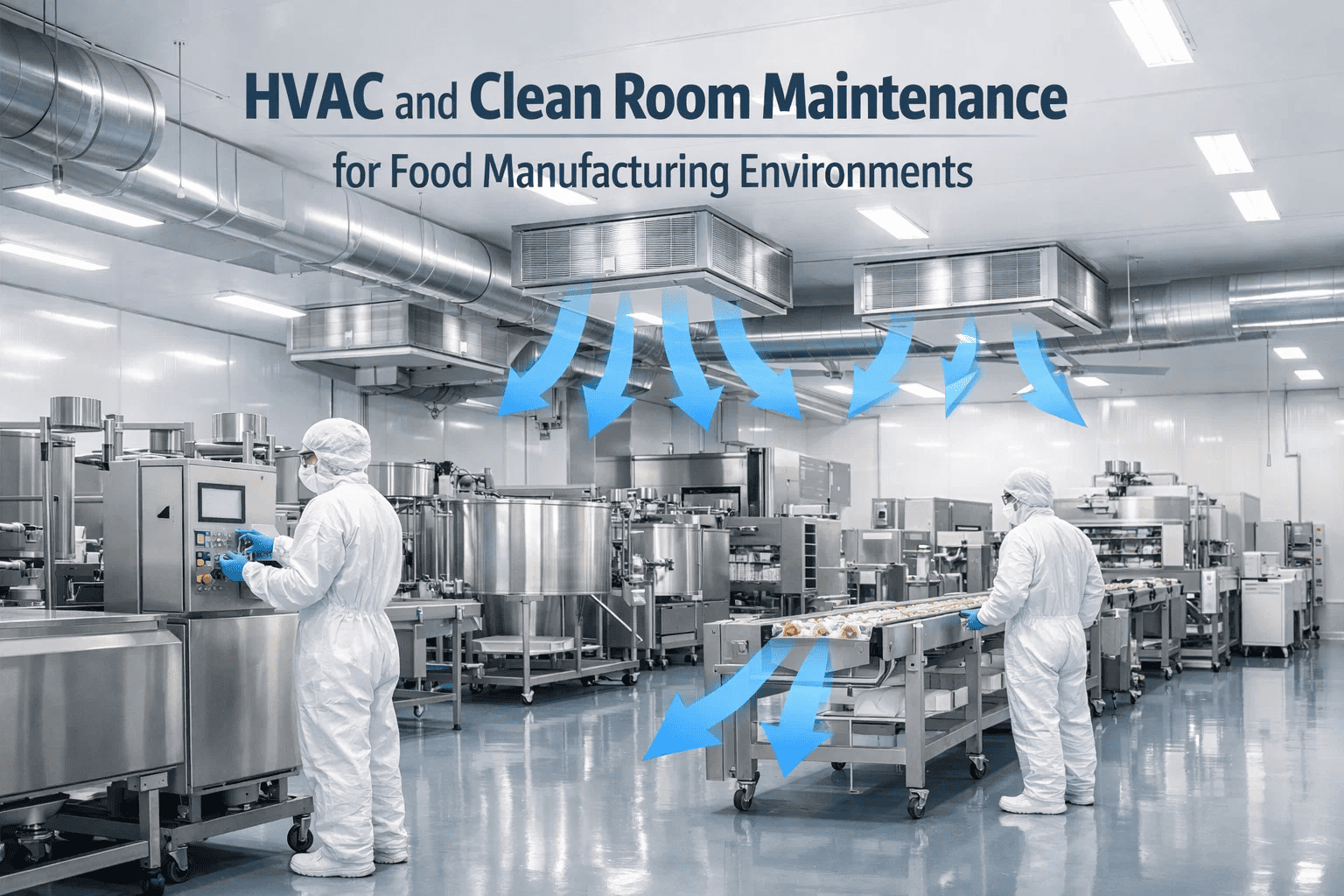
HVAC and Clean Room Maintenance for Food Manufacturing Environments
Contaminated air is invisible. Failed HEPA filters, drifted pressure differentials, and untracked temperature excursions are food safety failures waiting to be discovered — by an auditor or a recall. CMMS-driven preventive maintenance makes them preventable.
68%
of food facility environmental failures trace to HVAC system gaps
4.2x
higher recall risk when clean room pressure monitoring lapses
$2.4M
average cost of a product recall triggered by contamination
12 wk
typical HEPA filter overrun interval at facilities without CMMS
What Food Plant HVAC Maintenance Actually Controls
In food manufacturing, HVAC is not comfort heating and cooling — it is a food safety system. Every component failure carries contamination risk, regulatory exposure, and production loss. Facilities that manage HVAC reactively are operating a compliance liability, not a controlled environment.
Positive Pressure Zones
Higher-pressure clean rooms prevent external contaminated air from entering. Pressure differentials must be verified and logged — not assumed.
HEPA Filtration
HEPA filters rated H13/H14 remove 99.97%+ of 0.3-micron particles. Loading over time reduces efficacy — replacement intervals must be tracked by runtime, not calendar only.
Temperature and Humidity Control
Process zones in food manufacturing have defined temperature and RH ranges for safety and shelf life. Excursions must trigger immediate corrective action, not end-of-shift discovery.
Air Change Rate (ACH)
Clean rooms require defined air changes per hour — typically 20 to 60 ACH depending on classification. Fan performance degradation reduces ACH below specification silently.
Drainage and Condensate Control
AHU drain pans and condensate lines are primary Listeria and mold harborage sites. Blocked drains cause standing water — a direct contamination pathway under FDA 21 CFR Part 117.
Microbial Monitoring Zones
Environmental monitoring programmes test air quality in clean zones on scheduled intervals. HVAC maintenance is the first line of control — monitoring confirms the system is working.
Where HVAC Failures Create Food Safety Risk
Each failure mode in food plant HVAC maps directly to a contamination risk, a regulatory gap, or a recall trigger. These are not maintenance inconveniences — they are HACCP critical control point failures.
Contamination Risk
Overloaded HEPA Filter
Filter loading beyond rated capacity allows particle breakthrough — including mold spores, Listeria, and allergen particles — into open-process clean zones. Most facilities discover this at replacement, not before.
Particle bypass risk increases 6x after filter overloads by 30%
Compliance Gap
Pressure Differential Drift
Positive pressure zones lose their protective function when pressure falls below 0.03–0.05 inches W.C. differential. Without automated monitoring and documented correction, this becomes an FDA 483 observation.
35% of facilities cannot produce pressure logs for last 90 days
Production Loss
AHU Fan Belt or Bearing Failure
Air handling unit fan failure stops air circulation in the clean zone. Production halt is immediate and mandatory under FSMA. Emergency repair in food-grade environments requires sanitization downtime after any maintenance access.
Unplanned AHU downtime averages 6.4 hours in food facilities
Harborage Site
Blocked AHU Drain Pan
Standing water in drain pans under 10°C supports Listeria monocytogenes colonization. The pathogen biofilm can then be distributed through the air supply system into the process environment.
Listeria in drain pans found in 41% of ready-to-eat facilities audited
Reactive vs. Preventive HVAC Management in Food Plants
The difference between reactive and preventive HVAC management is not just cost — it is the difference between proactive compliance and a corrective action report after an audit finding.
HEPA filter replaced when airflow noticeably drops
Filter replacement triggered by runtime hours and differential pressure threshold
Pressure differentials checked during audits only
Continuous pressure logging with excursion alerts and documented correction
AHU drain pans cleaned when odour is detected
Drain pan cleaning scheduled monthly with photographic completion records
Temp and RH excursions logged on paper, inconsistently
Automated excursion work orders with timestamp, zone, and corrective action record
Maintenance records assembled manually before audit
Audit-ready digital records accessible in real time, with technician signatures
Belt and bearing wear discovered at breakdown
Vibration and temperature trending on rotating equipment triggers PM before failure
How OxMaint Manages Food Plant HVAC and Clean Room Compliance
OxMaint connects HVAC asset records, PM schedules, environmental data, and audit documentation into one platform — so your environmental control programme is always current and always auditable.
1
HVAC Asset Registry
Every AHU, fan coil, filter bank, and sensor registered with zone classification, filter specification, rated ACH, and installation date. Asset hierarchy maps each HVAC unit to the clean room zones it serves.
2
PM Schedule Automation
Filter replacement, drain pan cleaning, belt inspection, and calibration tasks run on calendar intervals and runtime hours — whichever triggers first. Work orders are auto-generated and assigned to qualified technicians.
3
Environmental Data Integration
Temperature, RH, and pressure sensors feed into OxMaint via IoT integration. Threshold violations generate corrective action work orders instantly — with zone, timestamp, and specification logged automatically.
4
Mobile Inspection Execution
Technicians complete HVAC inspection checklists on mobile — recording filter condition, pressure readings, drain status, and photos. Digital signatures and timestamps provide GMP-compliant completion records.
5
Audit-Ready Documentation
Every HVAC maintenance action, corrective response, and inspection record is stored with technician ID, completion time, and outcome. SQF, BRC, and FDA 21 CFR Part 117 audit packages generated in minutes, not hours.
HVAC Maintenance Schedule — Food Manufacturing Reference
| Task |
Interval |
Zone Type |
Compliance Linkage |
CMMS Trigger |
| HEPA filter differential pressure check |
Weekly |
All clean zones |
FDA 21 CFR 117 / SQF |
Calendar PM |
| HEPA filter replacement |
Per DP threshold or 6 months |
Processing and packaging |
HACCP CCP verification |
Sensor threshold + calendar |
| AHU drain pan inspection and cleaning |
Monthly |
All AHUs |
FDA environmental monitoring |
Calendar PM |
| Positive pressure differential verification |
Daily (automated) / Weekly (manual) |
Clean rooms and airlocks |
BRC / IFS / SQF audit item |
IoT auto + weekly work order |
| Belt, bearing, and fan inspection |
Quarterly |
All AHUs |
Preventive maintenance |
Calendar PM |
| Coil cleaning and disinfection |
Semi-annually |
All AHUs |
FDA facility sanitation |
Calendar PM |
| Full system air balance verification |
Annually |
All clean rooms |
GFSI audit requirement |
Annual PM work order |
| Temperature and RH sensor calibration |
Annually or per drift |
All monitored zones |
FDA 21 CFR 117 / HARPC |
Calendar PM |
Results: What Structured HVAC Maintenance Delivers
94%
PM completion rate
Facilities using CMMS-driven HVAC PM schedules vs. 61% manual
83%
Fewer audit findings
Environmental control findings reduced at facilities with documented PM
40%
Lower HVAC repair cost
Planned maintenance vs. breakdown repair cost reduction
3 min
Audit record retrieval
Average time to pull 90-day HVAC maintenance log from OxMaint
Frequently Asked Questions
How does OxMaint handle HEPA filter replacement tracking in food clean rooms?
Each HEPA filter bank is registered as an asset in OxMaint with rated capacity, installation date, and differential pressure specification. PM triggers are set for both calendar intervals and pressure differential thresholds — whichever is reached first generates a replacement work order. Technicians record the completed replacement with filter lot number, new baseline DP reading, and a digital signature for compliance records.
Start a free trial to configure your HEPA filter tracking.
Can OxMaint integrate with building automation systems for real-time pressure and temperature data?
OxMaint connects to BAS and IoT sensor platforms via REST API and MQTT. Temperature, RH, and pressure differential data feeds continuously into the platform. When sensor readings cross defined thresholds, OxMaint creates corrective action work orders automatically — with zone, timestamp, specification, and actual reading pre-populated for the technician.
Book a demo to see the sensor integration workflow.
What documentation does OxMaint generate for SQF and BRC HVAC audit requirements?
OxMaint generates timestamped work order completion records, inspection checklists with technician signatures, corrective action logs, and PM compliance rate reports. For SQF Module 11 and BRC Issue 9, the platform can export 90-day and 12-month HVAC maintenance histories with asset-level drill-down — reducing audit preparation time from hours to minutes.
How should positive pressure clean room zones be managed during HVAC maintenance windows?
OxMaint allows maintenance windows to be logged against clean room zones — flagging when a zone is operating outside normal pressure conditions during planned maintenance. Production scheduling, QA, and maintenance can be notified simultaneously. All excursion periods are recorded with start time, end time, reason, and responsible technician — creating the documented deviation record required by FDA 21 CFR Part 117 and FSMA.
Start Your Food Plant Environmental Control Programme
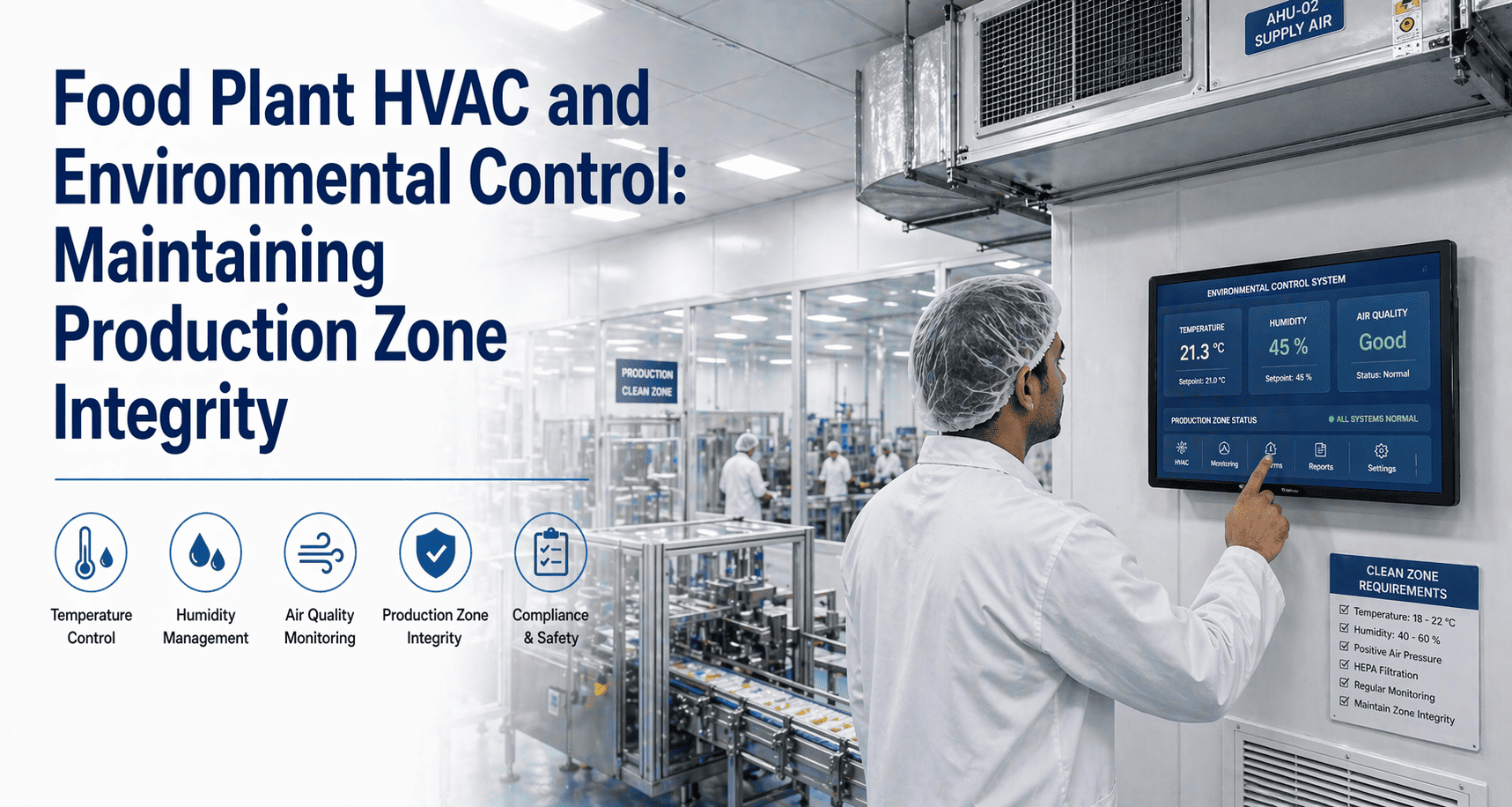
Your HVAC System Is a Food Safety Control. Is It Maintained Like One?
OxMaint registers every AHU, filter bank, and sensor as a maintainable asset — automating PM schedules, logging every inspection, integrating real-time environmental data, and generating audit-ready records that hold up to FDA, SQF, and BRC scrutiny without last-minute document assembly.