Food safety certification is one of the most consequential compliance decisions a manufacturing facility makes. Whether you operate a dairy processing plant in Ontario, a ready-meal facility in Birmingham, a bakery production line in Frankfurt, or a seafood export hub in Dubai, the food safety standard you choose shapes your audit burden, customer eligibility, supply chain credibility, and long-term operational investment. The four dominant GFSI-benchmarked schemes — SQF, BRC, FSSC 22000, and IFS — each carry distinct structural requirements, audit cadences, and market positioning advantages. This guide cuts through the complexity so quality directors can make the right certification decision, faster.
Need Help Aligning Your Facility to a GFSI Standard?
Discover how leading food manufacturers use compliance management platforms to streamline audit readiness, track prerequisite programs, and maintain certification with confidence.
Understanding GFSI: The Foundation of Modern Food Safety Standards
The Global Food Safety Initiative (GFSI) does not itself issue certifications. Instead, it benchmarks existing private standards against a rigorous set of food safety criteria. Standards that achieve GFSI recognition — including SQF, BRC, FSSC 22000, and IFS — are considered equivalent in fundamental safety outcomes, giving buyers and retailers confidence that any GFSI-recognized certification meets a minimum threshold of food safety management capability.
But equivalence in outcome does not mean equivalence in structure. Each scheme has a different audit architecture, scope definition, industry focus, and operational philosophy. For food safety and quality directors, understanding these differences is not an academic exercise — it directly determines which retailers will accept your certificate, how frequently your facility will be audited, and how much internal infrastructure you need to maintain certification year over year.
The four schemes dominate global food manufacturing: SQF is most prevalent in North America and the Asia-Pacific export market; BRC GFSI (now BRCGS) is the retailer-preferred standard in the UK and much of Europe; FSSC 22000 is the choice of multinationals and ISO-aligned organizations worldwide; IFS Food holds a commanding position in the German, French, and broader European retail supply chain. Each is explored in full below.
SQF: Safe Quality Food Program — Structure, Scope, and Requirements
The Safe Quality Food (SQF) program, managed by the Food Industry Association (FMI), is structured across three tiers: SQF Fundamentals (entry-level), SQF Food Safety (Level 2), and SQF Quality (Level 3). Most large-scale manufacturers seeking retail compliance target SQF Level 2 or Level 3, which require demonstrated food safety management systems built on HACCP principles and detailed prerequisite programs.
SQF uses a sector-specific code architecture — there are distinct SQF codes for primary production, food manufacturing, food retail, storage, and distribution. This modularity makes SQF particularly well-suited to facilities that operate across multiple food categories, since each code is calibrated to the actual hazard profile of that production environment. SQF Edition 9, the current version, significantly expanded requirements around food safety culture, management responsibility, and food defense.
SQF Audit Structure and Frequency
SQF operates on an annual announced certification audit cycle following initial certification. Surveillance or unannounced audits are not a standard feature at Level 2, though some certification bodies offer unannounced options. The audit duration is site-specific, based on facility size, number of employees, product complexity, and number of processes. Initial certification requires passing both a documentation review and a facility audit within a defined window.
SQF Maintenance Requirements
Maintaining SQF certification requires active management of prerequisite programs (PRPs) including pest control, allergen management, cleaning and sanitation, maintenance and calibration, supplier approval, and traceability. SQF places particular emphasis on documented food safety culture activities — leadership must demonstrate active engagement in food safety, not simply delegate it to the quality team. Corrective action records, internal audit completion, and management review meetings must be documented and available for every certification audit.
SQF is the dominant standard in North American retail supply chains. Major US and Canadian grocery retailers — including those operating in Ontario, British Columbia, and Alberta — often specify SQF as a minimum requirement for domestic and imported food suppliers. For facilities exporting to the US market from the UAE or Germany, SQF recognition provides a recognized entry point. Sign up today to manage your SQF prerequisite programs and audit records in one place.
BRCGS (BRC Global Standard for Food Safety): Structure, Scope, and Requirements
The BRC Global Standard for Food Safety — now branded as BRCGS Food Safety — is the most widely demanded certification in UK retail and a cornerstone requirement for supplying major British supermarket chains. Developed by the British Retail Consortium, it has expanded far beyond its origins and is now accepted across Europe, the Middle East, and increasingly in North America. BRCGS Issue 9, released in 2022, introduced significant enhancements to food safety culture, management review, and remote assessment capabilities.
BRCGS organizes its requirements into modules: Senior Management Commitment, Food Safety Plan (HACCP), Food Safety and Quality Management System, Site Standards, Product Control, Process Control, and Personnel. The standard applies to manufacturers, primary processors, and added-value food producers — it does not cover agricultural production or foodservice, which are addressed by separate BRCGS schemes.
BRCGS Audit Structure: Announced vs. Unannounced
BRCGS is distinctive for its dual audit track. Facilities can choose between an announced annual audit or an unannounced audit program (which requires two visits per certification cycle but earns the facility an "AA" or "A+" grade designation that many UK retailers specifically request). The unannounced audit track is increasingly becoming a de facto requirement for UK supermarket supply and demonstrates a higher level of food safety management maturity.
BRCGS Grade Structure
BRCGS uses a scoring system that assigns grades from AA (highest) through C (minimum pass). Grade AA requires a score above 95% with no critical non-conformances. Grade A requires 95% or above. Grades B and C reflect lower scores with increasing numbers of non-conformances. Failure to achieve grade C results in non-certification. The grade is visible on the BRCGS Directory, allowing retailers and buyers to evaluate supplier performance publicly — creating strong commercial incentives for facilities to invest in system quality beyond the minimum compliance threshold.
For food manufacturers in the UK and those exporting to British retailers from Canada, Germany, or the UAE, BRCGS is typically the most commercially necessary GFSI standard to hold. An integrated food safety compliance platform can help facilities track BRC module requirements, manage non-conformance responses, and maintain the documented management review evidence that BRCGS Issue 9 mandates.
FSSC 22000: ISO-Based Food Safety System Certification
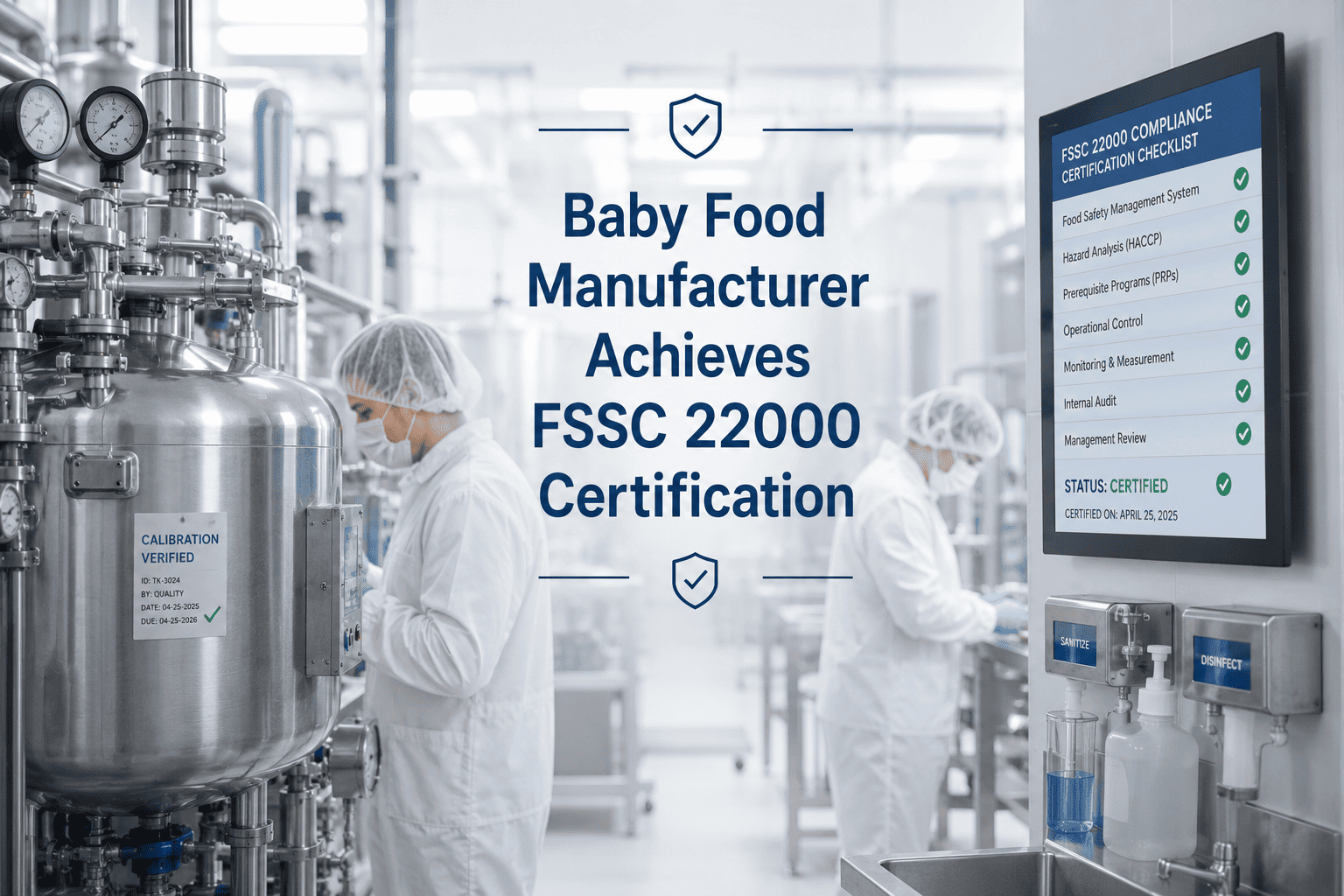
FSSC 22000 (Food Safety System Certification 22000) is built on ISO 22000, the international standard for food safety management systems, combined with sector-specific prerequisite program (PRP) requirements from ISO/TS 22002-1 (for food manufacturing) and additional FSSC-specific requirements. This ISO-based architecture makes FSSC 22000 the natural choice for multinational food manufacturers that already operate within an ISO management system framework — particularly those with ISO 9001 or ISO 14001 certifications already in place.
FSSC 22000 Version 6, released in 2023, introduced significantly strengthened requirements around food fraud prevention, food defense, allergen management, and environmental monitoring programs. Version 6 also expanded requirements for food safety culture and added more prescriptive expectations around the use of food safety management software and automation tools.
FSSC 22000 Audit Architecture
FSSC 22000 operates on a three-year certification cycle with annual surveillance audits in years two and three. In year one, both a Stage 1 (documentation review) and Stage 2 (facility audit) are conducted. FSSC also requires unannounced integrity audits — conducted by the FSSC Foundation itself, not the certification body — at a proportion of certified facilities each year. This integrity audit layer adds an additional accountability mechanism not present in SQF or BRCGS announced tracks.
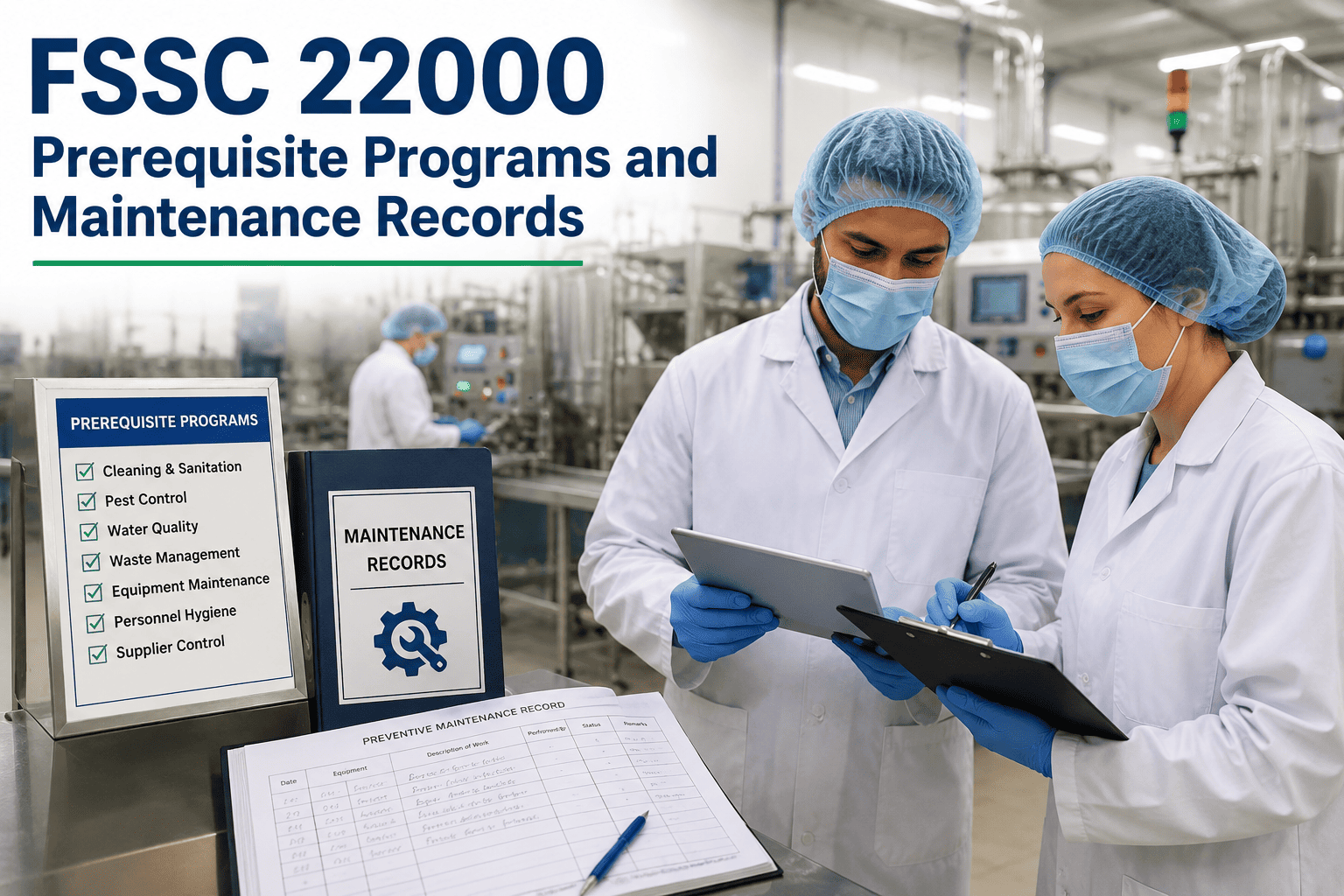
FSSC 22000 Prerequisite Program Requirements
The prerequisite program requirements under FSSC 22000 are drawn from ISO/TS 22002-1 for food manufacturers. These cover construction and layout, cleaning and disinfection, pest control, waste and sewage disposal, equipment suitability, cross-contamination prevention, allergen management, water and air quality, and employee facilities. The specificity and technical depth of ISO/TS 22002-1 requirements makes FSSC 22000 one of the most operationally demanding standards at the PRP level — but also one of the most rigorous in terms of actual food safety infrastructure.
FSSC 22000 has strong adoption in Germany, the Netherlands, and across continental Europe, where ISO management culture is deeply embedded in food manufacturing operations. It is also widely used by large multinationals operating facilities across the UK, Canada, UAE, and beyond who want a single globally coherent management system framework rather than country-specific standards. Book a demo to see how OxMaint aligns with FSSC 22000 and ISO/TS 22002-1 PRP requirements.
IFS Food Standard: European Retail's Preferred Certification
The International Featured Standards (IFS) Food standard was developed by German and French retail associations and remains the certification of choice for supplying major European grocery retailers — particularly in Germany, France, Italy, and Spain. IFS Food Version 8, the current edition, introduced a revised scoring model, enhanced requirements for food safety culture, and expanded expectations for digital documentation and remote audit capabilities.
IFS Food is structured around six chapters: Senior Management Responsibility, Quality and Food Safety Management System, Resource Management, Planning and Production Process, Measurements, Analyses, Improvements, and Food Defense/External Inspections. The standard applies to food processors of all sizes, with requirements proportionate to facility complexity and product risk profile.
IFS Scoring and Grading
IFS Food uses a percentage-based scoring system. Facilities scoring 75% or above achieve IFS certification. Facilities scoring 95% or above achieve Higher Level certification — a grade specifically valued by German and French retail buyers as evidence of exemplary food safety management. Each requirement is scored on a 0-to-4 scale, with "KO" (knockout) requirements that, if failed, automatically result in non-certification regardless of overall score. IFS has more KO requirements than BRCGS, making pre-audit gap assessment particularly important.
IFS Maintenance in German and European Markets
For food manufacturers supplying German retailers — including REWE, EDEKA, Lidl, and Aldi — IFS Food certification is essentially non-negotiable. Facilities in Germany operating under IFS face an annual announced audit with the option of an unannounced element. IFS also has a dedicated maintenance requirements chapter that covers building fabric, equipment maintenance, calibration programs, pest management contracts, and cleaning validation — requirements that directly intersect with a facility's overall asset and infrastructure management program. Sign up free to streamline your IFS maintenance documentation and audit trail.
How AI Vision Enhances Food Safety Management
AI Vision — computer vision technology deployed through smart cameras and automated image analysis systems — is rapidly becoming one of the most practical tools available to food safety and quality directors for maintaining certification readiness between formal audits. Unlike traditional inspection programs that produce a snapshot once or twice a year, AI Vision generates continuous observational data that feeds directly into your food safety management system.
The business value is measurable: AI Vision replaces costly periodic third-party inspection services, generates the continuous monitoring evidence that modern GFSI auditors increasingly expect, and gives quality directors real-time visibility into compliance status across every shift without requiring additional headcount. Ready to see it in practice? Start your platform journey with a free trial today.
SQF vs BRC vs FSSC 22000 vs IFS: Full Comparison
The table below provides a structured comparison of the four major GFSI-benchmarked food safety standards across the dimensions most relevant to food safety and quality directors evaluating their certification options.
| Criteria | SQF | BRCGS Food Safety | FSSC 22000 | IFS Food |
|---|---|---|---|---|
| Governing Body | SQFI / FMI (US) | BRCGS (UK) | FSSC Foundation (NL) | IFS Management GmbH (DE) |
| Current Version | SQF Edition 9 | BRCGS Issue 9 | FSSC 22000 V6 | IFS Food V8 |
| Audit Frequency | Annual | Annual (announced or unannounced track) | Annual surveillance + 3-yr recertification | Annual |
| Unannounced Audits | Optional | Available (required for AA/A+ grade) | FSSC integrity audits (mandatory % of sites) | Optional extension module |
| Grading/Scoring | Percentage score + critical failures | AA / A / B / C grades | Pass / Conditional / Fail | Percentage score + KO requirements |
| PRP Framework | SQF Code-specific PRPs | BRCGS-defined modules | ISO/TS 22002-1 | IFS-defined chapters |
| Food Safety Culture | Explicit requirement (Ed.9) | Fundamental requirement (Issue 9) | Required (V6 expansion) | Required (V8) |
| Primary Market Acceptance | North America, Asia-Pacific | UK, Middle East, global retailers | Global (ISO-aligned organizations) | Germany, France, continental Europe |
| Maintenance Infrastructure | Documented PM program, calibration records | Planned maintenance schedule, equipment register | ISO/TS 22002-1 maintenance PRPs | Dedicated maintenance chapter with KO risk |
| Best Suited For | North American food manufacturers and exporters to US/Canada | UK retail suppliers; export to British supermarkets | Multinationals; ISO-system users; diverse market access | European retail supply; German and French market entry |
Maintenance Requirements Across All Four GFSI Standards
One of the most commonly underestimated dimensions of food safety certification is the maintenance and infrastructure requirement embedded in each standard. All four GFSI schemes include substantive requirements around building fabric condition, equipment maintenance, calibration, and pest management — and auditors consistently cite inadequate maintenance documentation as a source of non-conformances across all scheme types.
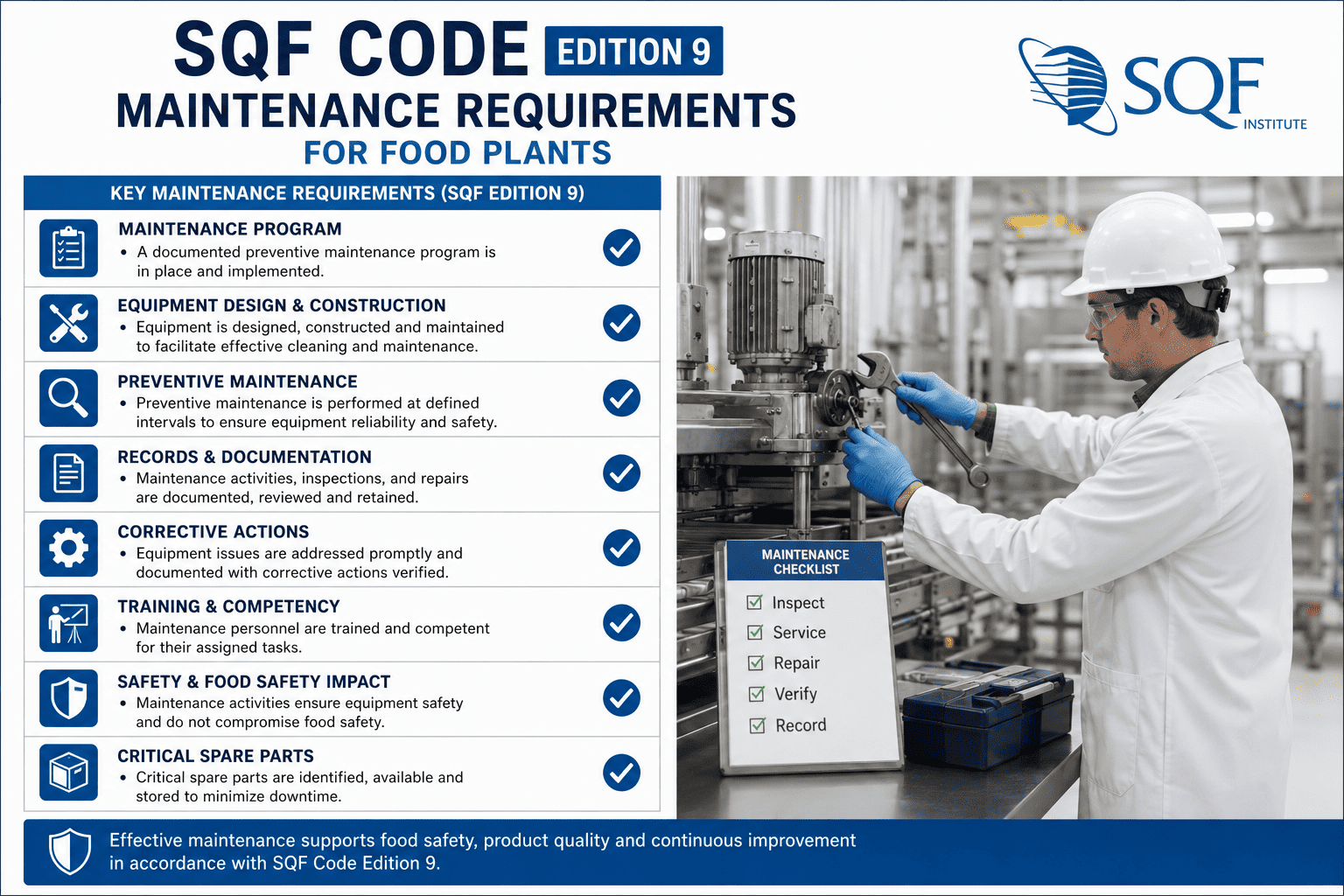
SQF Maintenance Requirements
SQF requires a documented preventive maintenance schedule covering all equipment and building systems in the food production environment. Equipment breakdowns must be documented, corrective actions recorded, and maintenance completion verified before equipment returns to production. Calibration records for monitoring and measuring equipment must be maintained and available. SQF Edition 9 strengthened requirements around the segregation of maintenance activities from food handling areas during repairs.
BRCGS Infrastructure Requirements
BRCGS Issue 9 dedicates a full section of its Site Standards chapter to building fabric, equipment maintenance, and engineering services. Requirements include a documented planned maintenance schedule, evidence that maintenance activities are completed on time, procedures for cleaning and reinspection after maintenance work, and records demonstrating that maintenance contractors are aware of and adhere to food safety requirements. Buildings must be maintained in a condition that prevents pest harbourage and product contamination — and auditors will walk the facility looking for paint flaking, floor cracks, ceiling damage, and drainage issues that indicate inadequate maintenance programs.
FSSC 22000 and ISO/TS 22002-1 Infrastructure PRPs
Under FSSC 22000, maintenance requirements are defined by ISO/TS 22002-1 Section 8 (Maintenance and Repair). This covers construction and maintenance of buildings, equipment design, maintenance schedules, and temporary repairs. ISO/TS 22002-1 is notably specific: temporary repairs must be documented, given a defined maximum duration, and removed or made permanent before that date. Maintenance-related contamination risks — including lubricant management and tool control — are explicitly addressed. Facilities using an automated maintenance management platform to document PM completion, track calibration due dates, and log corrective maintenance find FSSC 22000 audit preparation significantly more manageable.
IFS Food Maintenance Chapter
IFS Food Version 8 includes a dedicated maintenance chapter with requirements around planned maintenance for all processing, storage, and packing equipment. IFS auditors scrutinize maintenance records closely — and the IFS scoring system means that multiple minor maintenance non-conformances can accumulate to a grade-impacting score deduction. Facilities supplying German retailers must demonstrate that their maintenance programs are actively managed, not just documented in a binder that is opened once a year before the audit.
Choosing the Right GFSI Standard for Your Facility
The decision about which GFSI standard to pursue should be driven primarily by commercial necessity — specifically, which standards your current and target retail and foodservice customers require. Start by surveying your top ten customers for their certification requirements. If there is a single dominant requirement, the decision is straightforward. If customers are split across schemes, the next question is whether dual certification is warranted. Book a demo and let our team help you map the right certification path for your facility.
When to Pursue Dual Certification
Dual GFSI certification — for example, holding both BRCGS and IFS Food — is common among European food manufacturers that supply both UK retailers and German retailers simultaneously. The management system overhead of maintaining two certifications is significant but manageable with a well-structured compliance platform. Some facilities elect to pursue FSSC 22000 as a single standard that offers broad global acceptance, trading the market-specific grade prestige of BRCGS or IFS for a single coherent ISO-aligned system.
Facility Size and System Maturity Considerations
Smaller facilities or those new to GFSI certification often find SQF's tiered entry structure (SQF Fundamentals) a practical starting point for building foundational food safety management capability before stepping up to full Level 2 or Level 3 certification. FSSC 22000, given its ISO 22000 base, requires a higher level of management system sophistication at the outset — it rewards organizations that already think in process terms, have documented risk management frameworks, and are comfortable with the audit rigor of ISO-based systems.
Common Certification Challenges and How to Solve Them
Challenge 1: Gap Between Documentation and Operational Reality
Problem: Many facilities have well-written food safety programs that do not reflect how operations actually run. Auditors for all four GFSI standards are trained to identify this gap through worker interviews, direct observation, and production record verification.
Solution: Conduct a live operational gap assessment, not a document review. Walk the production floor with your food safety plan in hand and verify that every control measure described is actually being implemented. Use internal audits — a mandatory requirement under all four schemes — to identify and close operational gaps before the certification audit.
Challenge 2: Allergen Management Non-Conformances
Problem: Allergen management non-conformances are consistently among the most frequently cited findings in BRCGS and IFS audits. Inadequate labeling verification, insufficient cleaning validation, or missing allergen risk assessments generate major non-conformances that can drop a BRCGS grade or generate an IFS KO failure.
Solution: Build allergen management as a standalone module within your food safety management system — not as an add-on to HACCP. Maintain documented allergen risk assessments for every product, validated cleaning procedures for shared lines, and allergen-specific training records. All four GFSI standards have tightened allergen requirements in recent versions; treat this as a premium audit risk area.
Challenge 3: Supplier Approval Program Gaps
Problem: Incomplete supplier approval records — missing certificates, expired audits, or unapproved emergency suppliers — are a consistent source of non-conformances under SQF, BRCGS, FSSC 22000, and IFS. The supplier approval requirements in each scheme have become progressively more demanding with each version update.
Solution: Centralize supplier approval records in a digital platform with automated certificate expiry tracking. Set renewal reminders at 60 and 30 days before expiry. Establish a clear procedure for handling approved supplier deviations — including documented risk assessments and senior management sign-off — that satisfies auditor scrutiny under all four schemes.
Challenge 4: Food Safety Culture Evidence
Problem: All four GFSI standards now explicitly require food safety culture — and auditors are increasingly using worker interviews, behavioral observation, and leadership engagement records to assess culture, not just documentation. Many facilities struggle to produce tangible evidence of active food safety culture beyond posters and training attendance sheets.
Solution: Build a food safety culture action plan with measurable activities: leadership production floor walks with documented food safety observations; employee suggestion systems with recorded responses; food safety communication meetings with minutes; and trend analysis of internal audit findings presented to senior management. Document these activities consistently throughout the year — not just in the weeks before the certification audit.
Best Practices for Maintaining GFSI Certification Year-Round
Treat Every Week as Audit Week
The most audit-ready facilities operate at certification standard continuously, not in burst mode before the scheduled audit. This means internal audits are conducted on a rolling schedule throughout the year — not compressed into a pre-audit sweep. Records are updated in real time. Non-conformances are closed within defined timelines. Management reviews happen at regular intervals with documented outcomes. The certification audit then becomes a confirmation of ongoing performance rather than a high-stakes annual event.
Integrate Prerequisite Program Management with Operational Systems
Prerequisite programs — cleaning schedules, pest control contracts, calibration registers, maintenance logs — generate evidence that auditors review intensively. Facilities that manage PRPs in disconnected paper logs or isolated spreadsheets consistently struggle to produce complete, organized records on audit day. Integrating PRP management into a single digital compliance platform ensures that every required record is created, dated, signed, and accessible when auditors request it.
Invest in Internal Auditor Competency
All four GFSI standards require internal audits conducted by competent personnel. "Competent" means trained, but it also means objective — auditors should not be auditing their own work areas. Facilities that invest in developing multiple trained internal auditors, rather than relying on a single quality manager, achieve greater coverage, more objective findings, and a richer pool of evidence that demonstrates active system management to certification body auditors.
Use Trending and Analytics to Drive Proactive Improvement
GFSI standards require trend analysis of internal audit findings, customer complaints, corrective actions, and monitoring data. Facilities that use compliance management software to automate this trending — surfacing recurring non-conformance categories, high-risk production areas, or equipment types generating repeated maintenance-related issues — can address systemic problems before they generate major audit findings. This is how leading food manufacturers in the UK, Germany, Canada, and UAE maintain premium grades across certification cycles.
Maintain Any GFSI Standard with Confidence
OxMaint's food safety compliance platform helps quality directors manage prerequisite programs, track supplier approvals, automate internal audit scheduling, and generate the evidence trail your BRCGS, SQF, FSSC 22000, or IFS audit demands — all in one system, across every facility.
Frequently Asked Questions
Is GFSI a certification itself?
No. GFSI is not a certification scheme — it is a benchmarking framework operated by The Consumer Goods Forum. GFSI evaluates and recognizes existing private food safety standards (SQF, BRCGS, FSSC 22000, IFS, and others) as meeting its criteria. Food manufacturers are certified to the individual scheme (e.g., "BRCGS Grade A"), not to "GFSI" itself. When buyers and retailers say they "require GFSI certification," they mean certification to any GFSI-recognized scheme.
Can a facility hold more than one GFSI certification simultaneously?
Yes. Dual or multi-scheme certification is common among food manufacturers serving diverse markets. A facility supplying both UK supermarkets (which may require BRCGS) and German retailers (which typically require IFS) may hold both certifications simultaneously. Each scheme requires a separate audit conducted by an approved certification body, but the underlying management system requirements overlap significantly — particularly around HACCP, PRPs, and management review — allowing facilities to maintain multiple certifications without duplicating their entire food safety management infrastructure.
What is the difference between SQF Level 2 and Level 3?
SQF Level 2 covers food safety management — HACCP, PRPs, traceability, and food safety monitoring. SQF Level 3 adds a full quality management system layer on top of the food safety requirements, addressing product quality consistency, customer specification compliance, and quality improvement processes. Most retailers accept SQF Level 2 for food safety compliance. SQF Level 3 is typically pursued by manufacturers that want to demonstrate quality management maturity beyond food safety — similar in intent to combining ISO 22000 with ISO 9001.
How long does initial GFSI certification take?
Initial certification typically requires three to twelve months of preparation depending on the facility's starting point. Facilities with no existing food safety management system will need longer to develop and implement the required programs, run them for a sufficient period to generate records, conduct internal audits, and complete management review before being ready for certification audit. Facilities transitioning from one scheme to another typically require less time — often three to six months to address the differences between schemes and generate the required records under the new standard.
Which standard is best for exporting food products to the European Union?
FSSC 22000 and IFS Food are the most commonly accepted standards for EU retail market access, with IFS being particularly dominant for German and French retailers. BRCGS is well-accepted across the EU as well. For facilities in the UAE or Canada seeking to export processed food to EU markets, any GFSI-recognized scheme will satisfy the baseline requirement of most European buyers, but the specific retailer or importer may have a preference — always confirm with the purchasing entity before selecting your certification scheme.
How does software help maintain GFSI certification between audits?
Food safety compliance software centralizes all the records that GFSI auditors review: internal audit findings and close-out records, corrective action logs, PRP completion records, supplier approval certificates, calibration logs, maintenance work orders, and management review minutes. By automating reminders, generating trend reports, and providing a single evidence repository, compliance platforms dramatically reduce the administrative burden of maintaining certification — and eliminate the chaotic pre-audit record gathering that undermines audit confidence. Facilities across the UK, Germany, Canada, and UAE that use integrated compliance platforms consistently report smoother audit experiences and fewer administrative non-conformances.