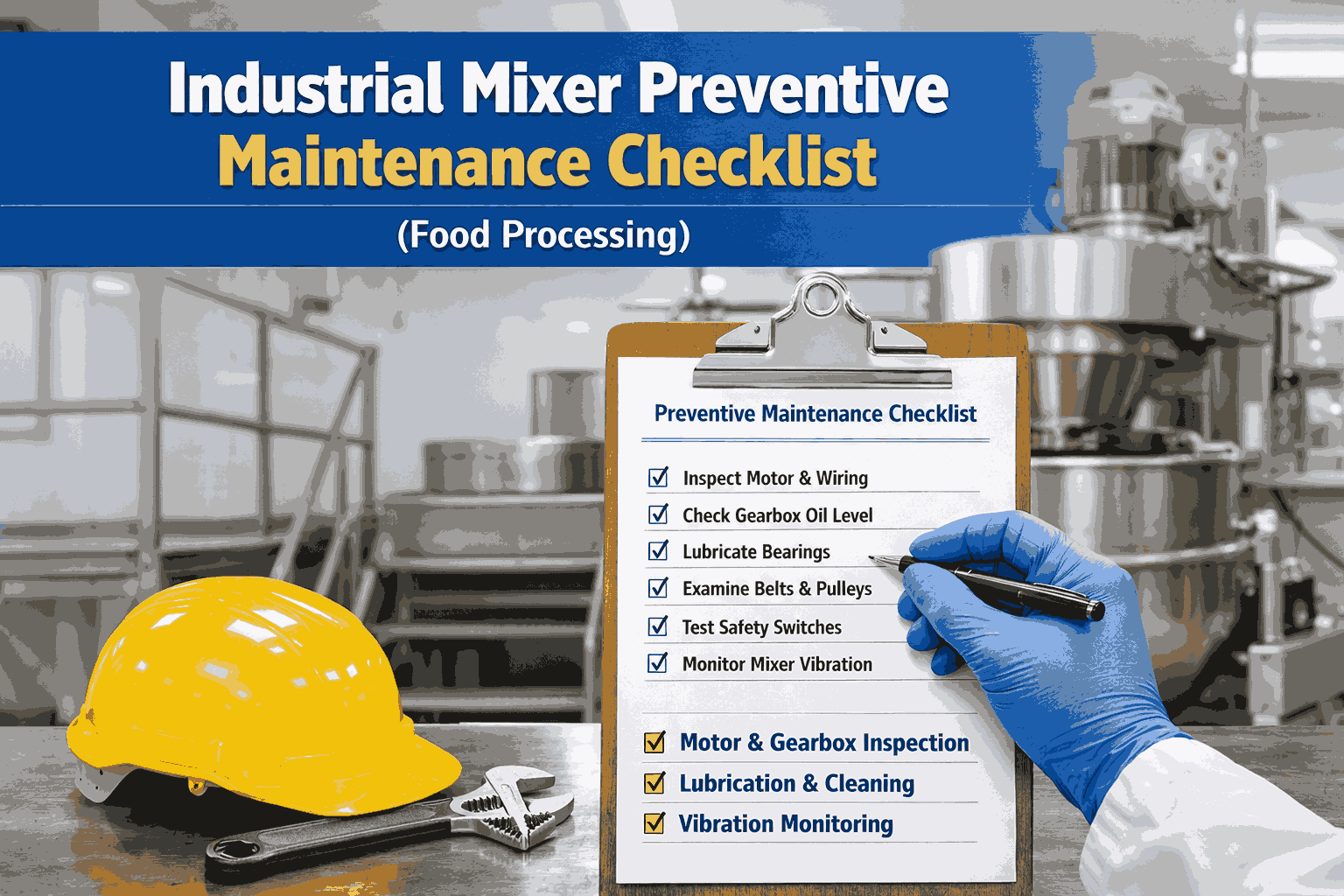
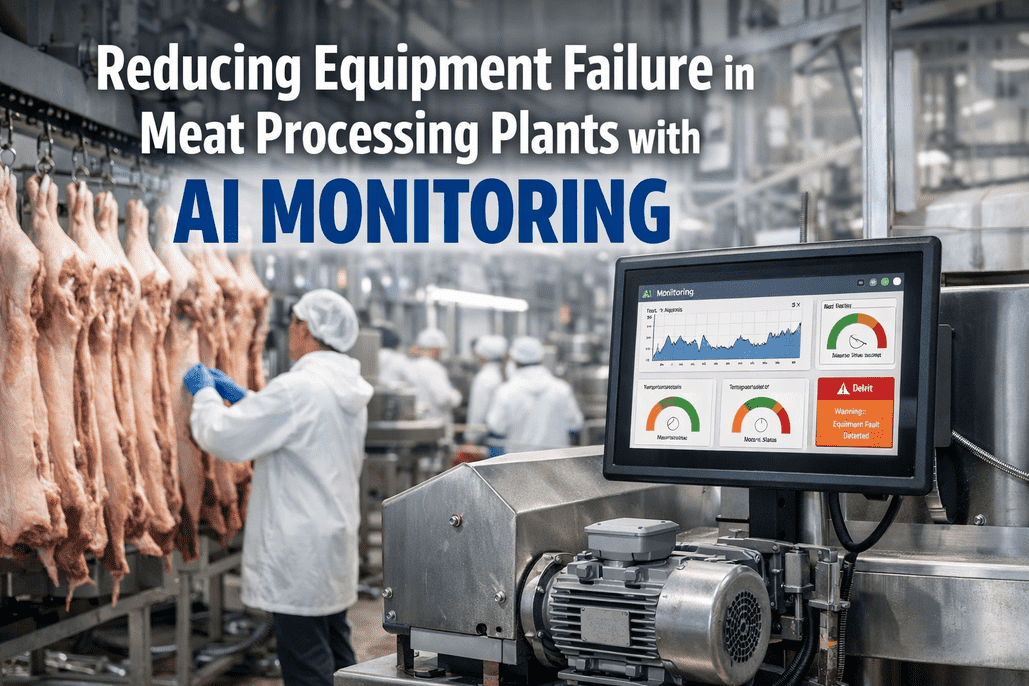
Meat processing equipment maintenance is not a discretionary operational activity — it is the structural backbone of USDA compliance, food safety assurance, and production continuity in any facility handling raw or processed meat products. Grinders that wear beyond tolerance introduce metal contamination risk. Slicers with degraded blade guards and worn product-contact surfaces become vectors for cross-contamination between product runs. Tumblers with failing seals compromise marinade integrity and harbor microbial growth in hard-to-clean zones. Smokehouses operating with compromised damper systems or degraded heat distribution produce out-of-specification product that fails FSIS lethality requirements. In each case, the maintenance failure is not just mechanical — it is a regulatory event. Sign Up Free to start building a structured preventive maintenance program for your meat processing facility today.
Automate Your Meat Plant PM Program
Replace paper logs and maintenance spreadsheets with a centralized CMMS platform purpose-built for food-grade environments. Track grinder hours, slicer blade cycles, smokehouse calibrations, and USDA compliance records in one place.
The Regulatory Framework: USDA FSIS, HACCP, and How They Define Maintenance Requirements
Every maintenance decision in a meat processing facility occurs within a regulatory environment administered by the USDA Food Safety and Inspection Service. FSIS regulations under 9 CFR Part 416 establish Sanitation Standard Operating Procedures (SSOPs) that require documented evidence of equipment cleanliness and maintenance condition before and during each production shift. HACCP plans required under 9 CFR Part 417 identify equipment condition as a prerequisite program that supports critical control points throughout the production process. Together, these frameworks convert equipment maintenance from an operational best practice into a legally enforceable compliance requirement.
Under FSIS requirements, facilities must demonstrate that all food-contact equipment surfaces are maintained in a condition that prevents the adulteration of product. This means that a worn grinder plate showing metal fatigue, a slicer blade with micro-fractures, or a tumbler drum with pitting on the interior surface are not just maintenance concerns — they are SSOP deviations that require immediate corrective action and documentation before production can resume. Maintenance records become part of the regulatory evidence trail that FSIS inspectors review during establishment reviews and for cause inspections.
Meat Grinder Preventive Maintenance: Managing Wear in High-Throughput Grinding Systems
Industrial meat grinders operate under conditions that produce accelerated wear on every product-contact component. The combination of bone fragments, connective tissue, and high throughput volumes acting across hardened steel plates and knives creates wear rates that are predictable but demand active management. A grinder plate worn beyond its tolerance specification does not simply reduce throughput — it generates metal particulate that creates an undeclared physical hazard in the finished product and a USDA FSIS adulteration finding.
Grinder maintenance must address two distinct degradation mechanisms simultaneously: mechanical wear on cutting components and microbial risk from product residue accumulation in areas that are difficult to reach during standard sanitation procedures. Grinder worm screws, plates, and knives require dimensional inspection at defined intervals. Feed throat housings, auger bearings, and drive shaft seals require separate inspection protocols focused on seal integrity and contamination prevention. Meat processing teams looking to automate grinder PM scheduling and wear tracking can explore OxMaint to see how asset-level maintenance records are structured for food-grade compliance.
Meat Grinder Preventive Maintenance Schedule
Worm screws, plates, knives, feed throats, auger bearings, drive seals, and hopper assemblies| Inspection Task | Responsible Role | Frequency | Regulatory / Safety Basis |
|---|---|---|---|
| Grinder plate and knife dimensional inspection — measure land area thickness against OEM tolerance specification | Maintenance Technician | Weekly or per tonnage threshold | FSIS physical hazard prevention — metal wear particulate adulteration risk |
| Worm screw flight inspection — check for chipping, deformation, and surface pitting | Maintenance Technician | Weekly | OEM wear limits; product contamination prevention |
| Feed throat and housing inspection — check for cracks, surface damage, and product buildup in inaccessible zones | Sanitation / Maintenance | Daily post-sanitation verification | 9 CFR 416 SSOP — food-contact surface condition before each production shift |
| Drive shaft seal inspection — verify seal integrity, check for product infiltration around drive assembly | Maintenance Technician | Monthly | Contamination prevention; lubrication segregation from product zones |
| Auger bearing lubrication and wear assessment | Maintenance Technician | Monthly | OEM service interval; food-grade lubricant verification required |
| Motor drive coupling and gearbox oil level check | Maintenance Technician | Monthly | OEM interval; food-grade oil specification compliance |
| Full disassembly inspection and component replacement program — plates, knives, seals, and bearings | OEM Service / Senior Technician | Annually or per throughput limit | Comprehensive wear lifecycle management; regulatory surface condition compliance |
Industrial Slicer Maintenance: Blade Integrity, Guard Systems, and Cross-Contamination Prevention
Industrial slicers used in deli meat, bacon, and portioning operations present a maintenance profile unlike any other piece of meat processing equipment. The primary hazard is not mechanical failure in the traditional sense — a worn slicer rarely stops working in a way that is visible during production. Instead, slicer degradation manifests as blade geometry changes that alter slice thickness consistency, guard wear that creates uncontrolled product deflection zones, and product-contact surface deterioration that prevents effective sanitation between allergen or species changes. Each of these degraded states can reach the finished product without triggering an obvious production event.
Blade maintenance programs for industrial slicers must distinguish between sharpening intervals, which address cutting performance, and replacement intervals, which address structural integrity. A blade that has been sharpened beyond its minimum thickness specification retains cutting performance while losing the structural margin that prevents catastrophic fracture during bone contact or product resistance events. Blade thickness measurement must be part of every sharpening record, and blades at or below minimum specification must be removed from service regardless of apparent performance. Facilities managing multi-line slicer operations can schedule a demo with OxMaint to see how blade cycle logs and retirement records are tracked across every unit in a centralized platform.
Industrial Slicer Preventive Maintenance Schedule
Blades, blade guards, product tables, carriage assemblies, sanitation access panels, and drive systems| Inspection Task | Responsible Role | Frequency | Notes |
|---|---|---|---|
| Blade sharpness assessment and sharpening — verify cutting edge geometry maintains OEM specification | Operator / Maintenance | Daily or per cycle count | Log sharpening event with blade thickness measurement; retire blades at minimum thickness |
| Blade thickness measurement and retirement check — compare against minimum thickness specification | Maintenance Technician / QA | Each sharpening event | Blades below minimum thickness are a physical hazard risk regardless of cutting performance |
| Blade guard and deflector plate inspection — check for deformation, wear, and secure attachment | Maintenance Technician | Weekly | Damaged guards create uncontrolled product deflection — safety and contamination risk |
| Product table and carriage rail inspection — check for surface scoring, buildup, and alignment | Sanitation / Maintenance | Daily post-sanitation | Scored product-contact surfaces are not cleanable to FSIS standards — require refurbishment or replacement |
| Sanitation access panel and seal inspection — verify all panels seal completely and open fully for cleaning | Sanitation Supervisor | Weekly | Panels that do not seal create product infiltration zones; panels that restrict access create cleaning failures |
| Drive belt or chain inspection — check tension, wear, and product-side contamination risk | Maintenance Technician | Monthly | Drive components near product zones require food-safe lubricant and contamination barrier verification |
| Full slicer disassembly, deep inspection, and product-contact surface refinishing assessment | OEM Service / Maintenance | Annually | Document surface condition findings; any scored or pitted surfaces require resolution before return to service |
Meat Tumbler Maintenance: Seal Integrity, Drum Condition, and Vacuum System Performance
Meat tumblers used in marination, curing, and tenderizing operations introduce a maintenance challenge that combines mechanical complexity with microbiological risk in a single system. The vacuum environment that makes tumbling effective at accelerating marinade penetration also creates conditions where seal failures, drum surface degradation, and inadequate cleaning of internal baffles and fins can support microbial persistence across production runs. A tumbler that passes a visual pre-operation inspection may still harbor Listeria in biofilm on worn drum surfaces or in the vacuum line assembly — a contamination pathway that is invisible during standard pre-shift checks.
Tumbler maintenance programs must address three distinct subsystems: the mechanical drive and rotation assembly, the vacuum system and its associated seals and fittings, and the product-contact interior including the drum shell, baffles, and loading mechanisms. Each subsystem has different failure modes, different inspection requirements, and different regulatory implications when it degrades. A vacuum pump that delivers 85% of rated vacuum appears operational while systematically under-performing on marinade distribution consistency — a quality deficiency that may not manifest as a food safety issue but creates product specification non-conformance.
Meat Tumbler Preventive Maintenance Schedule
Drum assemblies, vacuum systems, lid seals, baffles, drive units, and loading mechanisms| Inspection Task | Responsible Role | Frequency | Notes |
|---|---|---|---|
| Lid seal and vacuum port seal inspection — check for compression set, cracking, and extrusion | Maintenance Technician | Weekly | Seals that cannot maintain full vacuum compromise both marinade performance and contamination prevention |
| Vacuum pump performance test — measure achievable vacuum depth against validated baseline | Maintenance Technician | Monthly | Greater than 5% vacuum degradation from baseline requires investigation and corrective action |
| Drum interior inspection — check for surface pitting, weld crack initiation, and baffle attachment integrity | Maintenance Technician / QA | Monthly | Pitted or cracked internal surfaces are not cleanable to FSIS SSOP standards; require immediate remediation |
| Baffle and fin cleaning verification — ATP swab testing of internal surfaces post-sanitation | QA / Sanitation Supervisor | Weekly | High ATP readings on internal baffles indicate cleaning failure requiring protocol review |
| Drive gearbox oil level and seal condition inspection | Maintenance Technician | Monthly | Food-grade oil specification required; oil seal condition determines contamination risk to product zone |
| Rotation speed and program timing verification | Operator / QA | Monthly | Speed deviation from validated parameters affects marination uniformity and product specification compliance |
| Full tumbler disassembly inspection, seal replacement program, and drum surface assessment | OEM Service / Maintenance | Annually | Complete seal set replacement recommended annually regardless of apparent condition |
Smokehouse Maintenance: Heat Distribution, Damper Systems, and FSIS Lethality Compliance
Smokehouse systems in meat processing facilities carry a maintenance burden that is directly tied to FSIS lethality requirements. The time-temperature profiles validated in a facility's HACCP plan for cooking, smoking, and heat processing of ready-to-eat products are achievable only when the smokehouse operates within the mechanical parameters for which those profiles were validated. A smokehouse with a malfunctioning damper system, degraded heating element distribution, or failing temperature sensor array may appear to complete a full cook cycle while systematically failing to achieve the validated lethality at the coldest point of the product load. The result is an out-of-specification product that carries an undetected food safety risk into distribution.
Temperature uniformity validation is the foundation of smokehouse maintenance practice. FSIS requires that cook processes achieve validated lethality throughout the product load, which means the coldest point — not the average temperature — must reach the required time-temperature combination. Smokehouse maintenance that allows temperature uniformity to degrade invalidates the lethality validation and creates regulatory exposure for every production run completed in the degraded state. Facilities can book a demo with OxMaint to see how smokehouse calibration schedules, temperature uniformity surveys, and HACCP documentation are managed in a single compliance-ready platform.
Smokehouse Preventive Maintenance Schedule
Damper assemblies, heating elements, temperature sensors, smoke generators, airflow systems, and door seals| Inspection Task | Responsible Role | Frequency | Regulatory / Safety Basis |
|---|---|---|---|
| Temperature sensor calibration check — verify against NIST-traceable reference at operating temperature range | QA / Instrumentation Tech | Monthly | FSIS HACCP — all process monitoring instruments require documented calibration traceability |
| Damper and airflow control inspection — verify full range of motion and position accuracy | Maintenance Technician | Weekly | Damper failure directly affects temperature uniformity and validated lethality achievement |
| Temperature uniformity survey — multi-point data logging across full product load volume | QA / Process Engineer | Quarterly or after any heating system repair | Required to validate that HACCP lethality profile is achievable throughout chamber volume |
| Heating element or burner inspection — check for failed elements, uneven distribution, and scaling | Maintenance Technician | Monthly | Failed elements reduce thermal uniformity; degraded distribution invalidates temperature mapping data |
| Door seal inspection — verify full compression contact around complete door perimeter | Maintenance Technician | Weekly | Door seal failure allows ambient air infiltration that disrupts validated temperature profiles |
| Smoke generator and smoke delivery system inspection — nozzle condition, airflow balance | Maintenance Technician | Monthly | Smoke delivery imbalance creates product color and flavor non-uniformity; combustion inspection for safety |
| Full smokehouse revalidation — temperature uniformity survey with updated HACCP documentation package | QA / HACCP Team | Annually or after major repairs | Required after any modification affecting heat distribution; complete documentation for FSIS inspection readiness |
Equipment Maintenance Frequency Matrix: Meat Processing Systems
Meat Processing Equipment Maintenance Frequency Reference
| Equipment System | Primary Wear Mechanism | Key PM Intervals | Leading Failure Indicator |
|---|---|---|---|
| Meat Grinder | Plate and knife wear, auger bearing degradation, drive seal failure | Daily SSOP verification; weekly plate inspection; monthly bearing check | Declining throughput rate at constant drive load or metal particulate detection |
| Industrial Slicer | Blade geometry loss, guard wear, product-contact surface scoring | Daily blade sharpness check; weekly guard inspection; monthly drive inspection | Slice thickness variance exceeding specification tolerance |
| Meat Tumbler | Lid and vacuum seal compression set, drum surface pitting, pump degradation | Weekly seal inspection; monthly vacuum performance test; monthly drum inspection | Reduced maximum vacuum depth or elevated ATP readings on interior surfaces |
| Smokehouse | Damper actuator wear, heating element failure, sensor calibration drift | Weekly damper check; monthly sensor calibration; quarterly uniformity survey | Increasing temperature uniformity spread across multi-point survey data |
| Injection System | Needle wear and blockage, pump seal degradation, filter fouling | Daily needle inspection; weekly pump seal check; monthly filter replacement | Declining injection yield percentage or uneven brine distribution in product |
| Portioning / Forming Equipment | Die and mold wear, piston seal degradation, conveyor surface deterioration | Daily pre-shift SSOP check; weekly die inspection; monthly seal replacement program | Portion weight variance exceeding specification limits or increased rejection rate |
FSIS Compliance Gaps That Create Food Safety and Audit Risk in Meat Plants
Meat processing facilities with active maintenance programs consistently carry unmanaged compliance risk through patterns that are predictable across facility types, ownership structures, and production volumes. FSIS enforcement actions and third-party food safety audit findings repeatedly identify the same categories of maintenance deficiency. Understanding these patterns allows quality and maintenance teams to close them before they result in an FSIS noncompliance record, a product adulteration finding, or a recall event. Teams ready to build a gap-free PM program can explore OxMaint's compliance tools designed specifically for FSIS and HACCP documentation requirements.
Facilities that retire grinder plates, slicer blades, and cutting knives based on operator judgment rather than measured dimensional data cannot demonstrate to FSIS that retirement decisions are made against a defined specification. When a physical hazard event occurs, the absence of dimensional records means there is no evidence that the retirement program was systematically applied — which FSIS treats as a prerequisite program failure regardless of whether the component was actually worn.
Facilities that perform the required baseline temperature uniformity survey for HACCP validation but do not repeat it after replacing heating elements, repairing damper systems, or modifying airflow configurations are operating on invalidated lethality data. FSIS requires that the cook process achieve validated lethality parameters — and a smokehouse that has been modified since its last temperature mapping study cannot demonstrate that the original validation remains applicable to current equipment conditions.
FSIS and NSF H1 requirements mandate that any lubricant with the potential for incidental food contact must be food-grade approved. Facilities that use correct lubricants but do not document the product specification and lot number in their maintenance records cannot demonstrate compliance during an FSIS review. The absence of lubricant records is treated as a potential adulteration gap even when no actual contamination has occurred.
Drum surfaces, baffles, and internal fittings in tumblers and mixers are among the most common sites for Listeria biofilm development in ready-to-eat production environments. Visual inspection after sanitation systematically misses early-stage biofilm on worn or pitted surfaces. Facilities that rely solely on visual pre-operation checks without supporting ATP verification data cannot demonstrate that their sanitation program is achieving the microbial reduction required by their SSOP.
FSIS HACCP requirements mandate that instruments used to monitor critical control points — including smokehouse temperature sensors, injection pressure gauges, and cook time controllers — be calibrated against traceable reference standards. Facilities that document calibration as "checked against house standard" without demonstrating that the reference instrument carries a current NIST-traceable calibration certificate create a compliance gap that FSIS auditors identify as a critical prerequisite failure.
Documentation Standards for Meat Processing Equipment Maintenance
FSIS, HACCP, and FSMA Preventive Controls requirements collectively create a documentation obligation for meat processing maintenance that paper-based systems cannot satisfy at scale with consistent reliability. Every maintenance event on food-contact equipment, every calibration activity on a process monitoring instrument, and every corrective action taken in response to an equipment finding must be traceable, retrievable, and legible under regulatory inspection conditions. Documentation that is assembled after the fact, inconsistently formatted, or missing key data elements — such as the reference standard used for calibration or the name of the technician who performed the inspection — is treated as no documentation at all during an FSIS establishment review. Facilities looking to build audit-ready documentation workflows can schedule a free demo and see how OxMaint structures meat plant compliance records for FSIS and SQF audit readiness.
Required Documentation Elements per Meat Processing PM Event
Equipment name, model, serial number, asset ID, production area, and HACCP-relevant classification where applicable
Exact date, time, and production shift of inspection — essential for correlating maintenance records with production lot data during FSIS investigations
Inspector name, role, and qualification — critical for regulatory-designated activities such as HACCP-critical instrument calibration
Actual dimensional measurements, calibration readings, vacuum depth values, and temperature data — not checkboxes
Out-of-specification findings with severity classification, immediate corrective action taken, and production hold status where applicable
Post-repair verification data confirming equipment returned to compliant operating condition before production resumed
Implementing a CMMS for Meat Processing: Moving Beyond Spreadsheets and Paper Logs
The regulatory complexity of meat processing maintenance — spanning FSIS SSOPs, HACCP critical control point monitoring, FSMA Preventive Controls documentation, and USDA food-grade material compliance — creates a management burden that manual systems cannot sustain reliably across a full production calendar. Facilities managing maintenance through spreadsheets and paper binders consistently experience documentation gaps, missed PM intervals during production peaks, and calibration traceability failures that only become visible during regulatory inspections or third-party food safety audits. A purpose-built CMMS platform eliminates these structural weaknesses by automating PM scheduling, enforcing documentation completeness at the point of data entry, and maintaining calibration traceability chains as part of the standard maintenance record.
When an FSIS inspector or SQF auditor requests the complete maintenance history for a smokehouse, a grinder, or a slicer blade management program, a CMMS delivers a retrievable, chronological, and audit-ready record in seconds — the same documentation that a paper-based system may require days to assemble, if complete records exist at all. Meat processing facilities ready to close this gap can start with OxMaint at no cost and begin centralizing equipment records, PM schedules, and FSIS-ready compliance documentation immediately.
Ready to Centralize Your Meat Plant Maintenance Program?
OxMaint gives meat processing teams a single platform to manage PM schedules for grinders, slicers, tumblers, and smokehouses — with built-in FSIS compliance documentation, calibration traceability, and audit-ready records.
Frequently Asked Questions
What are FSIS requirements for meat processing equipment maintenance documentation?
FSIS regulations under 9 CFR Part 416 require that meat processing facilities maintain written Sanitation Standard Operating Procedures (SSOPs) that include pre-operational and operational sanitation records for all food-contact equipment. HACCP regulations under 9 CFR Part 417 require that equipment maintenance with relevance to critical control points be documented as part of prerequisite program records. Calibration of process monitoring instruments — including smokehouse temperature sensors and injection system pressure gauges — must be documented with reference to a traceable calibration standard. All records must be retained for a minimum period and available for FSIS inspector review on demand.
How often should grinder plates and knives be inspected and replaced in a meat processing facility?
Grinder plate and knife inspection frequency should be determined by a combination of calendar interval and throughput threshold, whichever occurs first. Most high-volume operations establish weekly dimensional inspection intervals with a tonnage-based replacement trigger — typically defined as the throughput volume at which average plate thickness approaches the OEM minimum specification. Dimensional measurements must be recorded at each inspection, and components must be retired at or before minimum thickness regardless of apparent performance. Facilities processing products with high bone content should apply more frequent inspection intervals due to accelerated abrasive wear rates.
What maintenance is required to maintain smokehouse HACCP lethality compliance?
Smokehouse maintenance for HACCP lethality compliance centers on three requirements: temperature sensor calibration at defined intervals using NIST-traceable reference instruments, temperature uniformity surveys at a frequency that captures the effect of any changes to the heating system, and damper and airflow system maintenance that preserves the mechanical conditions under which the original temperature mapping data was generated. Any repair, replacement, or modification of components that affect heat distribution — including heating element replacement, damper actuator repair, or airflow baffle modification — requires a new temperature uniformity survey before the facility can continue to rely on its existing HACCP cook process validation.
What lubricants are approved for use in meat processing equipment maintenance?
Lubricants used in meat processing equipment where incidental food contact is possible must meet NSF H1 registration requirements for food-grade lubricants. NSF H1 lubricants are formulated and registered as acceptable for use in food processing environments where there is potential for incidental contact with food product. Lubricants in areas where contact with food is not possible — such as external drive housings fully isolated from product zones — may use NSF H2 classification. All lubricant applications must be documented in maintenance records with the product name, NSF registration number, application point, and quantity used to demonstrate compliance during FSIS or SQF audits.
How does a CMMS improve food safety compliance in meat processing facilities?
A CMMS platform designed for food processing environments improves compliance by eliminating the documentation gaps and scheduling failures that are structurally inherent in paper-based systems. Automated PM work order generation ensures that no inspection interval is missed during production peaks or personnel transitions. Mobile data entry at the point of inspection captures actual measured values — dimensional readings, calibration data, ATP results — rather than checkbox records that carry no evidential value under regulatory review. Calibration modules maintain the traceability chain between field instruments and reference standards as a native record feature. When FSIS or a third-party auditor requests the full maintenance history for any piece of equipment, a CMMS delivers a complete, chronological, and audit-ready record immediately.