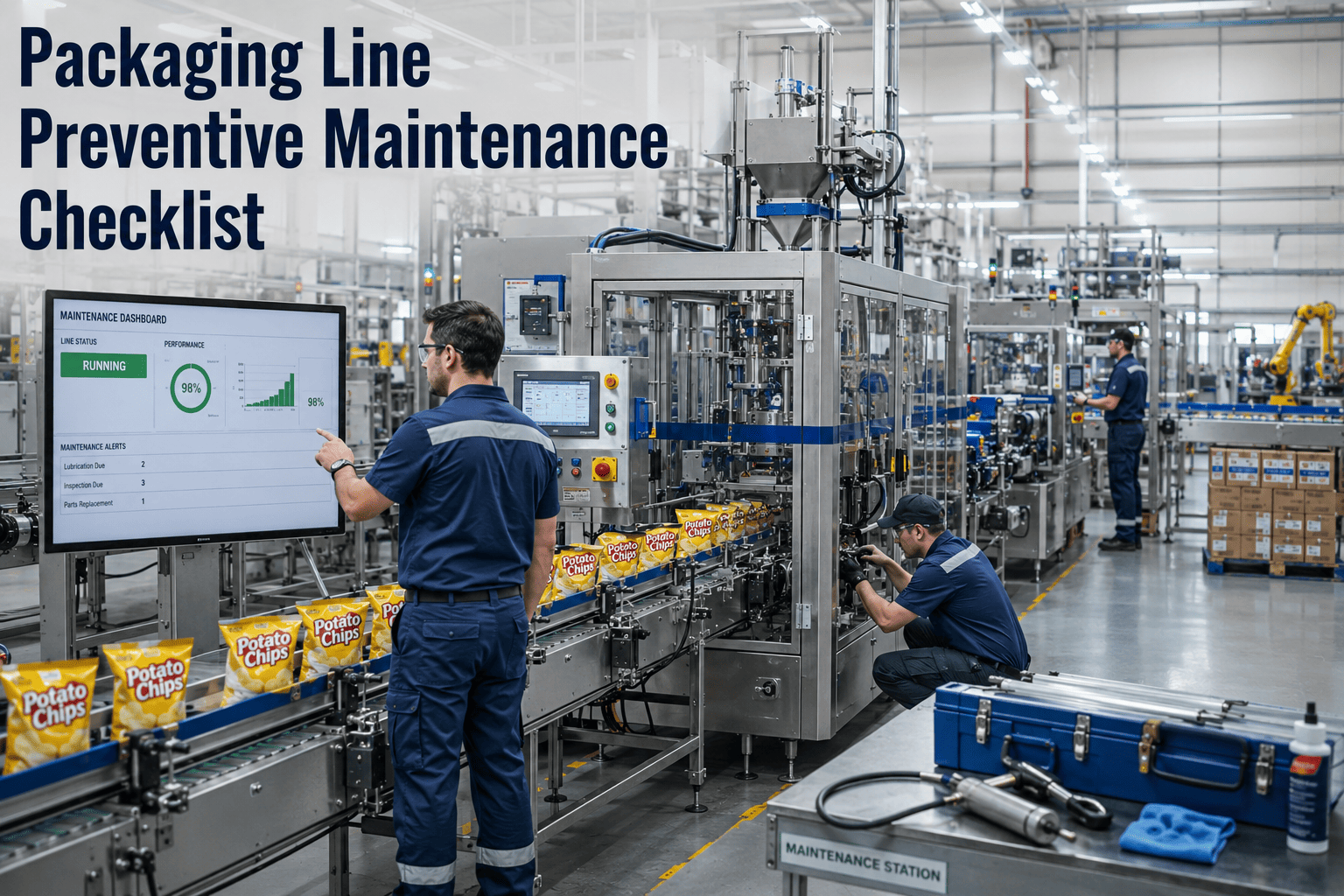
Packaging lines in food and beverage facilities are the final frontier between production and the customer — and they fail at the worst moments. A single filler breakdown during a peak production run can cost $15,000–$40,000 per hour in lost output, emergency labor, and material waste. Most of these failures are not sudden: they are the predictable result of deferred lubrication, missed adjustment windows, and sensor drift that no one noticed because there was no structured PM program. Facilities running digital preventive maintenance programs on packaging lines report 30–50% reductions in unplanned downtime and a 20% increase in Overall Equipment Effectiveness (OEE). Start a free trial on Oxmaint to digitize your packaging line PM schedules, or book a demo to see how automated work order scheduling works for multi-line food plants.
Stop Losing Production to Preventable Packaging Line Failures
See how much downtime cost you can eliminate from your packaging operations in the first 30 days.
- Real-time packaging equipment visibility and OEE tracking
- Automated PM scheduling for fillers, sealers, labelers, and palletizers
- 5–10 year CapEx forecasting for packaging line replacement
Used by operations teams managing 10,000+ assets — live in days, not months.
The Cost of Packaging Line Downtime in Food and Beverage
Packaging Line PM Checklist — What It Covers and Why
A packaging line preventive maintenance checklist is a structured, equipment-specific set of inspection, adjustment, lubrication, and verification tasks executed at defined frequencies — shift, daily, weekly, and monthly — to keep every machine on the line operating at peak performance and within food safety standards. In food and beverage, packaging equipment PM is not just a reliability issue: it is a product quality issue. A filler with drifting fill volumes, a sealer with degraded temperature control, or a labeler with misaligned print registration can all trigger product holds, recalls, or customer complaints.
This checklist covers the full packaging line — primary packaging (filling, sealing), secondary packaging (cartoning, case packing), tertiary packaging (palletizing, stretch wrapping), and the conveyors and transfers connecting them. Each checkpoint addresses a specific failure mode with a defined inspection method, acceptance criterion, and corrective action trigger. Teams that execute this checklist consistently and log results digitally build a maintenance history that supports OEE analysis, CapEx justification, and regulatory compliance simultaneously — start a free trial to structure these workflows in Oxmaint, or book a demo to see how PM scheduling works for your packaging configuration.
8 Packaging Equipment Areas Covered by This Checklist
Volume, weight, and level fill systems require calibration, seal inspection, nozzle cleaning, and drive maintenance to hold fill accuracy within spec.
Heat seal bars, jaws, torque heads, and induction systems must maintain temperature, pressure, and alignment settings to achieve hermetic seal integrity.
Label registration, print head condition, label web tracking, and date code accuracy are critical for regulatory compliance and traceability requirements.
Secondary packaging machines require glue system maintenance, folding guide adjustment, tuck/lock mechanism inspection, and drive chain lubrication.
Robotic and conventional palletizers require end-of-arm tooling inspection, layer pattern verification, sensor calibration, and safety system testing.
Belt tension, tracking, drive pulley condition, product guide settings, and accumulation sensor function must be verified at each inspection interval.
Camera systems, checkweighers, metal detectors, and X-ray units require calibration verification at every run start and documented periodic performance checks.
Food-grade lubricant application to chains, bearings, guides, and gearboxes must follow documented schedules with correct H1/H2 product selection for food contact zones.
6 Critical Risks in Food and Beverage Packaging Operations
Plants managing packaging PM on paper or spreadsheets face recurring failures that could be predicted and prevented with structured inspection programs — start a free trial to replace reactive firefighting with automated PM scheduling.
Uncalibrated fillers that drift even 2% over target create significant product giveaway — on a 10,000 unit/hour line, that is 200 units of product lost every hour.
Degraded heat seal elements or worn jaw pads produce intermittent seal failures that may not be detected until shelf life testing or customer complaints.
Date code errors, misregistered labels, or missing allergen declarations from poorly maintained labelers can trigger FDA warnings and mandatory product recalls.
Inspection equipment that has not been verified against calibration standards may miss reject events — a direct food safety and regulatory liability.
Worn conveyor belts, misaligned guides, and failed accumulation sensors are the top cause of minor stoppages — each one averaging 8–15 minutes of lost production.
Applying non-food-grade lubricant to packaging equipment in food contact zones creates contamination risk and potential FDA regulatory action.
How Oxmaint Manages Packaging Line PM Programs
Build PM checklists specific to each machine — filler, sealer, labeler, palletizer — with the correct tasks, frequencies, and acceptance criteria built in from day one.
Track lubrication points, application frequencies, and approved lubricant types (H1/H2) for every machine — with mobile sign-off and digital records.
Link work orders to downtime events on specific packaging lines. Build an OEE baseline and track the impact of PM improvements over time with automated reports.
Store calibration certificates for checkweighers, metal detectors, and vision systems with automatic expiry alerts and audit-ready record retrieval.
Track critical spare parts — seal bars, filler valves, label stock — at the machine level with reorder alerts that prevent production stops from parts shortages.
Manage PM compliance across all packaging lines in a single dashboard — showing overdue tasks, upcoming PMs, and equipment health scores by line and by site.
Reactive Maintenance vs. Planned PM Program — Packaging Lines
| Packaging Line Area | Reactive Approach | Planned PM (Oxmaint) |
|---|---|---|
| Filler calibration | Adjusted after fill audit failure or complaint | Weekly calibration check with documented fill accuracy |
| Seal bar maintenance | Replaced after seal failure event detected | Weekly temperature check, monthly bar inspection, planned replacement cycle |
| Labeler registration | Adjusted after label complaints from customers | Daily registration check, weekly print head inspection, preventive replacement schedule |
| Metal detector verification | Checked when auditor or customer requires it | Run start test kit verification with signed digital record every shift |
| Lubrication management | Applied when visible wear or noise is noticed | Documented schedule by lubrication point with food-grade product specification |
| Spare parts availability | Emergency orders during breakdown | Critical spare inventory tracked with automated reorder points |
| Downtime cost | $15,000–$40,000 per unplanned hour | Predictable planned stops at off-peak windows |
What Structured Packaging Line PM Programs Deliver
Operations teams that digitize packaging PM programs see measurable downtime reductions within the first 30 days — not through capital investment but through executing existing PM tasks more consistently and on schedule — start a free trial to build your packaging PM program in Oxmaint, or book a demo to see how the platform maps to your specific line configuration.
Packaging Line Preventive Maintenance Checklist
Use this checklist at the frequencies indicated. Check each item as completed and record readings, settings, and observations in your CMMS work order.
Packaging Line PM — Common Questions
How often should seal bar temperatures be verified on food packaging lines?
What lubricants are safe to use on food packaging equipment?
How frequently must metal detectors and checkweighers be verified on packaging lines?
Can Oxmaint manage PM schedules across multiple packaging lines and sites?
Turn Every Packaging Line Into a Reliable, Auditable Asset
Oxmaint replaces paper PM logs with automated digital inspection workflows — scheduling, executing, and documenting every packaging line PM task across all your facilities.
- Real-time packaging equipment visibility and OEE tracking
- Automated PM scheduling with mobile execution and sign-off
- 5–10 year CapEx forecasting for packaging line replacement
Used by operations teams managing 10,000+ assets. Live in days, not months. No heavy implementation required.