Every food processing facility faces a critical window before production begins — the pre-operational inspection phase. Whether you're running a meat processing line, a dairy filling operation, or a packaged goods facility, a structured pre-op inspection checklist is your frontline defense against contamination events, regulatory non-compliance, and costly production downtime. HACCP programs, FDA 21 CFR Part 117, and FSMA preventive controls all require documented verification that equipment is clean, assembled correctly, and fit for food contact before startup. A well-executed pre-operational routine doesn't just satisfy auditors — it protects consumers and keeps your operation running at full efficiency. Sign up free to explore how modern CMMS platforms digitize and automate pre-op inspection workflows for food processing environments.
See how digital inspection tools help food plants enforce pre-op compliance, reduce paperwork, and close corrective actions faster — all from one platform.
What Is a Pre-Operational Inspection in Food Processing?
A pre-operational inspection — commonly called a "pre-op" — is a systematic verification conducted before each production shift begins. Inspectors assess whether all food contact surfaces, equipment assemblies, conveyor systems, filling heads, cutting tools, and environmental zones meet sanitation and safety standards established by the facility's food safety plan. Unlike mid-shift or post-production checks, pre-op inspections occur after sanitation activities are complete and before any raw materials or packaging enter the production zone. The findings from each inspection must be documented, deviations corrected before startup authorization is granted, and records retained for regulatory review. Facilities using digital CMMS platforms can book a demo to see how automated pre-op workflows replace paper-based logs with timestamped, audit-ready digital records.
Food Processing Equipment Pre-Operational Inspection Checklist
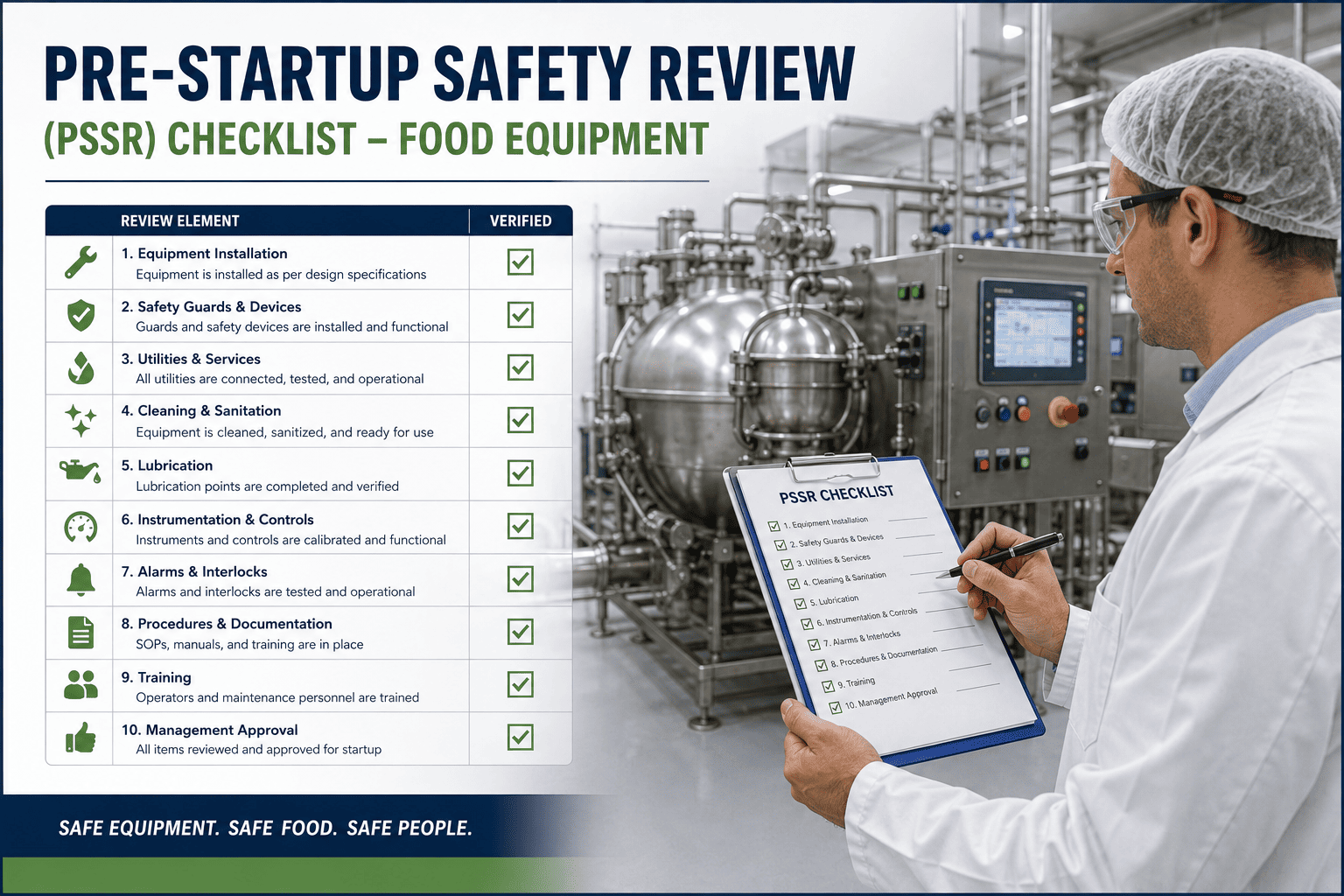
Use the following checklist before each production startup. Each item must be verified, documented, and signed off by a qualified inspector before equipment is cleared for operation. Items that fail inspection must trigger immediate corrective action — production must not begin until all critical items are resolved. Ready to digitize this checklist for your facility? Start a free trial or book a demo to see it in action.
Verify that the sanitation crew has completed all cleaning tasks for the production zone and that a designated sanitation supervisor has signed off on the cleaning log before the pre-op inspection begins. No inspection should start on an area that lacks a completed sanitation record.
Examine conveyor belts, chutes, hoppers, fillers, slicers, mixing bowls, and all surfaces that directly contact product. Any visible food residue, grease buildup, dried product, or discoloration indicates incomplete sanitation and requires re-cleaning before startup authorization.
Confirm that sanitizing agents have been properly rinsed from food contact surfaces where required by the facility's sanitation standard operating procedures (SSOPs). Residual sanitizer at improper concentrations can contaminate product and create regulatory violations.
Inspect equipment frames, guards, legs, overhead structures, and floor drains within the production area. While these surfaces are not direct food contact zones, soil or standing water on adjacent surfaces creates cross-contamination risk during production and must be corrected before startup.
All floor drain covers must be clean, correctly seated, and free of debris. Displaced or dirty drain covers in food processing areas are a documented vector for pathogen harborage and must be corrected before any production activity begins.
After sanitation disassembly, confirm that all gaskets, O-rings, valves, screens, blades, and mechanical parts have been correctly reinstalled per equipment manufacturer specifications and facility SOPs. Missing or incorrectly installed components can cause product contamination, foreign material incidents, or equipment failure during production.
Examine all rubber and polymer sealing components for cracks, swelling, cuts, or degradation. Damaged gaskets in pumps, valves, and filler heads create sanitation dead zones and potential foreign body contamination from rubber fragments entering the product stream. Replace any compromised seals before startup.
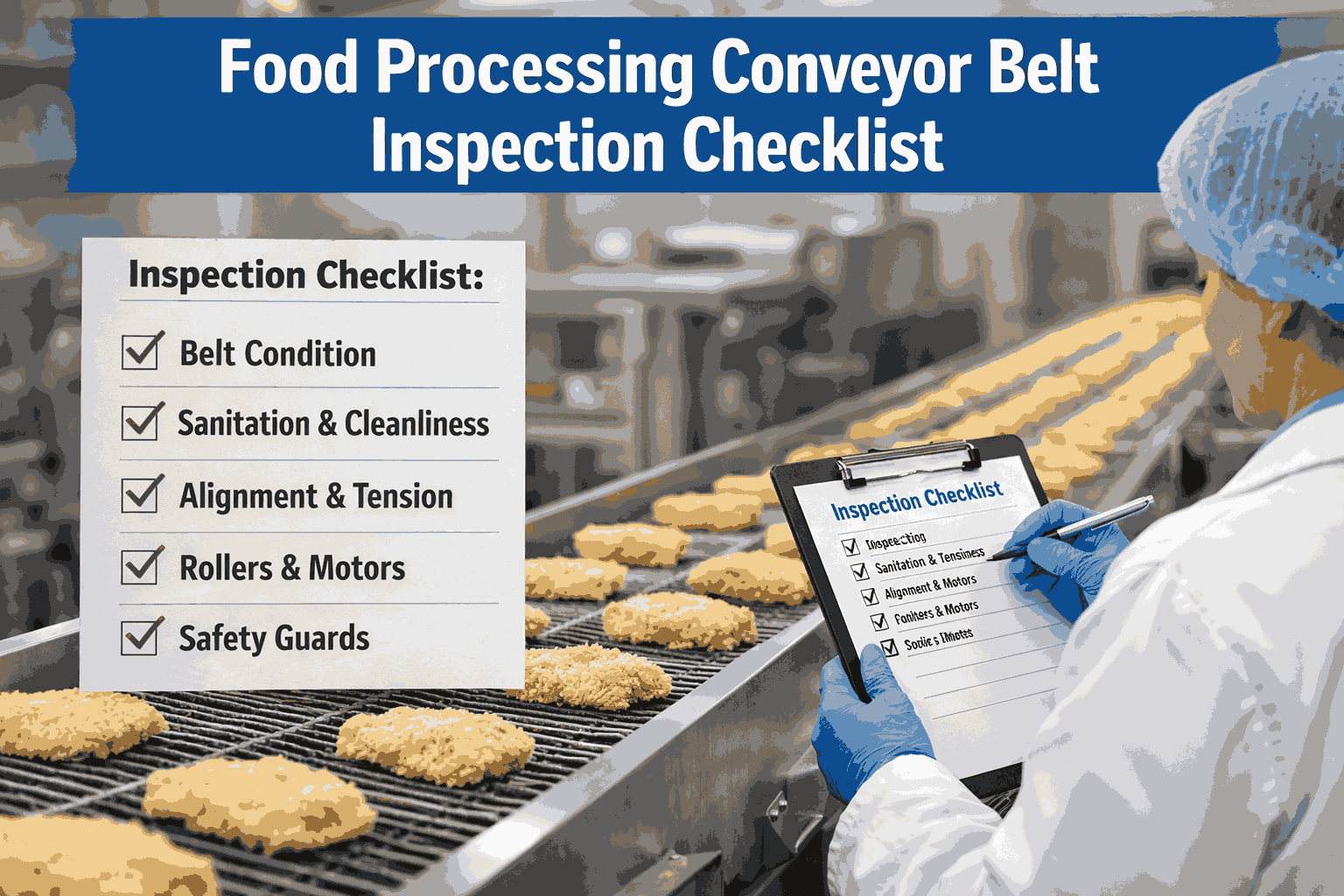
Confirm that conveyor belts are properly tensioned, tracking correctly, and free from cracks, tears, missing segments, or embedded debris. Belt damage creates foreign material risk and can cause unexpected production stoppages that compromise food safety if product contamination goes undetected.
Verify that mechanical guards, splash shields, and protective covers have been reinstalled after sanitation. Missing guards create both worker safety hazards and product exposure risks. No equipment should be energized for production with required guards absent.
Confirm that all equipment lubrication points requiring post-sanitation re-lubrication have been serviced using only NSF H1-registered food-grade lubricants. Non-food-grade lubricants in proximity to food contact zones represent a direct chemical contamination hazard and a critical regulatory violation.
Confirm that refrigerated areas, blast chillers, and cold process zones have reached and are maintaining required temperatures before product introduction. Temperature deviations at startup can compromise product safety, particularly for RTE (ready-to-eat) products with strict temperature control requirements under HACCP plans.
For thermal process equipment such as ovens, retorts, pasteurizers, and cook tanks, verify that all processing zones have stabilized at the validated kill-step temperatures specified in the facility's process authority letter before the first product batch is introduced.
Inspect thermometers, temperature probes, data loggers, and chart recorders to confirm calibration is current, sensors are clean, and readings are within acceptable tolerance. Malfunctioning temperature monitoring equipment is a critical control point failure and must be resolved before production begins.
Confirm that hot water supply systems supporting clean-in-place (CIP) circuits and manual sanitation stations are delivering water at required temperatures. Inadequate water temperature during sanitation activities is a root cause of recurring sanitation failures that manifest as pre-op inspection failures.
Verify that all tools, brushes, scrapers, knives, and utensils used during sanitation have been accounted for against the shadow board or tool inventory log. Any unaccounted tool must be located before production startup to prevent foreign body contamination from tools entering the product stream.
Visually and physically inspect accessible equipment interiors, including hoppers, mixers, and conveyors, for any loose hardware, broken fasteners, or maintenance debris left from prior shifts or overnight maintenance work. Metal-in-product incidents are among the most serious foreign body contamination events in food manufacturing.
Confirm that inline metal detection and X-ray inspection systems are powered on, have passed their challenge test with certified test pieces, and that reject mechanisms are functioning correctly. These critical control points must be verified operational before the first product passes through them.
Inspect ceiling panels, light fixtures, pipes, beams, and HVAC components directly above food contact zones and open product areas. Condensation drip, rust flakes, or peeling paint falling onto food contact surfaces or product represents a contamination event that requires corrective action before startup authorization.
Cross-reference the facility's glass and brittle plastic register against all identified items in the production zone. Confirm that no unregistered glass or brittle plastic items have been introduced and that all registered items are intact, with no breakage or damage noted since the last inspection record.
Confirm that all pest control devices within and adjacent to the production zone are in their correct positions and free of damage. Check the surrounding area for evidence of pest activity including droppings, gnaw marks, or nesting material. Any pest activity evidence must be reported to pest control management and documented before production begins.
Inspect all door seals, air curtains, strip curtains, and pest exclusion barriers at production zone entry points. Damaged or missing barriers allow pest ingress and can compromise temperature-controlled environments. Replace or repair any compromised exclusion barrier before startup.
Verify that all production zone lighting is functional and that all light fixtures have intact shatterproof sleeves or covers. Confirm that no light fixtures are cracked or missing protective covers. Adequate lighting is essential for effective pre-op inspection and ongoing monitoring throughout the production shift.
Verify that all production personnel entering the zone have completed required hygiene steps including handwashing, sanitizer dip, hair net and beard net application, and footwear sanitation at boot wash stations or foot baths. Document any personnel who have not completed the hygiene protocol before entry.
Confirm that all required personal protective equipment — including gloves, cut-resistant sleeves, hairnets, dedicated footwear, and color-coded aprons — is available, correctly worn, and in serviceable condition. Color-coded PPE must match the designated zone to prevent cross-zone contamination risk.
Verify that no jewelry, personal electronic devices, loose hair accessories, pens without clips, or other non-permitted personal items are present in the production zone. These items represent foreign body contamination risk and their presence in production areas is a standard violation flagged during third-party audits.
Complete the pre-op inspection record with the date, shift, inspector name, equipment IDs inspected, findings for each item, and pass/fail status. For paper-based systems, use indelible ink and avoid blank fields. For CMMS-based platforms, ensure all required fields are completed and the record is submitted before startup authorization is issued.
For every item that failed the initial inspection, record the specific deviation observed, the corrective action taken, the person responsible, the time of correction, and the verification re-check result. Corrective action documentation is a mandatory HACCP record requirement and must be traceable to the specific pre-op inspection event.
Production must not begin until a qualified food safety or quality supervisor has reviewed the completed pre-op inspection record, confirmed that all corrective actions have been resolved and re-verified, and provided their signature or digital authorization. Unauthorized startup ahead of inspection sign-off is a critical process deviation.
Store all pre-op inspection logs, corrective action records, and supporting documentation for a minimum of two years or as required by applicable regulations (FDA, USDA, FSMA, HACCP plan). Digital CMMS records provide automatic retention and retrieval, significantly reducing audit preparation time compared to paper-based systems.
Implementing Pre-Op Inspections With a CMMS Platform
Paper-based pre-op checklists introduce documentation gaps, illegible records, and delayed corrective action escalation that put food safety programs at risk. Modern CMMS platforms built for food manufacturing environments convert your pre-op inspection checklist into a structured digital workflow — with timestamped entries, mandatory field completion, automatic corrective action triggers, photo evidence capture, and role-based sign-off controls. Inspectors complete the checklist on a mobile device at the line, supervisors receive instant alerts on failed items, and every record is stored in a searchable audit-ready archive. Teams ready to modernize their pre-op compliance program can book a demo to walk through a live food plant inspection workflow configured for your production environment.
Frequently Asked Questions
Who is responsible for conducting the pre-operational inspection in a food plant?
Pre-op inspections are typically conducted by a trained quality assurance technician, food safety team member, or a designated production supervisor with documented food safety training. The inspector must be independent of the sanitation crew that performed the cleaning, and the final startup authorization must be provided by a qualified food safety supervisor or HACCP team lead.
What happens if a pre-op inspection fails before a production shift?
Any failed pre-op item triggers a corrective action — the specific deficiency must be corrected, the area or equipment re-inspected, and the re-inspection result documented before startup authorization is granted. Production must not begin in an area that has failed pre-op inspection until all critical items have been resolved and verified. All deviations and corrective actions must be recorded in the facility's HACCP records.
How is a pre-op inspection different from a post-operational inspection?
A pre-operational inspection occurs after sanitation is complete and before production begins — its purpose is to verify that equipment is clean, correctly assembled, and safe for product contact. A post-operational inspection occurs after production ends, typically before sanitation begins, to assess the extent of soiling and identify any equipment damage or foreign material issues that need attention during the upcoming cleaning cycle.
Does a pre-op inspection checklist need to be customized for each piece of equipment?
Yes. While a master checklist covers universal requirements like sanitation verification, personnel hygiene, and documentation, each major equipment system — fillers, slicers, pasteurizers, conveyors — should have equipment-specific checklist items that address unique disassembly points, gasket types, calibration requirements, and known failure modes. Generic checklists without equipment-specific items frequently miss critical sanitation dead zones identified in facility risk assessments.
Can a CMMS platform manage food processing pre-op inspection records?
Yes. CMMS platforms designed for food manufacturing environments support structured digital pre-op checklists with mandatory fields, pass/fail scoring, photo documentation, corrective action workflows, and role-based authorization controls. Digital pre-op records stored in a CMMS are timestamped, tamper-evident, and immediately retrievable during regulatory inspections or customer audits — significant advantages over paper-based systems.
Digitize your food processing pre-op inspection checklist and connect it to corrective action workflows, equipment records, and audit-ready reporting — no paperwork, no gaps.