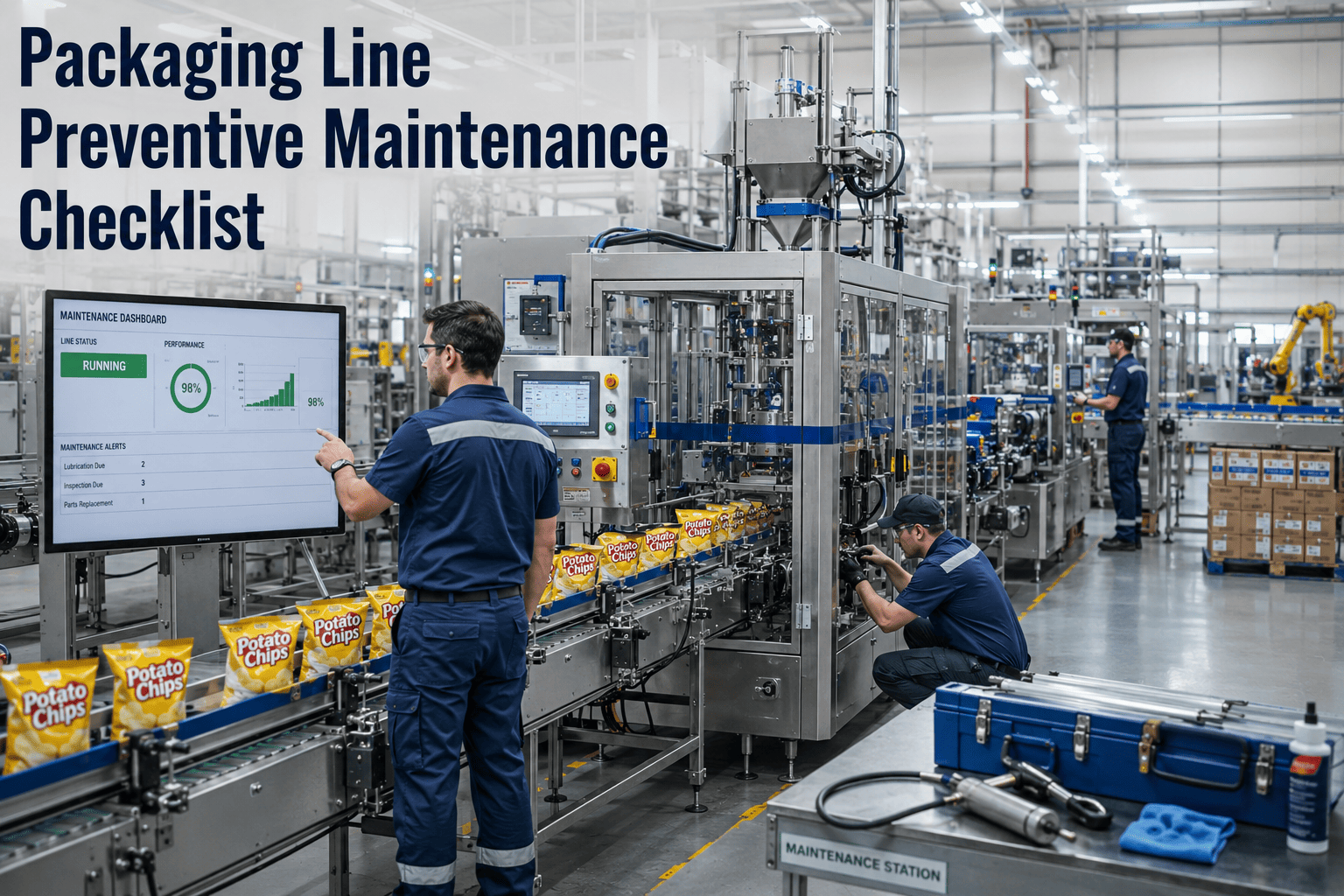
The quality manager at a cereal packaging facility couldn't understand why seal failures kept appearing after the cartoner passed its morning inspection. The checklist showed green across every item—carton feeding, glue application, compression, timing. But the inspection missed what mattered: the glue applicator nozzles had partial blockages that only showed up at full production speed. The morning check at idle speed detected nothing. When the line ran at 180 cartons per minute, inconsistent glue patterns created the seal failures that triggered customer complaints. A proper packaging machine inspection would have caught the nozzle degradation before it affected product—but the template didn't include high-speed verification steps.
Packaging machines operate at the critical junction between production and the customer. Every defect that passes through becomes a quality complaint, a returned shipment, or worse—a safety incident. Yet most facilities inspect packaging equipment with generic checklists that miss the failure modes that actually cause problems. Facilities using comprehensive, failure-mode-driven packaging inspections reduce quality defects by 47% and cut unplanned downtime by 38% by catching developing issues during structured inspections instead of discovering them through production failures.
Sign In Now. | Request a demo to see digital inspection templates in action.
Inspection / Asset Management
Packaging Machine Inspection Guide & Report Template
Catch problems before they reach customers. Document compliance. Build the maintenance intelligence that prevents failures.
Reduction in Quality Defects
Of Issues Found by Inspection
12 min
average
Complete Inspection Time
Why Generic Inspections Miss Packaging Problems
Most packaging machine inspections follow a "check the basics" approach: is the machine clean, are guards in place, does it power on? These checks confirm the machine exists but don't verify it will perform. Packaging equipment fails in subtle ways—wear that affects timing precision, contamination that degrades adhesive application, alignment drift that causes intermittent jams. Generic inspections miss these failure modes because they weren't designed to find them.
Effective packaging machine inspection requires understanding how each machine type fails and designing checks that detect those specific failure modes before they affect production. A cartoner inspection must verify glue pattern quality, not just that the glue system has pressure. A case packer inspection must confirm case squareness under load, not just that cases form. The difference between checking "is it working" and checking "will it work correctly" separates effective inspections from checkbox exercises.
82%
Of packaging equipment failures show detectable warning signs 1-4 weeks before breakdown. Structured inspections designed around specific failure modes catch these warnings during routine checks. Generic "is it running" inspections miss them entirely, converting preventable problems into unplanned downtime.
This guide provides inspection frameworks for common packaging equipment types, with specific checkpoints designed to catch the failure modes that actually cause production problems. Use these templates as starting points, then customize based on your equipment's specific failure history and operating conditions.
Cartoner Inspection Checkpoints
Cartoners combine mechanical precision with adhesive systems to create sealed packages at high speed. Inspection must verify both mechanical function and glue system performance under operating conditions:
The magazine feeds flat cartons into the forming section. Inconsistent feeding causes jams, double-feeds, and timing errors that cascade through the entire machine.
Inspection Points:
Magazine side guides aligned and parallel
Suction cups condition (no cracks, proper suction)
Carton separation fingers not worn or bent
Feed timing consistent (observe multiple cycles)
Warning Signs:
Double-feeds or missed picks
Cartons skewing during extraction
Inconsistent cycle timing
Forming converts flat blanks into open cartons. Wear in forming components creates cartons that don't seal properly or jam during product insertion.
Inspection Points:
Forming plows wear and alignment
Mandrel condition (no scoring or wear)
Transfer timing and positioning
Carton squareness after forming
Warning Signs:
Cartons not square (measure diagonals)
Score lines cracking or tearing
Inconsistent flap positioning
Glue systems must apply consistent patterns at production speed. Partial blockages or temperature drift cause seal failures that only appear under operating conditions.
Inspection Points:
Nozzle condition (clean, no partial blockages)
Glue temperature at operating setpoint
Glue pattern consistency (run at speed)
Tank level and condition
Warning Signs:
Inconsistent bead width or pattern
Stringing between application points
Temperature fluctuations during run
Closing mechanisms fold flaps and apply compression for seal formation. Worn or misadjusted components create weak seals that fail during handling.
Inspection Points:
Flap tucker timing and penetration
Compression belt tension and condition
Compression dwell time adequate
Seal strength (destructive test sample)
Warning Signs:
Flaps not fully seated
Glue squeeze-out or insufficient coverage
Seal opens under light pressure
Case Packer Inspection Checkpoints
Case packers handle product grouping, case forming, and loading operations. Inspection must verify mechanical precision, product handling, and case integrity:
Collation systems group products into case patterns. Timing errors or guide wear cause product damage and incorrect counts that create customer complaints.
Inspection Points:
Lane dividers aligned and secure
Product flight timing consistent
Pattern confirmation sensor operation
Product condition through collation
Warning Signs:
Products skewing or tipping
Inconsistent counts per layer
Product damage marks
Case forming creates the container that protects product through distribution. Out-of-square cases don't stack properly and compromise pallet integrity.
Inspection Points:
Case blank magazine feeding
Forming platen condition and alignment
Bottom seal tape or glue application
Case squareness (measure diagonals)
Warning Signs:
Cases not square (>3mm diagonal variance)
Bottom flaps not fully sealed
Score lines tearing during forming
Loading transfers products into cases without damage. Worn guides, timing errors, or inadequate support cause product damage and case integrity issues.
Inspection Points:
Loading head condition and alignment
Product guides smooth and aligned
Case positioning during load
Product count verification
Warning Signs:
Products caught on case edges
Inconsistent loading position
Product damage during insertion
Case sealing closes and secures cases for shipping. Inadequate sealing creates cases that open during handling, damaging products and creating liability.
Inspection Points:
Top flap folding mechanism condition
Tape head alignment and pressure
Tape application coverage and adhesion
Glue application (if equipped)
Warning Signs:
Tape not centered or wrinkled
Flaps not fully closed before seal
Seal peeling at edges
Your Guide to Complete Inspection
Get our comprehensive packaging machine inspection templates in digital format—including cartoner, case packer, and palletizer checklists with photo documentation and automatic scheduling.
Palletizer Inspection Checkpoints
Palletizers handle heavy loads with precision positioning requirements. Safety-critical components and high forces require thorough inspection for both operational reliability and personnel protection:
Infeed systems position cases for layer formation. Timing errors or orientation failures create unstable pallet patterns that collapse during transport.
Inspection Points:
Infeed conveyor tracking and alignment
Case turner operation (if equipped)
Row forming pusher timing
Pattern formation consistency
Warning Signs:
Cases not square to conveyor
Gaps in row formation
Turner hesitation or incomplete rotation
Layer formation creates the stable base for pallet stacking. Improper formation creates weak spots that cause pallet collapse during storage or transport.
Inspection Points:
Layer sweep mechanism condition
Layer squaring device operation
Layer pad dispenser (if equipped)
Layer pattern accuracy
Warning Signs:
Layer not square or tight
Cases shifting during transfer
Inconsistent layer positioning
Pallet dispensing and positioning systems must place pallets precisely. Mispositioned pallets create offset stacks that fail during handling.
Inspection Points:
Pallet magazine feeding
Pallet centering mechanism
Elevator/lift table operation
Pallet discharge conveyor
Warning Signs:
Pallets not centered on conveyor
Stack leaning after build
Jerky elevator movement
Palletizers operate with forces that can cause serious injury. Safety system verification is mandatory for every inspection—no exceptions.
Inspection Points:
Light curtain operation (test each beam)
Emergency stop function (all stations)
Guard interlocks (door switches)
Area scanner function (if equipped)
Critical Requirements:
All safety devices must stop motion
No bypassed or defeated interlocks
Document every test result
Shrink Wrapper and Bundler Inspection
Shrink systems combine film handling with heat application. Inspection must verify both mechanical function and temperature control for consistent package appearance:
01
Film Feed and Cutting
Check film unwind tension, tracking alignment, and cut-off blade condition. Verify seal bar temperature and dwell time settings match product requirements. Look for film wrinkling, miscuts, or inconsistent seam position.
02
Heat Tunnel Performance
Verify tunnel temperature at all zones using calibrated instrument. Check conveyor belt tracking and speed consistency. Inspect air circulation for dead spots. Look for scorching, inadequate shrink, or "fish eyes" in finished packages.
03
Product Handling
Verify infeed guides aligned for product size. Check collation accuracy for multipacks. Inspect pusher timing and product grouping. Monitor for product tipping, scuffing, or damage during handling.
04
Package Quality Verification
Inspect finished packages for proper shrink conformity, seal integrity, and appearance. Check print registration if printed film is used. Verify package dimensions meet specifications. Test seal strength on samples.
Inspection Frequency Guidelines
Inspection frequency should match equipment criticality, failure consequences, and operating conditions. These guidelines provide starting points for developing your inspection schedule:
Scope:
Safety system verification (all E-stops, guards)
Visual condition check (no obvious damage)
Lubrication level verification
First-article quality check at speed
Duration:
5-10 minutes. Focus on safety-critical items and quick visual checks that catch overnight changes or previous shift issues.
Scope:
All mechanical adjustments verified
Wear component condition assessment
Adhesive/film consumable levels
Quality output verification at speed
Duration:
10-15 minutes. Complete inspection of operating components with the machine running at production speed to detect speed-dependent issues.
Scope:
Full checklist completion with measurements
Lubrication per manufacturer schedule
Filter and strainer cleaning
Calibration verification
Duration:
30-45 minutes. Requires machine stopped for internal component inspection. Schedule during planned changeover or maintenance window.
Scope:
Internal component inspection
Chain/belt tension and wear measurement
Electrical connection inspection
Pneumatic/hydraulic system verification
Duration:
1-2 hours. Comprehensive inspection requiring guards removed and machine locked out. Schedule during planned maintenance days.
Inspection Report Documentation
Effective inspection documentation creates the record that enables analysis, demonstrates compliance, and guides maintenance decisions. Every inspection report should capture:
Identification Information
Header Section
Equipment identification (asset number, name, location)
Inspection date, time, and type
Inspector name and qualification
Operating conditions (product, speed, runtime hours)
Checkpoint Results
Body Section
Pass/Fail/Needs Attention for each checkpoint
Measurements where specifications apply
Observations and condition descriptions
Comparison to previous inspection results
Photo Documentation
Visual Evidence
Photos of any abnormal conditions found
Wear measurement reference images
Before/after comparison for recurring items
Product quality samples if issues found
Findings and Actions
Follow-up Section
List of issues requiring attention
Priority/urgency classification
Work orders created for repairs
Recommended actions and timeline
Signature and Verification
Completion Section
Inspector signature with timestamp
Supervisor review signature (if required)
Equipment release to production (if applicable)
Next scheduled inspection date
Digital Inspection Templates with Automatic Documentation
Oxmaint transforms paper checklists into mobile-ready digital inspections with automatic timestamps, photo capture, work order generation, and trend analysis—creating the documentation that audits require.
Common Packaging Machine Failure Modes
Effective inspections target the failure modes that actually cause problems. Understanding common failures helps focus inspection attention where it matters most:
34%
Of Packaging Failures
Timing drift between machine sections causes jams, misfed packages, and quality defects. Often develops gradually as components wear.
Inspection Focus:
Encoder and sensor alignment
Chain/belt tension and stretch
Gearbox backlash measurement
28%
Of Packaging Failures
Worn guides, seals, bearings, and tooling create gradual performance degradation that worsens until failure occurs.
Inspection Focus:
Guide rail and wear strip condition
Seal and gasket integrity
Bearing noise and temperature
22%
Of Packaging Failures
Mechanical adjustments loosening or drifting over time creates intermittent problems that worsen until quality failures occur.
Inspection Focus:
Centerline verification
Fastener torque checks
Alignment measurements
16%
Of Packaging Failures
Product residue, dust, and debris accumulation affects sensors, adhesive systems, and moving parts causing erratic operation.
Inspection Focus:
Sensor cleanliness
Glue system blockages
Accumulation in moving parts
Best Practices for Packaging Inspection
Get maximum value from your inspection program by following these proven practices:
1
Inspect at Operating Speed
Many packaging problems only appear at production speed. Static or slow-speed inspection misses timing issues, vibration problems, and speed-dependent failures. Always include running inspection at full speed.
2
Check Product Quality, Not Just Machine
The machine might look fine while producing defects. Include output quality verification—seal strength, carton squareness, case integrity—as part of every inspection. The product tells you what the machine won't.
3
Use Your Senses
Listen for unusual sounds. Feel for unusual vibration or heat. Watch for inconsistent motion. Experienced operators often detect problems through senses that checklists can't capture. Document these observations.
4
Compare to Previous Results
A measurement that's "within spec" but trending worse is a warning sign. Track inspection results over time to identify degradation patterns before they reach failure thresholds.
5
Act on Findings Immediately
Inspections that find problems but don't trigger repairs waste effort. Create work orders for every finding that needs attention. Track completion of inspection-generated work orders as a program metric.
6
Update Checklists from Failures
Every breakdown should prompt the question: "What inspection item would have caught this?" Add new checkpoints based on actual failure experience to continuously improve inspection effectiveness.
Frequently Asked Questions
How long should a packaging machine inspection take?
Inspection time varies by scope and machine complexity. Pre-shift safety and visual checks should take 5-10 minutes. Daily detailed inspections at operating speed typically require 10-15 minutes. Weekly comprehensive inspections with machine stopped need 30-45 minutes. Monthly deep inspections with guards removed may take 1-2 hours. The key is matching inspection depth to frequency—quick checks every shift, thorough inspections weekly. If inspections consistently take longer than these guidelines, simplify the checklist or break it into separate inspection tasks.
Should operators or maintenance technicians perform packaging inspections?
Both play important roles. Operators should perform pre-shift safety checks and basic visual inspections—they're closest to the machine and notice changes fastest. Maintenance technicians should perform detailed technical inspections requiring specialized knowledge (wear measurement, component condition assessment, calibration verification). The most effective programs combine operator vigilance with technician expertise. Train operators to identify warning signs and escalate issues; train technicians to perform thorough component evaluation. Document clear responsibilities to prevent gaps or duplication.
How do we customize generic templates for our specific equipment?
Start with standard templates as a foundation, then customize based on your equipment's specific characteristics. Add checkpoints from manufacturer maintenance manuals. Include items based on your actual failure history—if a component fails repeatedly, it deserves inspection attention. Remove items that don't apply to your configuration. Adjust measurement specifications to match your operating parameters. Test the customized template with experienced operators and technicians, then refine based on their feedback. Review and update templates annually based on inspection findings and failure experience.
What should we do when inspections consistently pass but equipment still fails?
Consistently passing inspections followed by failures indicates the checklist isn't targeting the right failure modes. Analyze recent failures to identify what failed and what inspection item should have detected the developing problem. Common gaps include: inspecting at idle speed when problems only appear at production speed, checking component presence without verifying function, missing intermittent problems that don't occur during inspection, and focusing on obvious items while missing subtle warning signs. Update the checklist to specifically target the failure modes your equipment actually experiences.
How do we document inspections for food safety audits?
Food safety audits require documented evidence of systematic equipment maintenance. Inspection records should include: date, time, and inspector identification; specific equipment inspected; checkpoint results (pass/fail/measurement); corrective actions for any findings; and supervisor review where required. Digital inspection systems with automatic timestamps and electronic signatures provide stronger audit evidence than paper records. Maintain records for the period required by your food safety standard (typically 2-3 years minimum). Organize records by equipment and date for quick retrieval during audits.
How do we measure inspection program effectiveness?
Track several metrics to evaluate inspection effectiveness: percentage of breakdowns preceded by inspection finding (should increase); time between inspections and related failures (should increase as you catch problems earlier); inspection completion rate and timeliness; ratio of inspection-generated work orders to emergency repairs (should favor inspections); and quality defect rates related to equipment condition. Analyze these metrics monthly to identify improvement opportunities. Also track inspector feedback—if inspectors report the checklist doesn't match equipment reality, update it based on their input.
Catch Problems Before They Reach Customers
Oxmaint's digital inspection templates transform packaging machine checks into systematic, failure-mode-driven inspections with automatic documentation, photo capture, and work order generation—building the maintenance intelligence that prevents equipment failures.