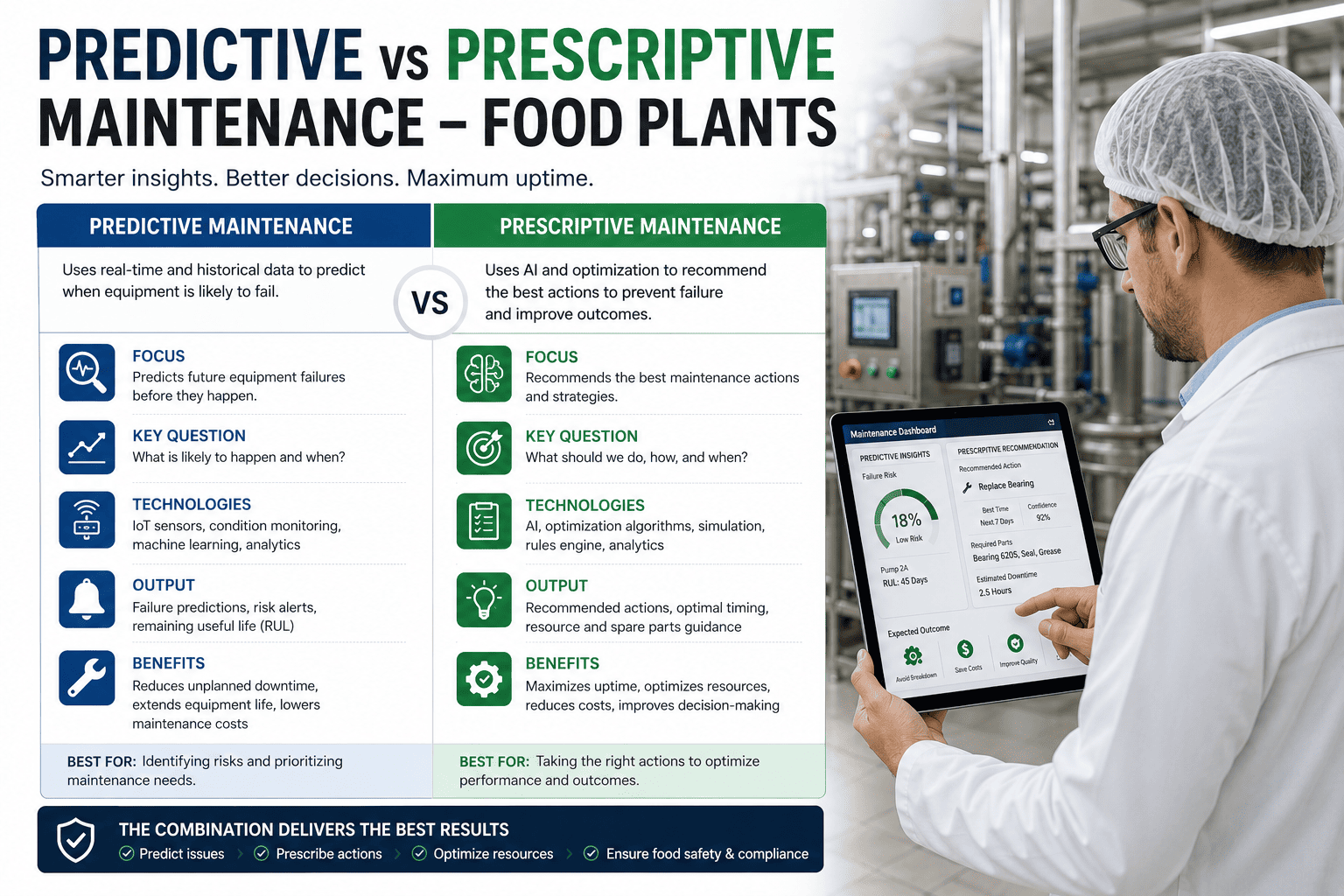
Predictive vs prescriptive maintenance is a question more food plant managers are asking as AI-driven CMMS platforms mature past simple alerting. Predictive maintenance tells you a failure is coming; prescriptive maintenance tells you exactly what to do about it — and for food manufacturing, where unplanned downtime risks both production loss and food safety exposure, the difference matters more than it sounds.
See predictive and prescriptive maintenance side by side on your own equipment data — in a 30-minute walkthrough.
Trusted by teams managing 10,000+ assets · Live in days, not months.
Predictive vs Prescriptive Maintenance: What's the Difference?
Predictive maintenance uses sensor data — vibration, temperature, runtime — to forecast when a component is likely to fail. Prescriptive maintenance goes a step further: it analyzes that same data and recommends the specific corrective action, work order, and timing needed to prevent the failure, removing guesswork from the response.
For food plants, this distinction affects more than uptime. A predictive alert tells a manager a conveyor motor is trending toward failure; a prescriptive recommendation tells them to replace the bearing within 5 days, during the next scheduled wash-down window, with a specific food-grade-compatible part — directly supporting both preventive maintenance planning and hygiene compliance.
Plants relying on predictive alerts alone still depend on a human to correctly interpret and act on every signal — prescriptive systems close that last gap.
Side-by-Side: How Each Strategy Performs
Key Concepts in Predictive & Prescriptive Maintenance
IoT and PLC feeds analyze vibration, temperature, and runtime to flag developing failures weeks in advance.
AI distinguishes between failure types so the response matches the actual root cause, not a generic alert.
Prescriptive systems convert a prediction directly into an assigned, scheduled work order with parts identified.
Repairs are scheduled around production and wash-down windows to minimize disruption and hygiene risk.
Each recommendation carries a confidence level, helping technicians prioritize which alerts need immediate action.
Outcomes from completed repairs feed back into the model, improving future prediction and recommendation accuracy.
Food plants without sensor-based maintenance still detect most failures only after they've already disrupted production.
Where Plants Get Stuck Choosing a Strategy
Too many raw sensor alerts without guidance overwhelm small maintenance teams, causing important signals to get missed.
Predictions that don't auto-generate a work order rely on someone remembering to act — a common failure point.
Without scheduling intelligence, repairs can clash with production runs or required wash-down cycles.
Legacy assets without sensors create blind spots that neither predictive nor prescriptive models can cover alone.
The right strategy depends on your current sensor coverage and team size — book a demo and we'll map the right mix for your plant.
How OxMaint Delivers Both, in One Platform
Predictive maintenance analyzes IoT and sensor feeds to flag failures weeks early with 94% accuracy.
The AI Vision Camera adds visual detection of cracks, corrosion, and leaks alongside sensor-based prediction.
Predictions convert directly into prioritized, assigned work orders routed to the nearest certified technician.
Analytics and reporting track prediction accuracy and repair outcomes to continuously refine recommendations.
Predictive Alone vs Predictive + Prescriptive
| Capability | Predictive Only | Predictive + Prescriptive (OxMaint) |
|---|---|---|
| Failure forecasting | Yes, via sensor trends | Yes, with 94% AI accuracy |
| Recommended action | Not specified | Auto-recommended with parts & timing |
| Work order creation | Manual, after review | Automatic on alert |
| Hygiene-window scheduling | Not considered | Built into recommendation |
| Technician decision burden | High | Low |
Results from AI-Driven Predictive + Prescriptive Maintenance
See these numbers against your own asset list — start a free trial to explore predictive and prescriptive maintenance on your equipment.
Frequently Asked Questions
What is the difference between predictive and prescriptive maintenance?
Predictive maintenance forecasts when a failure is likely to occur using sensor data. Prescriptive maintenance goes further, recommending the specific action, parts, and timing needed to prevent that failure.
Is prescriptive maintenance better than predictive maintenance for food plants?
Prescriptive maintenance builds on predictive data, so it isn't a replacement but an enhancement — it reduces the decision burden on technicians and aligns repair timing with hygiene and production windows.
Do I need IoT sensors to use predictive maintenance in a food plant?
Sensor data improves accuracy significantly, but platforms like OxMaint can combine available sensor feeds with AI Vision Camera monitoring to cover equipment without dedicated IoT sensors.
How accurate is AI-based predictive maintenance?
OxMaint's predictive maintenance models achieve approximately 94% prediction accuracy based on analysis of vibration, temperature, and runtime data across monitored assets.
Stop Guessing What to Do With Every Alert
Predictions without action plans just shift the decision burden onto your team. OxMaint pairs prediction with prescription — so every alert becomes a scheduled, assigned, parts-ready work order.
Trusted by teams managing 10,000+ assets · Live in days, not months.


