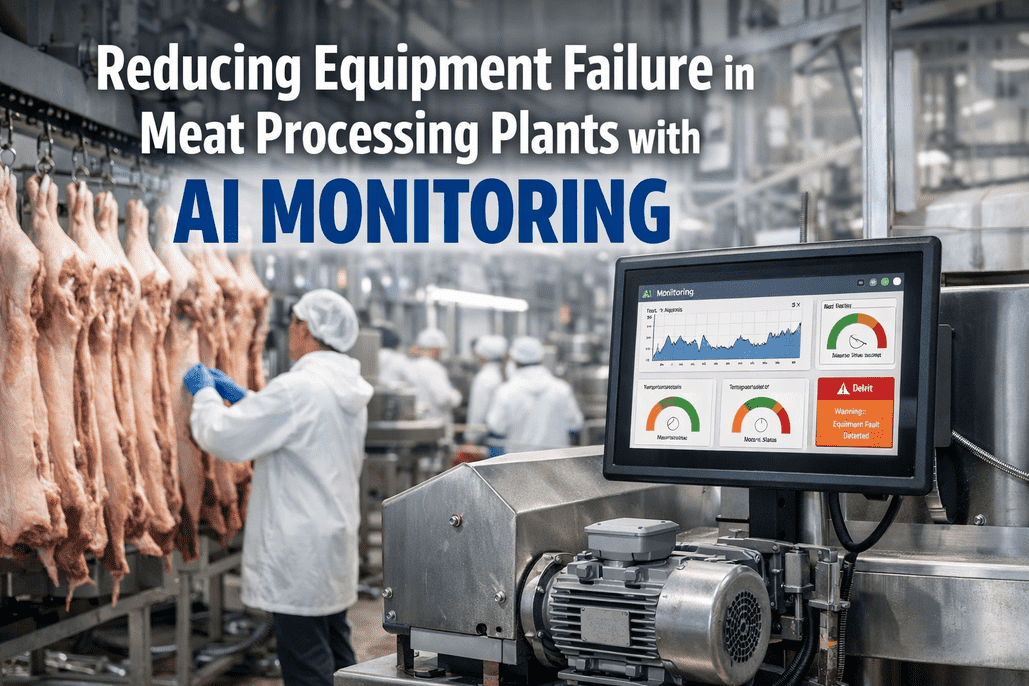
A failing bearing doesn't announce itself. It hums slightly differently, vibrates a fraction more than baseline, runs a degree or two warmer. For a food plant running 24/7, that silence before failure is the most dangerous sound in your facility. A single unplanned stoppage on a pasteurizer line doesn't just cost production time — it can compromise a batch, trigger a recall, and put a Form 483 in your file. In 2026, AI predictive maintenance has moved from pilot project to production-ready strategy. Here's exactly how to implement it.
Predictive Maintenance · 2026 Blueprint
AI Predictive Maintenance for Food Processing Plants
The step-by-step implementation guide for maintenance managers who are done reacting to failures
25–40%
Maintenance cost reduction with AI (McKinsey)
50%
Fewer downtime incidents
94.3%
Failure prediction accuracy with LSTM models
3–6 mo
Typical ROI payback for food plants
Why Food Plants Are Different
The Stakes Are Higher in Food Manufacturing — Here's Why AI PdM Is Not Optional
The Food Safety Failure Cascade
In a standard factory, equipment failure means lost production. In a food plant, it means something far worse. A bearing failing in a pasteurizer doesn't just halt a line — the metal particles it sheds become a contamination event. A leaking seal on a pump means lubricant in your product stream. A failed refrigeration compressor means temperature excursion, spoiled product, and a potential FDA action. In food manufacturing, a mechanical failure is simultaneously a production failure, a food safety failure, and a compliance failure.
HACCP & FSMA Compliance Posture
A time-based PM schedule that says "lubricate bearing every 500 hours" proves you performed a task. AI predictive maintenance proves the bearing was actually healthy — with timestamped sensor data demonstrating the asset operated within its safety parameters. Under FSMA, that distinction is the difference between a compliant record and an observation on Form 483.
The Zero-Margin-For-Error Environment
Food plants operate with perishable inputs, tight temperature windows, and production schedules that cannot absorb multi-hour emergency stoppages. Often, preventing just one or two major downtime events a year provides a full payback on a predictive maintenance investment. The economics are not complicated — they just require action.
The State of Adoption in 2026
Where the Industry Stands — And the Gap That Represents Opportunity
27%
Adopted
Food plants currently using predictive maintenance
Down from 30% in 2024 — pilots stalled without proper implementation
The gap between intent and implementation is the opportunity. 65% plan to invest. Only 27% have deployed. The plants that close that gap in 2026 will own a durable operational advantage.
The Implementation Blueprint
4-Phase Rollout: From Assessment to Full AI Deployment
Phase 1
Weeks 1–3
Asset Assessment & Criticality Ranking
Catalogue all production assets and rank by criticality — safety impact, downtime cost, failure frequency, and production dependency
Identify your top 3–5 assets to pilot: typically pasteurizers, main compressors, CIP pumps, and primary conveyors
Document current failure modes, MTBF, and maintenance history for each selected asset
Establish baseline KPIs: current downtime hours, maintenance cost per asset, and MTTR
Start here, not with sensors. Plants that skip criticality assessment deploy sensors on the wrong assets and wonder why the ROI didn't materialize.
Phase 2
Weeks 4–8
Sensor Deployment & Data Collection
Deploy IP69K-rated, washdown-safe wireless sensors on pilot assets — vibration, temperature, acoustic, and current draw monitoring
Connect sensor data streams to Oxmaint's AI engine via existing network or cellular IoT gateway
Establish normal operating baselines across all shifts — AI cannot detect anomalies until it knows what normal looks like
Feed historical maintenance records into the platform to accelerate model training
Modern IoT sensor costs have dropped to $0.10–$0.80 per unit. The infrastructure barrier is gone.
Phase 3
Weeks 9–16
AI Model Training & Alert Calibration
AI models analyze 6–8 weeks of baseline data to identify degradation patterns specific to your equipment and operating conditions
Calibrate alert thresholds with your maintenance team — tune sensitivity to reduce false positives while maintaining failure detection lead time
Validate first alerts against actual asset condition — inspect flagged equipment to confirm model accuracy before full trust
Configure automated work order generation triggered by AI alerts — ensure parts, SOPs, and technician routing are embedded
LSTM models achieve 94.3% accuracy in predicting manufacturing equipment failures. Most plants see first validated alerts within 6–8 weeks of data collection.
Phase 4
Month 4 onwards
Scale, Measure & Continuously Improve
Expand sensor coverage to remaining critical and semi-critical assets based on validated pilot ROI
Track leading KPIs monthly: MTBF improvement, MTTR reduction, planned-to-reactive maintenance ratio
Review AI model performance quarterly — retrain on new failure events and operating condition changes
Present ROI data to leadership: most facilities achieve 60–70% of projected savings within the first quarter post-implementation
Organizations implementing AI predictive maintenance typically achieve 10:1 to 30:1 ROI within 12–18 months.
Critical Assets to Prioritize First
Where to Deploy AI Monitoring First in a Food Processing Plant
Priority 1
HTST Pasteurizers
Failure = product safety event, batch loss, CCP deviation, and regulatory exposure. Highest downtime cost per hour of any asset in most food plants.
Monitor: Temperature sensors, pump vibration, heat exchanger pressure differential
Priority 1
Refrigeration Compressors
Failure = temperature excursion across cold chain, product spoilage cascade, and potential mass recall scenario for temperature-sensitive SKUs.
Monitor: Vibration, discharge temperature, current draw, suction pressure
Priority 2
CIP Systems & Pumps
Failure = sanitation compliance gap. A CIP pump underperforming does not clean to spec — creating microbial risk that may not be detected before product ships.
Monitor: Flow rate sensors, pressure, temperature, pump vibration signature
Priority 2
Primary Conveyors & Fillers
Failure = production line stoppage with perishable product already on the line. High frequency, high downtime impact, and often the first bottleneck in multi-line plants.
Monitor: Motor current, belt tension sensors, vibration at drive units
Proven ROI
What AI Predictive Maintenance Delivers Across the Industry
Before AI PdM
Failures discovered only after production stops
Emergency repairs cost 3–5× planned maintenance
Mean time to repair: 81 minutes avg (up 65% since 2022)
Technicians dispatched without parts or procedures
After AI PdM with Oxmaint
Failures flagged 2–6 weeks before they impact production
42% maintenance cost reduction on average
89% unplanned downtime eliminated at Oxmaint deployments
Auto work orders include parts, SOPs, and technician routing
$353K
Net annual savings — Valley Fresh Dairy (180K gal/day)
7.3 mo
Average payback period on Oxmaint implementation
196%
ROI on $180K CMMS implementation at food processing facility
The transformation was remarkable. We went from firefighting daily equipment failures to having full visibility and control over our maintenance operations. Our technicians are more productive because they're doing planned work instead of emergency repairs. The CMMS paid for itself in seven months.
Frequently Asked Questions
Common Questions About Implementing AI Predictive Maintenance
Everything you need to know about deploying AI-powered failure prediction in your food processing facility.
Initial investment typically ranges from $50K–$180K for a mid-sized facility, covering software licensing, sensor deployment on 15–25 critical assets, network infrastructure, and implementation support. However, modern IoT sensors now cost $0.10–$0.80 per unit, and cloud-based AI platforms eliminate the need for on-premise servers. Most food plants achieve ROI payback within 6–12 months through avoided downtime, reduced emergency repair costs, and extended asset life.
No. Modern AI predictive maintenance platforms like Oxmaint are designed for maintenance managers and plant engineers, not data scientists. The AI engine runs in the background, analyzing sensor data and generating alerts automatically. Your team receives actionable notifications ("Compressor 3 trending toward failure — replace bearing within 2 weeks") with auto-generated work orders. No coding, model training, or algorithm configuration required from your staff.
LSTM (Long Short-Term Memory) neural network models achieve 94.3% accuracy in predicting manufacturing equipment failures when trained on 6–8 weeks of baseline data. In practice, this means the system correctly identifies assets trending toward failure while minimizing false positives. Most plants start with a validation period — when the AI flags an asset, technicians inspect it to confirm the diagnosis. After 2–3 validated predictions, teams gain confidence and shift to acting on alerts without manual verification.
Modern wireless sensors can transmit via cellular IoT gateways, completely independent of your plant's WiFi network. These gateways use 4G/5G connectivity and cost $200–$400 per unit, covering an entire production area. Alternatively, sensors can store data locally and sync when connectivity is available. The AI platform handles intermittent connectivity gracefully — it doesn't require real-time data streaming to generate accurate predictions.
Yes. Oxmaint integrates with major CMMS platforms (SAP, IBM Maximo, Fiix, eMaint) and ERP systems through standard APIs. When the AI detects an anomaly, it can automatically create a work order in your existing CMMS, trigger parts ordering in your ERP, and log the event in your maintenance history. If you're currently using spreadsheets or paper logs, Oxmaint functions as a standalone CMMS with built-in AI — no additional systems required.
AI predictive maintenance provides timestamped, tamper-proof records proving equipment operated within safe parameters — critical for FSMA preventive controls and HACCP verification. If an auditor asks "Can you prove your pasteurizer maintained proper temperature throughout the January production run?" you can pull sensor data showing continuous monitoring, not just a logbook entry saying "checked at 8am." This elevates compliance from task completion to continuous validation — exactly what FSMA requires.
Older equipment is actually where AI predictive maintenance delivers the highest value. Legacy assets often lack built-in diagnostics, making them invisible until they fail catastrophically. External sensors (vibration, temperature, acoustic) can be retrofitted onto any mechanical equipment — motors, pumps, compressors, conveyors — regardless of age or manufacturer. In fact, the average age of industrial fixed assets is now 24 years (the oldest in 70 years), making sensor-based monitoring more critical than ever.
Most plants see first validated AI alerts within 6–8 weeks of sensor deployment (the time needed to establish baselines and train models). Measurable ROI typically appears within 3–4 months as prevented failures start accumulating. Full financial payback averages 6–12 months. However, immediate benefits include digital work order automation, real-time asset visibility, and compliance-ready documentation — value that starts on day one, before the AI has even flagged its first predicted failure.
Your 2026 Blueprint Starts Here
Stop Waiting for the Next Failure. Start Predicting It.
Oxmaint's AI predictive maintenance platform is built for food processing plants — with food-safe sensor support, HACCP-integrated compliance workflows, and automated work order generation from the first AI alert. Go from reactive to predictive in 24 hours, not months.
No credit card required
Setup in 24 hours
Cancel anytime