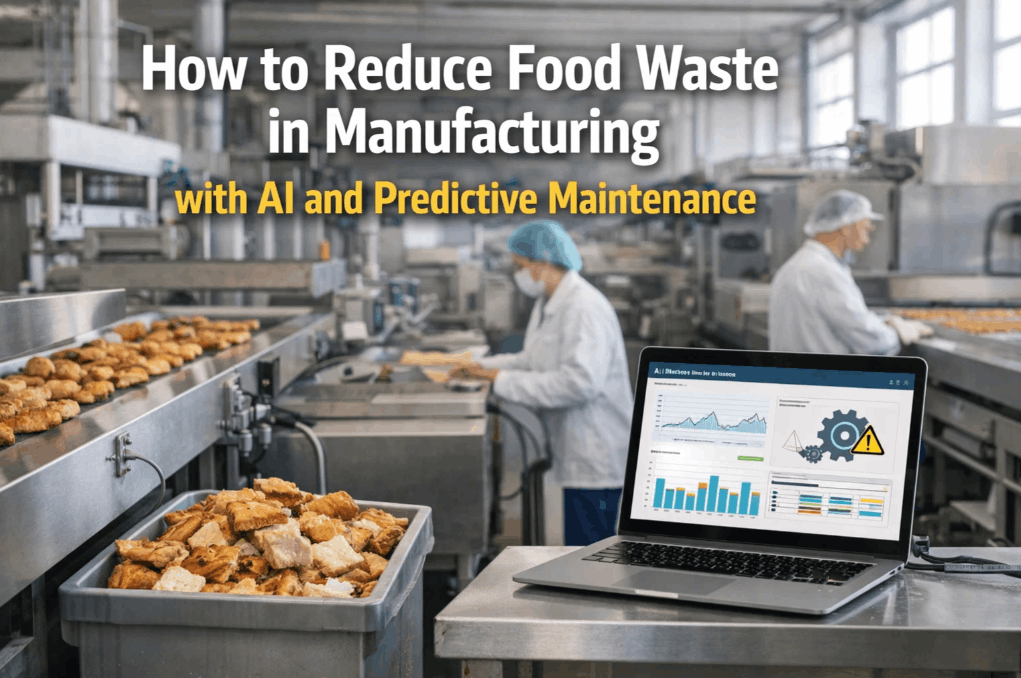
Food manufacturing plants lose billions of dollars annually to preventable waste — spoiled batches, ingredient losses from equipment failures, and inefficient production runs that generate excess byproducts. Reducing food waste in manufacturing is no longer just a sustainability goal; it's a bottom-line imperative. AI-powered predictive maintenance and intelligent CMMS platforms are transforming how food producers identify, measure, and eliminate waste before it occurs. This guide explores practical, data-backed strategies for sustainability managers and operations leaders who are ready to move beyond reactive waste management. Sign up free to see how OxMaint helps facilities cut waste at the source.
The Real Cost of Food Waste in Manufacturing
The Food and Agriculture Organization estimates that roughly one-third of all food produced globally is lost or wasted — and manufacturing facilities are significant contributors. For sustainability managers, the challenge is that most production waste is not caused by poor ingredient quality or human error alone. It is caused by equipment failures, temperature deviations, and process inconsistencies that could be predicted and prevented with the right data systems in place.
A single unexpected chiller breakdown can spoil an entire batch of perishable product worth thousands of dollars. A packaging line running out of calibration can cause sealing failures and product rejection at scale. These are not random events — they are predictable failure patterns that AI and predictive maintenance systems are specifically designed to intercept. Book a demo to see how OxMaint intercepts these failures before they hit your bottom line.
How Predictive Maintenance Prevents Food Spoilage and Batch Failures
Predictive maintenance for food waste reduction works by continuously monitoring equipment performance data — vibration, temperature, pressure, motor current, and throughput — and using machine learning models to detect early degradation signals before failures occur. In food manufacturing environments, this capability directly prevents the three most common causes of production waste.
Refrigeration and Temperature Equipment Failures
Compressor degradation, refrigerant leaks, and condenser fouling all cause temperature drift before they cause full equipment failure. AI monitoring detects these patterns hours or days in advance, allowing maintenance teams to intervene before cold chain integrity is compromised and product is lost to spoilage.
Mixer, Homogenizer, and Heat Exchanger Failures
Processing equipment that runs outside specification — even marginally — can cause batch inconsistencies that trigger quality rejection. Predictive maintenance identifies motor bearing wear, heat exchanger fouling, and seal degradation early, maintaining the process conditions that keep batch yields within specification.
Filling and Sealing Equipment Deviations
Packaging line failures generate significant product waste through seal failures, underfills, and line jams that cause product exposure and contamination. AI-driven condition monitoring on fill heads, sealing jaws, and conveyors prevents the unplanned stoppages that turn packaging lines into waste generators.
AI Food Waste Reduction: How the Technology Works in Practice
AI-powered food waste reduction integrates sensor data from production equipment with CMMS maintenance records and batch production logs to create a unified view of where, when, and why waste is being generated. Rather than analyzing waste events after the fact, these systems identify the equipment and process conditions that correlate with waste outcomes — and act on them proactively. Get started free and connect your equipment data to real waste reduction outcomes.
Continuous Equipment Monitoring
IoT sensors on critical food production equipment stream real-time performance data — temperature readings, vibration signatures, pressure values, and cycle counts — to the AI monitoring platform for continuous baseline comparison.
Anomaly Detection and Failure Prediction
Machine learning models trained on historical equipment data and past failure events detect deviation patterns in real time. When sensor signatures match known pre-failure profiles, the system generates predictive maintenance alerts days before a failure would cause production disruption or product loss.
Automated CMMS Work Order Generation
Predictive alerts automatically trigger maintenance work orders in the CMMS, assigning tasks to the right technician with relevant equipment history and required parts — ensuring maintenance happens before the equipment failure causes a batch failure or spoilage event.
Waste Event Correlation and Root Cause Analysis
The platform cross-references waste events logged in production records with concurrent equipment performance data and maintenance history, identifying which equipment failures and process deviations are driving the highest waste volumes across the facility.
Continuous Improvement Reporting
Sustainability managers access dashboards showing waste reduction trends, equipment reliability improvement, batch failure rate history, and the financial value of prevented spoilage — creating the evidence base for sustainability reporting and capital investment decisions.
CMMS Waste Tracking: Connecting Maintenance Data to Sustainability Goals
A modern CMMS for food manufacturing sustainability does far more than schedule preventive maintenance tasks. When configured for waste reduction objectives, it becomes the operational data infrastructure that connects equipment health to production outcomes — making it possible to quantify exactly how much waste is prevented by each maintenance intervention.
Sustainability managers who integrate waste event logging with maintenance records can answer questions that are impossible to address with siloed systems: Which equipment failures have caused the most product loss over the past 12 months? What is the average batch waste cost per equipment failure type? How much waste has been prevented by the predictive maintenance program compared to the reactive maintenance baseline? Book a demo to see these insights live in OxMaint's unified dashboard.
| Waste Category | Primary Equipment Cause | Predictive Maintenance Intervention | Waste Reduction Potential |
|---|---|---|---|
| Batch spoilage (temperature) | Chiller/refrigeration failure | Compressor vibration monitoring, refrigerant leak detection | Up to 90% of temperature-related batch losses |
| Process rejection (quality) | Mixer or heat exchanger deviation | Motor current analysis, fouling detection via pressure drop monitoring | 25–40% reduction in out-of-spec batch rejections |
| Packaging waste (seal failures) | Sealing jaw wear and misalignment | Seal integrity monitoring, jaw temperature deviation alerts | 30–50% reduction in packaging rejection rates |
| Ingredient overuse (calibration) | Filling and dosing equipment drift | Fill weight variance monitoring, automated calibration alerts | 15–25% reduction in ingredient giveaway waste |
| Conveyor and line jams | Drive motor and belt wear | Vibration signature trending, belt tension monitoring | 20–35% reduction in line stoppage-related waste |
Batch Failure Prevention: AI Strategies for High-Risk Food Processes
Batch failure prevention in food manufacturing requires a layered approach that combines equipment reliability, process parameter monitoring, and rapid response protocols. AI platforms integrate these layers by continuously correlating equipment performance with batch outcome data — learning which combinations of conditions most reliably predict batch failures before they occur. Sign up free and start protecting your highest-risk production processes today.
Sustainable Food Manufacturing: Building the Business Case for AI Investment
For sustainability managers navigating capital investment decisions, the business case for AI-powered sustainable food manufacturing rests on three value streams that are each independently compelling — and collectively transformative when delivered through a unified platform.
Implementing AI Waste Reduction: A Practical Roadmap for Sustainability Managers
Deploying AI for food production waste reduction is most effective when approached as an operational transformation initiative rather than a technology project. The facilities that achieve the greatest waste reduction outcomes are those that combine AI tooling with clear measurement frameworks, cross-functional alignment, and disciplined continuous improvement processes. Sign up for OxMaint to explore how integrated CMMS and waste analytics can be deployed across your facility's equipment environment.
Quantify Current Waste by Category and Cause
Before deploying AI, establish a comprehensive baseline: total waste volume by product category, waste cost by production stage, frequency and cost of batch failures, and equipment downtime events correlated with waste outcomes. This baseline makes ROI measurable and identifies where predictive maintenance will deliver the fastest impact.
Prioritize Critical Equipment for Sensor Deployment
Not all equipment carries equal waste risk. Begin sensor deployment on the equipment whose failures have historically caused the highest waste costs — refrigeration systems, batch processing equipment, and high-throughput packaging lines. Focused implementation delivers faster results than attempting facility-wide deployment simultaneously.
Integrate CMMS with Production and Waste Records
Configure your CMMS to capture waste events alongside maintenance records, creating the data linkage that enables root cause analysis. When a batch failure occurs, the CMMS should automatically surface recent maintenance history, active alerts, and equipment performance data for the relevant equipment — accelerating investigation and preventing recurrence.
Define Waste Reduction KPIs and Review Cadence
Establish specific, measurable waste reduction targets for each production area — batch failure rate, packaging rejection rate, cold chain spoilage events — and review performance against these KPIs monthly. AI platforms generate the analytics automatically; sustainability managers need to build the review process that converts data into operational decisions.
Expand and Iterate Based on Demonstrated Results
Once the initial deployment demonstrates measurable waste reduction outcomes, use the quantified results to build the business case for broader facility rollout. AI waste reduction programs compound in effectiveness as sensor coverage expands, historical data accumulates, and models learn the specific failure patterns of your equipment fleet.
Frequently Asked Questions
How does predictive maintenance reduce food waste in manufacturing?
Predictive maintenance reduces food manufacturing waste by detecting equipment degradation before it causes failures that result in batch spoilage, quality rejections, or packaging defects. Sensors monitor critical equipment continuously, and AI models identify early warning patterns — allowing maintenance teams to intervene before a compressor failure spoils refrigerated product or a mixer deviation causes a batch rejection.
What types of food manufacturing waste can AI help prevent?
AI and predictive maintenance address the most costly categories of food manufacturing waste: cold chain spoilage from refrigeration failures, batch rejections from processing equipment deviations, packaging waste from seal and fill failures, ingredient overuse from dosing equipment drift, and finished product losses from unplanned line stoppages. The common factor is that all of these waste types are caused by equipment performance issues that sensor monitoring can detect in advance.
How do you track food waste reduction with a CMMS?
An integrated CMMS tracks food waste reduction by connecting maintenance event records with production waste logs — creating a linked dataset that enables root cause analysis across equipment failures and waste outcomes. Sustainability managers can generate reports showing waste events by equipment type, production area, and time period, and compare waste frequency and cost before and after predictive maintenance implementation to quantify impact.
What is the ROI of AI-powered food waste reduction programs?
ROI from AI-powered food waste reduction depends on current waste costs and production scale, but most food manufacturers achieve full payback within 6 to 18 months of deployment. The primary value drivers are avoided batch failure costs, reduced ingredient waste, lower packaging rejection rates, and decreased emergency maintenance costs — all of which are directly measurable through CMMS and production data integration.
Can small and mid-sized food manufacturers implement AI waste reduction tools?
Yes — modern CMMS platforms and predictive maintenance solutions are designed to scale from single-facility operations to large multi-site manufacturers. Cloud-based platforms with modular sensor integration allow smaller facilities to start with high-priority equipment and expand incrementally, making AI-powered waste reduction accessible without large upfront capital commitments.


