A baked goods plant in Ohio ran three shifts a day, six days a week. No one noticed the oven conveyor belt motor was drawing 18% above its baseline current — until it seized mid-production on a Friday afternoon. 4,200 kg of in-process product scrapped. Emergency maintenance over the weekend. $190,000 in losses. The data that could have predicted it had been sitting unread in a paper log for 11 days. Real-time monitoring would have flagged the anomaly on day one. Sign up for Oxmaint to connect your equipment to a live monitoring system that catches failure signals before they become production disasters.
9.8%
CAGR — IoT in Food Market
2023–2030
80%
of major food companies now
use IoT for traceability
$45B
Food traceability market
projected by 2034
40B+
IoT devices projected
globally by 2034
Why Traditional Monitoring Fails Food Plants
Manual rounds, paper logs, and end-of-shift reports were designed for a world where equipment ran slower and margins were thicker. In today's food manufacturing reality — where a single deviation in temperature or pressure can trigger a full recall — reactive monitoring is not a monitoring strategy. It is a liability.
Data Collected Hours Late
Manual checks every 2–4 hours mean equipment can run out-of-spec for an entire shift before anyone notices.
No Trend Visibility
Individual readings stored in binders cannot reveal the gradual degradation curves that precede equipment failures.
Alerts That Come Too Late
By the time a technician reads the log and escalates, the window for preventive action has already closed.
What Real-Time Solves
Continuous sensor data + automated thresholds + instant alerts = issues caught in seconds, not shifts.
✓ The Fix
The 6 Critical Parameters Real-Time Systems Track
Food manufacturing equipment failure does not announce itself — it leaks through data signals that compound over time. These are the six parameters your IoT monitoring system must be reading continuously, and what happens when each goes untracked.
Temperature
±0.5°C threshold
Deviation triggers pathogen growth, product loss, and regulatory non-compliance — especially in cold storage and cooking lines.
Vibration & Bearing Wear
µm/s continuous
Rising vibration signatures in motors and conveyors are the earliest predictive signal of bearing failure — detectable weeks before breakdown.
Pressure & Flow Rate
PSI / L·min⁻¹
CIP systems, pneumatic conveyors, and filling heads all depend on precise pressure. Deviations indicate blockages, seal failures, or pump wear.
Humidity & Moisture
%RH continuous
Critical in dry processing — spice, snack, and powder facilities where moisture fluctuations promote Salmonella and Cronobacter harborage.
Motor Current Draw
±2% baseline alert
A motor working harder to maintain speed reveals mechanical resistance — conveyor jams, worn gear teeth, or misalignment — before failure occurs.
OEE & Runtime Hours
% availability live
Overall Equipment Effectiveness tracked in real time reveals micro-stoppages that erode capacity silently — often 8–15% of production time lost undetected.
How a Real-Time IoT Monitoring System Works
The architecture is simpler than most plant managers expect. You do not need to replace your existing equipment. IoT sensors attach to what you already have — and start sending data within hours of installation.
01
Sensor Attachment
Wireless sensors clip, bolt, or magnetically attach to existing motors, conveyors, ovens, chillers, and pipelines. No downtime required.
02
Gateway Transmission
Edge gateways collect sensor data via Bluetooth, Wi-Fi, or cellular and transmit securely to the cloud every few seconds — continuously.
03
Live Dashboard & Trending
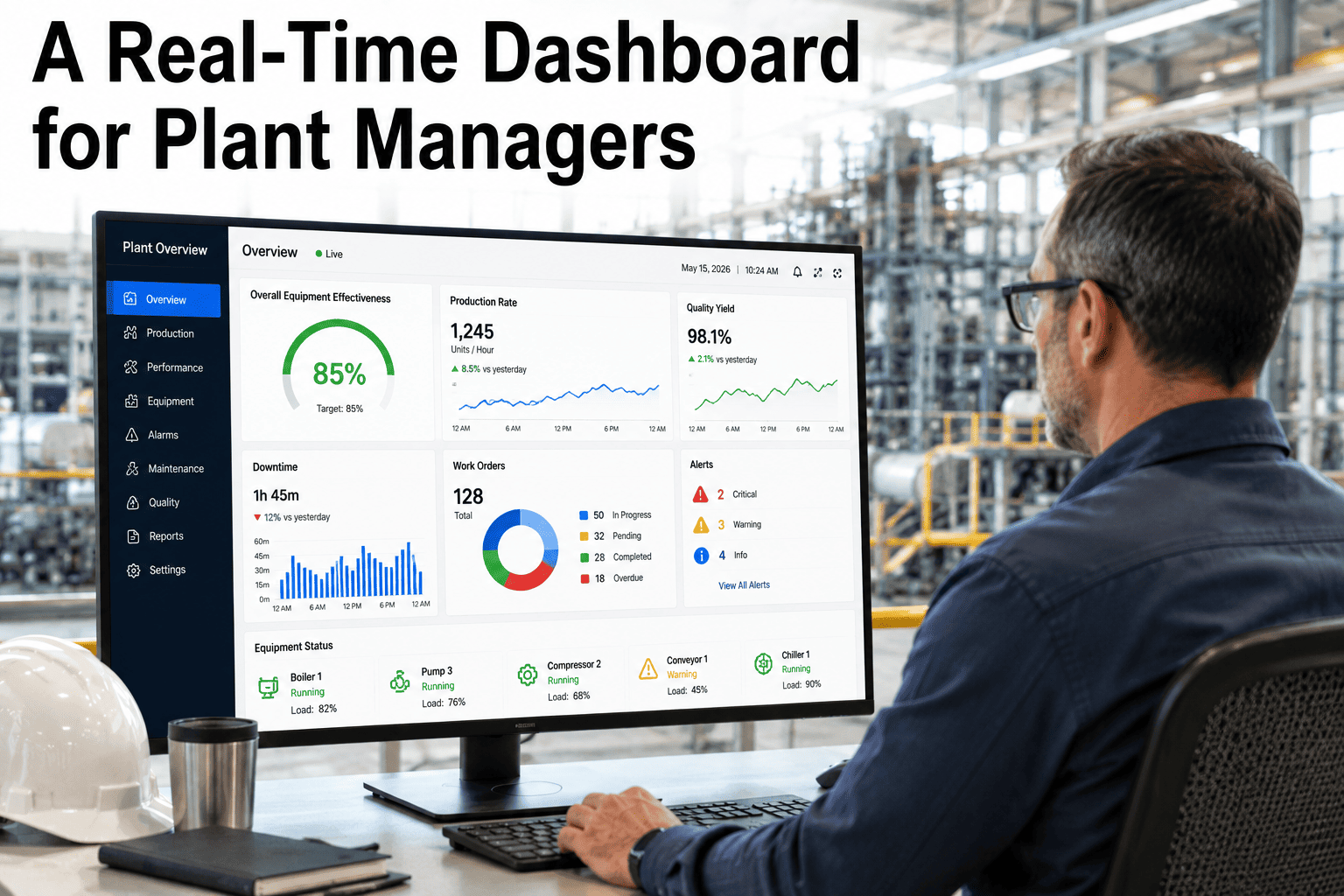
Every parameter streams into a live dashboard where trend lines, threshold breaches, and anomaly scores are visible to QA and maintenance teams in real time.
04
Automated Alerts & Work Orders
When a reading crosses a threshold, the system immediately sends alerts to assigned personnel and auto-generates a maintenance work order — with no human trigger needed.
The Operational Impact: Before vs. After
The difference between a facility running reactive maintenance and one with real-time IoT monitoring is not incremental — it is structural. Here is what that gap looks like in practice.
✕
Equipment failures discovered during breakdown — after product loss has already occurred
✕
Temperature deviations in cold storage found during end-of-shift walkthrough — 6–8 hours late
✕
Maintenance schedules based on calendar time — not actual equipment condition
✕
OEE calculated from shift reports — 8–15% of micro-stoppages never recorded
✕
Compliance documentation assembled manually before audits — risk of gaps
✓
Anomaly signals detected hours or days before failure — maintenance dispatched proactively
✓
Temperature breach alert fires within 30 seconds — cold chain never compromised without immediate response
✓
Condition-based maintenance triggered by actual vibration, current, and runtime data
✓
True OEE calculated from continuous sensor data — every micro-stoppage captured automatically
✓
Timestamped sensor logs available instantly — audit-ready records with zero manual assembly
The Numbers Are Clear
Facilities using real-time monitoring report up to 35% reduction in unplanned downtime and 20% lower maintenance costs within 12 months.
Oxmaint connects your plant's physical equipment to a live digital monitoring layer — alerts, work orders, compliance logs, and trend analytics in one system.
What Oxmaint's Real-Time Monitoring Gives Your Plant
Oxmaint is not a generic IoT dashboard. It is built specifically for food manufacturing operations — where monitoring failures have safety, regulatory, and financial consequences that no other industry faces at the same scale. Book a demo to see live sensor data flowing through Oxmaint in a food plant environment.
Every monitored asset shows its current status, recent trend, and anomaly score in a single view. QA managers and maintenance leads see the same live data simultaneously — no radio calls needed.
Live Sensor FeedMulti-Line View
Threshold Alerts & Escalations
Define warning and critical thresholds per asset and parameter. When crossed, alerts route to the right person via SMS, email, or in-app notification — with automatic escalation if unacknowledged.
Smart ThresholdsAuto-Escalation
Predictive Maintenance Triggers
Rising vibration trends and abnormal current draw patterns automatically generate predictive maintenance work orders — assigned, prioritized, and tracked to completion inside Oxmaint.
Predictive LogicAuto Work Orders
Cold Chain & HACCP Compliance Logs
Every temperature and humidity reading is timestamped, zone-tagged, and stored as an immutable compliance record — aligned to HACCP critical control points and ready for FSMA or BRC audit requests.
HACCP AlignedFSMA / BRC Ready
Frequently Asked Questions
These are the questions food manufacturing operations teams ask most before implementing a real-time monitoring system — answered directly.
Do we need to replace existing equipment to install IoT monitoring sensors?
No. IoT sensors are designed to retrofit onto existing equipment — motors, conveyors, ovens, chillers, and pipelines — using magnetic mounts, clamps, or adhesive brackets. Installation typically requires no downtime and no changes to your existing machinery. Sensors begin transmitting data within hours of attachment.
How quickly does the system alert us when something goes wrong?
Alert latency depends on your sensor transmission interval and gateway configuration, but most real-time systems — including Oxmaint — deliver threshold breach alerts within 30 to 60 seconds of the deviation occurring. For cold chain and temperature CCP monitoring, near-instant alerting is critical and achievable with properly configured IoT gateways.
Is the monitoring data accepted as compliance evidence by FDA or GFSI auditors?
Yes — provided the system generates timestamped, immutable records tied to specific equipment, locations, and parameters. FDA FSMA requires records to be accessible within 24 hours of inspector request. Oxmaint stores all sensor logs as tamper-evident compliance records aligned to HACCP CCP documentation requirements and GFSI frameworks including BRC and SQF.
What is the difference between real-time monitoring and predictive maintenance?
Real-time monitoring is the continuous collection and display of live equipment data — it tells you what is happening right now. Predictive maintenance is an application built on top of that data — it uses trend analysis (rising vibration, increasing current draw, temperature drift) to forecast when a component is likely to fail. Oxmaint does both: it streams live data and automatically generates predictive maintenance work orders when sensor trends cross pre-defined risk thresholds.
How many sensors does a typical food manufacturing plant need?
It depends on facility size and priority assets, but a typical mid-size food plant starts with 15–40 sensors covering critical production line equipment, cold storage units, and key environmental zones. A phased approach — starting with the highest-risk or most costly failure points — is recommended. Oxmaint's team helps map sensor placement during onboarding based on your asset list and failure history.
Can the system integrate with our existing ERP or CMMS?
Yes. Oxmaint supports API-based integrations with major ERP and CMMS platforms so that work orders generated from sensor alerts can flow directly into your existing maintenance workflows. This eliminates duplicate data entry and ensures your maintenance team receives real-time alerts inside the tools they already use.
Book a demo to discuss your specific integration requirements.
What happens if the internet connection goes down at the facility?
Edge gateways store sensor data locally during connectivity interruptions and automatically sync to the cloud when the connection is restored — ensuring no data gaps in your compliance records. For facilities with intermittent connectivity, cellular-backup gateways are available to maintain continuous transmission without relying solely on facility Wi-Fi.
Built for Food Manufacturers
Stop Finding Problems After the Damage Is Done.
Oxmaint gives food manufacturing plants a real-time IoT monitoring system — live dashboards, threshold alerts, predictive work orders, and automated compliance logs — running from day one, without replacing existing equipment.