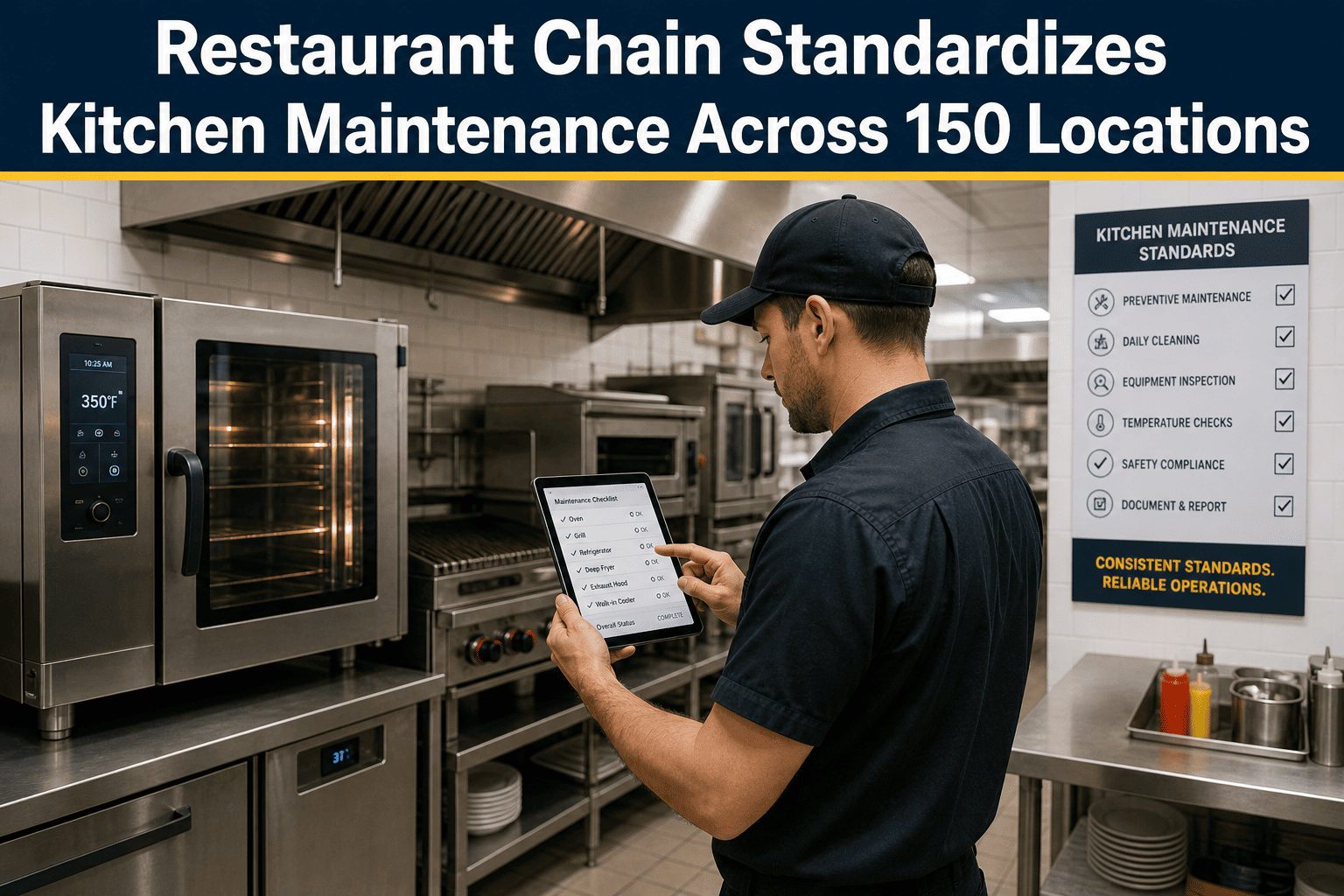
Restaurant and Commercial Kitchen Equipment Maintenance Management

By Josh Turley on April 25, 2026

restaurant-commercial-kitchen-equipment-maintenance-management

Equipment breakdowns during peak dinner service account for nearly one in three unplanned restaurant closures — and most of them were preventable. A walk-in cooler that loses a condenser fan at 7 PM on a Friday isn't bad luck: it's six weeks of skipped PM made visible at the worst possible moment, during your highest-revenue service window. With the foodservice industry losing an estimated $46 billion annually to equipment downtime, and repair and maintenance costs rising 31% since 2019, the gap between restaurants running structured preventive maintenance and those reacting to failures is growing wider every year. Start your OxMaint free trial — commercial kitchen PM schedules running in 48 hours

Restaurant Maintenance · Commercial Kitchen · Work Order Management

Kitchen Equipment That Fails During Service Was Neglected During Prep

Fryers, combi ovens, walk-in coolers, dishwashers, and hood suppression systems operate under continuous production load in high-temperature, high-humidity conditions with health code compliance pressure added on top. OxMaint manages preventive maintenance, compliance documentation, and multi-site work orders for commercial kitchen operations — from single-site independents to multi-unit franchise groups managing dozens of locations.

$46B
Annual foodservice industry cost of equipment downtime

1 in 3
Unplanned restaurant closures caused by equipment failure during service
31%
Rise in restaurant repair and maintenance costs since 2019

30–40%
Fewer breakdowns with structured preventive maintenance programs
Equipment Coverage

Every Critical Kitchen Asset — One Maintenance Platform

A commercial kitchen contains 15–40 maintenance-critical assets, each with different PM intervals, compliance requirements, and failure consequences. OxMaint manages all of them from a single platform — with QR code scanning for instant work order creation, mobile completion from anywhere in the kitchen, and compliance records available in seconds for health inspectors. See how OxMaint manages your kitchen assets in a 30-minute demo

Commercial Fryers
Daily oil filter Fire risk Health code
Key PM: Oil changes, burner calibration, carbon removal, drain valve inspection
Combi Ovens and Ranges
Descaling Door seals Calibration
Key PM: Steam circuit descaling, burner inspection, door gasket replacement, deliming
Walk-In Coolers and Freezers
Temp logs Food safety Gaskets
Key PM: Condenser coil cleaning, door gasket inspection, refrigerant checks, temp log verification
Commercial Dishwashers
Sanitizer levels Health code Descaling
Key PM: Rinse temperature verification, sanitizer concentration, filter cleaning, deliming cycles
Hood Suppression Systems
Fire safety Compliance cert Grease filters
Key PM: Grease filter replacement, suppression system inspection, exhaust fan cleaning, fire cert renewal
Ice Machines
Sanitization Filter change Health code
Key PM: Sanitization cycles, water filter replacement, bin cleaning, condenser coil maintenance
HVAC and Ventilation
Air quality Filter change Energy
Key PM: Filter replacement, coil cleaning, belt tension, refrigerant charge check, airflow balance
Grease Traps and Drains
Regulatory Pumping schedule FOG compliance
Key PM: Grease trap pumping, drain enzyme treatment, FOG compliance record, blockage inspection
Health Code Compliance

Inspection Ready — Every Day, Not Just Before the Inspector Calls

Environmental health officers arrive unannounced. Restaurants with CMMS maintenance records pass health inspections at significantly higher rates than those relying on paper logs or memory — because digital records show exactly when each PM task was completed, by whom, and what was found. Dirty condenser coils alone increase refrigeration energy use by 20–35% and accelerate compressor failure. Structured PM prevents both the cost and the compliance failure. See OxMaint's compliance documentation in action — start a free trial

Critical — Health Code
Temperature Monitoring
Daily refrigeration temperature logs with automatic out-of-range alerts. Timestamped digital records showing continuous safe food storage — replacing paper logs that get altered or left blank.
Daily work orders · Mobile completion · Instant alerts
Critical — Fire Safety
Hood and Suppression Records
Grease filter replacement logs and suppression system inspection certificates stored in CMMS — retrievable in seconds when the fire marshal visits, not after 40 minutes searching paper files.
Monthly filter · Semi-annual system cert · Annual inspection
Important — Food Safety
Dishwasher Sanitizer Logs
Daily sanitizer concentration readings and rinse temperature verification — proof that dishwashing meets health code standards with digital records showing consistent performance between inspections.
Daily readings · Weekly deep clean · Monthly certificate
Important — Regulatory
Grease Trap Pumping Records
FOG compliance documentation showing grease trap pumping on schedule with licensed contractor certificates attached — preventing FOG violations that carry fines and license suspension risk.
Quarterly pumping · Annual inspection · Permit renewal
Multi-Site Management

Manage Kitchen Maintenance Across Every Location From One Dashboard

Multi-unit restaurant groups face a maintenance standardization problem that single-site operators don't — ensuring every location follows the same PM schedules, uses the same procedures, and generates compliance documentation to the same standard. OxMaint's portfolio view gives operations managers real-time visibility across every site simultaneously. See multi-site management in a 30-minute platform demo

01
Standardized PM Templates Across All Sites
Build PM templates once — push to all locations simultaneously. Every site follows identical procedures with identical documentation standards, eliminating the variation that creates compliance gaps at individual locations.
02
Portfolio-Level Compliance Visibility
Operations managers see PM completion rates, overdue work orders, and compliance certificate status across all locations on a single dashboard — identifying at-risk sites before health inspectors do.
03
Equipment Performance Benchmarking
Compare fryer downtime, refrigeration failure frequency, and maintenance cost per site — identifying which locations have equipment reliability problems and which PM practices deliver the best outcomes.
04
Mobile-First for Kitchen Teams
Kitchen staff complete daily temperature logs and maintenance requests by scanning QR codes on equipment — no CMMS training required. Work orders completed in under 2 minutes directly from the production floor.
Reactive vs. Planned

The Real Cost of Running a Kitchen Without Structured Maintenance

Reactive Kitchen Management
Walk-in fails Friday 7 PM — $4,200 in product lost, emergency contractor at 3x rate
Hood suppression system last inspected 14 months ago — fire marshal violation notice
Fryer carbon buildup undetected — flash fire risk, forced mid-service shutdown
Dishwasher sanitizer depleted unnoticed — EHO finds inadequate rinse temperature
Condenser coils dirty — energy bill 20-35% higher, compressor failure in 6 months
Ice machine not sanitized — biofilm found during health inspection, immediate closure order
Managed via OxMaint
Monthly condenser cleaning prevents failure — walk-in reliable through peak season
Hood cert renewal scheduled 60 days ahead — compliance maintained with zero violations
Weekly fryer carbon inspection — buildup removed before fire risk develops
Daily dishwasher sanitizer log — out-of-range alert fires before health code breach
Quarterly coil cleaning scheduled — energy costs controlled, compressor life extended
Monthly ice machine sanitization on schedule — digital record proves compliance to inspector
ROI Numbers

What Structured Kitchen Maintenance Delivers

30–40%
Fewer Equipment Breakdowns

Hospitality kitchens with structured PM programs consistently report this improvement — preventing the service disruptions that damage customer experience
20–30%
Lower Total Maintenance Costs

Planned PM replaces emergency contractor callouts — standard labor rates vs. after-hours emergency premium, parts on stock vs. overnight procurement
20%
Energy Cost Reduction

Clean condenser coils, calibrated ovens, and serviced HVAC units consume significantly less energy — reducing utility bills across every kitchen asset
2–3 min
Inspector Record Retrieval

Digital maintenance records pulled up instantly — vs. 40+ minutes searching paper files when the environmental health officer arrives unannounced
Commercial Kitchen CMMS · Multi-Site · Compliance-Ready

Stop Running Your Kitchen Reactively. Breakdowns During Service Are Optional.

Every expensive kitchen breakdown was preventable with a scheduled work order that didn't get done. OxMaint gives restaurant operators preventive maintenance scheduling, health code compliance documentation, and multi-site visibility — all accessible from mobile in under 2 minutes per task. Whether you're managing one location or a hundred, structured kitchen maintenance pays back in reduced breakdowns, lower energy costs, and inspections you pass first time. Start your free trial today.

Frequently Asked Questions

Restaurant Equipment Maintenance Management — What Operators Ask

Can kitchen staff complete daily temperature logs without CMMS training?
Yes. Daily temperature log work orders in OxMaint are designed for completion on mobile in under two minutes. Kitchen team members scan the QR code on the walk-in or refrigeration unit, enter the temperature reading, confirm cleaning tasks as completed, and submit. No CMMS training required — the workflow is equivalent to filling in a paper log but creates a timestamped, named digital record. If any reading falls outside the configured safe range, an instant alert fires to the site manager before the food safety window expires. The entire team is operational on day one. Try the mobile daily log workflow in a free OxMaint account
How does OxMaint handle maintenance across multiple restaurant locations?
OxMaint's portfolio view gives operations managers a real-time dashboard showing PM completion rates, overdue work orders, compliance certificate status, and equipment health scores across every site simultaneously. PM templates built once push to all locations — ensuring every site follows identical procedures. When the environmental health officer visits Site 7, the operations manager at head office can see the site's maintenance record status in real time. Multi-site deployment typically completes within 48–72 hours with no IT infrastructure required at individual locations — each site needs only internet connectivity and mobile devices for the kitchen team.
What compliance certificates can OxMaint store and track for commercial kitchens?
OxMaint stores and tracks renewal dates for all compliance certificates relevant to commercial kitchen operations: hood and suppression system inspection certificates (typically semi-annual), gas safety certificates, electrical inspection records, grease trap pumping compliance records, dishwasher sanitizer calibration certificates, and pest control visit reports. Certificate expiry alerts fire at 60 and 30 days ahead — giving operators time to schedule renewals before certificates lapse. When an environmental health officer or fire marshal requests records, every certificate is retrievable from the asset profile in under 60 seconds. See certificate management in a live platform demo
How quickly can a restaurant get up and running on OxMaint?
A single-site restaurant can be fully operational on OxMaint within 2–3 days — equipment assets registered, PM schedules configured, daily temperature log work orders active, and compliance certificate records uploaded. The typical deployment sequence: Day 1 covers equipment registration and PM template configuration. Day 2 covers kitchen team mobile training (15–20 minutes per person) and first live work orders completed. Day 3 covers any site-specific customization and management reporting setup. Multi-site groups typically add 1–2 days per additional location after the first site deployment, as templates replicate automatically. No IT infrastructure, no server setup, no consultant fees. Start your deployment today with a free trial

Share This Story, Choose Your Platform!