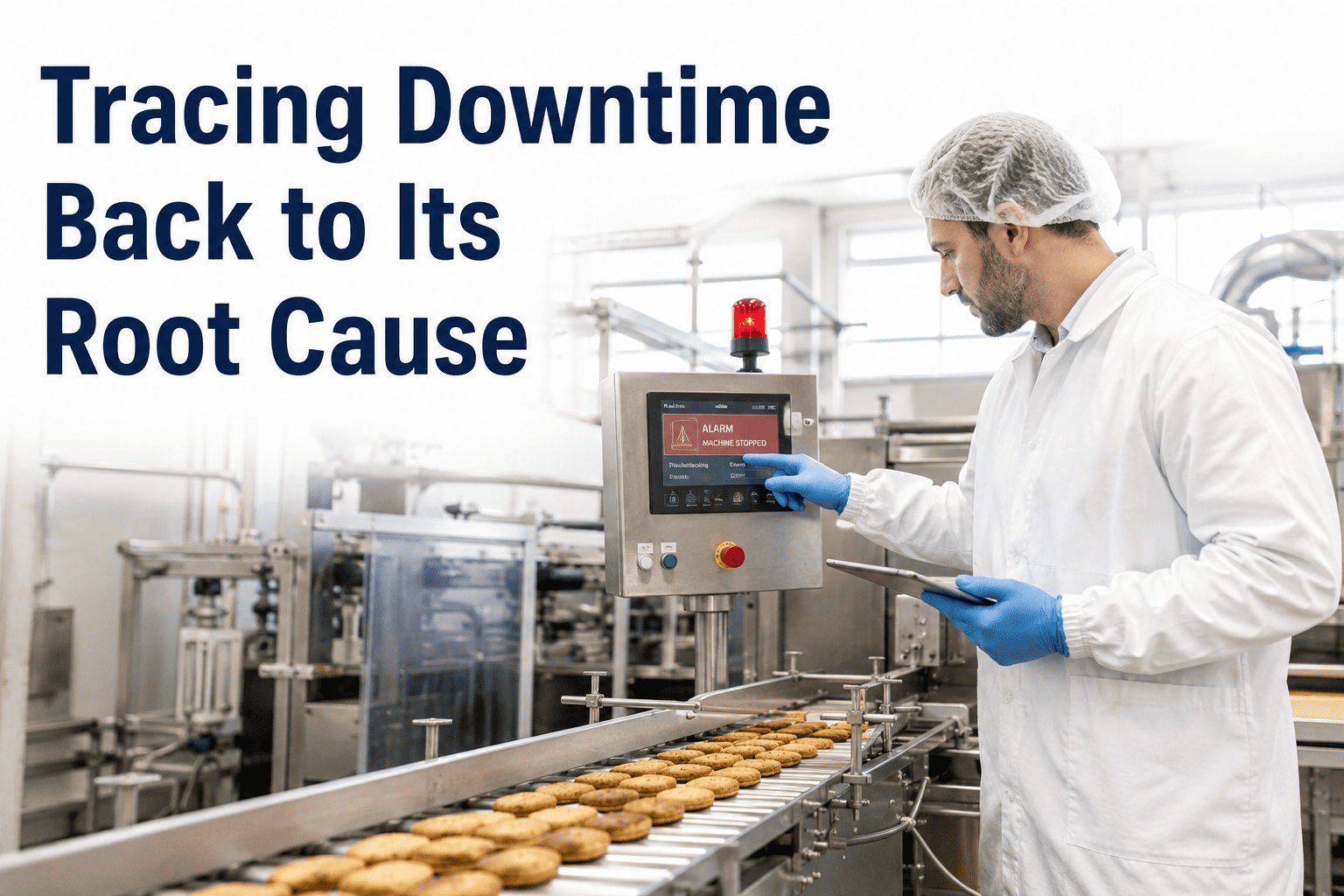
Root cause analysis in food manufacturing is the difference between fixing a problem once and fixing it forever. When a filling machine jams, a conveyor belt slips, or a packaging seal fails repeatedly, reactive maintenance only treats the symptom. A structured RCA food plant process digs beneath the surface — identifying the actual source of recurring equipment failure and eliminating it at its root. For reliability and maintenance leads managing high-speed production lines, RCA is not optional. It is the foundation of a sustainable, cost-efficient operation.
Stop Recurring Failures Before They Cost You Another Shutdown
OxMaint CMMS gives food manufacturing teams a structured RCA framework — capture failure data, run investigations, and track corrective actions in one platform.
What Is Root Cause Analysis in Food Manufacturing?
Root cause analysis (RCA) is a structured problem-solving methodology used to identify the fundamental cause of an equipment failure, process deviation, or quality incident — not just its visible symptoms. In a food plant environment, RCA is applied when failures recur, when a breakdown causes significant downtime, or when a quality escape creates compliance risk.
The objective is not to assign blame. It is to understand the complete causal chain — from the immediate trigger all the way back to the systemic condition that allowed the failure to occur — and then implement corrective actions that break that chain permanently. Teams that run RCA investigations consistently report fewer repeat failures, lower emergency maintenance spend, and improved equipment availability over time.
In highly regulated industries like food and beverage, RCA also serves a compliance function. Regulatory bodies in the UK, US, Canada, Germany, and UAE increasingly require documented failure investigations as part of Good Manufacturing Practice (GMP) and food safety management systems. A CMMS-integrated RCA process creates that documentation automatically.
Why Recurring Equipment Failures Happen in Food Plants
Recurring failures share a common characteristic: they were addressed at the symptom level the first time. A technician replaces a worn bearing, the line restarts, and the investigation ends there. Three weeks later, the bearing fails again — because the underlying cause (misalignment, improper lubrication, wrong component specification) was never identified or corrected. Sign up free with OxMaint to start capturing structured failure data from your first work order.
Food manufacturing environments compound this problem. High-throughput lines run under significant production pressure. Downtime is costly. The incentive to restore production quickly often overrides the slower, more disciplined process of formal failure investigation. Over time, this creates a maintenance culture that is permanently reactive — constantly chasing failures that a structured equipment failure analysis food program would have eliminated months earlier.
Additional factors that drive recurring failures in food plants include inadequate maintenance data capture, unclear ownership of investigation processes, and the absence of standardized RCA tools. Without a system that links failure events to investigation records and corrective action tracking, even well-intentioned teams struggle to close the loop. Book a demo to see how a CMMS closes this gap automatically.
Core RCA Methodologies for Food Manufacturing
Three structured methodologies form the practical foundation of food equipment failure analysis: the 5 Why technique, the fishbone (Ishikawa) diagram, and Failure Mode and Effects Analysis (FMEA). Each serves a distinct purpose. Effective RCA programs deploy all three in the appropriate context.
The 5 Why Technique in Food Manufacturing
The packaging seal fails on the production line — visible problem, production stops.
Seal temperature was inconsistent during the run — equipment was not holding target.
The temperature sensor drifted out of calibration — readings were inaccurate.
Calibration intervals were never scheduled in the CMMS — no PM task existed for this sensor.
The PM program was built without manufacturer calibration specs — a systemic gap, not a broken part. Fix it in OxMaint in under 20 minutes.
Fishbone Diagram (Ishikawa) for Food Equipment Failures
The fishbone diagram maps all potential causes of a failure across six standard categories: Machine, Method, Material, Man, Measurement, and Environment. For food manufacturing, these categories are well-aligned to the actual failure landscape — mechanical wear, operating procedure deviations, ingredient or packaging material variation, operator technique inconsistencies, sensor inaccuracies, and temperature or humidity conditions all appear regularly as contributing causes.
A fishbone diagram food investigation typically begins with a cross-functional team session — maintenance lead, line operator, quality technician, and engineering — walking through each cause category systematically. The structured format ensures that no contributing factor is overlooked because the investigation focused too narrowly on the most obvious cause. Teams in UK food manufacturing facilities increasingly use digital fishbone tools that feed directly into CMMS corrective action workflows.
Failure Mode and Effects Analysis (FMEA) in Food Plants
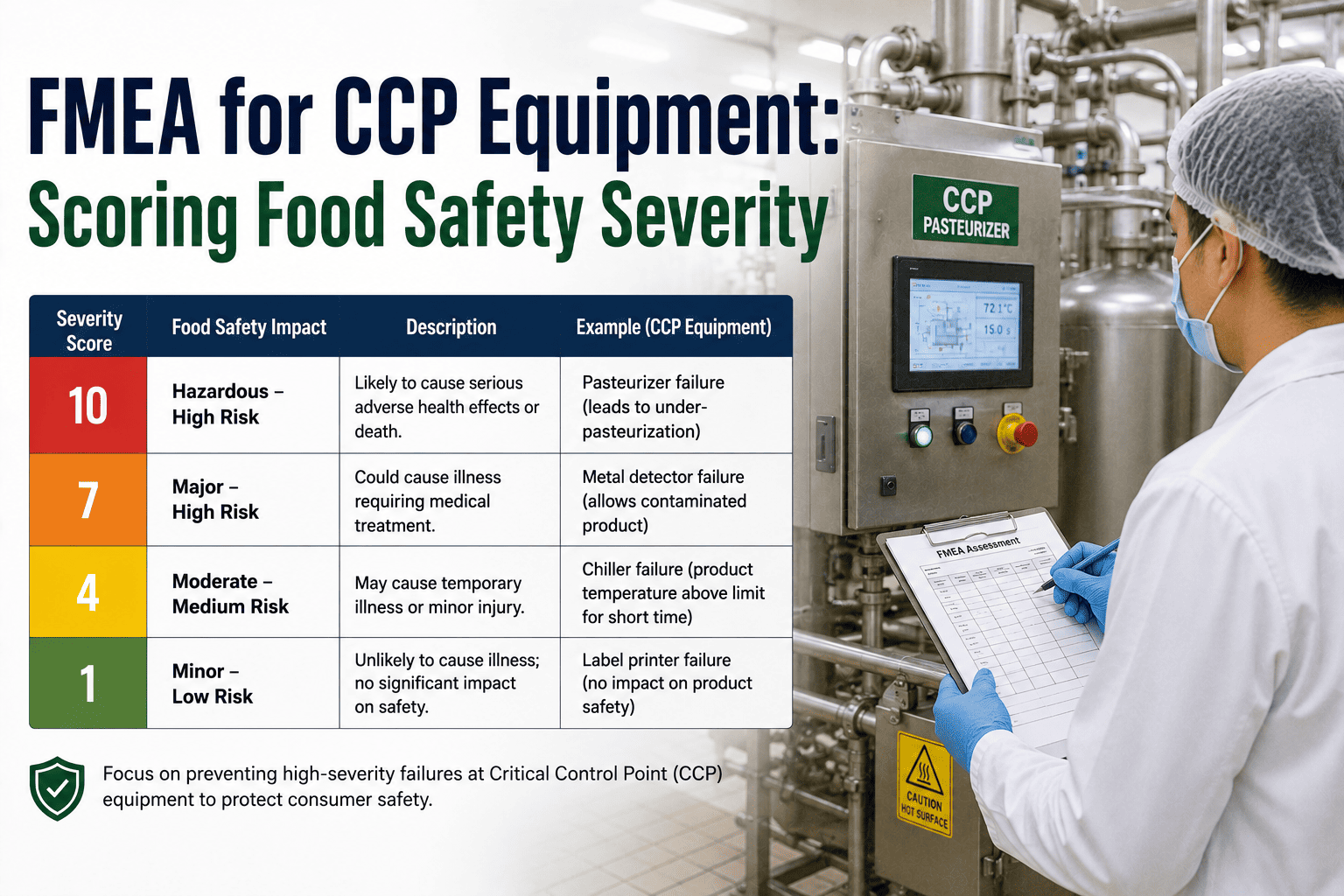
FMEA is a proactive RCA methodology that identifies potential failure modes before they occur — and prioritizes them by their severity, frequency, and detectability. A FMEA food plant analysis assigns a Risk Priority Number (RPN) to each identified failure mode, guiding the maintenance team to focus preventive resources on the highest-risk failure scenarios first.
In food manufacturing, FMEA is particularly valuable during new equipment commissioning, after a production line changeover, and when introducing new product SKUs that alter machine operating parameters. An FMEA conducted before a high-speed capping machine is installed identifies potential torque inconsistency, cap feed jams, and sensor blind spots — and puts mitigation measures in place before the first production run. Platforms like OxMaint allow teams to store FMEA records linked directly to individual assets, creating a living document that updates as operating experience accumulates.
CMMS-Based RCA Data Capture: Closing the Loop
The most common failure in food plant RCA programs is not the analysis itself — it is the data capture that feeds the analysis. Without structured failure data, even the most skilled maintenance team is investigating from memory and anecdote. A CMMS RCA tracking system transforms failure data collection from an informal practice into a systematic operational process.
Effective CMMS-based RCA data capture requires four elements. First, every work order for a corrective maintenance event should include mandatory fields for failure mode, immediate cause, and the asset component involved. Second, high-impact failures should trigger an automatic RCA investigation workflow that assigns ownership and sets a completion deadline. Third, corrective actions identified through the RCA should be linked back to the originating work order and tracked through to verification. Fourth, the CMMS should generate trend data that surfaces assets and failure modes that are repeating — giving maintenance leads visibility into where RCA resources should be directed next. Get started free and configure all four elements in OxMaint today.
Food manufacturing operations in Germany and Canada that have implemented structured CMMS RCA tracking report a measurable reduction in repeat failures within the first 90 days — simply because the structured data collection process reveals patterns that were previously invisible in disconnected spreadsheet records.
Step-by-Step RCA Investigation Framework for Food Plants
A reproducible investigation framework ensures that RCA quality does not depend on who is conducting the investigation. The following five-step process is applicable across all food manufacturing equipment categories — from processing and filling to packaging and cold chain systems. Book a demo to see how OxMaint guides teams through each step with structured digital templates.
A vague problem statement produces a vague investigation. Define the failure in specific, measurable terms: what failed, on which asset, at what time, under what operating conditions, and with what production impact. "Conveyor belt slipped" is not a problem statement. "Conveyor belt on Line 3 slipped 4 times in 72 hours during high-speed operation, resulting in 140 minutes of unplanned downtime" is a problem statement that can drive a structured investigation.
Before repairs begin, document the physical state of the failed component — photographs, measurements, sensor readings at time of failure, recent maintenance history, and operator observations. In food plant environments, the pressure to restore production quickly often causes technicians to begin repairs before this documentation is complete. CMMS mobile work orders with mandatory photo capture fields create a natural checkpoint that preserves failure evidence.
Select the RCA tool matched to the failure complexity. Simple recurring failures with a clear pattern are well-served by a 5 Why investigation. Complex failures with multiple contributing variables require a fishbone diagram and cross-functional team input. New or critical equipment failures should trigger an FMEA review. The methodology selected should be documented in the investigation record — this supports audit readiness under GMP and food safety management standards applied in the UK, US, Canada, and UAE markets.
The proposed root cause must pass two tests. First, if the root cause is eliminated, does the failure chain break? Second, does the evidence collected support the proposed root cause, or is the team reasoning backward from a preferred explanation? Cross-functional verification — having a second technician or engineer independently review the causal chain — improves root cause accuracy and reduces the risk of confirmation bias in the investigation.
Each identified root cause should generate at least one corrective action with a named owner, a completion deadline, and a verification method. Corrective actions range from PM interval adjustments and component specification changes to operator training updates and process control modifications. Verification — confirming that the failure has not recurred following corrective action — closes the RCA loop and provides the evidence base for ongoing reliability improvement food reporting.
How AI Vision Enhances Root Cause Analysis in Food Manufacturing
AI vision (computer vision) monitors equipment continuously — detecting early warning signals before a failure occurs, so your RCA starts with real data, not guesswork. Sign up free with OxMaint to integrate AI-powered signals into your maintenance workflow.
Detects belt tension irregularities before slip events occur — triggering a CMMS inspection before the line stops.
Visually inspects every packaging seal in real time, auto-rejecting out-of-spec seals and logging deviation data.
Identifies fill inconsistencies that indicate pump wear or valve degradation — before a line failure occurs.
Captures the full causal chain before failure — making RCA investigations faster, more accurate, and audit-ready.
Deployed at scale in UAE and Germany food plants. AI signals feed directly into CMMS work order workflows.
Shifts RCA from reactive to proactive — maintenance leads investigate degradation, not just completed failures.
RCA Tools and Platform Comparison
Selecting the right combination of failure mode analysis food tools and CMMS RCA tracking platforms is critical to building a program that maintenance teams will actually use consistently. The table below compares the key platforms and methodologies used in food manufacturing RCA programs.
| Tool / Platform | Primary Use Case | RCA Integration | Best For | Compliance Readiness |
|---|---|---|---|---|
| OxMaint CMMS | End-to-end maintenance & RCA data capture | Native RCA templates, corrective action tracking, asset failure history | Mid to large food manufacturers | GMP, ISO 22000, FSSC 22000 audit trail |
| 5 Why Template (CMMS-linked) | Simple recurring failure investigation | Linked to work orders; auto-closes with corrective action verified | Line-level maintenance teams | Supports GMP documentation requirements |
| Fishbone / Ishikawa Software | Multi-cause failure mapping | Exportable; linked to CMMS via corrective action import | Cross-functional investigation teams | Supports HACCP and quality system documentation |
| FMEA Software (standalone) | Proactive failure risk assessment | RPN scoring drives PM program priorities | Engineering and reliability teams | ISO 9001, IFS Food, BRC compliance evidence |
| AI Vision Monitoring Platform | Real-time equipment condition detection | Triggers CMMS work orders from anomaly detection events | High-throughput production lines | Provides pre-failure data record for RCA investigations |
Reliability Improvement Through Systematic RCA Programs
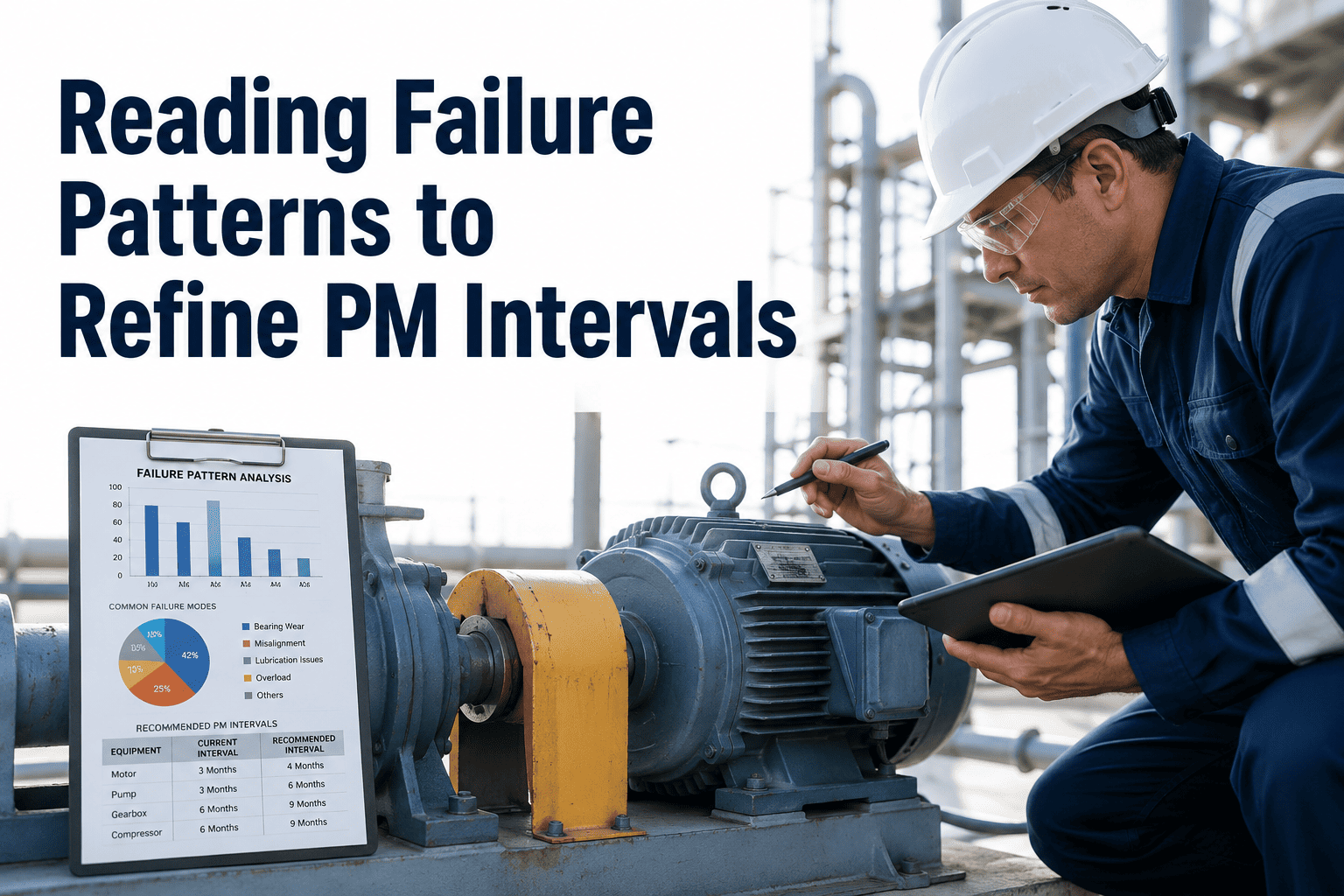
Reliability improvement food manufacturing programs are built on a foundation of accumulated RCA data. A single investigation resolves a single failure. A systematic program — where every significant failure triggers a structured RCA, every investigation produces verified corrective actions, and every outcome feeds back into the PM program — progressively eliminates the failure modes that consume the most maintenance resource.
The compounding effect of this approach is significant. As recurring failure modes are eliminated, emergency maintenance spend decreases, planned maintenance ratios improve, and overall equipment effectiveness (OEE) rises. Food manufacturers in Canada and the UK running mature RCA programs consistently report planned-to-reactive maintenance ratios above 80:20 — compared to industry averages closer to 50:50 for plants managing maintenance reactively. Get started now and begin building that ratio in your plant.
RCA data also feeds directly into asset lifecycle decisions. When CMMS failure history shows that a specific filling machine has accumulated corrective maintenance costs exceeding 40% of replacement value, that data supports a capital investment request with a documented business case — rather than an informal appeal based on technician frustration. OxMaint's reporting dashboards surface exactly this type of asset-level cost and reliability data automatically.
Common RCA Challenges in Food Manufacturing — and How to Solve Them
The most common RCA failure mode: the line is down, the shift manager needs production restored, and the investigation is skipped. The solution is not asking maintenance teams to resist production pressure — it is building a two-track response protocol. Track one: immediate containment and line restoration. Track two: mandatory RCA trigger for all failures meeting defined criteria (downtime threshold, repeat event, food safety impact). The RCA investigation happens after production resumes, with a defined 24–48 hour completion window.
Technicians completing repairs without capturing failure data create an investigation dead end. CMMS mobile work orders with mandatory failure mode fields and photo capture requirements resolve this at the process level — making data capture a natural part of the repair workflow rather than a separate administrative task completed later from memory.
An RCA investigation that produces a list of corrective actions but no follow-through is worse than no investigation — it creates the impression that the problem has been addressed when it has not. CMMS-based corrective action tracking with assigned owners, due dates, and automated escalation alerts closes this gap. Corrective actions that remain open past their due date should automatically escalate to the reliability or maintenance manager.
Organizations that restrict RCA to major breakdowns miss the accumulation of minor recurring failures that collectively consume significant maintenance resource. A tiered RCA approach — lightweight 5 Why investigations for minor recurring failures, full cross-functional investigations for major events — ensures that the entire failure landscape is addressed without overwhelming the team's capacity.
Best Practices for RCA in Food Manufacturing
These practices separate teams that consistently eliminate failures from those that repeat the same fixes. Book a demo to see how OxMaint supports each of these in a single platform.
Define which failures require RCA before the next breakdown — downtime threshold, repeat events, food safety impact. Without this, investigations get skipped under production pressure.
Include maintenance, quality, operations, and engineering in every investigation. Single-discipline RCA misses contributing causes. Sign up free to assign and track team roles.
Track which assets generate the most RCAs and which failure modes recur. Turn your monthly maintenance meeting into a forward-looking reliability session.
A corrective action is only complete when confirmed effective — not when implemented. Monitor the asset for recurrence before closing the investigation loop.
GMP and food safety audits in the UK, US, Canada, and UAE require traceable investigation records. Book a demo to see audit-ready RCA documentation in OxMaint.
Use lightweight 5 Why for minor recurring failures and full cross-functional analysis for major events. Don't apply the same effort to every failure — focus where it counts.
Frequently Asked Questions
What is the difference between 5 Why and fishbone diagram in food manufacturing RCA?
The 5 Why technique traces a single causal chain from symptom to root cause through sequential questioning. It is most effective for straightforward failures with a clear linear cause-and-effect pattern. The fishbone diagram maps multiple potential causes across six categories simultaneously and is better suited to complex failures where several contributing factors interact. Many food manufacturing RCA programs use 5 Why as the first-pass tool and escalate to fishbone analysis when the investigation reveals multiple contributing causes or when the initial corrective action does not prevent recurrence.
How does CMMS support root cause analysis in food plants?
A CMMS supports RCA by providing structured failure data capture at the work order level, automatically surfacing recurring failure patterns across assets and failure modes, storing investigation records linked to specific assets, tracking corrective actions from identification through verified closure, and generating trend reports that guide where RCA resources should be focused. Without CMMS integration, RCA investigations rely on manually assembled data that is slow to gather, incomplete, and difficult to trend over time.
Which failures in a food manufacturing plant require a formal RCA investigation?
At minimum, formal RCA investigations should be triggered by any failure that results in unplanned downtime exceeding the plant's defined threshold (commonly 2–4 hours), any failure that recurs within 90 days of a previous repair on the same asset, any failure with a food safety, quality, or regulatory compliance implication, and any failure that results in product loss or customer impact. Lower-severity recurring failures can be addressed with a lightweight 5 Why investigation rather than a full cross-functional process.
How long should an RCA investigation take in a food manufacturing environment?
A 5 Why investigation for a straightforward recurring failure should be completable within 24–48 hours of the failure event, including corrective action identification. A full cross-functional fishbone investigation for a complex or major failure typically requires 3–5 business days, allowing time to gather physical evidence, assemble the investigation team, complete the causal analysis, and develop verified corrective actions. Investigations that stretch beyond two weeks typically indicate either insufficient data collection or lack of investigation ownership and escalation accountability.
Can RCA documentation satisfy food safety and GMP audit requirements?
Yes — and in many food safety management systems, documented failure investigation processes are explicitly required. CMMS-generated RCA records provide auditors with a traceable history of failure events, investigation methodology, identified root causes, corrective actions taken, and verification outcomes. This documentation satisfies requirements under GMP frameworks applicable in the UK, US, Canada, Germany, and UAE, as well as certification schemes including ISO 22000, FSSC 22000, BRC Global Standard, and IFS Food. The key requirement is that the documentation is structured, consistent, and linked to specific assets and failure events — not maintained in informal notes or emails.
Build a Failure-Free Production Line with Structured RCA
OxMaint gives food manufacturing reliability teams the tools to investigate every failure, track every corrective action, and prove to auditors that recurring failures are being eliminated — not just repaired. Join leading food manufacturers across the UK, US, Canada, Germany, and UAE already running smarter maintenance with OxMaint.