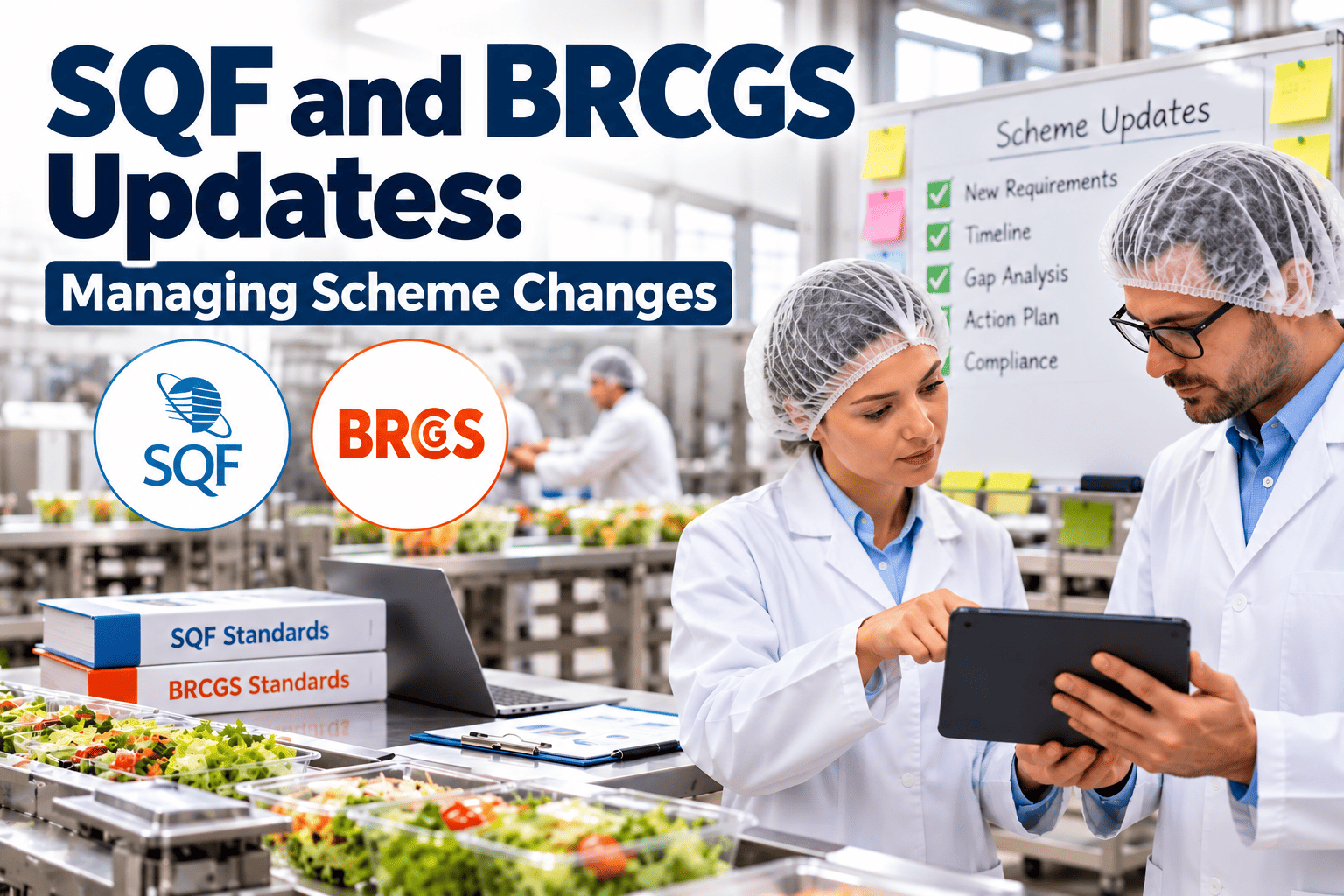
Food safety schemes do not stand still. SQF and BRCGS revise their standards periodically, and each revision can add requirements, clarify clauses or change how auditors interpret evidence. Plants that treat an update as a one-off panic tend to find gaps at the next audit, while those with a repeatable change process absorb it calmly. This article lays out a documented approach to monitoring standard updates, assessing impact and updating procedures and training, and shows where Oxmaint maintenance management software supports the maintenance and records side of that work.
SQF and BRCGS Updates: A Repeatable Way to Manage Scheme Changes
Monitor revisions, assess impact, update procedures and training, and prove it on a documented timeline.
Where plants lose time when a standard changes
A documented change timeline from announcement to audit
Confirm exact dates, transition periods and scope on the official SQFI and BRCGS websites and with your certification body, since they differ by scheme and edition.
Log the change
Record the new edition, effective dates and your certification body's guidance. Assign one owner.Gap and impact review
Compare changed or new clauses against your procedures, records, equipment and training.Action plan
List every update needed, with owner, due date and evidence expected.Update and train
Revise documents, issue new versions and train staff, recording attendance and understanding.Verify
Run an internal audit against the new edition, close findings and confirm management review.Map each change to the area it touches
| Area affected | Questions to ask | Typical evidence |
|---|---|---|
| Procedures and policies | Which documents mention the changed requirement? | Revised documents with version history |
| Training | Who needs to know, and how will understanding be shown? | Attendance and competency records |
| Equipment and maintenance | Do inspections, calibrations or preventive tasks need to change? | Updated schedules and completed work orders |
| Monitoring and verification | Are new checks or frequencies required? | New check sheets and results |
| Supplier and site controls | Do supplier or facility requirements shift? | Revised approvals and site records |
Keep scheme changes from becoming audit surprises
Track maintenance tasks, inspections and compliance records in Oxmaint, so updated requirements show up in everyday work.
Where maintenance records meet scheme requirements
Schemes expect equipment to be maintained, inspected and documented. When a revision touches that area, the maintenance system should change with it.
Habits that keep a plant ahead of revisions
Types of change to look for in a new edition
Revisions rarely rewrite everything. Reading the summary of changes, then the full text of affected clauses, shows where your system needs to move.
New requirements
Clauses that did not exist before and need new procedures or records.Strengthened wording
Existing requirements made more explicit, often about what evidence is expected.Clarifications
Guidance that does not add work but may change how auditors assess you.Structural changes
Renumbered or reorganized sections that break cross-references in your documents.Assigning responsibility for each stage
| Stage | Owner | Output |
|---|---|---|
| Monitoring announcements | Food safety or quality manager | Entry in the standards register |
| Clause-by-clause review | Food safety team | Gap list with severity |
| Procedure updates | Document owners per area | Revised documents and version log |
| Training | HR or training coordinator | Attendance and competency records |
| Equipment and maintenance changes | Maintenance manager | Updated schedules and completed work orders |
| Internal audit | Internal auditor | Audit report and corrective actions |
| Approval | Site leadership | Management review minutes |
How a single clause change flows through a plant
The example below is illustrative, not a real clause. It shows how one change touches several teams, and why a shared record helps.
Mistakes that make updates harder than they need to be
Using software to keep changes visible
Spreadsheets and shared folders can track a standard update, but they rely on people remembering to check them. Dedicated tools make status visible to everyone.
Before the first audit on a new edition
Where to hear about changes first
Waiting for someone to mention a change is not a plan. Assign monitoring to a named person and use official channels.
- The official SQFI and BRCGS websites, including announcements, edition pages and transition information.
- Your certification body, which usually publishes transition timelines and audit changes for clients.
- Customer communications, since retailers and brand owners sometimes set their own expectations on adoption.
- Training providers and industry associations that run briefings on new editions.
- Internal feedback from auditors during surveillance visits, which often hints at upcoming focus areas.
Documents and records that commonly need review
| Document or record | Why it may change | Who reviews |
|---|---|---|
| Food safety manual and policy | Terminology, structure and references to clauses | Food safety lead |
| Hazard analysis and food safety plan | New expectations on methodology or review | Food safety team |
| Maintenance procedures and schedules | Inspection, calibration or sanitary design expectations | Maintenance manager |
| Sanitation and cleaning programs | Verification or frequency changes | Sanitation supervisor |
| Training matrix | New roles, competencies or topics | HR or training lead |
| Internal audit program | Scope, frequency or checklists | Internal auditors |
| Supplier approval documents | Changed supplier or site requirements | Purchasing and quality |
Bringing the whole site along
Leadership
Explain the change, the budget and the timeline so decisions are made early.Supervisors
Brief them on new procedures and records they will be asked to complete.Operators
Use short toolbox talks to show what changes on the floor and why.Contractors
Share requirements with cleaning, pest control and maintenance providers.Working with your certification body
Certification bodies usually set how and when clients move to a new edition. Ask early so your internal timeline matches theirs.
Why the maintenance team should be in the room
Food safety schemes include expectations about equipment, facilities, calibration and corrective action. When a revision touches these areas, maintenance records are often the evidence.
- Review preventive schedules for critical equipment against any changed expectations.
- Confirm calibration of monitoring devices is scheduled, recorded and traceable.
- Check that repairs on food contact equipment include a clean-up and release step.
- Make sure temporary repairs are tracked and replaced with permanent fixes.
- Use work orders to document corrective actions from internal audit findings.
Keeping a standards register
A simple register stops edition confusion. It records what applies to your site today and what is coming.
| Field | What to record | Why |
|---|---|---|
| Standard and edition | Scheme name, edition number and publication date | Shows exactly which version you are audited against |
| Effective date for your site | Date confirmed by the certification body | Drives your project timeline |
| Owner | Person responsible for the transition | Prevents tasks falling between teams |
| Status | Monitoring, gap review, implementing or verified | Gives leadership a quick view |
| Linked records | Gap list, action plan, training and audit reports | Makes evidence easy to retrieve |
Learning from the first audit on a new edition
- Review every nonconformity and observation to see whether it traces back to the standard change.
- Update your gap assessment so the next transition starts from better information.
- Share auditor feedback with the teams affected, including maintenance and sanitation.
- Record lessons learned in the management review minutes.
- Adjust the monitoring process if you heard about the change later than you should have.
Building change management into the annual calendar
Treating standard updates as part of the yearly cycle removes the surprise. Add them to the same meetings and reviews you already hold.
- Put a standards update item on the agenda of every monthly food safety team meeting.
- Check the official scheme websites and certification body notices on a fixed day each quarter.
- Review the standards register during management review and confirm owners and dates.
- Include the latest edition when planning the internal audit program for the year.
- Refresh training for new starters so it reflects the current edition, not an older one.
- Retire superseded forms and procedures promptly so staff never use outdated versions.
What a good action record contains
SQF and BRCGS update questions
Where do I find the latest edition details?
Use the official SQFI and BRCGS websites and your certification body, and record the version and effective date.
Who should own change management?
A named food safety or quality lead, supported by a small cross-functional team.
Does maintenance software help with certification?
It supports records for equipment, inspections and corrective actions. Oxmaint is not a substitute for your food safety system.
How do we prove training on new requirements?
Keep dated attendance, content covered and a check of understanding for each person trained.
Can the team see this in practice?
Yes, you can book a demo to see maintenance and compliance records in one place.
Stay audit-ready through every scheme revision
Bring maintenance, inspections and compliance records into one system with Oxmaint.