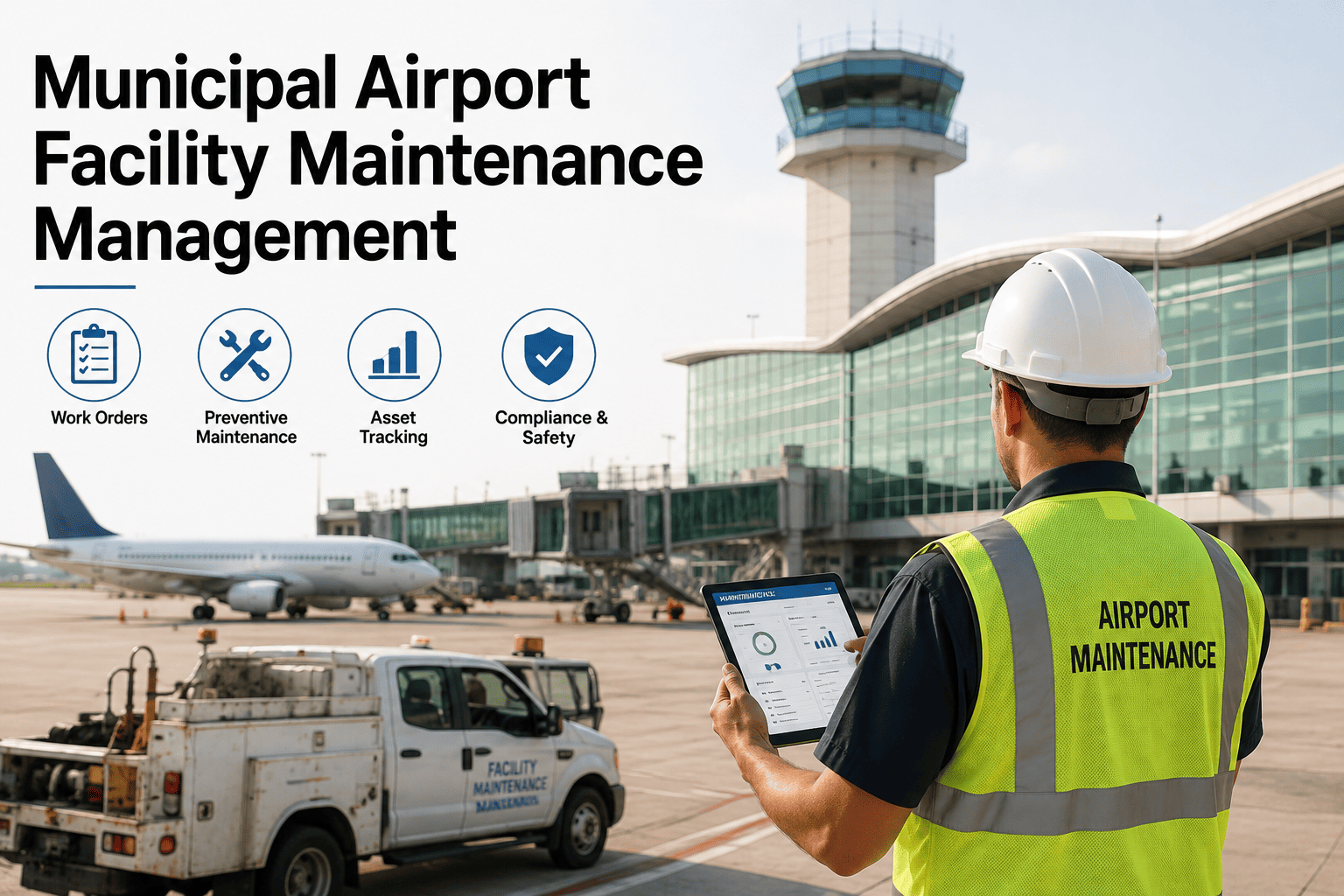
Municipal airport maintenance demands far more than routine custodial upkeep — it requires coordinated stewardship of airfield lighting, NAVAIDs, terminal systems, pavement, fuel farms and FAA-compliant records across every shift. Small public airports and general aviation facilities often carry the same compliance expectations as commercial hubs, yet operate with lean teams and limited budgets, making a structured municipal airport facility maintenance program essential for safety, audit readiness and operational continuity. By replacing spreadsheet tracking and reactive work orders with a centralized CMMS, maintenance managers can cut unplanned downtime 30–50%, extend asset life and pass FAA inspections without scrambling for documentation. Ready to modernize your airport maintenance program? Start Free Trial or keep reading to see how OxMaint transforms public airport facility management.
Municipal Airport Maintenance
Can your municipal airport pass an FAA inspection tomorrow — without a single spreadsheet?
Most small airports juggle airfield lighting, NAVAID coordination, terminal HVAC and pavement inspections across disconnected logs and clipboard checklists. OxMaint consolidates every asset, work order and compliance record into one AI-powered CMMS — so your team is audit-ready every day, not the night before.
FAA Compliance & Part 139
What FAA compliance means for municipal airport maintenance programs
A general aviation airport with 50–150 based aircraft typically manages 200–600 tracked assets — from runway edge lights and PAPI systems to terminal boilers, baggage-cart doors and fuel-farm pumps. Every one of those assets carries an inspection cadence, and a single missed self-inspection can trigger a FAA finding that jeopardies grant funding under the Airport Improvement Program (AIP).
Part 139 Self-Inspections
Commercial-service airports must complete daily, weekly and quarterly self-inspections covering movement areas, signage, markings and lighting. OxMaint digitizes the entire checklist, attaches photos to each finding and auto-generates the compliance trail inspectors expect.
Grant Assurance 31
Airport sponsors accepting AIP funds must operate and maintain the airport safely in accordance with FAA standards. A defensible CMMS record demonstrates that preventive maintenance was scheduled, assigned and completed on time.
AC 150/5380-7 Pavement
Pavement condition must be monitored under the Airport Pavement Management Program. OxMaint schedules PCI assessments, tracks crack-sealing and joint-repair work orders, and maintains a full repair history per runway, taxiway or apron section.
"A regional airport with 80 based aircraft was cited for 11 self-inspection gaps in a single FAA review — each traceable to a paper log that was never filed. Centralizing those records in a CMMS eliminated repeat findings within two inspection cycles."
Airfield Asset PM
Preventive maintenance checklist for airfield assets at general aviation airports
Airfield assets carry the highest risk and the strictest inspection intervals of any municipal airport facility. Below is a tiered PM framework covering the five asset classes that generate the most compliance findings at small public airports.
Airfield Lighting
- Inspect runway edge & threshold lights — monthly
- Test PAPI / REIL systems — monthly
- Check constant-current regulator output — quarterly
- Replace burned-out lamps before 10% failure rate
- Verify wind cone illumination — monthly
Pavement & Markings
- Daily FOD sweep of movement areas
- Inspect pavement markings for contrast — quarterly
- Crack-seal program before winter freeze cycle
- Hold-short sign placement verification — monthly
- Pavement Condition Index assessment — 3-yr cycle
Fuel Farm & Storage
- Daily sump check on avgas & Jet-A tanks
- Monthly fuel quality test (ASTM D1655)
- SPCC plan review & secondary containment check
- Fire-suppression system inspection — annual
- Leak-detection monitor calibration — quarterly
Terminal & Support
- HVAC filter replacement — quarterly
- Emergency lighting / exit sign test — monthly
- Back-up generator load test — monthly
- Fire extinguisher visual check — monthly
- ADA door operator inspection — semi-annual
| Asset Class | Critical Inspection Interval | Regulatory Driver | Common Finding |
|---|---|---|---|
| Runway edge lighting | Monthly | AC 150/5340-26 | Non-functioning fixtures past 10% threshold |
| PAPI / REIL | Monthly | AC 150/5345-28 | Misalignment or lamp burnout undetected |
| Movement-area pavement | Daily / 3-yr PCI | AC 150/5380-7 | Unaddressed cracking / spalling |
| Fuel farm sumps | Daily | EPA SPCC | Water contamination in sump logs |
| Emergency generator | Monthly load test | NFPA 110 | Missed load-test documentation |
NAVAID & Terminal Coordination
How to coordinate NAVAID maintenance with FAA tech ops and terminal systems
NAVAIDs — VOR, DME, AWOS, approach lighting — are usually maintained by FAA Air Traffic Organization technicians, but the airport sponsor is responsible for site access, power, grounding and obstruction-free zones. A CMMS closes the coordination loop so outages get reported, tracked and restored faster.
AWOS or NAVAID anomaly detected
OxMaint receives the alert — from a pilot report, an automated monitoring system or a daily self-inspection — and instantly creates a work order tagged to the affected asset, location and NOTAM reference.
Notify FAA Tech Ops & issue NOTAM
The work order routes to both the airport maintenance team and the FAA ATO regional office. OxMaint tracks the NOTAM number, outage start time and estimated restoration, so everyone operates from the same record.
Site access, power & grounding verified
Airport staff verifies access road condition, commercial power, backup generator status and equipment grounding — all documented as checklist items inside the same work order for a complete audit trail.
NOTAM cancellation & compliance record
When the NAVAID returns to service, OxMaint captures the restoration time, technician sign-off and any parts consumed — then closes the loop with a timestamped, immutable compliance record.
Cost & ROI
The real cost of reactive municipal airport maintenance — and the payback of a CMMS
A small public airport maintaining 300 assets on spreadsheets typically spends $35,000–$60,000 annually on unplanned repairs, expedited parts and overtime. The status quo feels cheap until you account for the compounding cost of emergency callouts and compliance findings.
Annual Reactive Cost at a Typical GA Airport
Unplanned Repairs + Expedited Parts + Overtime + Compliance Penalties = $48K / yr
Based on a 300-asset municipal airport with one runway, 12 based turbine aircraft, a 10K-gal fuel farm and 8,000-sq-ft terminal.
| Cost Category | Spreadsheet-Based (Annual) | OxMaint CMMS (Annual) | Savings |
|---|---|---|---|
| Unplanned repair labor & parts | $24,000 | $11,500 | $12,500 |
| Overtime for emergency callouts | $9,600 | $3,200 | $6,400 |
| Expedited parts shipping | $4,200 | $900 | $3,300 |
| Inspection reporting labor | $7,200 | $2,400 | $4,800 |
| Compliance finding remediation | $3,000 | $0 | $3,000 |
| Total Annual Cost | $48,000 | $18,000 | $30,000 |
How OxMaint Helps
How OxMaint powers municipal airport facility maintenance management
OxMaint was built for the complexity of airport operations — where a single missed PM can ground aircraft, trigger a FAA finding or jeopardize grant funding. Here is how four core capabilities map directly to the challenges municipal and general aviation airports face every day.
Digital Work Orders & PM Automation
Replace clipboard checklists and email chains with automated PM schedules triggered by date, flight-hours or condition. Every work order carries asset history, parts consumed, photo evidence and technician sign-off — eliminating paper work orders and cutting unplanned downtime 30–50%.
Predictive Maintenance with AI
OxMaint analyzes vibration, temperature and run-time data from runway lighting regulators, generators and HVAC units to predict failures before they happen — shifting your team from reactive firefighting to condition-based intervention that extends asset life 20–40%.
Compliance & Audit Readiness
Self-inspection checklists, Part 139 records, SPCC logs and pavement-condition reports live in one searchable system. Generate a complete compliance binder for any FAA review in minutes — not days — with timestamped, immutable records that stand up to scrutiny.
Spare-Parts Inventory Control
Track lamp assemblies, regulator parts, filters and fuel-system components with real-time stock levels, min-max alerts and automatic reorder triggers. No more expedited shipping fees or grounded operations because a critical part was out of stock.
"We went from three-ring binders and a wall of sticky notes to a full digital trail. Our last FAA self-inspection review took 90 minutes instead of two days — the inspector could see every PM, every work order, every sign-off in real time."
— Operations Manager, Midwest Regional Airport (72 based aircraft)
See OxMaint on Your Assets
Book a 30-minute demo tailored to your airport
Walk through a live environment with your own airfield assets, inspection checklists and compliance records. See how OxMaint cuts reporting time, eliminates paper work orders and keeps you audit-ready — every single day.
Frequently Asked Questions
Municipal airport maintenance management — answered
What is municipal airport facility maintenance management?
It is the coordinated process of inspecting, maintaining and documenting every asset at a public airport — airfield lighting, pavement, NAVAIDs, fuel farms, terminal systems and ground-support equipment — in compliance with FAA standards and grant assurances. Most airports use a CMMS like OxMaint to automate PM schedules, track work orders and maintain audit-ready compliance records. Start Free Trial to see it in action.
Does a small general aviation airport need a CMMS?
Yes. Even a GA airport with 50 based aircraft typically manages 200+ trackable assets with FAA-mandated inspection intervals. Spreadsheets and paper logs create gaps that lead to missed PMs, overtime callouts and compliance findings. A CMMS pays for itself by eliminating a single emergency lighting outage or FAA citation — often within the first quarter.
How does a CMMS help with Part 139 self-inspections?
A CMMS digitizes daily, weekly and quarterly self-inspection checklists so technicians complete them on mobile devices in the field, attach photos to findings and auto-generate the compliance trail. Inspectors can pull a complete, timestamped record of every inspection and corrective action in minutes — no binder hunting or log reconstruction required.
Can OxMaint coordinate NAVAID maintenance with FAA Tech Ops?
Yes. OxMaint creates a work order for any NAVAID or AWOS anomaly, tracks the NOTAM reference, notifies both airport staff and FAA ATO contacts, and captures the full outage timeline — detection, coordination, resolution and closure. This coordinated record reduces restoration time by up to 40% and ensures every event is documented for compliance. Book a Demo to see the workflow.
How long does it take to switch from spreadsheets to OxMaint?
Most municipal airports are fully operational on OxMaint within 2–4 weeks. The platform imports your existing asset list, PM schedules and inspection checklists, and the mobile app is intuitive enough for field technicians to adopt on day one. Onboarding includes data migration support and role-based training for maintenance staff, operations managers and airport directors.
Get Started Today
Modernize your municipal airport maintenance program
Join the public airports using OxMaint to cut unplanned downtime, pass FAA inspections with confidence and eliminate paper work orders for good. Your assets, your compliance records, your analytics — all in one AI-powered platform.
Free 14-day trial · No credit card