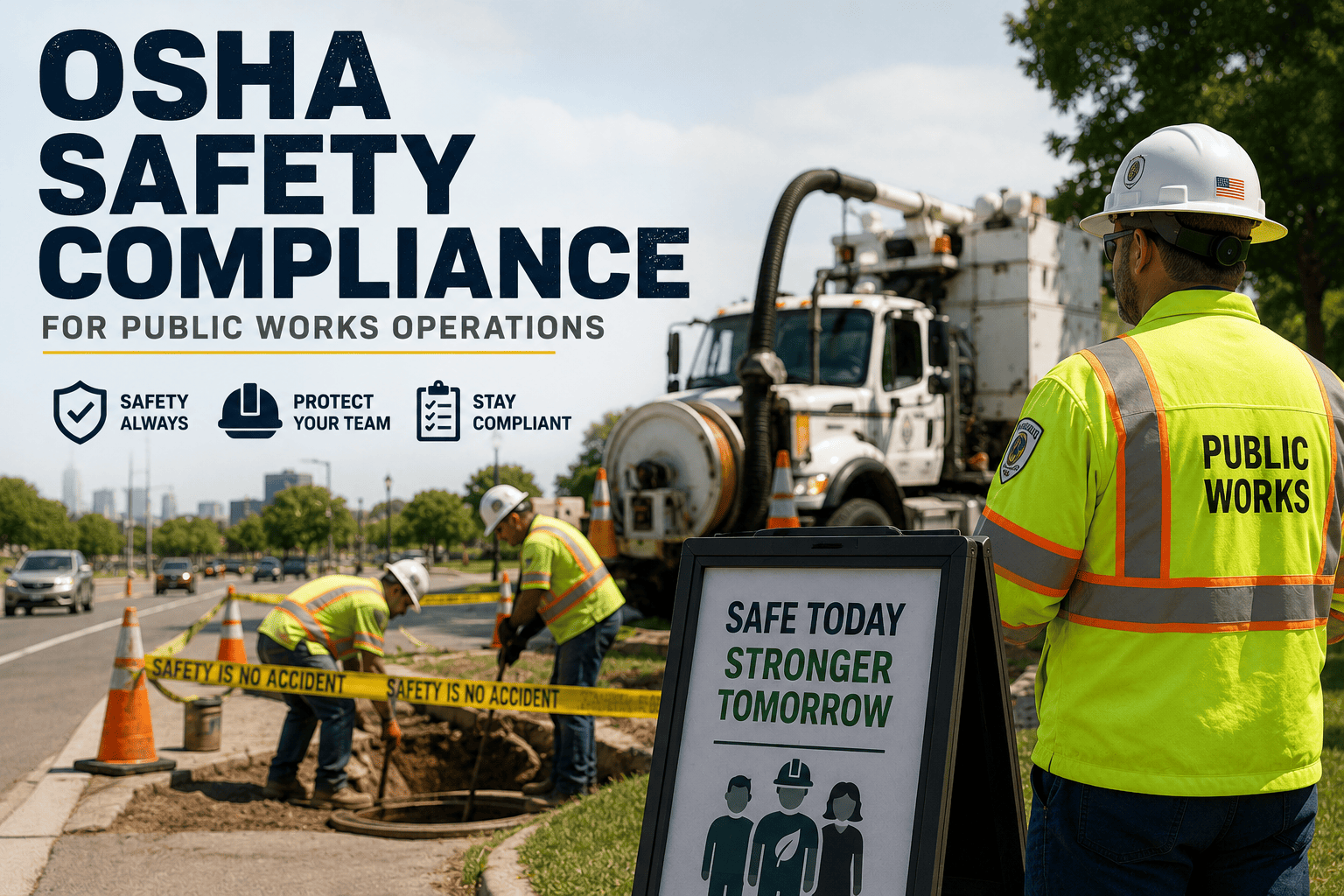
Government facility managers carry personal OSHA liability that private sector employers rarely face — willful violations result in penalties up to $156,259 per citation, criminal referrals to the Department of Justice for knowing endangerment, and reputational exposure that elected officials cannot ignore. Public works departments, parks operations, custodial services, and maintenance crews perform work covered by at least eight separate OSHA standards simultaneously, yet most government facilities manage compliance through paper-based inspection logs, verbal safety briefings with no dated records, and LOTO programs that exist in policy manuals but are never enforced at the work order level. Schedule a demo to see how Oxmaint automates OSHA compliance templates, LOTO tracking, and safety inspection documentation for government facilities.
Government facility OSHA compliance requires active, documented programs — not passive policy manuals — across eight standards that apply to public sector maintenance operations: lockout/tagout (1910.147), confined space entry (1910.146), fall protection (1926.502), electrical safety (1910.303–1910.399), hazard communication (1910.1200), respiratory protection (1910.134), asbestos (1910.1001/1926.1101), and lead (1910.1025/1926.62). Oxmaint enforces compliance requirements at the work order level — LOTO procedures trigger before technicians accept equipment maintenance tasks, confined space permits attach to lift station and vault inspection work orders, and every safety step creates a timestamped, GPS-confirmed record that withstands OSHA inspection.
OSHA Standards Applicable to Government Facility Maintenance Operations
Most government maintenance operations involve work covered by multiple concurrent OSHA standards. A single HVAC repair in a mechanical room with ACM insulation and electrical equipment triggers four separate standards simultaneously. The table below maps the standards to the work types — and the documentation each requires. See HVAC-specific OSHA compliance requirements for government buildings.
| OSHA Standard | Applicable Work Types | Required Documentation | Penalty Exposure Without Records |
|---|---|---|---|
| 29 CFR 1910.147 — Lockout/Tagout | Any maintenance, service, or repair on equipment with stored energy — HVAC, pumps, electrical, generators, elevators | Written energy control procedures per equipment, authorized employee training records, annual program audit documentation | $15,625–$156,259 per instance — most commonly cited government facility violation |
| 29 CFR 1910.146 — Confined Space | Lift station, wet well, vault, tank, digester, crawl space, and underground utility structure entry | Permit-required confined space program, entry permit per event, attendant and entrant records, atmospheric testing logs | $15,625/violation — fatalities trigger criminal referral and 3x penalty multiplier |
| 29 CFR 1926.502 — Fall Protection | Rooftop HVAC, fall protection, and other work at heights exceeding 6 feet in construction-classified operations | Fall protection plan, equipment inspection records, training documentation per employee, rescue plan on file | $15,625 per serious violation — personal injury claims against municipality if fall occurs without documentation |
| 29 CFR 1910.303–399 — Electrical Safety | Electrical panel maintenance, switchgear inspection, MCC work, generator ATS transfer, VFD maintenance | Qualified electrical worker designation records, PPE selection documentation, arc flash hazard analysis, energized work permits | Willful violation if unqualified worker performs electrical maintenance — $156,259 per instance |
| 29 CFR 1910.1200 — HazCom | Chemical storage, HVAC refrigerant handling, boiler chemical treatment, cleaning chemicals, pool treatment, welding | Chemical inventory, current SDS on file per chemical, training records per employee, labeling compliance documentation | $15,625 per serious violation — multiple chemicals in inventory means multiple violations for a single inspection |
| 29 CFR 1910.134 — Respiratory Protection | Asbestos O&M work, lead abatement, confined space entry, chemical handling, welding, painting operations | Written respiratory protection program, medical evaluations, fit test records per employee, equipment inspection logs | $15,625 per serious violation — required even when respirator use is voluntary in certain chemical environments |
The Six Compliance Gaps That Trigger the Most Government Facility OSHA Citations
OSHA enforcement data for government and public administration facilities consistently identifies the same six documentation failures. Each is preventable with work order-level enforcement — not policy documents. See asbestos and lead paint OSHA compliance requirements for public buildings.
OSHA 1910.147 requires a written energy control procedure specific to each piece of equipment — a generic "lockout policy" does not satisfy the standard. Government facilities with hundreds of pieces of equipment have procedures for almost none of them.
Entry permits must be completed and signed before workers enter a permit-required confined space — not after. Lift station inspections, wet well entries, and vault access regularly occur without a completed permit in government operations.
OSHA inspectors require proof that safety communication occurred before work began — not a supervisor's recollection. Verbal-only toolbox talks and informal briefings produce no compliant record and provide zero protection in enforcement proceedings.
1910.147 requires an annual audit of the energy control program — including inspection of each procedure with the affected authorized employee. Most government facilities conduct no audit at all, or conduct one informally with no written record.
OSHA training requirements are ongoing — not one-time at hire. Confined space, LOTO, fall protection, and respiratory protection training must be refreshed when procedures change, new hazards are introduced, or when an employee demonstrates inadequate knowledge.
Government facilities using outside contractors remain responsible for OSHA compliance in their facilities. A contractor's LOTO, confined space, or respiratory protection program must meet OSHA standards — and the facility manager must document that verification occurred before work began.
Enforce OSHA Safety Requirements at the Work Order Level — Not the Policy Level
Oxmaint embeds OSHA compliance requirements into maintenance work orders — LOTO procedures trigger before equipment work is accepted, confined space permits attach automatically to relevant work orders, and every safety step creates a timestamped compliance record.
Oxmaint Platform Features for Government OSHA Compliance
Written energy control procedures stored per equipment asset — linked to the asset record so the correct procedure auto-attaches to any maintenance work order on that equipment. Annual program audit work orders generated automatically with the procedure review checklist required by 1910.147. Authorized employee training records tracked with expiration alerts. See LOTO requirements for standby generator and ATS maintenance.
Confined space locations registered in the asset registry with hazard classification and entry requirements. Work orders for registered confined spaces automatically generate the entry permit checklist — atmospheric testing, attendant assignment, rescue plan confirmation — that must be completed before the technician can accept the job. GPS check-in at mobile work order acceptance confirms on-site presence. Every entry creates a permanent OSHA 1910.146-compliant permit record.
Pre-built inspection templates calibrated to OSHA inspection intervals — annual fall protection equipment checks, annual LOTO program audits, monthly eyewash station tests, quarterly fire extinguisher inspections. Work orders generated automatically with escalating alerts at 30, 7, and 1 day before deadline. Every completed inspection creates a timestamped, technician-attributed record that satisfies the documentation requirement for that standard. See fire safety and life safety inspection scheduling requirements.
Training completion dates, trainer credentials, and curriculum version tracked per employee per OSHA standard. Expiration alerts trigger retraining work orders before records lapse — eliminating the discovery during an OSHA inspection that training certificates expired months earlier. Contractor certification verification records stored with the work order for every outside vendor performing work in the facility.
Chemical inventory maintained in Oxmaint with SDS linked per chemical — accessible from mobile devices in the field without paper binder lookback. Work orders for chemical handling tasks auto-attach the relevant SDS and PPE requirements. HazCom training completion tracked per employee with product-specific acknowledgment records. See asbestos and lead paint HazCom requirements for government facility maintenance operations.
Complete compliance documentation for any OSHA standard exported on demand — work order records with technician attribution, GPS confirmation, photo documentation, and timestamps. OSHA 300 Log data tracked automatically from injury-involved work orders. 30-year record retention for exposure monitoring and medical records as required by 1910.1001(m) — records accessible after staff turnover, system migrations, and agency restructuring events.
Before and After: Government Facility OSHA Compliance
Frequently Asked Questions
Continue Reading
Replace Paper-Based OSHA Compliance With Work Order-Level Enforcement
Oxmaint enforces LOTO procedures, confined space permits, fall protection documentation, and safety training records at the point of work — not in a policy binder. Every maintenance event creates a timestamped OSHA compliance record. Live in 14 days, no consultant fees.