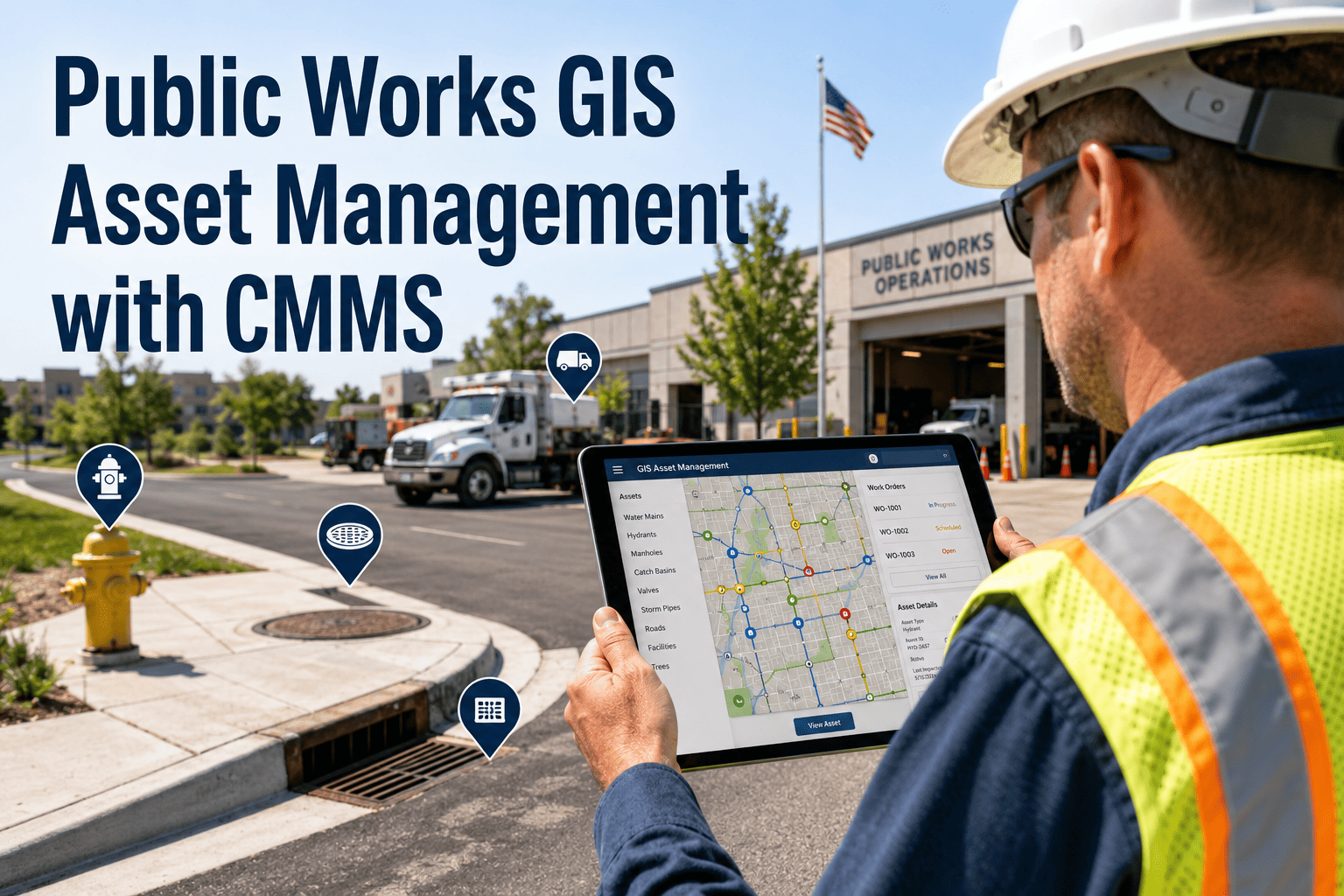
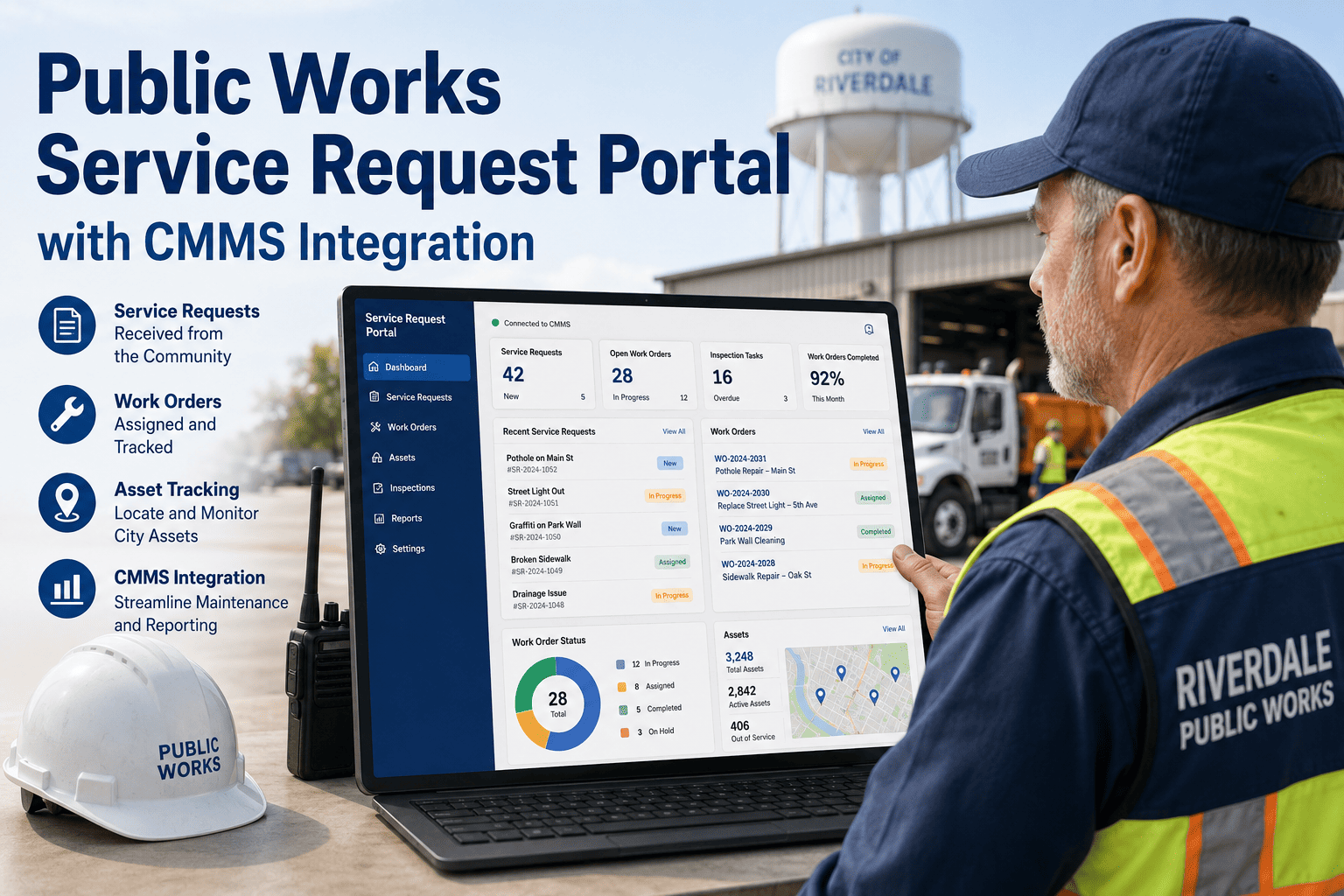
Public works departments managing road networks, water distribution mains, lift stations, and park assets across hundreds of square miles cannot operate effectively from a list-based asset registry alone. Without GIS integration, field crews dispatch blind — no spatial context, no adjacent asset visibility, no route optimization — while directors make capital decisions from spreadsheet data that has no geographic dimension. Oxmaint's GIS integration layers the full asset registry onto an interactive map, making every work order, inspection, and condition score location-aware. Book a demo to see Oxmaint's GIS integration configured for your agency's asset network.
GIS integration with a government CMMS links every asset — road segment, pump station, building, hydrant, or park amenity — to its precise geographic coordinates, enabling map-based asset search, location-aware work order dispatch, spatially clustered field routing, and condition heat maps for capital planning. The result is a maintenance operation where every decision carries geographic intelligence — from crew dispatch to CIP prioritization.
What Oxmaint's GIS Integration Delivers
Every registered asset rendered as a map layer — color-coded by condition score, PM compliance status, or open work order count. Directors click any asset on the map to view full maintenance history, next scheduled PM, and FCI score without leaving the map interface.
Work orders dispatched to the nearest available qualified technician based on real-time GPS position. Multi-stop route optimization groups adjacent work orders into a single crew run — reducing average field drive time by 31% and fuel cost per work order by 24%.
FCI scores and deferred maintenance values rendered geographically — surfacing asset clusters in poor condition that share a geographic corridor. Capital improvement plan submissions built on spatial condition evidence carry an 88% council approval rate versus 47% for estimate-only requests.
Assets registered with GPS coordinates from mobile field capture or imported from existing GIS data sources — Esri ArcGIS, QGIS, and OpenStreetMap-compatible. All subsequent PM records, inspection results, and cost data inherit the asset's spatial identity automatically.
Map Your Entire Asset Network — Linked to Live Maintenance Data
Oxmaint integrates with Esri ArcGIS, QGIS, and existing municipal GIS layers — no duplicate data entry, no separate GIS maintenance required.
Key Use Cases by Government Asset Type
Pavement condition index scores mapped by road segment. FHWA bridge inspection status visible spatially. CIP road rehabilitation prioritized by geographic corridor condition clustering — not just individual asset FCI.
Water mains, valves, hydrants, and lift stations mapped with age, material, and break history overlaid. High-risk pipe segments identified spatially for proactive replacement — reducing unplanned main break costs of $180K+ per event.
Municipal buildings mapped with current FCI score, open work order count, and next major PM date. Capital planners see at a glance which facilities in a geographic district are approaching replacement threshold simultaneously.
Park amenities, playground equipment, irrigation systems, and trail segments mapped across a distributed network. Field crews routed geographically across multiple park sites in a single shift — eliminating cross-district travel inefficiency.
How GIS Integration Works in Oxmaint
Import existing Esri ArcGIS feature layers, QGIS shapefiles, or GeoJSON exports directly into Oxmaint. Existing asset GIS records map to the Oxmaint asset registry automatically — no re-entry of location data already captured in your GIS platform. Book a demo to scope your GIS data import.
For assets not yet in GIS, field crews register location on the mobile app with a single GPS pin drop. Photo, condition score, and asset details captured in the field — synced to both the Oxmaint registry and the connected GIS layer in real time.
Supervisors create, assign, and monitor work orders directly from the asset map. Adjacent open work orders cluster visually — enabling multi-stop dispatch runs that reduce field travel time by 31%. All work order closures update asset condition on the map layer automatically. Book a demo to see map-based dispatch in action.
Condition scores, maintenance cost history, and deferred backlog values export back to ArcGIS as updated feature attributes — keeping the agency's master GIS current without manual data synchronization. Capital planners pull corridor-level condition reports directly from the live map for CIP submissions.
Outcomes — Oxmaint GIS-Integrated Agencies
Frequently Asked Questions
Continue Reading
Put Your Asset Network on a Map — With Live Maintenance Data Behind Every Pin
Oxmaint's GIS integration connects your existing ArcGIS layers to a full CMMS — location-aware dispatch, condition heat maps, and spatially evidenced CIP reports. Live in 2–3 weeks.