Government buildings — courthouses, municipal offices, libraries, community centres, correctional facilities, and public works depots — carry a fire safety compliance burden that is more complex than most private sector facilities. They must satisfy federal life safety standards (NFPA 101), local fire codes enforced by the authority having jurisdiction (AHJ), and in many cases specific state agency requirements that layer additional inspection frequencies on top of the base code. Yet most public sector facilities teams are managing fire safety inspections with paper logs, disconnected spreadsheets, and manual reminder systems that produce documentation gaps exactly when surveyors and AHJ inspectors arrive. OxMaint's compliance tracking platform gives government facilities teams a structured, digital-first fire safety inspection programme — complete asset coverage, automated scheduling, corrective work order enforcement, and on-demand compliance reports ready for any regulatory review. Start a free OxMaint trial or book a demo to see the government compliance dashboard.
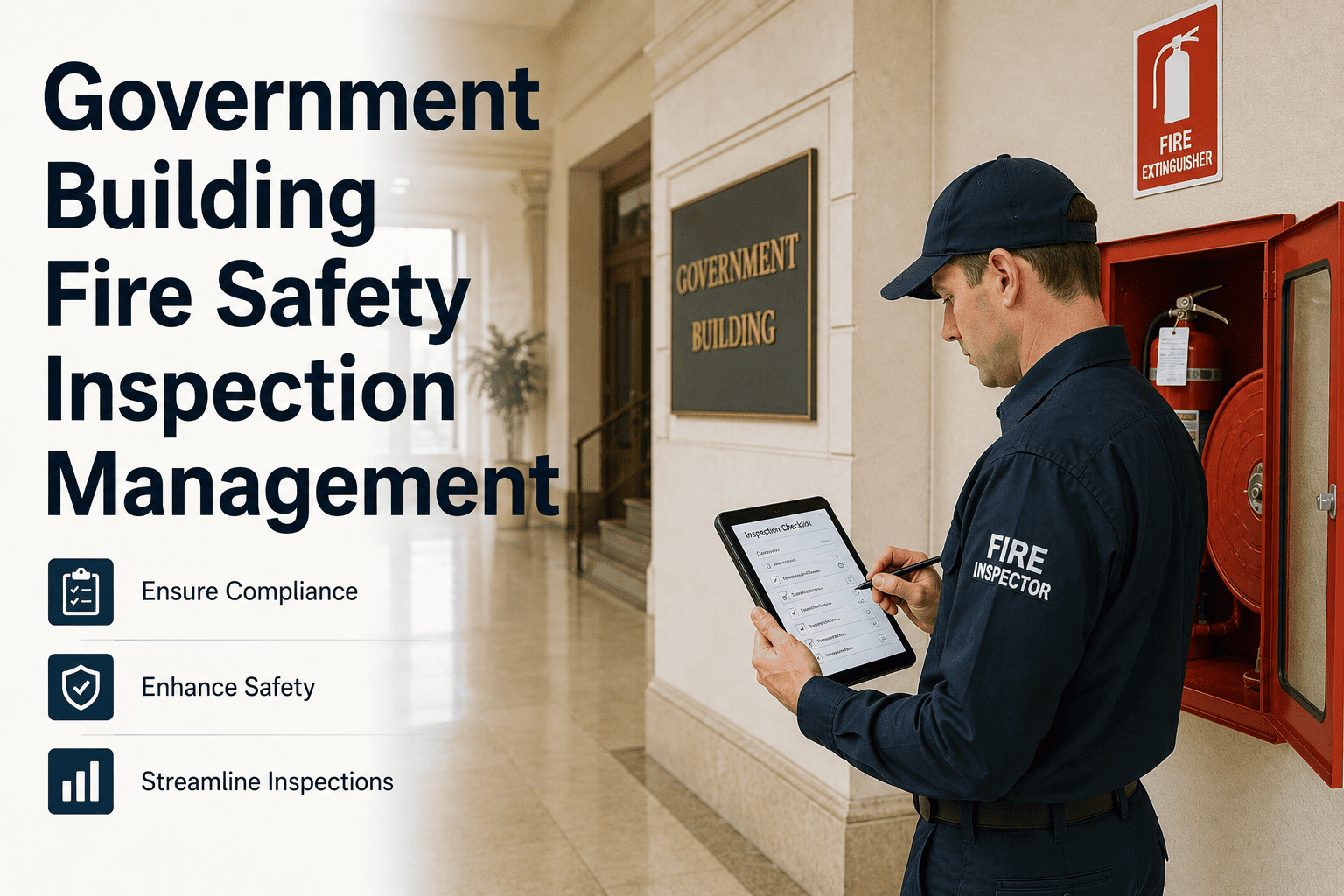
Government Building Fire Safety Inspection Management
A complete inspection framework covering fire suppression, detection, emergency egress, extinguishers, and documentation requirements — built for public sector facilities teams managing multi-building government campuses under NFPA 101 and local fire codes.
Why Government Buildings Face Unique Fire Safety Risk
Public buildings carry a responsibility that no private facility does — they are constitutionally accessible to all members of the public, including individuals with mobility limitations, cognitive impairments, and no prior familiarity with the building layout. A fire safety failure in a courthouse or community centre is not a private operational risk; it is a public safety event with legal, political, and regulatory consequences that extend well beyond the building itself.
Inspection Frequency Matrix — Government Buildings
Fire safety systems in government buildings require inspection at frequencies ranging from weekly to every five years — and failing to distinguish between these intervals is itself a compliance finding. The matrix below maps each system type to its NFPA standard, required inspection frequency, and responsible inspector classification. AHJ requirements may impose more frequent inspection than the NFPA baseline — always verify with your local fire authority.
| System / Component | NFPA Standard | Inspection Frequency | Test Frequency | Responsible Inspector | OxMaint Trigger |
|---|---|---|---|---|---|
| Fire alarm control panel | NFPA 72 | Weekly (visual) | Annual (full test) | Trained staff or contractor | Auto-scheduled |
| Smoke detectors | NFPA 72 | Annual (inspection) | Annual (sensitivity test) | Licensed fire alarm contractor | Auto-scheduled |
| Heat detectors | NFPA 72 | Annual | Every 5 years (replacement or test) | Licensed fire alarm contractor | Auto-scheduled |
| Sprinkler system (wet pipe) | NFPA 25 | Quarterly (visual) | Annual (flow test) · 5-yr (full) | Certified sprinkler contractor | Auto-scheduled |
| Fire pump | NFPA 25 | Weekly (no-flow test) | Annual (flow test) | Certified contractor | Auto-scheduled |
| Fire extinguishers | NFPA 10 | Monthly (visual) | Annual (service) · 6-yr (internal) | Certified extinguisher service tech | Auto-scheduled |
| Exit signs and emergency lighting | NFPA 101 | Monthly (30-sec test) | Annual (90-min battery test) | Trained facility staff | Auto-scheduled |
| Fire doors (assembly) | NFPA 80 | Annual | Annual (close and latch test) | Qualified inspector | Auto-scheduled |
| Standpipe system | NFPA 25 | Annual (inspection) | Every 5 years (flow test) | Certified contractor | Auto-scheduled |
| Kitchen hood suppression (if applicable) | NFPA 17A / 96 | Semi-annual | Semi-annual | Certified hood service contractor | Auto-scheduled |
OxMaint auto-schedules every system inspection in this matrix at the correct frequency, routes work orders to the designated inspector or contractor, and tracks completion status on a real-time compliance dashboard — eliminating missed inspections before they become AHJ findings.
Checklist A — Fire Suppression System (NFPA 25)
Complete this checklist for every sprinkler zone and suppression system component in the building. Any failed item must generate a corrective work order on the same day. If the deficiency compromises active fire protection, initiate an Interim Life Safety Measure immediately and document it in OxMaint before leaving the area.
| Ref | NFPA 25 Section | Inspection Item | Pass | Fail | N/A |
|---|---|---|---|---|---|
| A-01 | 5.2.1.1 | Control valve in fully open position — no partial closure or tamper indicator triggered | P | F | - |
| A-02 | 5.2.1.2 | System pressure gauge within normal operating range — no deviation from design pressure | P | F | - |
| A-03 | 5.2.1.3 | Alarm valve, check valve, and trim visible and undamaged | P | F | - |
| A-04 | 5.2.2.1 | Sprinkler heads — no corrosion, paint, physical damage, or loading on deflectors | P | F | - |
| A-05 | 5.2.2.2 | Sprinkler head clearance: minimum 18 inches below deflector to storage, obstructions, or ceiling materials | P | F | - |
| A-06 | 5.2.3.1 | Pipe hangers secure — no sagging sections, missing hangers, or pipe resting on non-approved supports | P | F | - |
| A-07 | 5.2.4.1 | Supervisory devices (tamper switches, water flow alarms) functional — no bypassed or disconnected devices | P | F | - |
| A-08 | 5.2.5.1 | Spare sprinkler heads cabinet: correct type, minimum 6 heads, wrench present and accessible | P | F | - |
| A-09 | 13.2.1 | System drain test completed — waterflow alarm activated within 90 seconds of main drain opening | P | F | - |
Checklist B — Fire Alarm and Detection System (NFPA 72)
Fire alarm system inspections in government buildings must be documented per device — not as a single system pass/fail. NFPA 72 Chapter 14 requires individual device records that are retrievable for AHJ review. OxMaint stores inspection results per device ID within the asset record, satisfying this requirement automatically.
| Ref | NFPA 72 Section | Inspection Item | Pass | Fail | N/A |
|---|---|---|---|---|---|
| B-01 | 14.2.4 | Fire alarm control panel: normal condition displayed — no active alarms, troubles, or disabled zones | P | F | - |
| B-02 | 14.2.4 | All indicating lights and displays functional — no burned-out indicators | P | F | - |
| B-03 | 14.2.5 | Primary power supply (AC) present and within normal voltage range | P | F | - |
| B-04 | 14.2.5 | Standby battery: charge level satisfactory, no battery low or trouble condition | P | F | - |
| B-05 | 14.3.1.1 | Smoke detectors (sample): visual inspection for contamination, damage, or obstructions within 18 inches | P | F | - |
| B-06 | 14.4.2.1 | Manual pull stations: unobstructed access, no damage, not bypassed or locked out | P | F | - |
| B-07 | 14.4.3.1 | Notification appliances (horns, strobes): no damage, mounting secure, no painted-over strobes | P | F | - |
| B-08 | 14.4.4.1 | Duct smoke detectors: access panels intact, no bypass jumpers, indicator lights visible | P | F | N/A |
| B-09 | 14.4.5 | Annunciator panel (remote): normal condition, location labels legible, no disabled zones shown | P | F | N/A |
| B-10 | 14.6.1 | Annual test: smoke detector sensitivity within listed range — no devices out of tolerance | P | F | - |
Checklist C — Means of Egress and Emergency Lighting (NFPA 101)
Egress compliance is the most frequently cited fire safety deficiency in government buildings during AHJ inspections — primarily because egress conditions change dynamically as buildings are modified, furniture is rearranged, and storage accumulates in corridors. Monthly checks are required and must document the actual condition, not simply confirm that the inspection was performed.
| Ref | NFPA 101 Section | Inspection Item | Pass | Fail | N/A |
|---|---|---|---|---|---|
| C-01 | 7.1.10.1 | All egress corridors clear — minimum 44-inch width maintained, no storage, equipment, or furniture in path | P | F | - |
| C-02 | 7.2.1.4 | Exit doors operable from egress side without key, special knowledge, or effort — no padlocks, deadbolts requiring keys | P | F | - |
| C-03 | 7.2.1.4 | Panic hardware (where required) functions — latches release with single push, no binding | P | F | N/A |
| C-04 | 7.2.2.1 | Stairwell doors self-close and latch — no wedges, props, or door holders preventing closure | P | F | N/A |
| C-05 | 7.8.1.3 | Emergency lighting units functional — 30-second test confirms illumination of egress path | P | F | - |
| C-06 | 7.10.1.1 | All exit signs illuminated — no burned-out lamps or missing signs at any exit or change of direction | P | F | - |
| C-07 | 7.10.8.1 | Exit sign directional arrows legible and correctly oriented — no signs removed, painted over, or obscured | P | F | - |
| C-08 | 7.1.8.1 | No new obstructions created since last inspection — construction materials, IT equipment, seasonal displays | P | F | - |
| C-09 | Annual | 90-minute battery test: emergency lighting maintains required 1 footcandle at floor level for full test duration | P | F | - |
Checklist D — Portable Fire Extinguishers (NFPA 10)
Fire extinguisher compliance is the most straightforward element of fire safety — and the most commonly failed in government buildings during AHJ spot inspections. The monthly visual check is a 60-second walk-by inspection; the failure mode is almost always administrative — the check was not performed, not recorded, or not recorded per unit.
| Ref | NFPA 10 Section | Inspection Item | Pass | Fail | N/A |
|---|---|---|---|---|---|
| D-01 | 7.2.2.a | Extinguisher in designated location — mounted in bracket, cabinet unlocked, not moved from listed position | P | F | - |
| D-02 | 7.2.2.b | Pressure gauge in operable range — needle in green zone, no indicator in red range | P | F | - |
| D-03 | 7.2.2.c | Safety pin and tamper seal intact — seal unbroken, pin fully seated in handle | P | F | - |
| D-04 | 7.2.2.d | No visible damage — no corrosion, dents, leakage, or clogged discharge nozzle | P | F | - |
| D-05 | 7.2.2.e | Operating instructions legible — label facing outward, not painted over, no text obscured | P | F | - |
| D-06 | 7.2.2.f | Current annual service tag present — within 12-month service window, tag securely attached | P | F | - |
| D-07 | 7.2.2.g | Accessibility: unobstructed path to extinguisher, mounting height compliant (top not to exceed 5 ft for units over 40 lb, 3.5 ft otherwise) | P | F | - |
| D-08 | 7.2.2.h | Inspection record: date and initials recorded on extinguisher tag for this month's inspection | P | F | - |
Deficiency Response Guide — Government Buildings
Government facilities have an additional layer of accountability that private buildings do not — AHJ inspectors can issue orders to the jurisdiction itself, and unresolved fire safety deficiencies in public buildings carry both legal liability and political exposure. The response framework below establishes tiered response times and escalation requirements for each deficiency severity level.
| Severity Level | Deficiency Examples | Max Response Time | Required Interim Measure | Escalation Required |
|---|---|---|---|---|
| Critical | Sprinkler control valve closed, fire alarm panel in trouble with unknown cause, egress door locked from inside | Immediate — within 2 hours | Fire watch posted; area closed to public if unsafe | Facility director + AHJ notification required |
| High | Obstructed egress corridor, non-functional emergency lighting, missing or discharged extinguisher | Same day correction | Staff notification; temporary ILSM if correction delayed | Supervisor notification; track in OxMaint |
| Moderate | Detector out of sensitivity range, spare sprinkler head cabinet incomplete, exit sign lamp out | Within 30 days | Document in CMMS; schedule corrective WO | Compliance dashboard alert to facilities manager |
| Low | Minor signage issue, extinguisher tag date approaching, inspection record gap (non-critical system) | Within 60 days or next scheduled PM cycle | Log in CMMS; assign to next inspection round | Tracked on compliance dashboard; no immediate escalation |
How OxMaint Manages the Entire Compliance Workflow
The inspection checklists above are the starting point — the compliance risk in government buildings comes from what happens after an inspection result is recorded. OxMaint enforces the complete workflow: scheduled inspection, digital result capture, automatic corrective work order generation, ILSM documentation, and on-demand reporting for AHJ review.
Expert Review
The compliance gap I see most consistently in government building fire safety programmes is not the inspection itself — it is the documentation trail between the inspection finding and the corrective work order resolution. An inspector finds a smoke detector out of sensitivity range, writes it on a clipboard, hands it to the supervisor, and the paper moves into an inbox where it competes with 40 other items. Six months later the AHJ asks for documentation that the finding was resolved, and the jurisdiction cannot produce it. That is not a fire safety failure — it is a documentation system failure that creates the appearance of a fire safety failure. OxMaint solves this by making the corrective work order automatic and inseparable from the finding, which means the chain of evidence is complete by default rather than dependent on someone remembering to create it.
Fire safety compliance in government buildings is fundamentally a public trust issue, not just a regulatory one. When a member of the public enters a government building, they are implicitly trusting that the jurisdiction has maintained that building to a safe standard — and the jurisdiction has an obligation to be able to demonstrate that it has done so, not just assert it. The shift from paper-based inspection records to a CMMS-managed compliance programme is the shift from assertion to evidence. I have been through AHJ inspections with paper records and with OxMaint, and the experience is categorically different: with OxMaint, the inspector asks a question and I show them the record in 20 seconds. With paper, the same question triggered a 45-minute search of binders that sometimes produced incomplete results. The difference in inspector confidence — and in the jurisdiction's legal exposure — is substantial.
Frequently Asked Questions
Give Your Government Facility the Compliance Infrastructure It Needs — and the Records to Prove It
OxMaint auto-schedules every fire safety inspection at the correct NFPA frequency, enforces corrective work orders for every deficiency, tracks ILSM documentation for unresolved findings, and produces AHJ-ready compliance reports in under 3 minutes. Public sector facilities teams are deploying OxMaint in 60–90 days — without a multi-year IT project.