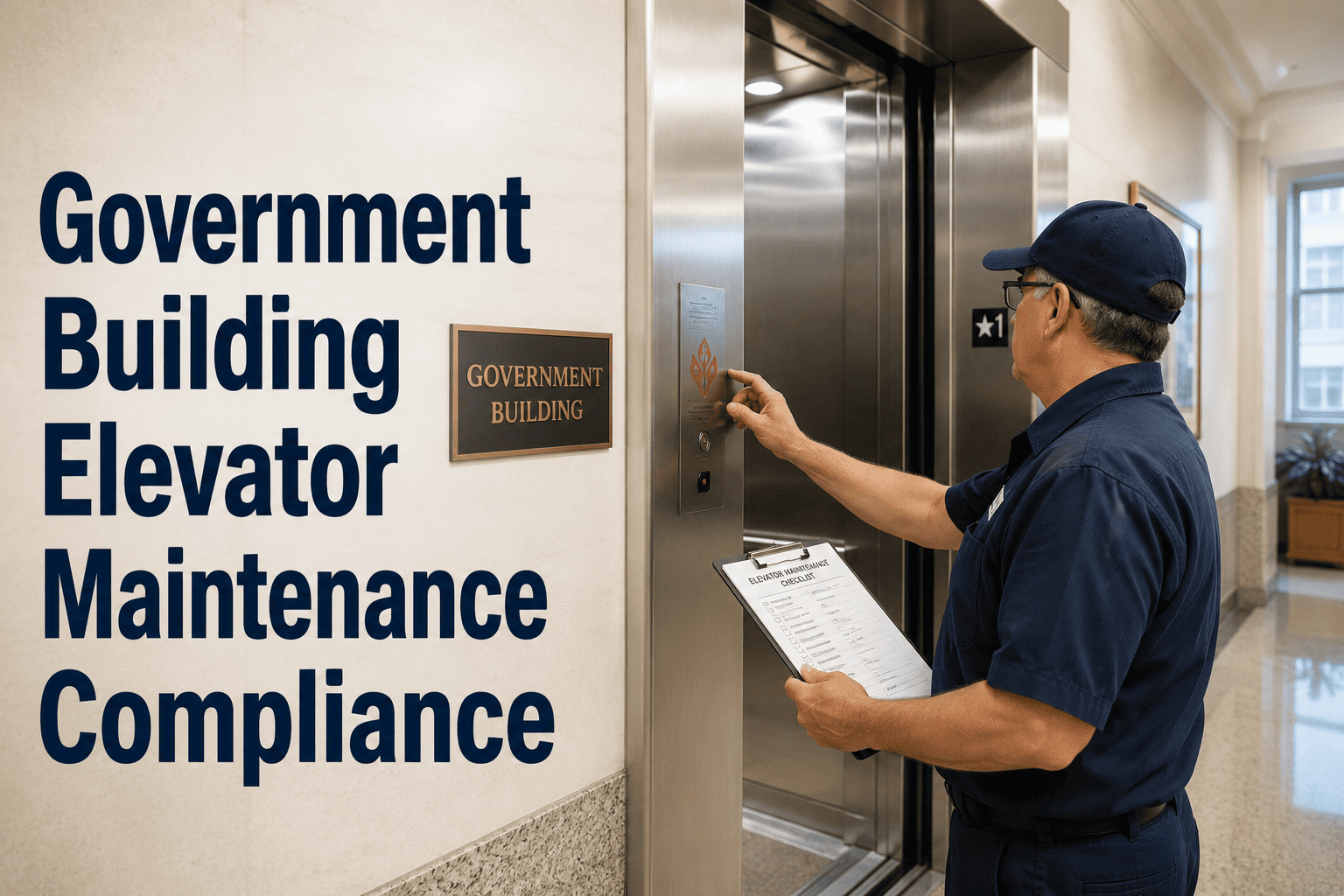
Government Building Elevator Maintenance Compliance

By James Smith on May 27, 2026

government-building-elevator-maintenance-compliance

US elevators make 18 billion passenger trips every year. Every one of those trips in a government building depends on a documented maintenance programme that satisfies ASME A17.1-2025, the current Safety Code for Elevators and Escalators — now including cybersecurity requirements alongside its longstanding mechanical, electrical, and structural mandates. Every government building elevator is legally required to have a documented Maintenance Control Programme (MCP) under ASME A17.1 Section 8.6. Missing or incomplete MCP documentation is one of the most frequently cited inspection violations. A missing annual periodic inspection triggers a mandatory stop-operation order — government buildings are not exempt. Emergency repair costs run 4.8× higher than planned maintenance costs. In a public facility where an out-of-service elevator triggers ADA Title II accessibility obligations, an unplanned shutdown is not just a maintenance failure — it is a legal exposure. Book a demo to see OxMaint's elevator compliance tracking for government buildings — or start free and register your first elevator today.

Checklist · Government Buildings · Elevator Compliance · ASME A17.1-2025

Government Building Elevator Maintenance Compliance Checklist

Monthly PM, annual periodic inspection, 5-year load test, emergency phone test, MCP documentation, and ADA accessibility requirements — the complete compliance checklist for government building elevators under ASME A17.1-2025.

Elevator Compliance Calendar
Monthly
PM service visit + emergency phone test
ASME A17.1 §8.6 + ADA
Quarterly
Safety device functional test (if applicable)
ASME A17.1 §8.6
Annual
Periodic inspection by state-licensed QEI inspector
ASME A17.1 §8.10
Annual
Safety test — safeties, buffers, governor overspeed
ASME A17.1 §8.11
5-Year
Full load test (rated load, full speed, both directions)
ASME A17.1 §8.11
5-Year
Hydraulic elevator pressure vessel inspection (if applicable)
ASME A17.1 §8.11.4

Monthly PM Checklist — Machine Room and Equipment

Monthly PM visits by a licensed elevator mechanic are the foundation of ASME A17.1 compliance. All items below must be inspected, results recorded, and the work order signed by the licensed mechanic before the visit is considered complete.

Machine Room Inspection

Machine room temperature within permitted range — verify HVAC functioning, no moisture or water ingress visible Record: Machine room log entry · Standard: ASME A17.1 §2.7 · Responsible: Licensed elevator mechanic

Motor and drive unit — check for unusual noise, overheating, loose connections, and oil leaks Record: PM visit report · Standard: ASME A17.1 §2.24 · Responsible: Licensed elevator mechanic

Controller and selector — inspect contactors, relays, and printed circuit boards; no burn marks, corrosion, or loose wiring Record: PM visit report · Standard: ASME A17.1 §2.26 · Responsible: Licensed elevator mechanic

Brake — test for proper operation and adjustment; verify brake lining condition and clearance Record: PM visit report with brake measurement · Standard: ASME A17.1 §2.24.3 · Responsible: Licensed elevator mechanic

Governor — inspect rope, sheave, and overspeed device; verify seal condition and date of last test Record: PM visit report · Standard: ASME A17.1 §2.18 · Responsible: Licensed elevator mechanic
Hoistway Inspection

Hoist ropes — inspect for wear, broken wires, corrosion, and lubrication; measure diameter to confirm no reduction beyond 10% of nominal Record: Rope inspection log with measurements · Standard: ASME A17.1 §2.20 · Responsible: Licensed elevator mechanic

Guide rails and fasteners — inspect for alignment, rust, damage, and secure attachment; verify clearances in car guide shoes Record: PM visit report · Standard: ASME A17.1 §2.23 · Responsible: Licensed elevator mechanic

Door interlocks — test all landing door interlocks; verify car cannot move with any landing door open or unlocked Record: Interlock test results per floor · Standard: ASME A17.1 §2.12 · Responsible: Licensed elevator mechanic
Car Interior Inspection

Car operating panel — all buttons functional, floor indicators operational, emergency lighting illuminates on power loss Record: PM visit report · Standard: ASME A17.1 §2.27 · Responsible: Licensed elevator mechanic

Emergency phone test — call placed, connection established with monitoring centre, duration logged; ADA-compliant operation verified Record: Emergency phone test log with timestamp, duration, and call-completion confirmation · Standard: ASME A17.1 §2.27.1.6, ADA §407.4.9

Capacity and certificate placard posted and current — required load capacity, number of passengers, and current inspection certificate visible Record: Visual verification · Standard: ASME A17.1 §2.16 · Required: Inspection certificate must be within current validity period
Pit Inspection

Pit — no water accumulation, no debris, pit lighting functional, pit stop switch accessible and functional Record: PM visit report · Standard: ASME A17.1 §2.2 · Responsible: Licensed elevator mechanic

Buffers — inspect oil level (oil buffers) or condition (spring buffers); verify no deformation or damage Record: Buffer inspection note · Standard: ASME A17.1 §2.22 · Responsible: Licensed elevator mechanic

Missing the Annual Periodic Inspection Means a Mandatory Stop-Operation Order. OxMaint Ensures That Never Happens.

OxMaint tracks every elevator's inspection due dates, generates advance work orders before deadlines, stores QEI inspection certificates and PM records against each unit, and produces the compliance status report that government facility auditors request — with every record retrievable in under two minutes.

Annual Periodic Inspection — What the QEI Inspector Examines

Required by ASME A17.1 §8.10 — Performed by State-Licensed QEI Inspector

Machine room — condition of motor, controller, sheave, brake, governor, and electrical equipment; machine room access and clearances Output: Inspection certificate filed if passed · Deficiency report if items require correction

Car — operating panel, capacity and certificate placard, emergency lighting, emergency phone, interior condition, car door and door operator Output: Inspection certificate or deficiency report per unit · ADA compliance items noted separately

Hoistway and landing doors — all interlocks tested, all landing door contacts verified functional; door clearances and guide shoe conditions Output: Per-floor interlock test results attached to inspection record

Pit — water, lighting, stop switch, buffers, compensation chains and ropes, travelling cables condition Output: Pit condition noted in inspection record; deficiencies requiring immediate correction flagged

Maintenance Control Programme (MCP) review — confirm MCP is current, site-specific, and that documented maintenance is being performed as specified Output: MCP compliance noted in inspection record · Missing or incomplete MCP is a violation finding regardless of equipment condition
!
Any deficiency requiring immediate correction results in the unit being placed out of service until the deficiency is resolved and re-inspected — government buildings must activate ADA accessibility accommodation plan immediately Required action: Corrective work order in OxMaint · ADA accommodation notification to building management · Re-inspection scheduled

Maintenance Control Programme (MCP) — What Must Be Documented

01
Written maintenance procedures per unit
The MCP must include written maintenance procedures for each specific elevator — not generic procedures for "all elevators." Each procedure must be site-specific to the equipment manufacturer, model, and installation configuration. Procedures define what is to be done, at what interval, and by whom.
02
Maintenance records kept on-site or retrievable on demand
All maintenance records must be available on-site or retrievable within a reasonable timeframe when requested by the AHJ. For government buildings managing multiple units, OxMaint stores all MCP-required records against each unit's asset record with a retrievable compliance history that satisfies the on-demand requirement without physical on-site filing.
03
Callback and entrapment records
Every instance of passenger entrapment, emergency callback, or safety device activation must be documented with the date, nature of the incident, response time, and corrective action taken. These records are reviewed by the QEI inspector during the annual inspection and are part of the MCP record package.
04
Permit and certificate tracking per unit
The current elevator operating permit and annual inspection certificate must be posted in the elevator car. The government building's compliance record must track the expiry date of each unit's certificate — and a certificate that lapses without renewal is a stop-operation trigger regardless of equipment condition.

Expert Review

"Government buildings face a compliance dynamic that commercial buildings do not: ADA Title II creates an enforceable accessibility obligation that activates the moment an elevator is placed out of service for any reason, including a failed inspection or an unplanned breakdown. Commercial buildings have some flexibility in accommodating accessibility during maintenance. Government buildings serving the public have very little — a federal courthouse, a benefits office, or a public records building with an out-of-service elevator must have a documented accessibility accommodation plan available immediately, or face a Title II enforcement referral in addition to the elevator compliance issue. The most effective strategy I have seen for managing this dual exposure is integrating elevator compliance tracking and ADA accessibility documentation into the same CMMS workflow — so when an elevator work order is created for a repair or inspection finding, the system simultaneously prompts the facility manager to confirm whether an ADA accommodation plan is in place for that unit's service disruption. That integration prevents the scenario where a technically competent maintenance team resolves the elevator issue promptly but fails to produce the ADA accommodation documentation, generating a separate enforcement finding from a resolved maintenance event."
James Okonkwo, PE, BEMP, HBDP
Licensed Professional Engineer · Building Energy Modelling Professional (ASHRAE) · High Performance Building Design Professional (ASHRAE) · 18 years government and institutional facility management · Specialist in ASME A17.1 compliance programme design and ADA Title II accessibility compliance for public buildings

Frequently Asked Questions

What is a Maintenance Control Programme (MCP) and is it required for government building elevators?
An MCP is a documented maintenance programme required under ASME A17.1-2025 Section 8.6 for every elevator and escalator. It must be site-specific, include written maintenance procedures for each unit, define maintenance intervals for all components, and be supported by records showing the programme is being executed. For government buildings, the MCP requirement applies to every conveyance in the building — there is no public building exemption. An MCP that exists on paper but is not supported by maintenance records showing actual execution is treated by QEI inspectors as a non-compliant MCP. Book a demo to see how OxMaint generates and maintains MCP documentation for each elevator unit.
What happens when a government building elevator fails its annual inspection?
A failed annual periodic inspection results in the QEI inspector issuing a deficiency report and, for items requiring immediate correction, placing the unit out of service. The out-of-service status remains until the deficiency is corrected and the unit re-inspected by the QEI or an approved alternative. For government buildings, this triggers a mandatory ADA Title II review — if the out-of-service elevator serves any accessible route to a programme, service, or activity provided by the government entity, an accessibility accommodation plan must be activated immediately. The government facility must also notify users of the affected service area. OxMaint's elevator work orders include an ADA accommodation prompt that activates when any unit is placed out of service, ensuring the compliance response is simultaneous with the maintenance response.
How often must the emergency phone in a government building elevator be tested?
The emergency phone in each elevator car must be tested monthly under ASME A17.1. The test must verify that the call is completed to the monitoring centre (for remote monitoring systems) or the designated answering point, that the connection is established and maintained, and that the ADA-required hands-free operation is functional. Each monthly test must be documented with the date, time, call duration, and confirmation that the call was answered. This record satisfies both ASME A17.1 §2.27.1.6 and ADA Section 407.4.9 in a single documented event. OxMaint generates a monthly emergency phone test work order per elevator unit, with mandatory completion fields for call timestamp, connection confirmed, and ADA operation verified.
What is the 5-year full load test and which government building elevators require it?
The 5-year full load test under ASME A17.1 §8.11 requires that the elevator be tested at rated load, at rated speed, in both directions, with all safety devices active. The test must be witnessed by a state-licensed QEI inspector and documented with a full test report. All electric traction elevators — the type most common in government buildings — require the 5-year full load test. Hydraulic elevators have a different pressure vessel inspection requirement at the same interval. The 5-year test date must be tracked per unit; OxMaint calculates the next test due date from the last test date entered, generates a planning work order 6 months in advance for contractor scheduling, and stores the test report against the unit's asset record for QEI review at the next annual inspection. Start free to configure OxMaint's elevator compliance tracking for your government facility.
ELEVATOR COMPLIANCE · GOVERNMENT BUILDINGS · ASME A17.1-2025 · OXMAINT

Monthly PM. Annual Inspection. 5-Year Load Test. ADA Accommodation. MCP Documentation. One Platform.

OxMaint tracks every compliance event for every government building elevator — scheduling advance work orders before deadlines, storing inspection certificates and MCP records per unit, activating ADA accommodation prompts when units go out of service, and producing the audit-ready compliance report in under two minutes for any inspection period or any unit.
Share This Story, Choose Your Platform!