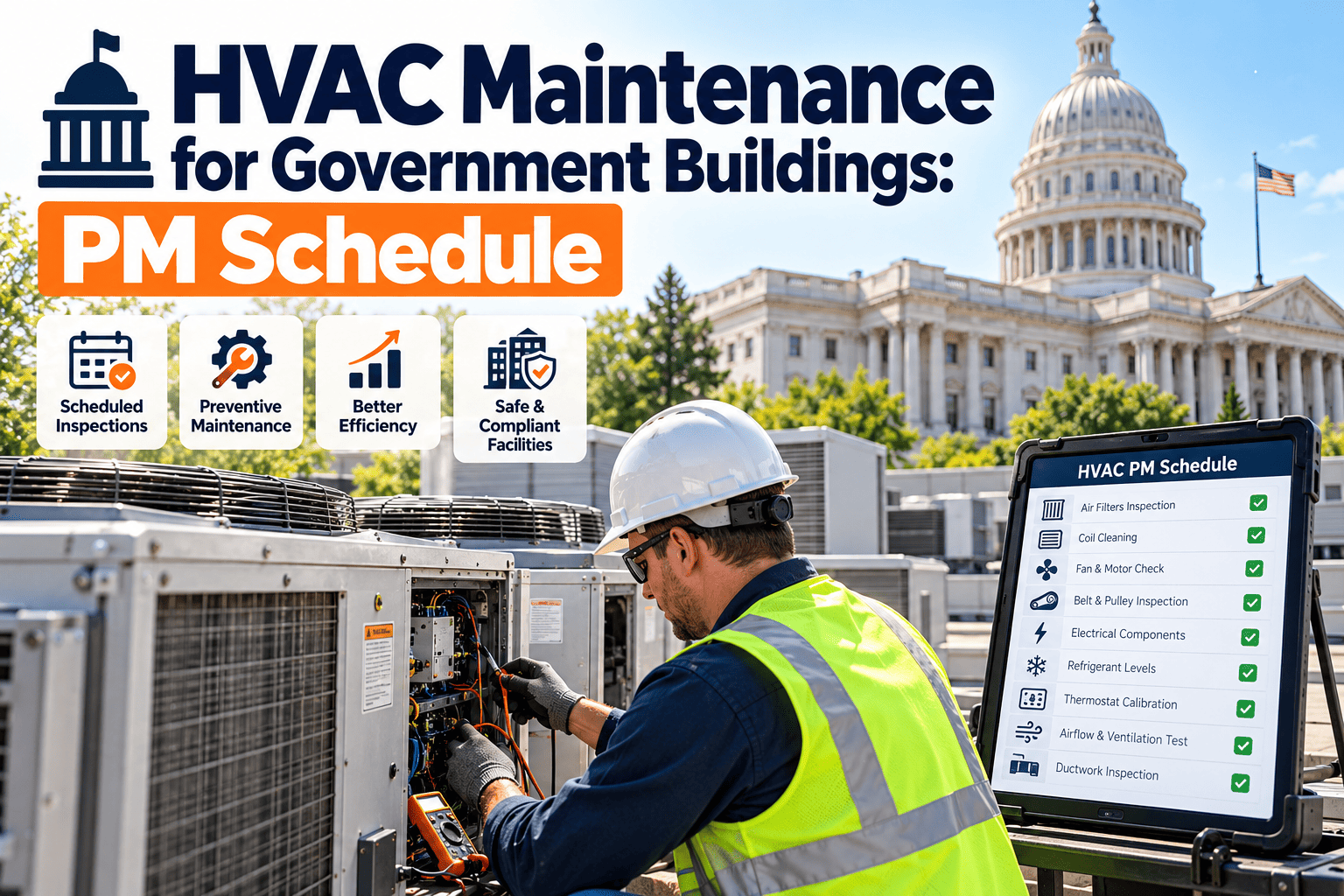
City halls, libraries, courthouses and municipal offices share one problem: their heating and cooling equipment is often older than the staff who depend on it. Budgets are fixed, replacement cycles slip, and a single failed chiller can close a public counter or delay a court session. A disciplined HVAC maintenance program for government buildings keeps equipment running, controls energy cost and produces the records auditors expect. This guide lays out a practical PM schedule, filter plan and workflow, and shows how maintenance management software can keep it all on track.
Facility Maintenance / Public Buildings
HVAC Maintenance for Government Buildings: A PM Schedule That Survives Aging Equipment and Tight Budgets
Build a repeatable schedule for air handlers, chillers, boilers, rooftop units and filters across city halls, libraries and courthouses, with every task, reading and repair recorded against the asset.
WinterBoiler and heating coil checks, freeze protection, humidification
SpringCooling start-up, coil cleaning, refrigerant and belt inspection
SummerLoad monitoring, condensate drains, cooling tower and chiller logs
AutumnHeating start-up, combustion tests, controls and damper calibration
Why Public Building HVAC Fails Differently
Typical conditionWhat it causes
Equipment past its expected service lifeRepairs replace planned work, and parts become hard to source
Several buildings, few techniciansRoutine tasks are skipped when emergencies pile up
Capital replacement postponed year after yearMaintenance has to stretch asset life without clear condition data
Records kept in binders, email and memoryStaff turnover erases equipment history
Public hours and court schedulesFew safe windows to shut equipment down for service
Root Causes Behind Missed HVAC Maintenance
1
No complete asset list
Without a verified inventory of units, serial numbers, locations and ages, nobody can build a schedule that covers every machine.2
Calendar-only reminders
Reminders in personal calendars do not follow the person who leaves, and they do not record what was actually done.3
Reactive prioritization
Comfort complaints drive the day, so inspections that prevent the next complaint are the first to be deferred.4
Contractor work without visibility
Service visits by outside firms are rarely logged in the same place as in-house tasks, so gaps stay hidden.The Core HVAC PM Schedule
| Frequency | Equipment | Typical tasks |
|---|---|---|
| Monthly | Air handlers, rooftop units, fan coils | Check filter condition and pressure drop, inspect belts, confirm condensate drains are clear, review thermostat and setpoint behavior |
| Monthly | Boilers and pumps | Record pressures and temperatures, listen for bearing noise, look for leaks at seals and fittings |
| Quarterly | Chillers and cooling towers | Log operating readings, inspect for refrigerant leaks, check water treatment, clean basins and strainers |
| Quarterly | Outdoor air and exhaust systems | Verify damper movement, inspect intake screens, confirm minimum outdoor air is being delivered |
| Semiannual | Coils and heat exchangers | Clean coils, inspect fins, check for corrosion and fouling before each heating and cooling season |
| Semiannual | Motors and drives | Lubricate where required, check alignment, measure amperage, tighten electrical connections |
| Annual | Boilers and burners | Combustion test, safety controls test, flue inspection, relief valve check |
| Annual | Building controls | Calibrate sensors, test sequences, review schedules, confirm alarms reach the right people |
Filter Plans by Building Type
Filters are the cheapest component in the system and the most commonly neglected. A clogged filter raises fan energy, starves coils of airflow and allows dust to foul everything downstream. Set the interval by pressure drop and occupancy, not only by the calendar.
- Install differential pressure gauges so a change is triggered by condition.
- Record the filter size, grade and quantity against each air handler.
- Use a work order for every change so the date and technician are on file.
- Shorten the interval after dust-producing renovation or wildfire smoke events.
City hall and officesModerate occupancy; review quarterly, with extra checks in dusty seasons
LibrariesPaper dust and long open hours; monthly inspection, humidity watched closely for collections
CourthousesHeavy foot traffic and security screening areas; monthly inspection, tighter tracking near entrances
Community and recreation centersVariable occupancy; adjust intervals to event calendars
From Reactive to Planned: Before and After
Before a structured PM program
- Work starts when someone complains about heat or cold
- Filters change when someone remembers
- Contractor invoices are the only service record
- Replacement requests lack condition evidence
After a structured PM program
- Recurring work orders generate automatically per asset
- Filter changes follow pressure readings and intervals
- Every visit, in-house or contracted, is logged to the unit
- Capital requests are backed by repair cost and failure history
Turn the Schedule Into Work Orders Your Team Will Actually Complete
Set up your HVAC assets, recurring tasks and technician checklists in one place, then see how the schedule runs on mobile devices in the plant room and on the roof.
Preventive, Corrective and Condition-Based Work Together
Preventive
Fixed-interval tasks such as belt checks, coil cleaning and combustion tests. These form the backbone because they are predictable and easy to budget.Corrective
Repairs that follow a fault or complaint. Each one should be logged with cause and parts used, so repeat failures stand out.Condition-based
Work triggered by readings such as filter pressure drop, vibration, amperage or discharge temperature rather than by the calendar alone.Compliance and Records Public Facilities Should Keep
Refrigerant handlingLeak checks, repairs and technician certification records for systems covered by EPA Section 608 rules.
Ventilation performanceOutdoor air and filtration checks aligned to the ventilation standard your jurisdiction follows, often ASHRAE 62.1.
Inspection and maintenance practiceDocumented tasks that reflect recognized guidance such as ASHRAE Standard 180 for commercial systems.
Boiler and pressure vesselJurisdictional inspection certificates, relief valve tests and operating logs.
Energy and sustainability reportingRun-time, setpoint and repair history that supports public energy targets and grant reporting.
Contractor documentationService reports, warranty terms and proof of completed visits attached to each unit.
How Oxmaint Supports the HVAC Workflow
RegisterAdd each air handler, chiller, boiler and rooftop unit with location, age and documents.
ScheduleCreate recurring preventive maintenance by time, season or meter reading.
DispatchTechnicians receive work orders and checklists on a phone or tablet on site.
RecordReadings, photos, parts and labor are captured against the asset.
ReviewDashboards show overdue work, repeat failures and cost per building.
- Inventory tracking keeps common filters, belts and contactors available before the season starts.
- Inspection checklists make the monthly round consistent between technicians.
- Reports give managers the evidence needed for budget and replacement discussions.
KPIs That Show Whether the Program Is Working
PM completion rateShare of scheduled HVAC tasks finished on time
Reactive-to-planned ratioHours spent on emergencies versus scheduled work
Repeat repair countAssets with several corrective orders in a season
Comfort complaintsRequests per building, tracked by month
Repair cost per assetEvidence for repair-or-replace decisions
Seasonal Readiness Checklist
- Confirm every HVAC asset is in the system with a current location
- Assign a named owner to each building schedule
- Order filters, belts and common spares before peak season
- Test alarms and after-hours notification paths
- Schedule shutdown windows around court and public hours
- Review last season's repeat failures and plan fixes
- Confirm contractor visits are logged against each unit
- Update replacement priorities using repair history
Equipment-Specific Notes for Public Buildings
| Equipment | Common problem | PM focus |
|---|---|---|
| Chillers | Fouled tubes, low refrigerant, tripping on high head | Log operating readings, clean condensers, test safeties |
| Boilers | Scale, burner drift, failed controls | Combustion tests, water treatment, low-water cutoff tests |
| Rooftop units | Dirty coils, failed belts, clogged drains | Coil cleaning, belt and bearing checks, drain pan inspection |
| Air handlers | Clogged filters, stuck dampers, wet insulation | Filter pressure drop, damper stroke, coil inspection |
| Terminal units and fan coils | Plugged drains, failed actuators, noisy motors | Drain cleaning and actuator tests during seasonal rounds |
| Cooling towers | Scale, biological growth, fill damage | Basin cleaning, water treatment records, fan drive checks |
| Pumps and motors | Seal leaks, misalignment, bearing wear | Vibration checks, lubrication, alignment |
| Building controls | Drifted sensors, overridden schedules | Calibrate sensors, review schedules and overrides |
How Maintenance Affects Energy and Comfort
- Dirty coils and filters force fans and compressors to work harder for the same output
- Stuck dampers can overcool or overheat rooms and waste conditioned air
- Overridden schedules leave equipment running in empty buildings
- Failed sensors send the wrong signal, so control loops chase a false temperature
- Leaking valves allow simultaneous heating and cooling
Indoor Air Quality and Occupant Health
What maintenance can control
- Filter condition and correct filter grade for the air handler
- Outdoor air intake cleanliness and damper operation
- Condensate drain pans that can grow mold when water stands
- Humidity control where records or collections must be protected
What to document
- Filter changes, dates and filter type
- Damper tests and outdoor air checks
- Coil and pan cleaning
- Complaint investigations and the corrective work done
Prioritizing Assets When Budgets Are Tight
| Priority | Examples | Approach |
|---|---|---|
| Critical | Courthouse systems, data rooms, emergency operations, areas with vulnerable occupants | Shortest PM intervals, spare parts and tested backup plans |
| Important | Main office floors, libraries, public counters | Seasonal PMs and condition tracking |
| Standard | Storage areas, low-occupancy rooms | Planned cycle with condition-based upgrades |
Use Maintenance Data in Capital Planning
- Track repair cost, downtime and complaints for every major unit
- Mark equipment that has passed its expected service life
- Flag units where refrigerant or parts are becoming hard to source
- Compare repair history with estimated replacement cost
- Present a ranked replacement list to decision makers with supporting records
Managing HVAC Contractors
- Record contracted tasks and frequencies against each asset
- Require service reports to be attached to the work order
- Track response times for after-hours calls
- Compare contract scope with the PM schedule so tasks are not duplicated or missed
- Review performance before each renewal
A 90-Day Plan to Get Started
| Period | Focus | Result |
|---|---|---|
| Days 1 to 30 | Build the asset list, label equipment and rank criticality | A complete and verified inventory |
| Days 31 to 60 | Create PM templates, filter plans and checklists | Recurring work orders for each building |
| Days 61 to 90 | Review completion, repeat failures and complaint patterns | Adjusted intervals and a first capital priority list |
Mistakes That Undermine HVAC Programs
- Leaving rooftop and mechanical room equipment out of the asset list
- Treating filter changes as a one-time chore instead of a tracked task
- Closing work orders without readings or notes
- Ignoring repeat complaints from the same room
- Replacing equipment without reviewing repair history
- Letting contractor visits sit outside the maintenance record
Frequently Asked Questions
How often should HVAC filters be changed in a government building?
It depends on the building and the filter grade. Many teams inspect monthly and change based on pressure drop, adjusting for dust, events and smoke.What is the first step in building an HVAC PM schedule?
Create a verified asset list. Once each unit is recorded, you can attach tasks and intervals in Oxmaint and begin tracking completion.How do we justify replacing old equipment?
Use logged repair frequency, parts cost, downtime and energy trends for each unit. That history is far stronger than an age-only argument.Can outside contractors work inside the same system?
Yes, their visits can be recorded as work orders against each asset, so in-house and contracted work stay in one history.Can we see this applied to our own buildings?
You can book a demo and walk through a schedule using your equipment types.Keep Public Buildings Comfortable, Compliant and Documented
Start scheduling HVAC preventive maintenance, capture every repair and give your team a clear record for budgets and audits.