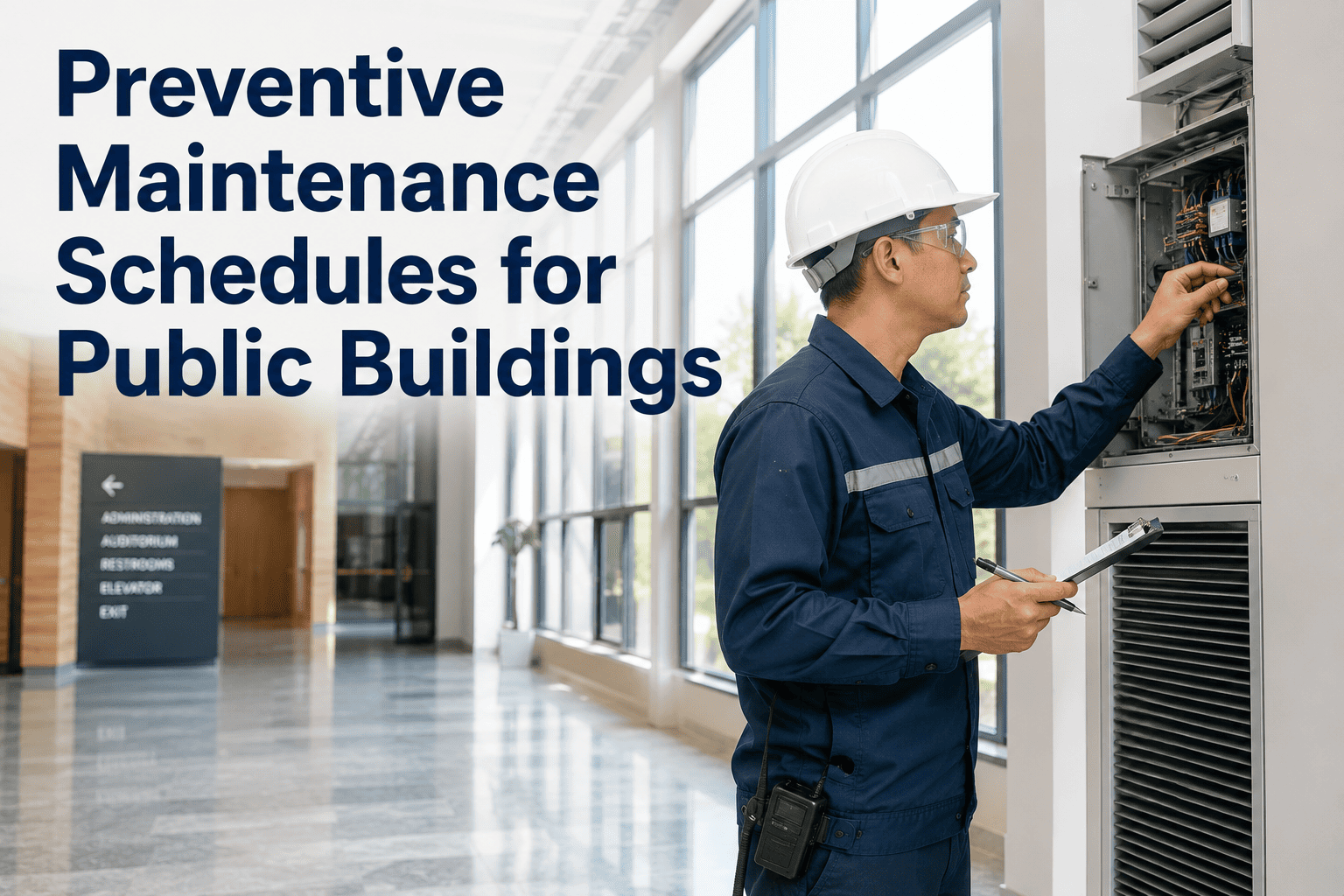
A public building preventive maintenance schedule is the line between a facility team that controls its infrastructure and one that spends every week putting out fires. When municipal PM compliance drops below 80%, accelerated asset decay, emergency repair premiums, and deferred maintenance backlogs follow — typically costing 3–5× more than planned service. This guide breaks down how to build a defensible building PM schedule across HVAC, electrical, plumbing, life safety, and roofing, and how a CMMS-driven program keeps government facility PM audit-ready year-round. Ready to stop reacting and start preventing? Start Free Trial and deploy OxMaint across your portfolio today.
Public Facility Maintenance Guide
Is your municipal PM compliance below 80%?
Public buildings that run on reactive maintenance spend up to 5× more on emergency repairs, lose critical service uptime, and accumulate deferred maintenance backlogs that balloon by 12–18% annually. OxMaint's AI-powered CMMS converts spreadsheet-driven chaos into a defensible, audit-ready preventive maintenance schedule across every system and season.
public building maintenance
The Cost of Reactive Maintenance
Why public building preventive maintenance fails without a system
A 2023 national facilities benchmark found that government buildings operating without a structured PM schedule experience 2.7× more unplanned downtime and 40% higher annual repair costs than peer facilities with PM compliance above 85%.
A mid-sized municipal courthouse portfolio (14 buildings, ~620 assets) was running PM on spreadsheets and sticky notes. PM compliance sat near 58%, and the facilities team closed over 1,400 reactive work orders per year — averaging $312 per emergency call. After implementing a CMMS-driven public building PM schedule with automated triggers and mobile work-order execution, compliance climbed to 91% within six months, reactive calls dropped 44%, and the annual emergency-repair budget fell by $185,000. The payback period on the software investment was under three months.
PM Library by System
Public building maintenance schedule: what to cover across all systems
A defensible government building PM program spans five core infrastructure systems. Below is the PM library framework — task cadence, standard reference, and criticality tier — that every municipal facility PM schedule should include.
HVAC & Air Distribution
- Quarterly: Inspect filters, belts, economizers; verify damper actuators
- Semi-annual: Clean condenser/evaporator coils; calibrate thermostats
- Annual: Combustion analysis, refrigerant charge, coil deep-clean
Electrical & Power Distribution
- Quarterly: Infrared scan of panels, breakers, switchgear
- Semi-annual: Test GFCI/AFCI, emergency lighting, transfer switches
- Annual: Megger testing, panel tightening, transformer inspection
Plumbing & Domestic Water
- Quarterly: Inspect fixtures, traps, backflow preventers; check leaks
- Semi-annual: Flush water heaters, test pressure-reducing valves
- Annual: Backflow certification, sump pump overhaul, pipe corrosion scan
Life Safety & Fire Systems
- Monthly: Inspect extinguishers, exit signs, fire alarm panel status
- Quarterly: Test sprinkler valves, fire pumps, hood suppression
- Annual: Full fire alarm functional test, extinguisher certification
Roofing & Building Envelope
- Bi-annual: Spring & fall roof inspection; clear drains and scuppers
- Quarterly: Inspect flashings, seals, and envelope penetrations
- Annual: Professional roof condition survey; thermal imaging for moisture
Interior & Vertical Transport
- Monthly: Inspect elevators, escalators, ADA door operators
- Quarterly: Lubricate guides, test emergency phones, inspect finishes
- Annual: Full elevator certification, vertical transport load test
Seasonal PM Calendar
Building maintenance schedule: public facility PM timeline by season
Public sector building maintenance must align with seasonal demand curves. Heating systems peak in winter, cooling in summer, and life-safety testing often ties to fiscal-year close. Below is a 12-month municipal building PM framework that maps system-specific tasks to the right window.
Winter Load & Freeze Protection
Boiler combustion analysis, heating coil inspection, freeze-protection valve check, emergency generator load test, ice dam inspection on roof edges.
Spring Turnover & Envelope
Roof survey after freeze-thaw, switch to cooling mode, clean cooling tower basins, inspect exterior sealants, backflow preventer certification.
Pre-Cooling Season Prep
Chiller refrigerant check, coil deep-clean, economizer calibration, sump pump overhaul ahead of storm season, ADA door operator test.
Peak Cooling & Electrical
Infrared panel scan under peak load, condenser coil cleaning, cooling tower Legionella protocol, verify dehumidification in archival storage.
Fall Turnover & Heating Prep
Boiler tune-up, heating valve actuation, weatherstripping audit, roof drain clearing ahead of leaf drop, fire alarm annual functional test.
Year-End Compliance & Fiscal Close
Extinguisher certification, elevator annual load test, compile PM compliance reports for audit, update asset registry, close deferred-maintenance log.
See OxMaint on your assets — book a 30-min demo
Discover how public facility teams use OxMaint to automate PM schedules, prove compliance, and cut reactive repair costs by 30–50%.
How OxMaint Helps
How OxMaint powers government building PM at scale
OxMaint is an AI-powered CMMS and EAM platform built to replace spreadsheets, paper work orders, and siloed maintenance logs with a single, audit-ready system of record for every public building asset.
Automated PM Triggers
Auto-generate preventive maintenance work orders based on runtime hours, calendar intervals, or condition sensors — ensuring your public building PM schedule never slips through the cracks.
Mobile Work Order Execution
Technicians receive, update, and close work orders from any mobile device — with photo attachments, parts usage, and digital signatures captured in real time, even offline.
Predictive Maintenance AI
OxMaint's AI analyzes asset history and sensor data to flag failure patterns before they escalate — recommending intervention exactly when and where it's needed across your portfolio.
Audit-Ready Compliance Reports
Generate defensible PM compliance reports by building, system, or asset class in one click — mapped to NFPA, ASHRAE, and ASME standards — ready for any municipal or insurance audit.
Reactive vs. Proactive
Municipal building PM: reactive maintenance vs. CMMS-driven PM
The gap between reactive firefighting and a CMMS-backed preventive maintenance program is measurable in cost, uptime, compliance, and staff morale. Here's how the two approaches compare across the metrics that matter to public facility leaders.
| Metric | Reactive / Spreadsheet PM | OxMaint CMMS-Driven PM |
|---|---|---|
| PM Compliance Rate | 50–65% (tasks missed or undocumented) | 90–98% (auto-triggered, mobile-verified) |
| Emergency Repair Cost Ratio | $3–$5 per $1 of planned PM | $0.80–$1.20 per $1 of planned PM |
| Unplanned Downtime | 2.7× higher; disruptive service outages | 30–50% lower; predictable service continuity |
| Audit Prep Time | 3–5 days of manual log compilation | Minutes — one-click compliance report |
| Deferred Maintenance Growth | 12–18% annual backlog increase | Backlog stabilized or reduced year-over-year |
| Technician wrench-time | 25–35% (chasing parts, paper, approvals) | 55–65% (mobile dispatch, parts pre-staged) |
Frequently Asked Questions
Public building preventive maintenance: common questions
What is a public building preventive maintenance schedule?
A public building preventive maintenance schedule is a structured, time- or condition-based plan that defines routine inspection, servicing, and testing tasks for every critical asset in a government or municipal facility — including HVAC, electrical, plumbing, life safety, and roofing systems. It ensures compliance with standards like NFPA 70B and ASHRAE 180 while reducing emergency repairs and extending asset life.
How often should preventive maintenance be performed in government buildings?
Frequency depends on asset type and criticality, but most public facility PM tasks run on monthly, quarterly, semi-annual, or annual cycles. Life-safety systems require monthly inspections per NFPA 72, while HVAC filters and belts typically need quarterly service. A CMMS like OxMaint auto-triggers each task at the correct interval so nothing is missed — book a demo to see the scheduling engine in action.
What PM compliance rate should a municipal facility maintain?
Facility management benchmarks recommend a minimum PM compliance rate of 80%, with top-performing public buildings targeting 90% or higher. Below 80%, deferred maintenance accelerates rapidly, emergency repair costs spike, and audit defensibility weakens. OxMaint tracks compliance in real time across every building and system, alerting managers before thresholds slip.
How does a CMMS improve public sector building maintenance?
A CMMS replaces spreadsheets and paper logs with automated work-order generation, mobile execution, asset history tracking, and compliance reporting. Public sector teams using OxMaint typically cut reactive repair costs 30–50%, raise PM compliance above 90%, and reduce audit preparation from days to minutes — all while eliminating lost paperwork and manual scheduling errors.
Can OxMaint handle PM schedules across multiple public buildings?
Yes. OxMaint is built for multi-site portfolios — you can manage PM schedules, asset registries, spare-parts inventory, and compliance reports across dozens of government buildings from a single dashboard. Role-based access lets facility directors see portfolio-wide KPIs while technicians receive building-specific work orders on their mobile devices.
Turn your public building PM schedule into a defensible program
Join the municipal facility teams using OxMaint to automate preventive maintenance, prove compliance, and eliminate reactive firefighting — across every building, system, and season.
Free 14-day trial · No credit card