Public School Facility Maintenance Checklist for Safe and Healthy Learning Environments
By Jason on March 24, 2026
Poor indoor air quality in school buildings costs US districts an estimated $10.5 billion annually in reduced student performance, increased absenteeism, and reactive HVAC repairs — yet fewer than 30% of public school districts have a documented IAQ maintenance program with defined inspection intervals and threshold-based corrective action protocols. Studies by the EPA and Harvard T.H. Chan School of Public Health directly link classroom CO2 levels above 1,000 ppm to measurable drops in student cognitive function and test scores. Book a demo to see how Oxmaint converts this checklist into digital work orders tied to your school HVAC asset hierarchy.
IAQ ChecklistSchool Indoor Air Quality Maintenance Program for Student Health and Performance10 min read
$10.5B
Estimated annual US school district cost from poor IAQ including absenteeism, performance loss, and reactive HVAC repairs
41%
Of US school buildings report unsatisfactory ventilation conditions per EPA National School IAQ Assessment data
7
IAQ inspection zones — HVAC filtration, ventilation rates, CO2 monitoring, mold, humidity, chemical storage, outdoor air intake
15%
Average student absence rate reduction at schools with structured IAQ programs per EPA Tools for Schools data
Checklist Scope
Critical — immediate corrective action before classroom reoccupancy. Monitor — raise work order, re-inspect within 14 days. Routine — document and trend. Priority ratings follow EPA Tools for Schools and ASHRAE 62.1 standards. All Critical and Monitor findings require photo documentation before the work order is raised in Oxmaint.
HVAC filtration is the primary mechanical defense against particulate matter, allergens, and biological contaminants in school buildings. Filter bypass — caused by collapsed, overloaded, or incorrectly installed filters — allows unfiltered air to short-circuit directly into occupied spaces. Schools with documented filter replacement programs on defined intervals show 28% lower reported respiratory illness rates than those relying on visual inspection alone. Book a demo to see how Oxmaint automates filter replacement scheduling across your school district's HVAC asset hierarchy.
Filter Condition and Installation
Air Handling Unit Condition
Zone 2 — Ventilation Rates and Outdoor Air Delivery
ASHRAE Standard 62.1 requires minimum outdoor air delivery rates of 10 cfm per person plus 0.12 cfm per square foot for school classrooms. Under-ventilation is the most prevalent IAQ deficiency in US school buildings — 41% of surveyed schools deliver less than the required outdoor air volume during peak occupancy. Damper position is the single most impactful variable and the most frequently found out-of-specification condition. Book a demo to see how Oxmaint captures damper inspection records with timestamped field verification against BAS control signals.
Carbon dioxide concentration is the most reliable proxy for ventilation adequacy in occupied school spaces. Harvard research published in 2015 found that cognitive function scores declined 15% for every 400 ppm increase above 1,000 ppm, with decision-making performance dropping 50% at 2,500 ppm. These measurements require calibrated fixed sensors or logged portable meter readings — visual observation is not a valid substitute.
CO2 Sensor Calibration and Placement
Carbon Monoxide Detection
Zone 4 — Moisture Intrusion and Mold Prevention
Mold is the most common IAQ enforcement trigger in US public school districts. EPA and OSHA take the position that no level of mold is acceptable in occupied school buildings — any visible mold growth requires immediate remediation regardless of species identification. Roof and window leaks unrepaired for more than 48 hours in warm conditions can produce visible mold colonies within 3 to 5 days. Book a demo to see how Oxmaint tracks moisture intrusion work orders with GPS-linked photo documentation for every finding.
Visual Mold and Moisture Survey
Roof and Envelope Integrity
Zone 5 — Humidity Control and Thermal Comfort
Relative humidity in school buildings should be maintained between 30% and 60% per ASHRAE 62.1. Below 30%, respiratory mucous membranes dry out and virus transmission rates increase. Above 60%, conditions favor mold growth, dust mite proliferation, and chemical off-gassing from furnishings. Most school buildings run unmonitored humidity for months at a time between manual inspection cycles.
Relative Humidity Monitoring
Thermal Comfort Verification
Connect IAQ Alerts to Automatic Work Orders in Oxmaint
Custodial cleaning products, art room solvents, science lab chemicals, and pest control agents are common sources of volatile organic compound emissions in school buildings. VOC concentrations in US schools average 2 to 5 times higher than outdoor ambient levels — and can spike to 10 to 100 times outdoor levels during and after cleaning operations if ventilation is not maintained. Book a demo to see how Oxmaint tracks chemical storage compliance and ventilation records for school custodial programs.
Custodial Chemical Storage and Handling
Science Lab and Art Room Chemical Management
Zone 7 — Outdoor Air Intake Screens and Exhaust Systems
Outdoor air intake contamination introduces pollutants directly into the building HVAC system before any filtration stage. Poorly positioned intakes drawing from loading dock exhaust, idling school bus areas, or cooling tower plumes can deliver vehicle emissions and biological aerosols into occupied classrooms at concentrations exceeding EPA health benchmarks.
Outdoor Air Intake Condition
Exhaust Systems and Restroom Ventilation
Zone Summary — Frequency and Priority
Zone
Monthly
Each Semester
Annual
Critical
Total
Zone 1 — HVAC Filtration
Filter checks
AHU full inspection
Full audit
4
12
Zone 2 — Ventilation Rates
Damper verification
TAB spot check
Full audit
2
8
Zone 3 — CO2 Monitoring
Peak reading log
Sensor calibration
Full audit
4
9
Zone 4 — Moisture and Mold
Visual survey
Moisture meter scan
Full audit
3
11
Zone 5 — Humidity Control
RH logging
Sensor calibration
Full audit
2
8
Zone 6 — Chemical Storage
Storage inspection
Inventory review
Full audit
3
8
Zone 7 — Outdoor Air Intake
Screen inspection
Exhaust verification
Full audit
3
9
Total
Selected
All 65
Full 65
21
65
Oxmaint IAQ Results at School Districts
89%
Filter PM Compliance
HVAC filter replacement compliance rate at school districts on Oxmaint automated scheduling versus 54% on manual paper systems
43%
Fewer IAQ Complaints
Reduction in student and staff IAQ-related health complaints at schools with structured digital IAQ inspection programs
14 days
Go-Live Time
Average time to live digital IAQ inspections at a multi-building school district including asset hierarchy build and technician training
100%
Auto Work Order Linkage
Critical and Monitor IAQ findings automatically generate corrective work orders with photo evidence and due dates in Oxmaint
Frequently Asked Questions
QWhat CO2 level in a classroom requires immediate corrective action versus a monitor and trend response?
ASHRAE 62.1 uses CO2 as a ventilation adequacy proxy. Readings consistently above 1,100 ppm above outdoor ambient indicate inadequate ventilation and trigger immediate damper inspection. Readings above 2,000 ppm absolute should prompt same-day corrective action and temporary supplemental ventilation. Book a demo to see how Oxmaint configures threshold-based CO2 alerts to automatic work orders.
QHow does a school facilities director present an IAQ program investment to a school board?
The ROI case combines taxpayer savings from reduced reactive HVAC repairs, reduced absenteeism costs, and liability reduction from documented EPA Tools for Schools compliance. Districts with structured IAQ programs report 15% lower absenteeism and avoid $50,000 to $500,000 per incident costs of mold remediation triggered by deferred moisture response. Book a demo to build a board-ready IAQ program ROI case.
QWhat MERV filter rating does EPA recommend for school classrooms and how does it affect PM scheduling?
EPA's IAQ Tools for Schools program recommends MERV-8 as the minimum for classrooms with MERV-13 preferred. Higher-rated filters load faster and require more frequent replacement — typically every 60 to 90 days at school occupancy levels. Oxmaint auto-generates replacement work orders 14 days before each filter's due date. Book a demo to see filter PM scheduling configured for your district's AHU inventory.
QWhat documentation does Oxmaint generate to satisfy EPA Tools for Schools and OSHA IAQ requirements?
Oxmaint generates timestamped inspection records, photo evidence of all findings, corrective work order trails, and sensor calibration logs — all exportable as an audit package for EPA regional office review, OSHA inspections, or state education department facility assessments. Records are public-records ready with full technician attribution and GPS check-in.
QHow long does it take to deploy Oxmaint IAQ inspections across a multi-school district?
QDoes Oxmaint support IAQ programs alongside other school facility maintenance programs?
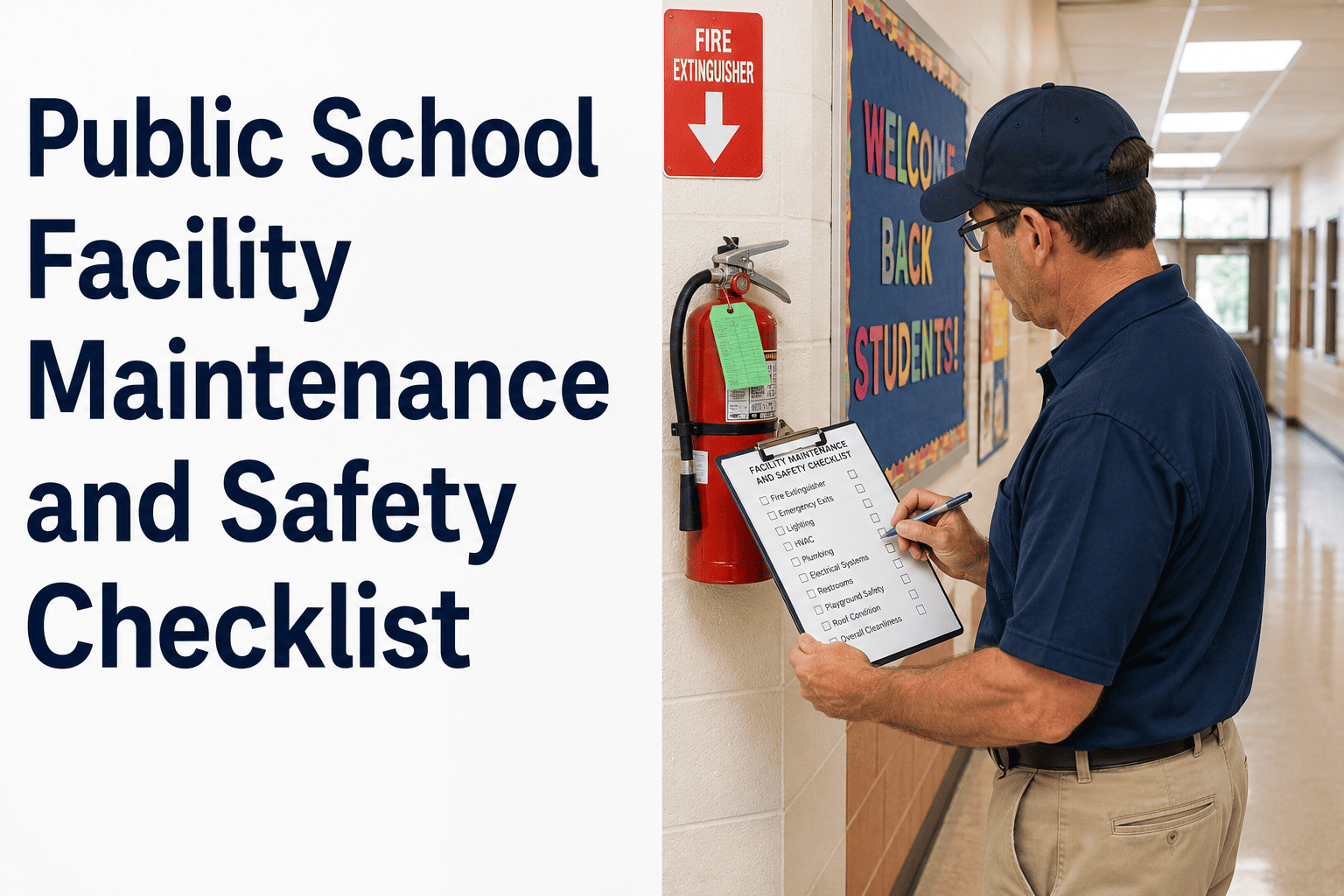
Yes — IAQ, playground safety, asbestos, lead paint, fire safety, and building envelope programs all run from a single Oxmaint platform with role-based access and portfolio-level dashboards. Facilities directors see all building systems in one view. See the complete public school facility maintenance checklist.
Deploy This IAQ Checklist as Live Digital Inspections in Oxmaint
Every zone and every item available as a structured digital inspection — assigned to your school HVAC asset hierarchy, CO2 and humidity threshold alerts auto-routed to work orders, and Critical findings documented with photo evidence before the inspector leaves the building.